Introduction
Bioinformatics workflow managers are software tools that help researchers, bioinformaticians, computational biologists, and data teams build, run, monitor, and reproduce complex biological data analysis pipelines. Instead of manually executing many scripts and tools one by one, workflow managers organize each step into a structured pipeline with defined inputs, outputs, dependencies, execution rules, logs, and error handling.
These tools are especially important in genomics, transcriptomics, proteomics, metagenomics, single-cell analysis, population-scale sequencing, clinical research, and multi-omics studies. Bioinformatics datasets are often large, sensitive, and computationally demanding, so teams need workflow managers that can run reliably across laptops, servers, HPC clusters, containers, and cloud platforms.
Common use cases include:
- Genomics sequencing pipelines
- RNA sequencing workflows
- Variant calling pipelines
- Single-cell data processing
- Metagenomics analysis
- Proteomics workflow automation
- Multi-omics pipeline orchestration
- Clinical research data processing
Buyers should evaluate:
- Workflow reproducibility
- Ease of pipeline development
- Support for containers
- Cloud and HPC compatibility
- Scalability for large datasets
- Error handling and resume support
- Community and documentation
- Integration with bioinformatics tools
- Security and access control
- Long-term maintainability
Best for: bioinformatics teams, genomics labs, clinical research groups, pharmaceutical companies, biotech startups, academic institutions, sequencing service providers, and data science teams working with large biological datasets.
Not ideal for: teams that only run very small one-off scripts, simple spreadsheet-based analysis, or basic manual data checks. In those cases, notebooks, shell scripts, or standalone bioinformatics tools may be enough.
Key Trends in Bioinformatics Workflow Managers
- Container-first workflows are becoming standard, helping teams improve reproducibility across local, HPC, and cloud environments.
- Cloud and hybrid execution are now critical, especially for sequencing labs and research programs processing large datasets.
- Community-maintained pipelines are gaining trust, because teams want reusable, transparent, and peer-reviewed workflows.
- Workflow portability is a major priority, allowing the same pipeline to run across different compute environments.
- Cost-aware execution is becoming important, especially when workflows run on cloud platforms with large storage and compute usage.
- Multi-omics workflows are increasing, requiring workflow managers that can connect genomics, transcriptomics, proteomics, epigenomics, and metadata pipelines.
- Pipeline observability is becoming more valuable, including logs, reports, task monitoring, and performance tracking.
- Automation and reproducibility are now expected, especially for clinical research, regulated studies, and large collaborative projects.
- Workflow languages and standards are maturing, helping teams define pipelines in a more consistent and maintainable way.
- Security and governance requirements are increasing, because bioinformatics workflows often process sensitive human or proprietary research data.
How We Selected These Tools
- We selected tools widely used or strongly relevant in bioinformatics, computational biology, genomics, and research data processing.
- We included a mix of bioinformatics-native workflow managers, general workflow orchestrators, and workflow standards.
- We considered support for local execution, HPC clusters, cloud platforms, and hybrid infrastructure.
- We prioritized reproducibility, container support, scalability, workflow portability, and practical usability.
- We evaluated ecosystem strength, including documentation, templates, community pipelines, and integration with scientific tools.
- We considered fit for different users, from academic labs to enterprise research organizations.
- We included tools that support real-world production workflows, not only small experimental scripts.
- We avoided guessing public ratings, certifications, or compliance claims where details are not clearly stated.
- We considered support for version control, metadata tracking, error recovery, and workflow reuse.
- We balanced ease of use with technical depth and long-term maintainability.
Top 10 Bioinformatics Workflow Managers Tools
#1 — Nextflow
Short description: Nextflow is one of the most widely used workflow managers for bioinformatics and scientific data pipelines. It helps teams build portable, scalable, and reproducible workflows that can run across local machines, HPC clusters, and cloud platforms. Nextflow is especially popular in genomics and multi-omics analysis because it supports containers and reusable pipeline design. It is best suited for bioinformatics teams that need production-ready workflow automation.
Key Features
- Workflow orchestration for bioinformatics pipelines
- Strong support for Docker, Singularity, Apptainer, and Conda
- Runs across local, HPC, and cloud environments
- Workflow resume and checkpointing support
- Scalable execution for large datasets
- Strong ecosystem through community pipelines
- Version control friendly pipeline development
Pros
- Highly portable across infrastructure environments
- Strong container and cloud support
- Excellent fit for genomics and multi-omics workflows
- Strong community and documentation ecosystem
Cons
- Requires scripting and workflow design knowledge
- Complex workflows can require careful debugging
- Non-technical users may find it difficult at first
- Governance depends on deployment environment
Platforms / Deployment
Linux / macOS / Windows via compatible environments
Self-hosted / Cloud / Hybrid
Security & Compliance
Security depends on the environment where Nextflow is deployed, including cloud accounts, HPC systems, container registries, storage, and access controls. Native enterprise compliance features are not publicly stated as universal built-in capabilities because Nextflow is primarily a workflow engine.
Integrations & Ecosystem
Nextflow has a strong ecosystem for bioinformatics workflows and works well with modern research infrastructure. It is commonly used with community pipelines, containers, cloud services, and institutional compute systems.
- Works with Docker, Singularity, Apptainer, and Conda
- Supports AWS, Google Cloud, Azure, local, and HPC execution
- Integrates strongly with nf-core pipelines
- Supports version-controlled workflow development
- Works with common bioinformatics command-line tools
- Useful for large genomics and multi-omics pipelines
Support & Community
Nextflow has strong documentation, tutorials, training materials, and a large bioinformatics community. Enterprise-style support may be available through related commercial offerings or implementation partners, while open-source users often rely on community resources and internal expertise.
#2 — Snakemake
Short description: Snakemake is a Python-based workflow management system widely used in bioinformatics research. It allows users to define workflows through rules, inputs, outputs, dependencies, and execution logic. Snakemake is especially useful for researchers and bioinformaticians who already work with Python and want transparent, reproducible pipelines. It is best suited for academic labs, research teams, and technical users who need flexible workflow control.
Key Features
- Python-based workflow definition
- Rule-based pipeline structure
- Automatic dependency resolution
- Local, cluster, and cloud execution support
- Container and environment management support
- Strong reproducibility features
- Good fit for custom research workflows
Pros
- Easy to adopt for Python users
- Flexible and lightweight
- Strong fit for academic research pipelines
- Works well with version control
Cons
- Requires technical skills
- Less enterprise-oriented than managed platforms
- GUI options are limited
- Large production deployments may need additional engineering
Platforms / Deployment
Linux / macOS / Windows via compatible environments
Self-hosted / Cloud / Hybrid
Security & Compliance
Security depends on the workstation, server, cloud, or HPC environment where Snakemake runs. Native enterprise features such as SSO, RBAC, audit logs, and formal compliance certifications are not publicly stated as built-in universal capabilities.
Integrations & Ecosystem
Snakemake fits well into Python-based bioinformatics environments and can integrate with many command-line tools, containers, and research data systems.
- Works with Python-based workflows
- Supports Conda and containers
- Can run on clusters and cloud systems
- Integrates with standard bioinformatics tools
- Supports reproducible workflow files
- Useful for custom genomics and omics pipelines
Support & Community
Snakemake has a strong academic and open-source community. Documentation and examples are available, but production teams should plan for internal workflow ownership, testing, and maintenance.
#3 — Cromwell
Short description: Cromwell is a workflow execution engine commonly used for workflows written in Workflow Description Language. It is widely used in genomics and biomedical research environments where reproducibility, scalable execution, and structured workflow management are important. Cromwell can run workflows across local systems, cloud infrastructure, and cluster environments. It is best suited for teams using WDL-based pipelines.
Key Features
- Workflow execution for WDL pipelines
- Local, cloud, and HPC execution support
- Task-level workflow tracking
- Scalable execution for large bioinformatics workflows
- Metadata tracking support
- Reproducible workflow execution
- Strong fit for genomics and research pipelines
Pros
- Strong option for WDL-based environments
- Useful for large-scale genomics workflows
- Supports structured workflow execution
- Works well in cloud and research infrastructure
Cons
- Requires WDL knowledge
- Operational setup can be complex
- Less beginner-friendly than GUI platforms
- Best value depends on technical maturity
Platforms / Deployment
Linux / Varies
Self-hosted / Cloud / Hybrid
Security & Compliance
Security depends on the cloud, server, or HPC infrastructure used to run Cromwell. Authentication, permissions, encryption, audit logs, and compliance controls must be evaluated at the environment level.
Integrations & Ecosystem
Cromwell fits naturally into WDL-based bioinformatics ecosystems and is often used in genomics pipelines requiring scalable execution and metadata tracking.
- Supports WDL workflows
- Works with local and cloud backends
- Supports containerized execution
- Useful for large genomics pipelines
- Provides workflow metadata tracking
- Fits research and production bioinformatics environments
Support & Community
Cromwell has strong recognition among WDL users and genomics workflow teams. Support is generally documentation and community-driven, although large organizations may manage it through internal platform engineering teams.
#4 — Galaxy
Short description: Galaxy is a web-based bioinformatics workflow platform designed to make scientific analysis more accessible. It allows users to create, run, share, and reproduce workflows through a graphical interface. Galaxy is especially useful for users who do not want to write complex scripts or command-line pipelines. It is best suited for research labs, educators, training programs, and collaborative analysis teams.
Key Features
- Web-based graphical workflow interface
- Large collection of bioinformatics tools
- Workflow sharing and reuse
- Data provenance tracking
- Public and private deployment options
- Support for genomics and multi-omics workflows
- Strong training and educational ecosystem
Pros
- Beginner-friendly compared with command-line workflow tools
- Good for teaching and collaborative research
- Strong focus on reproducibility and provenance
- Reduces coding requirements for many users
Cons
- Less flexible than scripting-first workflow managers
- Performance depends on server configuration
- Private deployments require administration
- Complex pipelines may still need expert support
Platforms / Deployment
Web
Cloud / Self-hosted / Hybrid
Security & Compliance
Security depends on whether Galaxy is used through a public instance, private server, institutional deployment, or cloud-hosted setup. Access control, authentication, encryption, and auditability should be reviewed based on the specific deployment.
Integrations & Ecosystem
Galaxy has a broad ecosystem of bioinformatics tools, workflow wrappers, training materials, and reproducible analysis features.
- Supports many genomics and omics tools
- Allows workflow sharing and reuse
- Useful for training and education
- Can be deployed privately by institutions
- Supports data histories and provenance
- Integrates with storage and research environments
Support & Community
Galaxy has a strong community, extensive training materials, documentation, and public learning resources. Institutional deployments may require local administrators, while public instances are easier for learning and smaller analysis tasks.
#5 — Apache Airflow
Short description: Apache Airflow is a general-purpose workflow orchestration platform used to schedule, monitor, and manage complex data pipelines. While not built only for bioinformatics, it can support bioinformatics operations where teams need production scheduling, task dependencies, monitoring, and integration with broader data infrastructure. Airflow is especially useful when biological data workflows connect with databases, cloud storage, dashboards, or enterprise data systems. It is best suited for data engineering-heavy bioinformatics teams.
Key Features
- Workflow scheduling and orchestration
- Directed acyclic graph based pipeline design
- Strong task dependency management
- Monitoring and retry capabilities
- Large integration ecosystem
- Useful for production data operations
- Good fit for bioinformatics data engineering workflows
Pros
- Strong scheduling and monitoring capabilities
- Large general data engineering ecosystem
- Useful for production operations
- Good for connecting bioinformatics with enterprise data workflows
Cons
- Not bioinformatics-native
- Requires engineering expertise
- Less ideal for scientific reproducibility compared with specialized workflow managers
- Container and HPC bioinformatics patterns may need custom setup
Platforms / Deployment
Linux / Web interface / Varies
Self-hosted / Cloud / Hybrid
Security & Compliance
Security depends on deployment configuration and hosting environment. Authentication, RBAC, encryption, audit logs, and enterprise controls may be available depending on setup, but compliance should be validated by the organization.
Integrations & Ecosystem
Airflow has a broad integration ecosystem and is useful when bioinformatics workflows must connect with data engineering, reporting, cloud services, and enterprise systems.
- Integrates with databases and cloud storage
- Supports scheduled pipeline operations
- Works with APIs and external systems
- Can trigger scripts, containers, and jobs
- Useful for reporting and downstream automation
- Fits enterprise data workflow environments
Support & Community
Apache Airflow has a large open-source and enterprise data engineering community. Documentation and managed service options exist, but bioinformatics-specific workflow patterns usually require internal expertise.
#6 — Toil
Short description: Toil is a workflow engine designed for scalable, reproducible, and portable workflows across local systems, clusters, and cloud platforms. It has strong relevance in bioinformatics because it supports Common Workflow Language and large-scale scientific computing use cases. Toil is useful for teams that need workflow portability and scalable execution. It is best suited for technical bioinformatics groups and research organizations working with standardized workflow definitions.
Key Features
- Scalable workflow execution
- Support for Common Workflow Language
- Local, cluster, and cloud execution options
- Fault tolerance and job recovery features
- Useful for large scientific workflows
- Portable workflow execution model
- Good fit for reproducible research pipelines
Pros
- Strong support for scalable scientific computing
- Useful for CWL-based workflows
- Can run across different infrastructure types
- Good for technical and research-focused teams
Cons
- Requires technical expertise
- Smaller user base than some major alternatives
- Operational setup may take planning
- Less beginner-friendly than graphical tools
Platforms / Deployment
Linux / macOS / Varies
Self-hosted / Cloud / Hybrid
Security & Compliance
Security depends on the infrastructure where Toil runs, including compute nodes, storage systems, cloud accounts, and access policies. Native enterprise security features are not publicly stated as universal built-in capabilities.
Integrations & Ecosystem
Toil works well in scientific workflows where portability, CWL support, and scalable execution matter.
- Supports Common Workflow Language
- Can run on cloud and cluster environments
- Supports large-scale scientific processing
- Works with command-line bioinformatics tools
- Useful for reproducible workflow execution
- Fits technical research infrastructure
Support & Community
Toil has documentation and open-source community support. Teams using it for production workloads should plan internal expertise for deployment, monitoring, and long-term workflow maintenance.
#7 — CWLTool
Short description: CWLTool is a reference implementation and runner for workflows written in Common Workflow Language. It is useful for validating, testing, and running CWL workflows in a standardized way. CWLTool is especially important for teams that care about portable workflow definitions and interoperability across execution platforms. It is best suited for technical users and organizations adopting workflow standards.
Key Features
- Runs Common Workflow Language workflows
- Useful for testing and validating CWL files
- Supports portable workflow definitions
- Strong fit for standards-based workflow development
- Works with command-line bioinformatics tools
- Useful for reproducibility and interoperability
- Helps maintain workflow consistency
Pros
- Strong standards alignment
- Useful for CWL workflow validation
- Lightweight and practical for technical users
- Supports portable scientific workflows
Cons
- Not a full enterprise workflow platform
- Requires CWL knowledge
- Less user-friendly for non-technical users
- May need other systems for large-scale orchestration
Platforms / Deployment
Linux / macOS / Varies
Self-hosted / Cloud / Hybrid / Varies
Security & Compliance
Security depends on the environment where CWLTool is used. Built-in enterprise security features such as SSO, RBAC, audit logging, and formal compliance certifications are not publicly stated as universal capabilities.
Integrations & Ecosystem
CWLTool is part of the broader Common Workflow Language ecosystem and is useful for testing workflow portability and reproducibility.
- Supports CWL workflow execution
- Works with command-line tools
- Useful for workflow validation
- Can support containerized workflows
- Fits standards-based bioinformatics pipelines
- Useful alongside other workflow platforms
Support & Community
CWLTool has support through documentation and the broader CWL community. It is best for teams that understand workflow standards and need portable, transparent pipeline definitions.
#8 — Argo Workflows
Short description: Argo Workflows is a Kubernetes-native workflow engine used to run containerized tasks and pipelines. Although it is not designed only for bioinformatics, it can be useful for organizations that already run scientific workloads on Kubernetes. Argo helps teams define workflows as Kubernetes resources and scale containerized jobs across clusters. It is best suited for platform engineering teams supporting bioinformatics pipelines in cloud-native environments.
Key Features
- Kubernetes-native workflow orchestration
- Container-based task execution
- Scalable workflow scheduling
- Workflow templates and reusable steps
- Good fit for cloud-native infrastructure
- Supports automation and pipeline execution
- Useful for platform-managed bioinformatics workloads
Pros
- Strong fit for Kubernetes environments
- Scales well for containerized workflows
- Useful for platform and DevOps teams
- Good for standardized infrastructure operations
Cons
- Not bioinformatics-specific
- Requires Kubernetes expertise
- Scientific reproducibility features may need extra design
- Less approachable for typical research users
Platforms / Deployment
Kubernetes / Web interface / Varies
Self-hosted / Cloud / Hybrid
Security & Compliance
Security depends on Kubernetes configuration, identity management, namespace controls, secrets management, storage policies, and cloud or infrastructure governance. Compliance should be validated by the organization based on its deployment.
Integrations & Ecosystem
Argo Workflows integrates well with containerized infrastructure and modern platform engineering stacks.
- Works with Kubernetes clusters
- Runs containerized bioinformatics tasks
- Integrates with CI/CD and DevOps workflows
- Can connect with cloud storage and registries
- Supports reusable workflow templates
- Useful for platform-managed pipelines
Support & Community
Argo Workflows has a strong cloud-native and Kubernetes community. Bioinformatics users may need internal platform engineering support to adapt it for scientific workflow requirements.
#9 — Luigi
Short description: Luigi is a Python-based workflow framework originally designed for building complex data pipelines. It can be used in bioinformatics when teams need dependency management, task orchestration, and Python-based pipeline logic. Luigi is not as bioinformatics-focused as Nextflow or Snakemake, but it can be useful for custom data processing workflows. It is best suited for Python-heavy teams with specific pipeline engineering needs.
Key Features
- Python-based task pipeline framework
- Dependency management between workflow tasks
- Batch data pipeline orchestration
- Suitable for custom data processing workflows
- Simple workflow visualization interface
- Useful for script-based pipeline organization
- Good fit for internal workflow automation
Pros
- Friendly for Python developers
- Useful for custom pipeline logic
- Simple dependency management model
- Lightweight compared with larger orchestration platforms
Cons
- Not bioinformatics-native
- Smaller fit for modern containerized omics pipelines
- Less active in bioinformatics compared with specialized tools
- Requires custom engineering for advanced execution environments
Platforms / Deployment
Linux / macOS / Windows via compatible environments
Self-hosted / Varies
Security & Compliance
Security depends on the infrastructure where Luigi is deployed. Native enterprise security controls such as SSO, RBAC, audit logs, and formal compliance certifications are not publicly stated as universal built-in features.
Integrations & Ecosystem
Luigi integrates well with Python scripts, databases, batch jobs, and custom data processing logic.
- Works with Python-based pipelines
- Can trigger command-line tools
- Integrates with databases and file systems
- Useful for internal automation workflows
- Supports dependency-based execution
- Can connect with custom bioinformatics scripts
Support & Community
Luigi has open-source documentation and a data engineering community, but its bioinformatics-specific ecosystem is smaller than Nextflow, Snakemake, Galaxy, or Cromwell. Teams should plan internal maintenance if using it for research workflows.
#10 — WDL
Short description: WDL, or Workflow Description Language, is a workflow language used to describe data analysis workflows in a clear and structured way. It is often used in genomics and biomedical research, especially with execution engines such as Cromwell. WDL helps teams define tasks, inputs, outputs, runtime settings, and workflow dependencies. It is best suited for teams that want standardized workflow definitions and scalable execution through compatible engines.
Key Features
- Workflow language for scientific pipelines
- Clear task and workflow definitions
- Strong fit for genomics workflows
- Works with execution engines such as Cromwell
- Supports reproducible pipeline design
- Useful for defining inputs, outputs, and dependencies
- Suitable for standardized research workflows
Pros
- Strong structure for defining bioinformatics workflows
- Useful for reproducible genomics pipelines
- Works well with Cromwell-based execution
- Good fit for teams using WDL workflow ecosystems
Cons
- It is a language, not a complete execution platform by itself
- Requires learning WDL syntax
- Needs compatible engines for execution
- Less useful for teams not committed to WDL workflows
Platforms / Deployment
Varies by execution engine
Self-hosted / Cloud / Hybrid / Varies
Security & Compliance
Security depends on the workflow execution engine and infrastructure used to run WDL workflows. WDL itself is a workflow language and does not provide native enterprise security controls.
Integrations & Ecosystem
WDL integrates with compatible workflow execution engines and is often used for genomics and biomedical workflows.
- Works with Cromwell and related execution environments
- Supports standardized workflow definitions
- Useful with containerized tasks
- Fits large genomics analysis pipelines
- Can be version controlled
- Supports reusable pipeline development
Support & Community
WDL has a strong presence in genomics workflow communities. Support depends on the execution engine, documentation, community adoption, and internal team expertise.
Comparison Table
| Tool Name | Best For | Platforms Supported | Deployment | Standout Feature | Public Rating |
|---|---|---|---|---|---|
| Nextflow | Scalable bioinformatics pipelines | Linux / macOS / Windows via compatible environments | Self-hosted / Cloud / Hybrid | Portable containerized workflow execution | N/A |
| Snakemake | Python-friendly research workflows | Linux / macOS / Windows via compatible environments | Self-hosted / Cloud / Hybrid | Rule-based reproducible pipeline design | N/A |
| Cromwell | WDL workflow execution | Linux / Varies | Self-hosted / Cloud / Hybrid | Scalable WDL pipeline execution | N/A |
| Galaxy | Accessible web-based analysis | Web | Cloud / Self-hosted / Hybrid | Graphical workflow building and provenance | N/A |
| Apache Airflow | Production data pipeline orchestration | Linux / Web interface / Varies | Self-hosted / Cloud / Hybrid | Scheduling and monitoring for data pipelines | N/A |
| Toil | CWL and scalable scientific workflows | Linux / macOS / Varies | Self-hosted / Cloud / Hybrid | Portable large-scale workflow execution | N/A |
| CWLTool | CWL workflow validation and execution | Linux / macOS / Varies | Self-hosted / Cloud / Hybrid / Varies | Reference runner for CWL workflows | N/A |
| Argo Workflows | Kubernetes-native pipelines | Kubernetes / Web interface / Varies | Self-hosted / Cloud / Hybrid | Containerized workflow orchestration on Kubernetes | N/A |
| Luigi | Python-based custom workflows | Linux / macOS / Windows via compatible environments | Self-hosted / Varies | Lightweight task dependency management | N/A |
| WDL | Standard workflow definitions | Varies by execution engine | Self-hosted / Cloud / Hybrid / Varies | Structured language for genomics workflows | N/A |
Evaluation & Scoring of Bioinformatics Workflow Managers
| Tool Name | Core 25% | Ease 15% | Integrations 15% | Security 10% | Performance 10% | Support 10% | Value 15% | Weighted Total |
|---|---|---|---|---|---|---|---|---|
| Nextflow | 9 | 7 | 9 | 5 | 9 | 9 | 9 | 8.25 |
| Snakemake | 8 | 7 | 8 | 5 | 8 | 8 | 9 | 7.65 |
| Cromwell | 8 | 5 | 8 | 5 | 8 | 7 | 7 | 6.95 |
| Galaxy | 8 | 9 | 7 | 6 | 7 | 9 | 8 | 7.85 |
| Apache Airflow | 7 | 6 | 9 | 7 | 8 | 9 | 8 | 7.65 |
| Toil | 7 | 5 | 7 | 5 | 8 | 7 | 8 | 6.75 |
| CWLTool | 6 | 5 | 7 | 4 | 6 | 7 | 8 | 6.20 |
| Argo Workflows | 7 | 5 | 8 | 7 | 9 | 8 | 8 | 7.35 |
| Luigi | 6 | 6 | 6 | 4 | 6 | 6 | 8 | 6.10 |
| WDL | 7 | 5 | 8 | 4 | 7 | 7 | 8 | 6.70 |
These scores are comparative and should be used as a practical shortlist guide, not as a final technical ranking. Nextflow and Snakemake score strongly for bioinformatics-native workflow development, while Galaxy scores highly for usability and accessibility. Cromwell and WDL are strong when teams are already committed to WDL-based workflows. Apache Airflow and Argo Workflows are better suited for organizations with stronger data engineering or Kubernetes infrastructure. Security scores are conservative because most workflow managers depend heavily on the infrastructure, identity controls, storage systems, and cloud configuration where they are deployed.
Which Bioinformatics Workflow Manager Is Right for You?
Solo / Freelancer
Solo bioinformaticians and independent consultants usually need tools that are flexible, low-cost, and easy to run on local machines or small cloud environments. Snakemake and Nextflow are strong choices because they support reproducible workflows and can scale when needed. CWLTool and WDL may also be useful for users working with standardized workflow definitions.
Galaxy is a strong option for users who prefer graphical workflows and want to avoid heavy scripting. Luigi can be useful for Python-heavy custom automation, but it is less bioinformatics-specific.
SMB
Small biotech companies, academic labs, and sequencing service providers need workflow managers that balance reproducibility, ease of maintenance, and scalability. Nextflow, Snakemake, Galaxy, and Cromwell are strong candidates depending on team skills. Nextflow is especially strong when the team wants portability across local, HPC, and cloud environments.
SMBs should focus on container support, workflow documentation, cost control, community adoption, and the ability to onboard new team members quickly.
Mid-Market
Mid-market research organizations often need stronger workflow standardization, collaboration, logging, and deployment flexibility. Nextflow, Cromwell, Galaxy, Apache Airflow, and Argo Workflows can all be relevant depending on infrastructure strategy. Nextflow is a strong choice for bioinformatics-native workflows, while Airflow may be useful when pipelines connect with broader data operations.
Mid-market buyers should evaluate how workflows will be monitored, versioned, tested, documented, and integrated with storage, LIMS, ELN, and reporting systems.
Enterprise
Enterprise pharmaceutical companies, clinical research organizations, diagnostics labs, and national research programs usually need scalable workflows, governance, access control, monitoring, and operational reliability. Nextflow, Cromwell, Galaxy, Apache Airflow, Argo Workflows, and WDL-based ecosystems can all be considered.
Large organizations often use more than one tool. For example, a genomics team may use Nextflow for scientific workflows, Airflow for enterprise scheduling, and Kubernetes-based orchestration for container infrastructure.
Budget vs Premium
Budget-focused teams should consider open-source workflow managers such as Nextflow, Snakemake, Galaxy, Toil, CWLTool, Luigi, and WDL-based workflows. These tools can offer strong value when the team has enough technical expertise.
Premium or enterprise buyers may still use open-source workflow managers but invest in managed infrastructure, platform engineering, consulting, cloud support, or enterprise workflow platforms. The real cost is often not the tool itself but maintenance, compute, storage, validation, and training.
Feature Depth vs Ease of Use
For deep workflow control, Nextflow, Snakemake, Cromwell, Argo Workflows, and Toil are strong options. They allow teams to build detailed, scalable, and highly customized pipelines.
For ease of use, Galaxy is often the strongest choice because it provides a web-based graphical interface and lowers the coding barrier. Airflow may be approachable for data engineering teams but less intuitive for research scientists without pipeline engineering experience.
Integrations & Scalability
Nextflow and Snakemake integrate well with containers, HPC systems, cloud platforms, and version-controlled scientific workflows. Cromwell and WDL are strong for WDL-based genomics pipelines. Airflow and Argo Workflows are stronger for enterprise data operations and Kubernetes-native infrastructure.
Teams should evaluate integrations with cloud storage, object storage, container registries, LIMS, ELN, metadata systems, reporting tools, and downstream analytics platforms.
Security & Compliance Needs
Security-sensitive teams should focus on identity management, permissions, encrypted storage, audit logs, secret management, container image governance, data retention, and cloud region policies. Bioinformatics workflows may process sensitive human genomic or clinical research data, so security should be reviewed before production use.
Workflow managers usually do not solve security alone. The secure design comes from the surrounding infrastructure, deployment architecture, access controls, and operating procedures.
Frequently Asked Questions
1. What is a bioinformatics workflow manager?
A bioinformatics workflow manager is a tool that organizes and runs multi-step biological data analysis pipelines. It controls dependencies, inputs, outputs, execution order, logs, and error handling. These tools help teams make workflows reproducible, scalable, and easier to maintain. They are commonly used in genomics, transcriptomics, proteomics, and multi-omics analysis.
2. Why do bioinformatics teams need workflow managers?
Bioinformatics workflows often involve many tools, large files, and complex dependencies. Running everything manually can lead to errors, missing steps, and inconsistent results. Workflow managers make analysis repeatable by defining each step clearly. They also help teams scale from small test datasets to large production workloads.
3. Which workflow manager is best for beginners?
Galaxy is often the easiest option for beginners because it provides a web-based graphical interface. Users can build and run workflows without writing complex command-line scripts. Snakemake may also be approachable for people who already know Python. Nextflow is powerful but may require more workflow design knowledge at the start.
4. Which workflow manager is best for large genomics pipelines?
Nextflow is one of the strongest options for large genomics pipelines because it supports containers, HPC, cloud execution, and reusable pipeline design. Cromwell is also strong for teams using WDL workflows. Argo Workflows can be useful for Kubernetes-based infrastructure. The best choice depends on team skills, workflow language, compute environment, and governance needs.
5. What is the difference between Nextflow and Snakemake?
Nextflow is often preferred for highly portable, containerized workflows across local, HPC, and cloud systems. Snakemake is Python-based and is popular with research teams that want rule-based workflow logic. Both support reproducible pipelines and are widely used in bioinformatics. The better choice depends on team programming skills, infrastructure, and long-term maintenance needs.
6. Is Apache Airflow good for bioinformatics?
Apache Airflow can be useful for bioinformatics when workflows are part of broader data engineering operations. It is strong for scheduling, monitoring, retries, and integration with databases or cloud services. However, it is not bioinformatics-native and may require custom engineering for scientific reproducibility. It is best for teams with strong data engineering support.
7. Can workflow managers run on cloud platforms?
Yes, many workflow managers can run on cloud platforms. Nextflow, Cromwell, Snakemake, Toil, Galaxy, Airflow, and Argo Workflows can support cloud-based workflows depending on configuration. Cloud execution helps teams scale compute and storage but also requires cost control and security planning. Teams should test performance and cost before running large projects.
8. How do workflow managers improve reproducibility?
Workflow managers improve reproducibility by defining steps, inputs, outputs, parameters, software versions, and execution environments. Containers and version control make it easier to rerun the same workflow later. Logs and metadata help track what happened during execution. This is especially important for research quality, clinical studies, and collaborative projects.
9. What are common mistakes when choosing a workflow manager?
A common mistake is choosing a tool based only on popularity instead of team skills and infrastructure fit. Teams may also ignore container support, cloud costs, debugging needs, and long-term maintenance. Another mistake is building pipelines without documentation, testing, or version control. A pilot workflow using real data is the best way to validate fit.
10. Are bioinformatics workflow managers secure?
Workflow managers can be part of a secure system, but they do not guarantee security by themselves. Security depends on user access, storage controls, encryption, secrets management, audit logs, cloud policies, and infrastructure design. Teams handling human genomic, clinical, or proprietary data should review security carefully. Compliance should be validated before production use.
Conclusion
Bioinformatics workflow managers are essential for making biological data analysis more reproducible, scalable, and maintainable. The best tool depends on team skills, infrastructure, data volume, workflow complexity, cloud strategy, and security requirements. Nextflow and Snakemake are strong choices for bioinformatics-native pipeline development, Galaxy is excellent for accessible web-based analysis, Cromwell and WDL are useful for standardized genomics workflows, and Airflow or Argo Workflows can fit teams with stronger data engineering or Kubernetes needs. No single workflow manager is perfect for every lab or organization, so teams should shortlist two or three options, test them on real datasets, evaluate ease of maintenance, validate integrations, and confirm security controls before choosing the right platform.

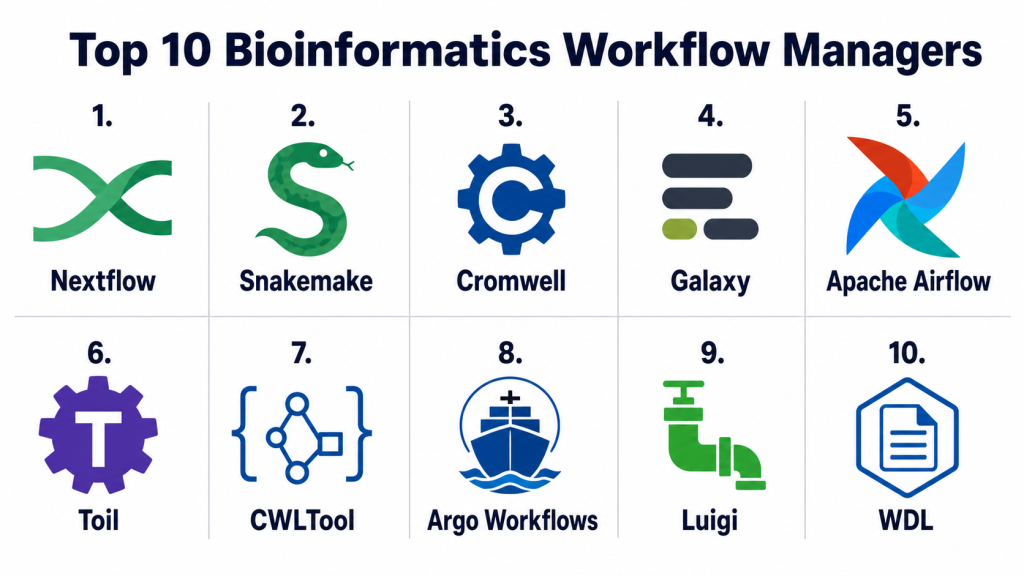
A well-organized comparison that simplifies the differences between bioinformatics workflow managers and helps readers quickly identify the right tool for their research and data processing needs.