Introduction
Drug discovery platforms are advanced software systems used by researchers to design, analyze, and develop new medicines using computational methods. These platforms combine artificial intelligence, data science, and molecular modeling to accelerate the drug development process.
Unlike traditional methods that rely heavily on laboratory experiments, modern platforms enable virtual simulations, predictive modeling, and automation. This significantly reduces time, cost, and failure rates in drug development pipelines.
Common Use Cases
- Identifying biological targets for diseases
- Designing and optimizing drug molecules
- Predicting toxicity and safety of compounds
- Managing large-scale scientific datasets
- Collaborating across research teams
What Buyers Should Evaluate
- AI and predictive modeling capabilities
- Data integration and scalability
- Ease of use for scientists
- Deployment flexibility
- Security and access control
- Integration with lab systems
- Performance and reliability
- Vendor support
Best for: Pharma companies, biotech startups, research labs, and computational biology teams.
Not ideal for: Non-research organizations or teams needing only basic analytics tools.
Key Trends in Drug Discovery Platforms
- AI-driven molecule design is becoming standard
- Generative models are creating new compounds
- Cloud-based research environments are expanding
- Automation is reducing manual experimentation
- Multi-omics data integration is increasing
- Real-time simulations are improving accuracy
- API-driven ecosystems are growing
- Collaboration features are improving workflows
How We Selected These Tools
- Strong adoption in pharma and biotech industries
- Complete drug discovery workflow support
- Proven performance and scalability
- Advanced AI and analytics capabilities
- Integration with research tools
- Security readiness
- Usability for scientists
- Balanced mix of enterprise and flexible tools
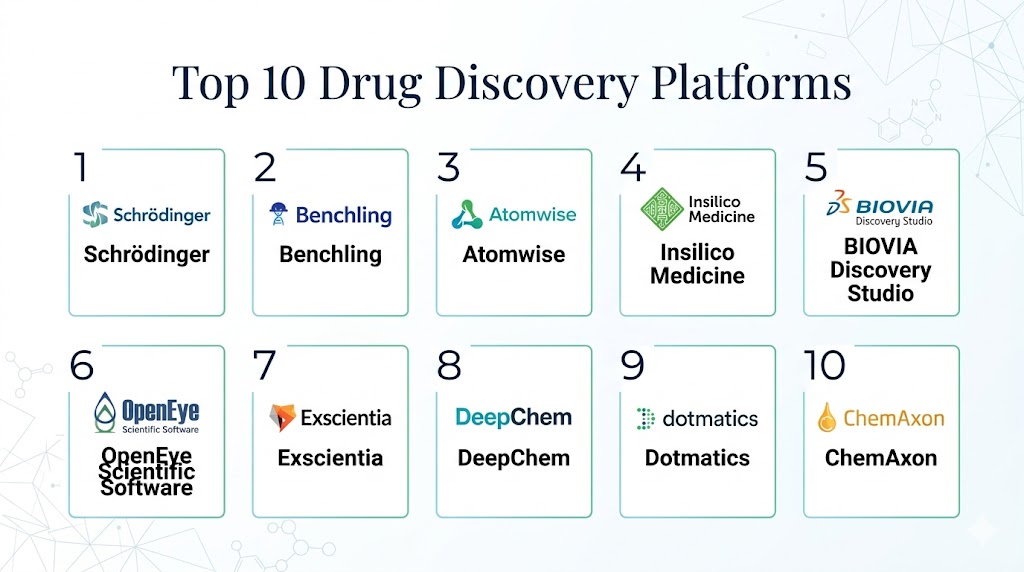
Top 10 Drug Discovery Platforms Tools
#1 — Schrödinger
Short description: Schrödinger is a leading platform for computational drug discovery that focuses on molecular modeling and simulation. It enables researchers to design drug molecules using physics-based methods and predictive analytics. The platform supports complex simulations and integrates with high-performance computing environments. It is widely used by large pharmaceutical organizations for advanced research.
Key Features
- Molecular modeling
- Structure-based drug design
- High-performance computing
- Visualization tools
- Predictive analytics
Pros
- Highly accurate simulations
- Enterprise-grade performance
- Scalable
Cons
- High cost
- Complex usage
- Requires expertise
Platforms / Deployment
Cloud / Self-hosted
Security & Compliance
Not publicly stated
Integrations & Ecosystem
Supports integration with research tools and data systems.
- API access
- Data pipelines
- HPC integrations
Support & Community
Strong enterprise support
#2 — Benchling
Short description: Benchling is a cloud-based platform designed for biotech teams to manage research workflows and data. It combines experiment tracking, collaboration, and data management in one system. The platform simplifies research processes and improves team productivity. It is widely known for its ease of use and modern interface.
Key Features
- Electronic lab notebook
- Workflow automation
- Data management
- Collaboration tools
- Cloud infrastructure
Pros
- Easy to use
- Strong collaboration
- Quick deployment
Cons
- Limited modeling features
- Pricing scalability
- Customization limits
Platforms / Deployment
Web / Cloud
Security & Compliance
SSO, RBAC, audit logs
Integrations & Ecosystem
- API integration
- LIMS support
- Data export
Support & Community
Good documentation
#3 — Atomwise
Short description: Atomwise is an AI-based drug discovery platform that uses deep learning to analyze molecular interactions. It helps researchers identify potential drug candidates faster through virtual screening. The platform reduces the need for physical experiments by using predictive models. It is widely used for AI-driven drug discovery projects.
Key Features
- Deep learning models
- Virtual screening
- Binding prediction
- Cloud processing
- Compound libraries
Pros
- Fast screening
- Strong AI capabilities
- Scalable
Cons
- Limited transparency
- Proprietary models
- Not full workflow
Platforms / Deployment
Cloud
Security & Compliance
Not publicly stated
Integrations & Ecosystem
- API tools
- Data integration
Support & Community
Varies
#4 — Insilico Medicine
Short description: Insilico Medicine is an AI-driven platform that focuses on generative drug design and biomarker discovery. It uses deep learning models to create new molecules and identify disease targets. The platform accelerates research using predictive analytics and automation. It is known for innovation in AI-based drug discovery.
Key Features
- Generative AI
- Drug design tools
- Biomarker discovery
- Predictive analytics
- Cloud infrastructure
Pros
- Advanced AI
- Innovative approach
- Strong research capability
Cons
- Requires expertise
- Complex workflows
- Limited transparency
Platforms / Deployment
Cloud
Security & Compliance
Not publicly stated
Integrations & Ecosystem
- AI integrations
- Data APIs
Support & Community
Growing support
#5 — BIOVIA Discovery Studio
Short description: BIOVIA Discovery Studio is a comprehensive platform for molecular modeling and simulation. It allows researchers to analyze biological systems and design drug candidates efficiently. The platform includes visualization and data analysis tools. It is widely used in enterprise research environments.
Key Features
- Molecular simulation
- Visualization tools
- Data analysis
- Workflow integration
- Structure-based design
Pros
- Feature-rich
- Enterprise ready
- Strong modeling
Cons
- Complex interface
- High cost
- Learning curve
Platforms / Deployment
Windows / Cloud
Security & Compliance
Not publicly stated
Integrations & Ecosystem
- API support
- Research tools
Support & Community
Enterprise support
#6 — OpenEye Scientific Software
Short description: OpenEye provides computational chemistry tools for molecular modeling and drug discovery. It supports docking, screening, and visualization workflows. The platform is designed for researchers who need high-performance chemistry tools. It is widely used in scientific research environments.
Key Features
- Molecular docking
- Screening tools
- Visualization
- Cloud support
- Data analysis
Pros
- High performance
- Flexible workflows
- Accurate results
Cons
- Requires expertise
- UI limitations
- Cost considerations
Platforms / Deployment
Cloud / Self-hosted
Security & Compliance
Not publicly stated
Integrations & Ecosystem
- APIs
- Research tools
Support & Community
Scientific community
#7 — Exscientia
Short description: Exscientia is an AI-based platform focused on precision medicine and automated drug design. It uses data-driven models to improve drug development outcomes. The platform supports automation and advanced analytics. It is used in specialized research environments.
Key Features
- AI drug design
- Automation workflows
- Data analytics
- Precision medicine tools
- Cloud infrastructure
Pros
- Advanced automation
- Strong AI models
- Personalized research
Cons
- Limited documentation
- Niche use
- Requires expertise
Platforms / Deployment
Cloud
Security & Compliance
Not publicly stated
Integrations & Ecosystem
- Data pipelines
- AI integrations
Support & Community
Varies
#8 — DeepChem
Short description: DeepChem is an open-source platform for machine learning in drug discovery. It allows developers and researchers to build custom models for chemical data analysis. The platform is highly flexible and widely used in academic research. It is ideal for teams with strong technical expertise.
Key Features
- Machine learning tools
- Open-source framework
- Chemical datasets
- Python-based workflows
- Custom model support
Pros
- Free
- Flexible
- Strong community
Cons
- Requires coding
- Limited enterprise support
- Not beginner-friendly
Platforms / Deployment
Linux / Cloud
Security & Compliance
Not publicly stated
Integrations & Ecosystem
- Python ecosystem
- ML frameworks
Support & Community
Open-source community
#9 — Dotmatics
Short description: Dotmatics is a scientific platform focused on data management and collaboration in research environments. It helps teams organize experimental data and automate workflows. The platform supports scalable infrastructure for growing research needs. It is widely used in mid and large organizations.
Key Features
- Data management
- Workflow automation
- Collaboration tools
- Visualization
- Cloud support
Pros
- Scalable
- Unified system
- Strong data handling
Cons
- Limited AI features
- Cost concerns
- Customization limits
Platforms / Deployment
Cloud / Hybrid
Security & Compliance
Not publicly stated
Integrations & Ecosystem
- APIs
- Data tools
Support & Community
Enterprise support
#10 — ChemAxon
Short description: ChemAxon provides cheminformatics tools for chemical data analysis and drug discovery. It helps researchers manage chemical structures and workflows efficiently. The platform supports integration with other systems. It is widely used for chemical data processing.
Key Features
- Chemical structure tools
- Data analysis
- Visualization
- API integration
- Workflow tools
Pros
- Strong chemistry tools
- Flexible integration
- Developer-friendly
Cons
- Limited full platform
- UI limitations
- Integration effort
Platforms / Deployment
Web / Cloud
Security & Compliance
Not publicly stated
Integrations & Ecosystem
- APIs
- Data systems
Support & Community
Good documentation
Comparison Table
| Tool | Best For | Platforms | Deployment | Standout Feature | Rating |
|---|---|---|---|---|---|
| Schrödinger | Enterprise pharma | Web | Hybrid | Molecular simulation | N A |
| Benchling | Biotech teams | Web | Cloud | Collaboration | N A |
| Atomwise | AI discovery | Web | Cloud | Deep learning | N A |
| Insilico | AI drug design | Web | Cloud | Generative AI | N A |
| BIOVIA | Simulation | Windows | Hybrid | Modeling tools | N A |
| OpenEye | Chemistry modeling | Cloud | Hybrid | Docking tools | N A |
| Exscientia | Precision medicine | Web | Cloud | AI automation | N A |
| DeepChem | Developers | Linux | Cloud | Open-source ML | N A |
| Dotmatics | Data management | Web | Hybrid | Unified platform | N A |
| ChemAxon | Cheminformatics | Web | Cloud | Chemical tools | N A |
Evaluation and Scoring
| Tool | Core | Ease | Integration | Security | Performance | Support | Value | Total |
|---|---|---|---|---|---|---|---|---|
| Schrödinger | 9 | 6 | 8 | 6 | 9 | 8 | 6 | 7.7 |
| Benchling | 8 | 9 | 8 | 7 | 8 | 9 | 7 | 8.1 |
| Atomwise | 8 | 7 | 7 | 6 | 8 | 6 | 7 | 7.3 |
| Insilico | 9 | 6 | 7 | 6 | 8 | 6 | 7 | 7.4 |
| BIOVIA | 9 | 6 | 8 | 6 | 9 | 8 | 6 | 7.8 |
| OpenEye | 8 | 6 | 7 | 6 | 8 | 7 | 7 | 7.2 |
| Exscientia | 8 | 6 | 7 | 6 | 8 | 6 | 6 | 7.0 |
| DeepChem | 7 | 5 | 8 | 5 | 7 | 7 | 9 | 7.1 |
| Dotmatics | 8 | 8 | 8 | 7 | 8 | 8 | 7 | 7.9 |
| ChemAxon | 7 | 7 | 8 | 6 | 7 | 7 | 7 | 7.2 |
Scoring is based on comparative evaluation across features, usability, integrations, and value. Higher scores indicate better alignment with enterprise or advanced research needs. Lower scores do not mean poor performance but reflect niche focus or complexity. Always match scores with your use case rather than choosing only the highest score.
Which Tool Is Right for You
Solo
DeepChem is best due to flexibility and zero cost.
SMB
Benchling offers ease of use and collaboration.
Mid Market
Dotmatics provides balance between features and scalability.
Enterprise
Schrödinger and BIOVIA are best for large research environments.
Budget vs Premium
- Budget option is DeepChem
- Premium options are Schrödinger and BIOVIA
Feature Depth vs Ease
- Feature depth tools include Schrödinger and Insilico
- Easy tools include Benchling
Integrations and Scalability
- Benchling and Dotmatics for integrations
- Schrödinger for scalability
Security Needs
Enterprise tools are better suited though details are not publicly stated
Frequently Asked Questions
1 What is a drug discovery platform
A drug discovery platform is software that helps researchers design and analyze drug candidates using computational tools. It reduces reliance on lab experiments and speeds up research workflows. These platforms combine data, AI, and modeling to improve outcomes.
2 How much do these tools cost
Costs vary widely depending on features and scale. Enterprise platforms can be expensive while open-source tools are free. Cloud tools usually follow subscription models.
3 Are AI features necessary
AI is becoming essential because it speeds up discovery and improves accuracy. Many modern platforms rely heavily on machine learning models. Without AI, the process is slower and less efficient.
4 How long does implementation take
Cloud platforms can be deployed quickly while enterprise systems may take longer. Implementation depends on integration and training needs. Teams should plan onboarding carefully.
5 Can small teams use these tools
Yes but they should choose simpler platforms or open-source options. Tools like DeepChem are suitable for smaller teams with technical expertise.
6 Are these platforms secure
Security varies by vendor. Many platforms include access control and encryption. However detailed compliance information is often not publicly available.
7 Do they integrate with lab systems
Yes most platforms integrate with LIMS and other research tools. APIs are commonly used for integration. This ensures smooth workflows.
8 Can I switch platforms later
Switching is possible but can be complex. Data migration and retraining may take time. Choosing the right tool early is important.
9 What are common mistakes
Choosing based only on cost is a mistake. Ignoring scalability and integration needs can cause issues later. Proper evaluation is critical.
10 What are alternatives
Alternatives include standalone modeling tools and manual workflows. However they are less efficient than integrated platforms.
Conclusion
Drug discovery platforms are transforming how pharmaceutical and biotech organizations approach research and innovation. By combining artificial intelligence, computational modeling, and large-scale data processing, these tools significantly reduce the time and cost required to develop new drugs. However, selecting the right platform depends on your specific needs, technical capabilities, and budget. Enterprise organizations may benefit from powerful simulation platforms, while smaller teams may prefer flexible or open-source solutions. It is important to evaluate features, scalability, and integration capabilities before making a decision. The best approach is to shortlist a few platforms, test them through pilot projects, and validate how well they fit into your workflow. A practical evaluation will help ensure long-term success and better research outcomes.

A well-written comparison that clearly explains the capabilities of different drug discovery platforms, making it easier to understand their strengths and evaluate the best option for research needs.