Introduction
Device Certificate Provisioning Tools help organizations issue, manage, renew, rotate, and revoke digital certificates for devices, workloads, IoT endpoints, servers, network appliances, and applications. These tools make sure every device has a trusted identity before connecting to networks, APIs, cloud services, or enterprise systems. Instead of manually creating certificates, IT and security teams use these platforms to automate certificate lifecycle management and reduce identity-related security risks.
Real-world use cases include IoT device onboarding, zero-trust device authentication, mTLS enablement, PKI automation, certificate renewal, secure manufacturing provisioning, VPN authentication, network device identity, and cloud workload certificate management. Buyers should evaluate certificate automation, PKI integration, device enrollment workflows, API support, scalability, policy controls, audit logging, security, compliance, and integration with cloud, IAM, MDM, DevOps, and IoT platforms.
Best for: Security teams, PKI administrators, IoT teams, DevOps teams, network teams, manufacturers, enterprises, MSPs, and organizations managing large numbers of devices or certificates.
Not ideal for: Very small teams with only a few manually managed certificates, organizations without PKI maturity, or teams that only need basic SSL certificate purchasing.
Key Trends in Device Certificate Provisioning Tools
- Automated certificate lifecycle management for devices, workloads, and applications
- Stronger adoption of zero-trust and certificate-based authentication
- Expansion of mTLS for APIs, microservices, and IoT communication
- Integration with cloud IoT platforms, MDM, IAM, and DevOps pipelines
- Shorter certificate lifecycles requiring faster renewal automation
- Hardware-backed identity using TPM, HSM, secure elements, and device roots of trust
- Policy-driven certificate issuance and revocation workflows
- Increased demand for certificate visibility and risk reporting
- API-first provisioning for large-scale device enrollment
- Stronger audit logging and compliance controls for regulated environments
How We Selected These Tools
- Evaluated market recognition in certificate lifecycle management, PKI, and device identity
- Assessed provisioning automation, renewal, revocation, and policy control features
- Reviewed fit for IoT, enterprise devices, workloads, and cloud environments
- Considered integration depth with PKI, HSM, IAM, MDM, DevOps, and cloud platforms
- Evaluated scalability for large certificate and device fleets
- Considered security posture, auditability, and administrative controls
- Assessed ease of deployment and operational usability
- Reviewed API support and automation capabilities
- Compared suitability for SMB, mid-market, and enterprise use cases
- Included a balanced mix of enterprise, cloud, IoT, and PKI-focused platforms
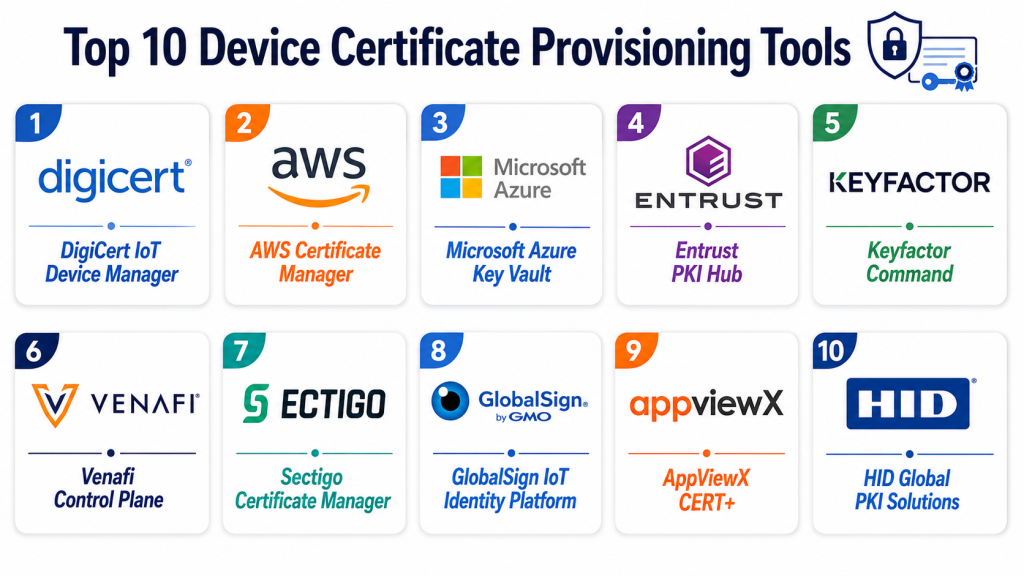
Top 10 Device Certificate Provisioning Tools
#1 — DigiCert Trust Lifecycle Manager
Short description: DigiCert Trust Lifecycle Manager helps organizations manage public and private certificates across devices, users, servers, applications, and connected systems. It is designed for enterprises that need centralized certificate visibility, automation, policy enforcement, and lifecycle control. The platform supports certificate discovery, issuance, renewal, revocation, and reporting for complex environments. It is especially useful for organizations managing large certificate estates and device identity programs.
Key Features
- Certificate discovery and inventory
- Automated certificate issuance and renewal
- Private and public PKI lifecycle management
- Policy-based certificate governance
- Device and workload identity support
- Reporting and risk visibility
- API-driven automation
Pros
- Strong enterprise certificate lifecycle coverage
- Good fit for large PKI environments
- Supports public and private certificate workflows
- Centralized visibility across certificate assets
Cons
- May be expensive for smaller teams
- Requires PKI knowledge for full value
- Implementation can take planning
- Advanced automation may need technical setup
Platforms / Deployment
Web
Cloud
Security & Compliance
SSO, RBAC, audit logging, encryption, and enterprise security controls are commonly supported. Specific compliance requirements should be verified during procurement.
Integrations & Ecosystem
DigiCert integrates with enterprise systems, cloud platforms, PKI infrastructure, DevOps tools, and security workflows.
- Public and private PKI
- Cloud platforms
- DevOps automation
- ITSM tools
- APIs
- HSM and security infrastructure
Support & Community
DigiCert provides enterprise support, documentation, onboarding resources, and PKI-focused customer guidance.
#2 — Keyfactor Command
Short description: Keyfactor Command is a certificate lifecycle automation and crypto-agility platform built for enterprises managing certificates, keys, and machine identities. It supports device certificate provisioning, PKI automation, inventory, renewal, policy enforcement, and compliance reporting. Security and infrastructure teams use it to reduce certificate outages and improve trust management. It is a strong fit for enterprises with complex PKI and device identity needs.
Key Features
- Certificate lifecycle automation
- Device identity and machine identity management
- PKI integration and orchestration
- Certificate discovery and inventory
- Policy enforcement and workflow automation
- Audit reporting and compliance visibility
- API and DevOps integration
Pros
- Strong machine identity management capabilities
- Good fit for large enterprise PKI environments
- Flexible automation and orchestration
- Helps reduce certificate outage risk
Cons
- Requires PKI expertise
- Can be complex for smaller organizations
- Implementation may require professional services
- Pricing is usually enterprise-oriented
Platforms / Deployment
Web
Cloud / Hybrid / Self-hosted
Security & Compliance
SSO, RBAC, audit logs, encryption, and enterprise admin controls are commonly supported. Specific certifications should be verified directly.
Integrations & Ecosystem
Keyfactor integrates with enterprise PKI, certificate authorities, DevOps pipelines, cloud environments, and security systems.
- Microsoft PKI
- Public certificate authorities
- HSM systems
- Kubernetes and DevOps workflows
- ITSM tools
- REST APIs
Support & Community
Keyfactor offers enterprise support, implementation assistance, documentation, and PKI-focused expertise.
#3 — Venafi TLS Protect
Short description: Venafi TLS Protect focuses on machine identity management, certificate discovery, lifecycle automation, policy enforcement, and certificate risk reduction. It helps organizations manage certificates across networks, cloud environments, applications, and devices. Security teams use it to prevent outages, enforce governance, and automate certificate renewal. It is particularly valuable for enterprises with large and distributed certificate environments.
Key Features
- Certificate discovery and inventory
- Automated renewal and provisioning
- Machine identity governance
- Certificate risk scoring
- Policy enforcement
- Integration with DevOps and cloud platforms
- Reporting and audit visibility
Pros
- Strong enterprise machine identity focus
- Helps reduce certificate outage risk
- Good policy and governance controls
- Scalable for complex environments
Cons
- Enterprise-focused cost structure
- Requires operational maturity
- Setup can be complex
- Smaller teams may find it too advanced
Platforms / Deployment
Web
Cloud / Hybrid
Security & Compliance
SSO, RBAC, encryption, audit logging, and enterprise security controls are commonly supported. Specific compliance status should be verified with the vendor.
Integrations & Ecosystem
Venafi integrates with certificate authorities, DevOps platforms, cloud services, security systems, and IT workflows.
- Public and private CAs
- DevOps pipelines
- Kubernetes platforms
- Cloud providers
- ITSM tools
- Security platforms
Support & Community
Venafi provides enterprise support, documentation, training resources, and customer success services.
#4 — AppViewX CERT+
Short description: AppViewX CERT+ is a certificate lifecycle automation platform that helps organizations discover, provision, renew, revoke, and manage digital certificates across enterprise environments. It supports certificate automation for network devices, applications, cloud platforms, and security systems. Teams use it to simplify certificate operations and reduce manual PKI work. It is well suited for organizations needing strong workflow automation and centralized certificate governance.
Key Features
- Certificate discovery and inventory
- Automated certificate provisioning
- Renewal and revocation workflows
- Policy-based certificate management
- Reporting and compliance dashboards
- Integration with CAs and security tools
- Workflow approvals and role-based administration
Pros
- Strong workflow automation
- Good certificate visibility and governance
- Supports multi-CA environments
- Useful for network and application certificate management
Cons
- Requires setup and process design
- Advanced workflows may need configuration
- Better suited for mature IT teams
- Pricing details may require vendor consultation
Platforms / Deployment
Web
Cloud / Hybrid
Security & Compliance
SSO, RBAC, encryption, and audit logging are commonly supported. Specific compliance certifications should be verified directly.
Integrations & Ecosystem
AppViewX integrates with certificate authorities, enterprise infrastructure, cloud platforms, load balancers, and IT systems.
- Public and private CAs
- Load balancers
- Cloud services
- ITSM platforms
- HSM systems
- APIs
Support & Community
AppViewX provides documentation, implementation support, onboarding services, and enterprise support options.
#5 — Sectigo Certificate Manager
Short description: Sectigo Certificate Manager helps organizations automate certificate issuance, deployment, renewal, and management across enterprise systems, users, devices, and applications. It supports public and private certificate lifecycle workflows and can be used for device certificate provisioning in managed environments. Security teams use it to improve visibility, reduce manual renewal work, and enforce certificate policies. It is suitable for businesses looking for centralized certificate management with CA-backed services.
Key Features
- Certificate lifecycle automation
- Public and private certificate management
- Device certificate provisioning support
- Discovery and inventory
- Automated renewal workflows
- Policy-based administration
- Reporting and audit controls
Pros
- Strong certificate authority ecosystem
- Supports enterprise certificate automation
- Useful for mixed public and private certificate needs
- Reduces manual renewal effort
Cons
- Advanced setup may require PKI knowledge
- Some workflows may need professional services
- Best value depends on certificate volume
- Pricing may vary by certificate type and scale
Platforms / Deployment
Web
Cloud
Security & Compliance
SSO, RBAC, encryption, and audit logging are commonly available. Specific certifications and compliance controls should be verified during procurement.
Integrations & Ecosystem
Sectigo integrates with enterprise systems, device management workflows, cloud infrastructure, and certificate automation tools.
- Public and private PKI
- MDM systems
- Cloud platforms
- DevOps workflows
- APIs
- Directory services
Support & Community
Sectigo provides documentation, onboarding resources, enterprise support, and PKI assistance.
#6 — GlobalSign Atlas
Short description: GlobalSign Atlas provides certificate automation and identity services for devices, users, and enterprise systems. It is designed to support secure digital identity lifecycle management across connected environments. Organizations can use it for automated certificate issuance, device identity, and PKI-backed trust workflows. It is a strong option for businesses requiring scalable certificate provisioning and managed PKI capabilities.
Key Features
- Device certificate provisioning
- Managed PKI services
- Automated certificate issuance
- Certificate lifecycle management
- Identity-based authentication support
- API-driven workflows
- Enterprise reporting and administration
Pros
- Strong managed PKI capabilities
- Good fit for device identity programs
- API-first certificate provisioning
- Scalable for connected environments
Cons
- May require PKI planning
- Advanced customization can require vendor support
- Best suited for managed PKI use cases
- Public feature detail may vary by package
Platforms / Deployment
Web
Cloud
Security & Compliance
Encryption, access control, and enterprise security controls are supported. Specific compliance details should be verified with the vendor.
Integrations & Ecosystem
GlobalSign Atlas integrates with enterprise PKI workflows, device provisioning processes, applications, and APIs.
- Managed PKI
- Device manufacturing workflows
- Enterprise applications
- APIs
- IAM systems
- Cloud services
Support & Community
GlobalSign offers documentation, managed PKI support, onboarding assistance, and enterprise customer support.
#7 — AWS IoT Core Device Provisioning
Short description: AWS IoT Core supports device certificate provisioning, secure device onboarding, and identity-based authentication for IoT fleets. It enables organizations to register devices, attach certificates, apply policies, and connect devices securely to AWS IoT services. It is especially useful for businesses already building IoT solutions on AWS. The platform is strong for cloud-scale device identity and telemetry-driven environments.
Key Features
- IoT device certificate provisioning
- Fleet provisioning support
- Secure device authentication
- Policy-based access control
- Device registry and identity management
- Integration with AWS IoT services
- Automation through APIs and cloud workflows
Pros
- Strong fit for AWS-based IoT deployments
- Scales well for large IoT fleets
- Supports certificate-based authentication
- Integrates with AWS analytics and automation
Cons
- Requires AWS expertise
- Best suited for AWS environments
- Pricing can become complex at scale
- Not a general enterprise certificate manager
Platforms / Deployment
Web / Linux / Windows
Cloud
Security & Compliance
IAM controls, encryption, certificate-based authentication, policy-based access, and audit integration are supported. Specific compliance requirements should be verified based on deployment.
Integrations & Ecosystem
AWS IoT integrates with cloud analytics, serverless automation, storage, monitoring, and security services.
- AWS IoT Core
- AWS Lambda
- Amazon S3
- Amazon CloudWatch
- AWS IAM
- APIs and SDKs
Support & Community
AWS provides extensive documentation, developer resources, enterprise support plans, and a large technical community.
#8 — Azure IoT Hub Device Provisioning Service
Short description: Azure IoT Hub Device Provisioning Service helps organizations securely provision and connect IoT devices to Azure IoT Hub at scale. It supports certificate-based device enrollment, group enrollment, and automated assignment to IoT hubs. It is best for enterprises already using Microsoft cloud services and Azure IoT architecture. The service helps simplify secure onboarding for distributed IoT fleets.
Key Features
- Automated IoT device provisioning
- Certificate-based enrollment
- Group enrollment support
- Device identity management
- Integration with Azure IoT Hub
- Secure device authentication
- Scalable provisioning workflows
Pros
- Strong fit for Azure-based IoT environments
- Scales for large device fleets
- Supports secure certificate enrollment
- Integrates with Microsoft cloud ecosystem
Cons
- Requires Azure IoT knowledge
- Not a broad certificate lifecycle platform
- Complex setup for new IoT teams
- Best value inside Azure ecosystem
Platforms / Deployment
Web / Linux / Windows
Cloud
Security & Compliance
Encryption, certificate-based authentication, RBAC, and Azure security controls are supported. Specific compliance coverage should be verified during procurement.
Integrations & Ecosystem
Azure IoT provisioning connects with Microsoft cloud, analytics, security, and device management services.
- Azure IoT Hub
- Azure Digital Twins
- Microsoft Defender
- Power BI
- Azure Functions
- APIs and SDKs
Support & Community
Microsoft provides documentation, enterprise support, learning resources, and a large developer ecosystem.
#9 — EJBCA Enterprise
Short description: EJBCA Enterprise is a PKI and certificate authority platform used to build and operate certificate infrastructures for devices, users, applications, and enterprise systems. It supports certificate issuance, enrollment protocols, lifecycle management, and automation for private PKI environments. Organizations use it when they need strong control over internal certificate authority operations. It is suitable for security-focused teams that want flexible, self-managed PKI capabilities.
Key Features
- Private PKI and CA management
- Certificate issuance and enrollment
- Support for common certificate protocols
- Device certificate provisioning workflows
- Policy and profile management
- Audit logging and access controls
- Deployment flexibility
Pros
- Strong private PKI control
- Flexible certificate authority capabilities
- Useful for custom device identity programs
- Suitable for regulated and high-control environments
Cons
- Requires PKI expertise
- Self-managed operations can be complex
- UI and workflows may feel technical
- Implementation requires planning
Platforms / Deployment
Web / Linux
Self-hosted / Hybrid
Security & Compliance
RBAC, audit logs, encryption, and CA security controls are supported. Specific certifications should be verified based on deployment and vendor package.
Integrations & Ecosystem
EJBCA integrates with enterprise PKI systems, HSMs, identity platforms, device enrollment systems, and automation workflows.
- HSM systems
- Enrollment protocols
- Directory services
- DevOps tools
- APIs
- Enterprise security systems
Support & Community
Enterprise support, documentation, and professional services are available through the vendor ecosystem.
#10 — Smallstep Certificate Manager
Short description: Smallstep Certificate Manager provides automated certificate management for developers, infrastructure teams, workloads, devices, and internal services. It focuses on practical PKI automation, short-lived certificates, mTLS, and secure identity for modern infrastructure. Teams use it to simplify certificate issuance and renewal across distributed systems. It is a strong fit for cloud-native teams that need automated internal PKI.
Key Features
- Automated certificate issuance
- Short-lived certificate support
- mTLS and workload identity
- Device and service certificate workflows
- Private CA management
- API and CLI automation
- Integration with modern infrastructure
Pros
- Developer-friendly certificate automation
- Strong fit for modern infrastructure and mTLS
- Supports short-lived certificates
- Useful for cloud-native security teams
Cons
- Requires PKI and infrastructure knowledge
- Less suited for traditional enterprise PKI buyers
- Advanced enterprise needs may require support plans
- Not ideal for simple SSL purchasing workflows
Platforms / Deployment
Web / Linux / macOS
Cloud / Self-hosted
Security & Compliance
Encryption, access controls, auditability, and secure CA operations are supported. Specific compliance details should be verified directly.
Integrations & Ecosystem
Smallstep integrates well with developer workflows, infrastructure automation, and cloud-native environments.
- Kubernetes
- DevOps pipelines
- APIs
- CLI workflows
- Cloud infrastructure
- mTLS systems
Support & Community
Documentation, developer resources, community support, and enterprise support options are available.
Comparison Table
| Tool Name | Best For | Platform Supported | Deployment | Standout Feature | Public Rating |
|---|---|---|---|---|---|
| DigiCert Trust Lifecycle Manager | Enterprise certificate lifecycle management | Web | Cloud | Public and private certificate governance | N/A |
| Keyfactor Command | Machine identity and PKI automation | Web | Cloud / Hybrid / Self-hosted | Enterprise PKI orchestration | N/A |
| Venafi TLS Protect | Machine identity governance | Web | Cloud / Hybrid | Certificate risk visibility | N/A |
| AppViewX CERT+ | Workflow-based certificate automation | Web | Cloud / Hybrid | Multi-CA automation workflows | N/A |
| Sectigo Certificate Manager | Centralized certificate management | Web | Cloud | CA-backed certificate automation | N/A |
| GlobalSign Atlas | Managed PKI and device identity | Web | Cloud | API-first certificate provisioning | N/A |
| AWS IoT Core Device Provisioning | AWS IoT device onboarding | Web / Linux / Windows | Cloud | Fleet certificate provisioning | N/A |
| Azure IoT Hub Device Provisioning Service | Azure IoT device enrollment | Web / Linux / Windows | Cloud | Group-based device provisioning | N/A |
| EJBCA Enterprise | Private PKI control | Web / Linux | Self-hosted / Hybrid | Flexible CA management | N/A |
| Smallstep Certificate Manager | Cloud-native PKI automation | Web / Linux / macOS | Cloud / Self-hosted | Short-lived certificates and mTLS | N/A |
Evaluation & Scoring
| Tool Name | Core 25% | Ease 15% | Integrations 15% | Security 10% | Performance 10% | Support 10% | Value 15% | Weighted Total |
|---|---|---|---|---|---|---|---|---|
| DigiCert Trust Lifecycle Manager | 9.0 | 8.0 | 8.5 | 9.0 | 8.5 | 8.5 | 7.5 | 8.40 |
| Keyfactor Command | 9.0 | 7.5 | 9.0 | 9.0 | 8.5 | 8.5 | 7.5 | 8.38 |
| Venafi TLS Protect | 9.0 | 7.5 | 8.5 | 9.0 | 8.5 | 8.0 | 7.0 | 8.20 |
| AppViewX CERT+ | 8.5 | 8.0 | 8.5 | 8.5 | 8.0 | 8.0 | 7.5 | 8.15 |
| Sectigo Certificate Manager | 8.0 | 8.0 | 8.0 | 8.5 | 8.0 | 8.0 | 8.0 | 8.08 |
| GlobalSign Atlas | 8.0 | 7.5 | 8.0 | 8.5 | 8.0 | 8.0 | 7.5 | 7.93 |
| AWS IoT Core Device Provisioning | 8.5 | 7.0 | 9.0 | 9.0 | 9.0 | 8.0 | 8.0 | 8.35 |
| Azure IoT Hub Device Provisioning Service | 8.5 | 7.0 | 9.0 | 9.0 | 8.5 | 8.0 | 8.0 | 8.30 |
| EJBCA Enterprise | 8.5 | 6.5 | 8.0 | 9.0 | 8.0 | 7.5 | 8.0 | 7.95 |
| Smallstep Certificate Manager | 8.0 | 8.0 | 8.0 | 8.5 | 8.0 | 7.5 | 8.0 | 8.00 |
These scores are comparative and should be used as a buying guide, not as fixed rankings. Enterprise tools score higher for governance, scalability, and ecosystem depth, while cloud-native tools may score better for developer usability and automation. Buyers should adjust weighting based on certificate volume, IoT scale, PKI maturity, security requirements, and deployment model.
Which Device Certificate Provisioning Tool Is Right for You?
Solo / Freelancer
Smallstep Certificate Manager or ThingsBoard-style open infrastructure may be useful for developers and small teams testing private PKI, mTLS, or internal device authentication workflows. These options are better when the team has technical skills and wants automation without heavy enterprise overhead.
SMB
Sectigo Certificate Manager, GlobalSign Atlas, or Smallstep can work well for SMBs that need managed PKI, device certificates, or internal service authentication without building everything from scratch. SMBs should prioritize ease of setup, support quality, and renewal automation.
Mid-Market
AppViewX CERT+, DigiCert Trust Lifecycle Manager, and Keyfactor Command are strong options for mid-market teams managing growing certificate estates. These tools help standardize certificate workflows, reduce outages, and improve visibility across infrastructure, applications, and devices.
Enterprise
DigiCert, Keyfactor, Venafi, AppViewX, and EJBCA Enterprise are better suited for complex enterprises with distributed PKI, multiple certificate authorities, audit requirements, and high-volume device identity needs. Enterprises should evaluate governance, HSM integration, API support, and compliance reporting.
Budget vs Premium
Budget-conscious teams may prefer Smallstep or cloud-native provisioning services already included in their existing cloud environment. Premium buyers should consider DigiCert, Keyfactor, Venafi, or AppViewX when governance, scale, auditability, and multi-CA automation are critical.
Feature Depth vs Ease of Use
Venafi, Keyfactor, DigiCert, and EJBCA provide deep PKI and machine identity capabilities but require stronger technical ownership. Smallstep, Sectigo, GlobalSign, AWS, and Azure may be easier depending on deployment context and existing ecosystem.
Integrations & Scalability
Large-scale environments should prioritize API support, CA integrations, HSM compatibility, cloud integrations, MDM support, and DevOps automation. AWS and Azure are strong for cloud IoT provisioning, while enterprise CLM tools are better for broad certificate governance.
Security & Compliance Needs
Organizations handling regulated data or mission-critical devices should prioritize RBAC, audit logs, encryption, HSM support, secure key storage, policy enforcement, and revocation workflows. Compliance claims should always be verified with the vendor before purchase.
Frequently Asked Questions
1. What is a Device Certificate Provisioning Tool?
A Device Certificate Provisioning Tool automates the issuance, deployment, renewal, and revocation of digital certificates for devices.
It helps devices prove their identity before connecting to networks, APIs, cloud systems, or enterprise applications.
These tools are commonly used for IoT, zero-trust, mTLS, PKI, and secure device onboarding.
2. Why is device certificate provisioning important?
Device certificates help prevent unauthorized devices from connecting to sensitive systems.
They provide stronger authentication than passwords or shared secrets.
Automated provisioning also reduces manual errors, certificate outages, and security gaps.
3. What is the difference between PKI and certificate provisioning?
PKI is the broader trust infrastructure that creates and manages digital certificates.
Certificate provisioning is the process of issuing and installing those certificates onto devices or systems.
Most enterprise tools combine PKI integration with automated provisioning workflows.
4. Can these tools support IoT devices?
Yes, many tools support IoT certificate provisioning for sensors, gateways, embedded devices, and connected products.
AWS IoT and Azure IoT are especially useful for cloud-connected IoT fleets.
Enterprise PKI tools can also support manufacturing and device identity workflows.
5. Do these tools support certificate renewal?
Yes, renewal automation is one of the most important features.
It helps prevent service outages caused by expired certificates.
Advanced tools can also support rotation, revocation, policy checks, and expiration alerts.
6. What integrations are important?
Important integrations include certificate authorities, HSMs, IAM systems, MDM platforms, DevOps tools, cloud services, ITSM platforms, and monitoring systems.
For IoT, integration with cloud IoT hubs and device registries is also important.
API support is critical for automation at scale.
7. Are open-source options available?
Yes, open-source and self-hosted PKI options are available, especially for technical teams.
EJBCA and Smallstep are popular choices for teams wanting more control over private PKI.
However, self-managed options require stronger PKI skills and operational ownership.
8. How do these tools improve security?
They enforce trusted device identity, automate certificate rotation, reduce manual handling of keys, and support revocation when devices are compromised.
They also improve auditability and policy enforcement.
Security improves further when integrated with HSMs, zero-trust systems, and monitoring tools.
9. What should buyers evaluate before choosing a tool?
Buyers should evaluate scale, certificate volume, device types, PKI maturity, cloud strategy, automation needs, and compliance requirements.
They should also review API support, CA compatibility, renewal workflows, admin controls, and audit reporting.
A pilot with real devices is recommended before full rollout.
10. Are these tools only for large enterprises?
No, smaller teams can also use device certificate provisioning tools for IoT products, internal services, and secure infrastructure.
However, large enterprises usually need more advanced governance, reporting, and integration capabilities.
The right tool depends on complexity, not just company size.
Conclusion
Device Certificate Provisioning Tools are essential for organizations that need strong device identity, secure onboarding, automated certificate renewal, and scalable PKI operations. Enterprises with complex certificate estates may prefer DigiCert, Keyfactor, Venafi, or AppViewX for lifecycle management and governance, while cloud IoT teams may choose AWS IoT or Azure IoT provisioning services. Organizations needing private PKI control can evaluate EJBCA Enterprise or Smallstep, especially when mTLS and internal trust automation are priorities. The best choice depends on certificate volume, device diversity, cloud strategy, compliance needs, and internal PKI expertise. Buyers should shortlist a few tools, test real provisioning workflows, validate integrations, review security controls, and confirm long-term support before scaling deployment.

This article gives a clear explanation of device certificate provisioning tools and how they help secure connected devices through automated certificate management. It also highlights the importance of authentication, scalability, and security in modern IoT environments.
One aspect that is often overlooked in certificate provisioning discussions is post-quantum cryptography (PQC) readiness. Many organizations are deploying IoT and industrial devices with expected lifespans of 10–20 years, which means today’s certificate architecture decisions could create future migration challenges. It would be valuable to compare how these platforms support crypto-agility, large-scale certificate reissuance, hybrid PQC deployments, and automated algorithm transitions without disrupting device operations. For long-lived edge fleets, future cryptographic migration may become as important as the initial provisioning process itself.
Certificate provisioning works well at initial deployment, but large-scale environments often face challenges during renewal and rotation cycles. A single misconfigured policy or expired certificate can disrupt thousands of connected devices simultaneously. Exploring automated certificate lifecycle management, emergency revocation procedures, and recovery mechanisms for offline devices would provide valuable operational insight for teams responsible for maintaining secure device fleets over many years.
Device certificate provisioning is more than a one-time onboarding task—it requires secure lifecycle management throughout the device’s operational life. Large-scale IoT deployments often face challenges with certificate renewal, revocation, ownership changes, and compromised devices. Including insights on automated certificate rotation, zero-touch provisioning, PKI scalability, and secure decommissioning would give readers a more complete understanding of how these platforms maintain trust and security across millions of connected devices.