Introduction
B2B Customer Portals are secure, self-service digital platforms that allow business customers to interact with a company, access services, place orders, manage accounts, track transactions, and resolve support issues without needing direct human assistance. These portals act as a central digital interface between businesses and their clients, replacing manual emails, phone calls, and fragmented workflows.
In 2026+, B2B portals have become essential because enterprise buyers expect real-time access, transparency, and automation in every business interaction. Companies now use these portals to improve customer experience, reduce operational costs, and scale support without increasing headcount.
Real-world use cases include:
- Order placement and tracking portals for distributors and wholesalers
- Account management dashboards for enterprise clients
- Invoice, billing, and payment portals
- Support ticketing and SLA tracking systems
- Partner and reseller management portals
- Product configuration and reordering systems
- Contract and subscription management dashboards
Key evaluation criteria:
- Self-service capabilities and usability
- Integration with ERP, CRM, and billing systems
- Role-based access control and security
- Workflow automation and approval processes
- Real-time data visibility (orders, invoices, tickets)
- Customization and branding flexibility
- API extensibility and integration ecosystem
- Multi-tenant scalability
- Performance and reliability under high load
- Analytics and customer insights
Best for: manufacturers, SaaS companies, distributors, logistics firms, financial services, and any enterprise serving recurring B2B clients.
Not ideal for: small businesses with low transaction volume or companies without structured client servicing processes.
Key Trends in B2B Customer Portals
- Rise of AI-powered self-service assistants and chatbots inside portals
- Shift toward API-first and headless portal architectures
- Deep integration with ERP, CRM, and billing ecosystems
- Real-time order tracking and predictive delivery updates
- Personalized dashboards based on customer behavior
- Embedded analytics for customers (self-serve insights)
- Expansion of mobile-first B2B portal experiences
- Secure identity management using SSO and zero-trust frameworks
- Automated workflows for approvals and reordering
- Unified experience portals combining support, commerce, and billing
How We Selected These Tools (Methodology)
- Enterprise adoption across B2B industries
- Strength of self-service and customer experience features
- Integration depth with ERP, CRM, and billing systems
- Security, authentication, and access control capabilities
- Workflow automation and process orchestration
- Customization and white-label capabilities
- Scalability for enterprise-level customer bases
- API and extensibility ecosystem maturity
- Reporting, analytics, and customer insight features
- Vendor maturity and long-term platform stability
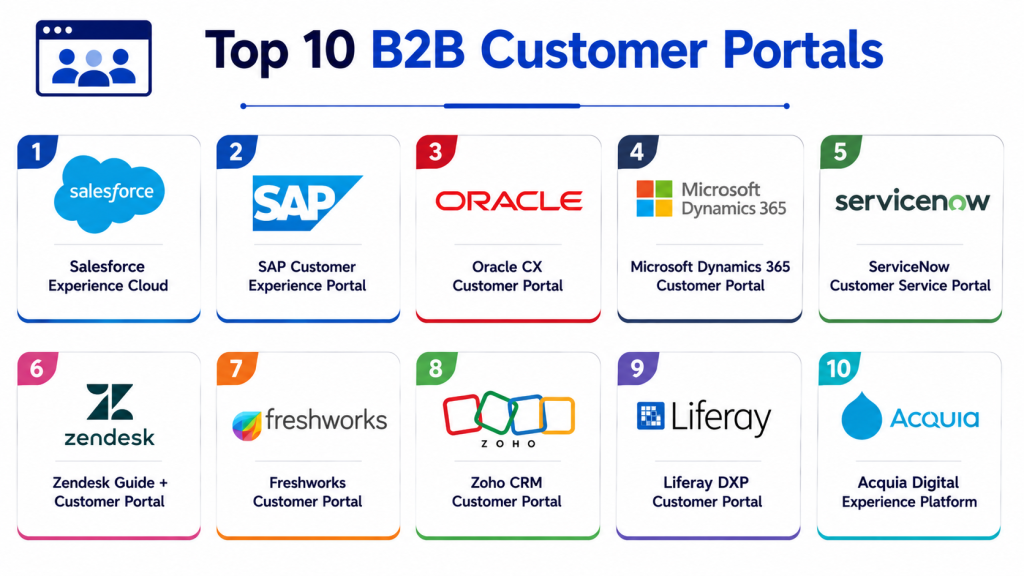
Top 10 B2B Customer Portals
#1 — Salesforce Experience Cloud
Short description: Salesforce Experience Cloud is a leading enterprise customer portal platform that enables companies to build branded B2B portals for customers, partners, and employees. It integrates deeply with Salesforce CRM to provide real-time customer data and seamless service experiences.
Key Features
- Custom B2B portal builder
- CRM-native data integration
- Self-service dashboards
- Case and ticket management
- Partner relationship management
- Workflow automation
- AI-powered recommendations
Pros
- Deep Salesforce ecosystem integration
- Highly customizable UI/UX
- Strong scalability for enterprises
- Excellent automation capabilities
Cons
- High cost of ownership
- Requires Salesforce expertise
- Complex implementation
- Performance tuning required at scale
Platforms / Deployment
- Web
- Cloud
Security & Compliance
- SSO
- MFA
- RBAC
- Encryption
- Audit logs
Integrations & Ecosystem
- Salesforce CRM
- ERP systems
- Marketing tools
- Billing platforms
- APIs
Support & Community
Strong global enterprise support ecosystem.
#2 — Microsoft Power Pages (Power Platform Portals)
Short description: Microsoft Power Pages is a low-code platform for building secure B2B portals integrated with Microsoft Dynamics and Azure ecosystems. It is widely used for enterprise self-service applications.
Key Features
- Low-code portal builder
- Dynamics 365 integration
- Role-based access control
- Form and workflow automation
- Customer self-service portals
- Data-driven dashboards
- Azure security integration
Pros
- Easy low-code development
- Strong Microsoft ecosystem integration
- Secure enterprise architecture
- Fast deployment
Cons
- Limited customization vs full-code systems
- Licensing complexity
- Requires Microsoft ecosystem dependency
- UI flexibility constraints
Platforms / Deployment
- Web
- Cloud
Security & Compliance
- Azure AD SSO
- MFA
- RBAC
- Encryption
- Compliance controls
Integrations & Ecosystem
- Microsoft Dynamics 365
- Azure services
- Power BI
- ERP systems
- APIs
Support & Community
Strong enterprise Microsoft support ecosystem.
#3 — SAP Customer Experience Portals (SAP CX)
Short description: SAP CX provides enterprise-grade B2B customer portals integrated with SAP ERP, enabling order management, billing visibility, and customer service automation.
Key Features
- Order management portals
- Customer self-service dashboards
- Billing and invoice tracking
- ERP integration
- Support ticketing system
- AI-driven personalization
- Commerce workflows
Pros
- Strong SAP ERP integration
- Enterprise-grade scalability
- Reliable data consistency
- Strong compliance support
Cons
- Complex deployment
- High cost structure
- Requires SAP expertise
- Less flexible UI customization
Platforms / Deployment
- Web
- Cloud / Hybrid
Security & Compliance
- SSO
- MFA
- RBAC
- Encryption
- Audit logs
Integrations & Ecosystem
- SAP S/4HANA
- SAP Commerce Cloud
- ERP systems
- CRM tools
- APIs
Support & Community
Strong enterprise SAP ecosystem support.
#4 — ServiceNow Customer Service Management Portal
Short description: ServiceNow provides a powerful B2B service portal focused on case management, IT service workflows, and enterprise customer support automation.
Key Features
- Customer service portals
- Case and incident tracking
- Workflow automation
- SLA management
- Knowledge base self-service
- AI chatbot support
- Reporting dashboards
Pros
- Strong workflow automation
- Excellent service management capabilities
- Scalable enterprise architecture
- Fast issue resolution workflows
Cons
- Limited commerce capabilities
- Complex configuration
- High enterprise pricing
- Requires ServiceNow expertise
Platforms / Deployment
- Web
- Cloud
Security & Compliance
- SSO
- MFA
- RBAC
- Encryption
- Audit logs
Integrations & Ecosystem
- ERP systems
- CRM tools
- ITSM systems
- APIs
- Data platforms
Support & Community
Strong enterprise IT service ecosystem.
#5 — Zendesk Guide + Customer Portal
Short description: Zendesk provides a lightweight but powerful customer portal solution focused on support ticketing, knowledge base access, and self-service automation.
Key Features
- Customer support portals
- Ticket tracking system
- Knowledge base integration
- AI chatbot support
- SLA tracking
- Workflow automation
- Customer insights dashboards
Pros
- Easy to deploy
- Strong customer support focus
- User-friendly interface
- Fast onboarding
Cons
- Limited enterprise customization
- Not full B2B commerce portal
- Scaling limitations for complex workflows
- Requires add-ons for advanced features
Platforms / Deployment
- Web
- Cloud
Security & Compliance
- SSO
- MFA
- Encryption
- RBAC
Integrations & Ecosystem
- CRM systems
- ERP tools
- Messaging platforms
- APIs
- Analytics tools
Support & Community
Strong global SMB and mid-market adoption.
#6 — Liferay Digital Experience Platform
Short description: Liferay is a flexible enterprise portal platform used to build highly customized B2B customer portals, intranets, and digital experience solutions.
Key Features
- Fully customizable portal builder
- Role-based content delivery
- Workflow automation
- Document management
- API-driven architecture
- Multi-site support
- Analytics dashboards
Pros
- Highly flexible architecture
- Strong customization capability
- Good enterprise scalability
- Open-source foundation options
Cons
- Requires technical expertise
- Complex setup and maintenance
- UI development effort needed
- Slower time-to-value
Platforms / Deployment
- Web
- Cloud / On-prem
Security & Compliance
- SSO
- MFA
- RBAC
- Encryption
- Audit logs
Integrations & Ecosystem
- ERP systems
- CRM platforms
- Identity providers
- APIs
- Data systems
Support & Community
Strong developer and enterprise support ecosystem.
#7 — Oracle Customer Portal (Oracle CX)
Short description: Oracle CX Customer Portal provides enterprise-grade customer engagement and self-service capabilities tightly integrated with Oracle Cloud applications.
Key Features
- Customer self-service dashboards
- Order and billing visibility
- Case management system
- AI-driven personalization
- ERP integration
- Workflow automation
- Analytics dashboards
Pros
- Strong Oracle ecosystem integration
- Enterprise scalability
- Robust data management
- Good AI capabilities
Cons
- Complex implementation
- High cost structure
- Oracle dependency
- Requires technical expertise
Platforms / Deployment
- Web
- Cloud
Security & Compliance
- SSO
- MFA
- RBAC
- Encryption
- Audit logs
Integrations & Ecosystem
- Oracle ERP Cloud
- CRM systems
- Finance tools
- Data warehouses
- APIs
Support & Community
Strong enterprise Oracle support.
#8 — Zoho Creator Portals
Short description: Zoho Creator enables businesses to build custom B2B customer portals with low-code tools, making it ideal for SMBs and mid-market companies.
Key Features
- Low-code portal builder
- Workflow automation
- Customer self-service apps
- Role-based access control
- Data dashboards
- Form-based interactions
- API integrations
Pros
- Easy to use low-code platform
- Affordable pricing
- Fast deployment
- Flexible customization
Cons
- Limited enterprise scalability
- Not suitable for complex systems
- Smaller ecosystem
- Performance limits at scale
Platforms / Deployment
- Web
- Cloud
Security & Compliance
- SSO
- MFA
- Encryption
- RBAC
Integrations & Ecosystem
- Zoho suite apps
- CRM systems
- ERP tools
- APIs
- Payment systems
Support & Community
Strong SMB-focused support ecosystem.
#9 — Freshdesk Customer Portal
Short description: Freshdesk provides a simple and effective B2B customer portal focused on support ticketing, self-service knowledge bases, and customer communication.
Key Features
- Ticket management portal
- Knowledge base system
- Customer self-service UI
- SLA tracking
- Automation workflows
- AI chatbot support
- Reporting dashboards
Pros
- Easy to set up
- Strong support workflows
- Affordable pricing
- User-friendly design
Cons
- Limited enterprise depth
- Not full B2B commerce portal
- Requires extensions for advanced use
- Limited customization
Platforms / Deployment
- Web
- Cloud
Security & Compliance
- SSO
- MFA
- Encryption
- RBAC
Integrations & Ecosystem
- CRM tools
- Messaging platforms
- ERP systems
- APIs
- Analytics tools
Support & Community
Strong mid-market customer support ecosystem.
#10 — IBM Digital Experience Manager
Short description: IBM Digital Experience Manager provides enterprise-grade B2B portals with strong personalization, content management, and integration capabilities.
Key Features
- Enterprise portal builder
- Content personalization engine
- Workflow automation
- Customer dashboards
- AI-driven insights
- Multi-channel experience delivery
- Analytics and reporting
Pros
- Strong enterprise scalability
- Powerful personalization engine
- Good security framework
- Robust integration capabilities
Cons
- Complex deployment
- High cost
- Requires IBM expertise
- Longer implementation cycles
Platforms / Deployment
- Web
- Cloud / On-prem
Security & Compliance
- SSO
- MFA
- RBAC
- Encryption
- Audit logs
Integrations & Ecosystem
- IBM Cloud
- ERP systems
- CRM platforms
- Data systems
- APIs
Support & Community
Strong enterprise IBM support ecosystem.
Comparison Table
| Tool Name | Best For | Platform(s) Supported | Deployment | Standout Feature | Public Rating |
|---|---|---|---|---|---|
| Salesforce Experience Cloud | CRM-based portals | Web | Cloud | CRM-native portal data | N/A |
| Microsoft Power Pages | Low-code portals | Web | Cloud | Azure integration | N/A |
| SAP CX | Enterprise commerce | Web | Cloud/Hybrid | ERP integration | N/A |
| ServiceNow | Support portals | Web | Cloud | Workflow automation | N/A |
| Zendesk | Support teams | Web | Cloud | Ticketing portal | N/A |
| Liferay | Custom portals | Web | Cloud/On-prem | Full customization | N/A |
| Oracle CX | ERP enterprises | Web | Cloud | Oracle ecosystem integration | N/A |
| Zoho Creator | SMB portals | Web | Cloud | Low-code builder | N/A |
| Freshdesk | Support SMBs | Web | Cloud | Easy support portal | N/A |
| IBM Digital Experience | Large enterprises | Web | Cloud/On-prem | Personalization engine | N/A |
Evaluation & Scoring of B2B Customer Portals
| Tool Name | Core (25%) | Ease (15%) | Integrations (15%) | Security (10%) | Performance (10%) | Support (10%) | Value (15%) | Weighted Total |
|---|---|---|---|---|---|---|---|---|
| Salesforce | 10 | 7 | 10 | 10 | 9 | 9 | 7 | 8.6 |
| Microsoft | 9 | 9 | 10 | 10 | 9 | 9 | 8 | 8.9 |
| SAP CX | 10 | 7 | 10 | 10 | 10 | 9 | 7 | 8.7 |
| ServiceNow | 9 | 8 | 9 | 10 | 9 | 9 | 8 | 8.6 |
| Zendesk | 8 | 9 | 8 | 9 | 8 | 9 | 8 | 8.3 |
| Liferay | 9 | 7 | 9 | 9 | 9 | 8 | 8 | 8.3 |
| Oracle CX | 9 | 7 | 10 | 10 | 9 | 9 | 7 | 8.6 |
| Zoho | 7 | 9 | 8 | 8 | 8 | 8 | 9 | 8.1 |
| Freshdesk | 7 | 9 | 8 | 8 | 8 | 8 | 9 | 8.0 |
| IBM | 9 | 7 | 9 | 10 | 9 | 9 | 7 | 8.4 |
Which B2B Customer Portal Is Right for You?
Enterprise Organizations
Best choices:
- Salesforce Experience Cloud
- SAP CX
- Oracle CX
Focus: scalability, integration, and global operations.
Mid-Market Companies
Best choices:
- Microsoft Power Pages
- Liferay
- ServiceNow
Focus: flexibility, automation, and integration balance.
SMBs
Best choices:
- Zoho Creator
- Freshdesk
- Zendesk
Focus: simplicity and fast deployment.
Support-Driven Businesses
Best choices:
- Zendesk
- Freshdesk
- ServiceNow
Focus: ticketing, SLA tracking, and self-service support.
Custom Portal Requirements
Best choices:
- Liferay
- IBM Digital Experience
- Microsoft Power Pages
Focus: customization and complex workflows.
Budget vs Premium
- Budget: Zoho, Freshdesk, Zendesk
- Premium: Salesforce, SAP, Oracle, IBM
Integration & Scalability
Best ecosystems:
- Salesforce ecosystem
- Microsoft Azure ecosystem
- SAP & Oracle enterprise ecosystems
Security & Compliance Needs
All enterprise portals must include:
- SSO
- MFA
- RBAC
- Encryption
- Audit logs
Frequently Asked Questions
1- What is a B2B customer portal?
It is a digital platform where business customers can manage orders, accounts, invoices, and support requests.
2- Why are B2B portals important?
They improve customer experience and reduce manual support workload.
3- Who uses B2B portals?
Manufacturers, SaaS companies, distributors, and service providers.
4- Do these portals support automation?
Yes, they automate workflows like orders, approvals, and support tickets.
5- Are they cloud-based?
Most modern portals are cloud-native.
6- Can they integrate with ERP systems?
Yes, ERP integration is a core requirement.
7- Do they support AI?
Many platforms use AI for personalization and support automation.
8- What is self-service in portals?
It allows customers to perform tasks without contacting support teams.
9- Are these portals secure?
Yes, enterprise portals use encryption, MFA, and RBAC.
10- What is the biggest challenge?
Integration complexity and data synchronization across systems.
Conclusion
B2B Customer Portals are essential for modern enterprises that want to deliver seamless, self-service digital experiences to business customers. These platforms reduce operational costs, improve transparency, and enhance customer satisfaction by centralizing orders, billing, support, and account management into a unified interface. While Salesforce, SAP, and Oracle lead enterprise deployments, Microsoft, ServiceNow, and Liferay provide flexible alternatives, and tools like Zoho and Freshdesk serve SMB needs. The right platform depends on business complexity, integration needs, and scalability requirements. A phased rollout with pilot testing ensures successful adoption and long-term value.

B2B customer portals often succeed or fail based on how seamlessly they integrate with backend systems like ERP, CRM, and order management platforms. Even well-designed interfaces can lose effectiveness if data synchronization is delayed or inconsistent across systems. Discussing integration reliability, role-based access design, and self-service adoption barriers would add practical depth to understanding how these portals perform in real enterprise environments.
Customer portal adoption is often driven less by the number of available features and more by how reliably users can complete everyday tasks without external support. Delays caused by inconsistent account permissions, outdated customer data, or disconnected backend systems can quickly reduce user confidence. Discussing identity governance, API resilience, and user behavior analytics would add valuable insight into building portals that remain effective as customer bases and transaction volumes grow.
As B2B organizations expand globally, customer portals must accommodate diverse business practices, languages, currencies, and regulatory requirements without increasing administrative complexity. A discussion on localization strategies, regional compliance support, and scalable multi-tenant architecture would provide valuable insight for companies planning to serve international customers through a unified portal experience.