Introduction
Multi-touch Attribution Tools help marketing teams understand how different customer touchpoints contribute to conversions, sales, and revenue. Instead of giving full credit to a single interaction, these platforms distribute value across multiple channels such as paid ads, email campaigns, social media, organic search, webinars, and direct visits. This gives organizations a more realistic view of the customer journey and helps improve marketing investment decisions.
Modern businesses rely heavily on these tools to optimize campaign performance, improve customer acquisition efficiency, align sales and marketing reporting, evaluate channel ROI, and identify high-performing touchpoints across complex buying journeys. Buyers evaluating Multi-touch Attribution Tools should focus on attribution modeling flexibility, AI-driven insights, reporting depth, integrations with CRM and analytics platforms, scalability, data accuracy, visualization capabilities, privacy compliance, automation, and ease of implementation.
Best for: Marketing teams, demand generation specialists, performance marketers, B2B SaaS companies, e-commerce businesses, and enterprise organizations running multi-channel campaigns.
Not ideal for: Small businesses using only one or two marketing channels or organizations with minimal customer journey complexity.
Key Trends in Multi-touch Attribution Tools
- AI-assisted attribution modeling improves accuracy and forecasting
- Increased use of first-party data due to privacy restrictions
- Cookieless attribution strategies are becoming more important
- Cross-device and cross-channel tracking capabilities continue to improve
- Real-time dashboards and visualization tools are now standard
- Integration with CRM, CDP, and revenue intelligence platforms is expanding
- Predictive attribution models are replacing rule-based systems
- Marketing and sales attribution are becoming more unified
- Automation reduces manual reporting and campaign analysis
- Cloud-native deployment improves scalability and performance
How We Selected These Tools
- Evaluated market adoption across SMB, mid-market, and enterprise organizations
- Assessed attribution model flexibility and reporting capabilities
- Reviewed AI and predictive analytics functionality
- Analyzed integrations with CRM, analytics, and advertising platforms
- Considered scalability for high-volume customer journeys
- Evaluated usability for marketing and analytics teams
- Reviewed security, privacy, and compliance readiness
- Assessed dashboard quality and visualization depth
- Considered implementation complexity and onboarding experience
- Evaluated overall value and ecosystem maturity
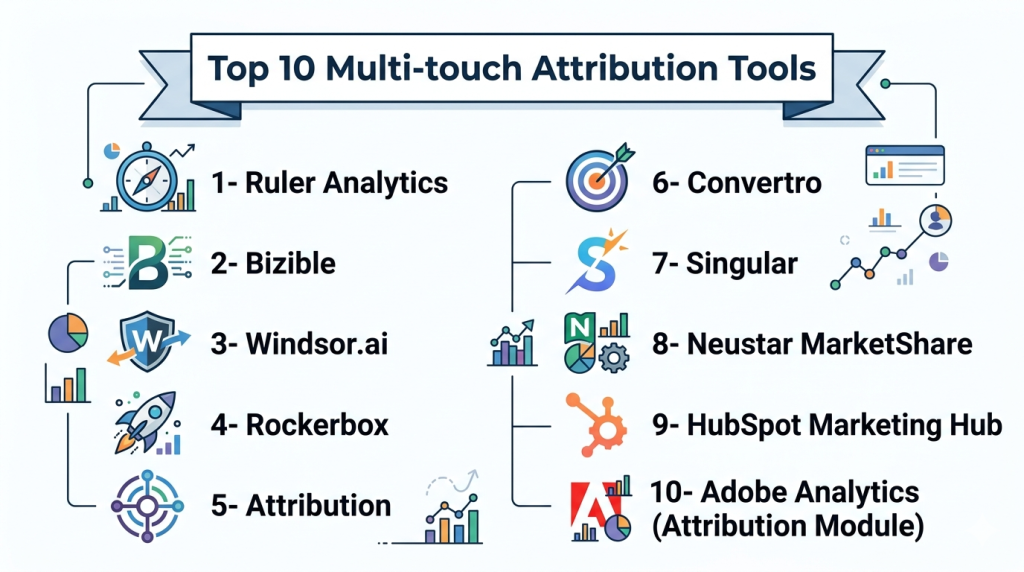
Top 10 Multi-touch Attribution Tools
1 — HubSpot Marketing Attribution
Short description: HubSpot Marketing Attribution helps businesses understand how marketing touchpoints contribute to leads and revenue. It is ideal for SMBs and growing companies that want integrated attribution inside a broader CRM and marketing platform.
Key Features
- Multi-touch revenue attribution
- Built-in CRM integration
- Contact journey tracking
- Campaign performance dashboards
- Custom attribution reporting
- Funnel analysis
- Marketing automation integration
Pros
- Easy to use for marketing teams
- Unified CRM and attribution reporting
- Strong automation ecosystem
Cons
- Advanced attribution options are limited compared to enterprise tools
- Premium plans can become expensive
- Complex enterprise customization may require technical support
Platforms / Deployment
- Web
- Cloud
Security & Compliance
- SSO, MFA
- GDPR support
Integrations & Ecosystem
HubSpot integrates with advertising, CRM, analytics, and sales tools to centralize marketing insights.
- Salesforce
- Google Ads
- LinkedIn Ads
- Slack
- Shopify
Support & Community
Strong onboarding resources, extensive documentation, and large community ecosystem.
2 — Dreamdata
Short description: Dreamdata focuses on B2B revenue attribution and customer journey analysis. It is designed for SaaS and enterprise companies managing long sales cycles and multiple touchpoints.
Key Features
- B2B revenue attribution
- Customer journey mapping
- AI-driven revenue insights
- CRM and ad platform integration
- Funnel analytics
- Account-based attribution
- Revenue forecasting
Pros
- Excellent for B2B SaaS organizations
- Strong revenue-focused analytics
- Detailed account journey visibility
Cons
- Less suitable for small businesses
- Requires data setup and integration planning
- Pricing may be high for smaller teams
Platforms / Deployment
- Web
- Cloud
Security & Compliance
Not publicly stated
Integrations & Ecosystem
Integrates deeply with CRM and marketing automation ecosystems.
- Salesforce
- HubSpot
- Google Analytics
- LinkedIn Ads
- Snowflake
Support & Community
Offers onboarding assistance and enterprise support options.
3 — Adobe Marketo Measure
Short description: Adobe Marketo Measure delivers enterprise-grade attribution and ROI reporting for organizations running sophisticated multi-channel marketing programs.
Key Features
- Multi-touch attribution models
- Revenue and pipeline tracking
- AI-powered insights
- Account-based marketing attribution
- Advanced reporting dashboards
- CRM integration
- Predictive analytics
Pros
- Enterprise-ready attribution capabilities
- Strong analytics and visualization
- Deep Adobe ecosystem integration
Cons
- High implementation complexity
- Expensive for SMBs
- Learning curve for non-technical teams
Platforms / Deployment
- Web
- Cloud
Security & Compliance
- SSO
- GDPR support
Integrations & Ecosystem
Works with CRM, analytics, and enterprise marketing systems.
- Salesforce
- Adobe Experience Cloud
- Microsoft Dynamics
- Marketo Engage
Support & Community
Enterprise-grade support and documentation with strong partner ecosystem.
4 — AppsFlyer
Short description: AppsFlyer specializes in mobile attribution and marketing measurement, helping businesses track app installs, user engagement, and campaign ROI.
Key Features
- Mobile attribution tracking
- Cross-device analytics
- Fraud prevention
- Real-time campaign dashboards
- AI-powered optimization
- Deep linking support
- Cohort analysis
Pros
- Strong mobile marketing capabilities
- Real-time analytics and reporting
- Effective fraud detection tools
Cons
- Less focused on traditional B2B attribution
- Enterprise features may increase costs
- Advanced setup requires expertise
Platforms / Deployment
- Web, iOS, Android
- Cloud
Security & Compliance
- GDPR support
- Encrypted data handling
Integrations & Ecosystem
Supports integrations with advertising and analytics ecosystems.
- Google Ads
- Meta Ads
- TikTok Ads
- Salesforce
- Firebase
Support & Community
Large mobile marketing community with strong technical documentation.
5 — Attribution
Short description: Attribution is a marketing attribution platform focused on tracking customer journeys across paid, organic, and direct channels.
Key Features
- Multi-touch attribution
- Conversion path analysis
- ROI dashboards
- Marketing channel reporting
- AI-assisted optimization
- Campaign performance tracking
- Revenue analytics
Pros
- Strong cross-channel visibility
- User-friendly reporting dashboards
- Good SMB and mid-market fit
Cons
- Enterprise customization is limited
- Advanced analytics may require technical expertise
- Some integrations need manual setup
Platforms / Deployment
- Web
- Cloud
Security & Compliance
Not publicly stated
Integrations & Ecosystem
Integrates with analytics, advertising, and CRM systems.
- HubSpot
- Salesforce
- Google Analytics
- Facebook Ads
- Shopify
Support & Community
Responsive support and onboarding assistance for growing businesses.
6 — Rockerbox
Short description: Rockerbox provides marketing attribution and measurement tools designed for e-commerce and performance marketing teams.
Key Features
- Unified marketing attribution
- Customer journey tracking
- Multi-channel reporting
- Real-time dashboards
- AI-driven insights
- Data normalization
- Budget optimization
Pros
- Strong e-commerce attribution features
- Easy visualization tools
- Cross-channel performance tracking
Cons
- Primarily focused on marketing attribution
- Enterprise customization may require support
- Advanced reporting setup can take time
Platforms / Deployment
- Web
- Cloud
Security & Compliance
Not publicly stated
Integrations & Ecosystem
Supports integration with advertising and analytics platforms.
- Shopify
- Meta Ads
- Google Ads
- Klaviyo
- TikTok Ads
Support & Community
Good onboarding support with growing ecosystem resources.
7 — Triple Whale
Short description: Triple Whale is an e-commerce attribution platform focused on helping brands measure customer acquisition and marketing performance.
Key Features
- E-commerce attribution dashboards
- Marketing spend tracking
- AI-powered insights
- Revenue and profit analytics
- Cross-channel reporting
- Real-time performance monitoring
- Creative performance analysis
Pros
- Excellent for Shopify brands
- User-friendly dashboards
- Strong profit-focused analytics
Cons
- Limited enterprise B2B capabilities
- Best suited for e-commerce environments
- Advanced customization is limited
Platforms / Deployment
- Web
- Cloud
Security & Compliance
Not publicly stated
Integrations & Ecosystem
Integrates with e-commerce and advertising ecosystems.
- Shopify
- Meta Ads
- Google Ads
- TikTok Ads
- Klaviyo
Support & Community
Strong e-commerce user community and onboarding resources.
8 — Wicked Reports
Short description: Wicked Reports focuses on revenue attribution for SMBs and direct-to-consumer brands looking to measure long-term campaign impact.
Key Features
- Revenue attribution tracking
- Customer lifetime value reporting
- Marketing ROI dashboards
- Email attribution analysis
- Funnel reporting
- Paid advertising tracking
- AI-assisted insights
Pros
- Strong ROI and LTV analysis
- Good SMB fit
- Useful for direct-response marketing
Cons
- Dashboard complexity for beginners
- Limited enterprise scalability
- Reporting customization may require setup
Platforms / Deployment
- Web
- Cloud
Security & Compliance
Not publicly stated
Integrations & Ecosystem
Supports CRM and advertising integrations.
- Shopify
- Klaviyo
- Facebook Ads
- Google Ads
- HubSpot
Support & Community
Provides onboarding support and marketing-focused training resources.
9 — Northbeam
Short description: Northbeam provides attribution and marketing intelligence tools for e-commerce brands managing multi-channel campaigns.
Key Features
- Multi-touch attribution
- Marketing performance dashboards
- Predictive analytics
- Creative analysis
- Budget optimization
- Real-time campaign tracking
- Customer journey reporting
Pros
- Strong e-commerce focus
- Real-time reporting capabilities
- AI-enhanced optimization
Cons
- Less suitable for B2B organizations
- Advanced features may increase costs
- Smaller ecosystem compared to large enterprise vendors
Platforms / Deployment
- Web
- Cloud
Security & Compliance
Not publicly stated
Integrations & Ecosystem
Integrates with major advertising and e-commerce systems.
- Shopify
- Meta Ads
- TikTok Ads
- Google Ads
- Klaviyo
Support & Community
Growing ecosystem with responsive support resources.
10 — Google Analytics Attribution
Short description: Google Analytics Attribution provides attribution modeling and customer journey reporting inside the Google Analytics ecosystem.
Key Features
- Attribution model comparison
- Conversion path reporting
- Cross-channel analytics
- AI-powered insights
- Customer journey analysis
- Advertising performance tracking
- Real-time dashboards
Pros
- Widely adopted analytics platform
- Strong integration with Google ecosystem
- Cost-effective for many organizations
Cons
- Advanced attribution customization is limited
- Enterprise-level reporting may require additional tools
- Privacy changes can impact tracking depth
Platforms / Deployment
- Web
- Cloud
Security & Compliance
- GDPR support
- Access control features
Integrations & Ecosystem
Deep integration with the Google marketing ecosystem.
- Google Ads
- Search Console
- BigQuery
- Looker Studio
- Firebase
Support & Community
Large community, extensive documentation, and broad training ecosystem.
Comparison Table Top 10
| Tool Name | Best For | Platform Supported | Deployment | Standout Feature | Public Rating |
|---|---|---|---|---|---|
| HubSpot Marketing Attribution | SMBs and growing businesses | Web | Cloud | CRM-integrated attribution | N/A |
| Dreamdata | B2B SaaS organizations | Web | Cloud | Revenue journey analytics | N/A |
| Adobe Marketo Measure | Enterprise marketing teams | Web | Cloud | Enterprise attribution modeling | N/A |
| AppsFlyer | Mobile marketing attribution | Web, iOS, Android | Cloud | Mobile attribution and fraud prevention | N/A |
| Attribution | SMB and mid-market teams | Web | Cloud | Cross-channel conversion tracking | N/A |
| Rockerbox | E-commerce marketing teams | Web | Cloud | Unified marketing measurement | N/A |
| Triple Whale | Shopify brands | Web | Cloud | Profit-focused analytics | N/A |
| Wicked Reports | SMB and DTC brands | Web | Cloud | Revenue and LTV attribution | N/A |
| Northbeam | E-commerce brands | Web | Cloud | Real-time attribution insights | N/A |
| Google Analytics Attribution | General marketing analytics | Web | Cloud | Integrated Google ecosystem analytics | N/A |
Evaluation & Scoring
| Tool Name | Core 25% | Ease 15% | Integrations 15% | Security 10% | Performance 10% | Support 10% | Value 15% | Weighted Total |
|---|---|---|---|---|---|---|---|---|
| HubSpot Marketing Attribution | 8 | 9 | 8 | 7 | 8 | 8 | 8 | 8.10 |
| Dreamdata | 9 | 7 | 8 | 7 | 9 | 7 | 7 | 7.95 |
| Adobe Marketo Measure | 9 | 6 | 9 | 8 | 9 | 8 | 6 | 8.00 |
| AppsFlyer | 8 | 8 | 8 | 7 | 9 | 7 | 7 | 7.90 |
| Attribution | 8 | 8 | 7 | 6 | 8 | 7 | 8 | 7.65 |
| Rockerbox | 8 | 8 | 7 | 6 | 8 | 7 | 7 | 7.50 |
| Triple Whale | 8 | 9 | 7 | 6 | 8 | 7 | 8 | 7.80 |
| Wicked Reports | 7 | 7 | 7 | 6 | 7 | 7 | 8 | 7.10 |
| Northbeam | 8 | 8 | 7 | 6 | 8 | 7 | 7 | 7.50 |
| Google Analytics Attribution | 8 | 8 | 9 | 7 | 8 | 8 | 9 | 8.15 |
Higher weighted totals indicate stronger balance across attribution capabilities, usability, integrations, reliability, support, and value. Enterprise organizations may prioritize advanced modeling and scalability, while SMBs often value ease of use and affordability. Scores are comparative and should be evaluated alongside business-specific requirements. Integration readiness, reporting flexibility, and attribution accuracy are especially important when selecting a long-term platform.
Which Tool Is Right for You
Solo / Freelancer
- Google Analytics Attribution or Attribution for affordable and easy-to-use attribution tracking
SMB
- HubSpot Marketing Attribution or Wicked Reports for integrated reporting and revenue visibility
Mid-Market
- Dreamdata or Rockerbox for advanced customer journey analytics and multi-channel visibility
Enterprise
- Adobe Marketo Measure or Dreamdata for scalable attribution and enterprise analytics capabilities
Budget vs Premium
- Budget-friendly: Google Analytics Attribution, Attribution
- Premium: Adobe Marketo Measure, Dreamdata
Feature Depth vs Ease of Use
- Deep attribution modeling: Adobe Marketo Measure, Dreamdata
- Easier setup and usability: HubSpot Marketing Attribution, Triple Whale
Integrations & Scalability
- Strong enterprise integrations: Adobe Marketo Measure, Dreamdata, HubSpot Marketing Attribution
Security & Compliance Needs
- Enterprise-focused security: Adobe Marketo Measure, HubSpot Marketing Attribution
- SMB-level controls: Attribution, Triple Whale
Frequently Asked Questions
1. What is a multi-touch attribution tool
A multi-touch attribution tool measures how different customer interactions contribute to conversions and revenue. It helps marketers understand the complete customer journey instead of crediting only one touchpoint.
2. Why are multi-touch attribution tools important
These tools help businesses optimize marketing budgets, identify high-performing channels, and improve campaign efficiency by showing which touchpoints drive conversions.
3. Are these tools suitable for small businesses
Yes, many tools offer SMB-friendly plans with simplified dashboards and easier setup. Platforms like HubSpot Marketing Attribution and Google Analytics Attribution are commonly used by smaller teams.
4. Do these platforms support AI-powered analytics
Yes, modern attribution platforms use AI and machine learning to improve predictive modeling, campaign optimization, and customer journey analysis.
5. Can attribution tools integrate with CRM systems
Most tools integrate with CRM platforms such as Salesforce and HubSpot to align marketing and sales reporting in one centralized environment.
6. How difficult is implementation
Implementation complexity varies. SMB tools are generally easier to deploy, while enterprise platforms may require technical teams and consulting support.
7. Are these tools secure for customer data
Most platforms include encryption, access controls, and compliance support for privacy regulations such as GDPR. Enterprise platforms typically provide stronger governance features.
8. Can these tools track offline marketing channels
Some enterprise-grade attribution platforms support offline channels such as TV, events, and direct mail alongside digital marketing activities.
9. What industries benefit most from attribution tools
E-commerce, SaaS, retail, media, and B2B organizations benefit significantly because they often run campaigns across multiple channels and touchpoints.
10. How should businesses choose the right attribution tool
Organizations should evaluate integration support, attribution model flexibility, reporting depth, scalability, pricing, and ease of use before selecting a platform.
Conclusion
Multi-touch Attribution Tools are essential for organizations looking to understand the true impact of their marketing activities across complex customer journeys. SMBs often prioritize affordability and simplicity, while enterprises require advanced attribution modeling, predictive analytics, and deep integration capabilities. AI-powered insights, cross-channel reporting, and revenue-focused analytics are now major differentiators in the market. Businesses should evaluate attribution accuracy, integration readiness, scalability, and reporting flexibility before committing to a platform. The best approach is to shortlist two or three tools, run pilot campaigns, validate data quality, and confirm alignment with marketing and sales workflows before scaling adoption across the organization.
