Introduction
Marketing Attribution Platforms are software solutions that help businesses track, analyze, and assign credit to marketing channels and campaigns that drive conversions, revenue, and customer engagement. They allow marketers to understand the impact of each touchpoint along the customer journey, enabling more informed budget allocation and performance optimization.
These platforms are vital for organizations seeking to maximize marketing ROI, optimize campaigns across multiple channels, and understand the effectiveness of paid, owned, and earned media. By leveraging data-driven insights, businesses can improve targeting, increase revenue, and make better strategic decisions.
Real-world use cases include:
- Determining which marketing channels drive the most conversions
- Measuring ROI of advertising campaigns across multiple platforms
- Optimizing budget allocation based on channel performance
- Identifying gaps and opportunities in customer journeys
- Supporting marketing reporting and executive decision-making
Evaluation criteria for buyers:
- Multi-touch attribution capabilities
- Real-time and historical reporting
- Cross-channel data integration
- AI-driven insights and predictive analytics
- Ease of use and dashboard flexibility
- Integration with CRM, analytics, and marketing platforms
- Security and compliance features
- Scalability for enterprise-level tracking
- Customization of reports and KPIs
- Quality of customer support and training resources
Best for: Marketing managers, growth teams, digital agencies, and enterprises seeking to optimize multi-channel marketing spend and performance.
Not ideal for: Companies with limited digital marketing activity, single-channel campaigns, or those only requiring basic analytics.
Key Trends in Marketing Attribution Platforms
- AI-powered multi-touch and predictive attribution
- Unified reporting across paid, organic, and offline channels
- Integration with CRM, marketing automation, and analytics platforms
- Cross-device and cross-platform attribution tracking
- Automation of insights and recommendations
- Privacy-first tracking to comply with GDPR and other regulations
- Cloud-based deployment with scalable options for large data volumes
- Real-time dashboards with customizable KPIs
- Increasing use of first-party and zero-party data for attribution
- Subscription-based SaaS pricing with tiered feature sets
How We Selected These Tools
- Market adoption and relevance in digital marketing analytics
- Completeness of attribution models and channel coverage
- Reliability, scalability, and performance
- Security and compliance standards
- Integration capabilities with marketing, CRM, and analytics tools
- Customer fit across SMB, mid-market, and enterprise organizations
- Ease of onboarding and user experience
- AI and automation capabilities for actionable insights
- Quality of reporting and dashboard customizations
- Pricing and value for feature set
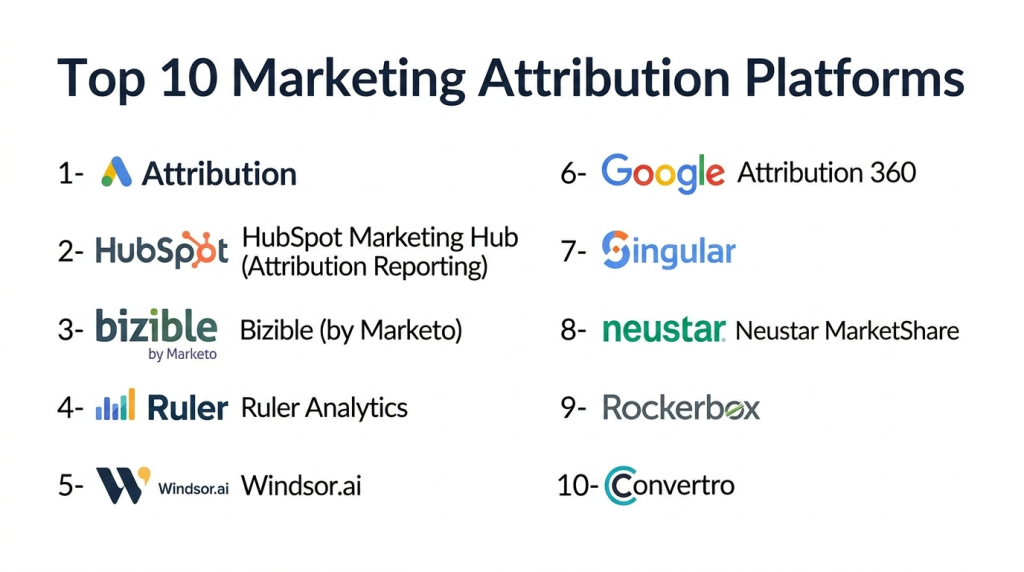
Top 10 Marketing Attribution Platforms
#1 — HubSpot Marketing Hub
Short description: HubSpot Marketing Hub offers marketing attribution insights as part of its integrated CRM and marketing platform, enabling businesses to track multi-channel performance.
Key Features
- Multi-touch attribution reports
- Campaign performance tracking
- AI-powered revenue attribution
- Integration with HubSpot CRM
- Customizable dashboards
- ROI reporting for campaigns
Pros
- Seamless integration with HubSpot ecosystem
- User-friendly dashboards
- Comprehensive reporting for SMBs and enterprises
Cons
- Advanced features require higher-tier plans
- Less flexibility for complex enterprise workflows
- Multi-channel tracking outside HubSpot may be limited
Platforms / Deployment
- Web / iOS / Android
- Cloud
Security & Compliance
- SOC 2
- GDPR compliance
- SSO/SAML support
Integrations & Ecosystem
Integrates with marketing, CRM, and analytics platforms:
- Salesforce
- Google Ads
- LinkedIn Ads
- Zapier
Support & Community
- Knowledge base
- Webinars and tutorials
- Community forums
#2 — Google Analytics 360
Short description: Google Analytics 360 provides enterprise-grade attribution modeling and marketing analytics, tracking the customer journey across channels and devices.
Key Features
- Multi-channel funnel analysis
- Custom attribution models
- Cross-device tracking
- Real-time analytics
- AI-driven insights
Pros
- Robust data analytics capabilities
- Deep integration with Google marketing products
- Flexible attribution modeling
Cons
- Complexity may require analytics expertise
- Premium pricing for enterprise edition
- Learning curve for advanced features
Platforms / Deployment
- Web
- Cloud
Security & Compliance
- GDPR compliant
- SOC 2
- Encryption at rest and in transit
Integrations & Ecosystem
- Google Ads
- BigQuery
- Data Studio
- CRM platforms via connectors
Support & Community
- Email and chat support
- Extensive documentation
- Active user community
#3 — Bizible
Short description: Bizible specializes in B2B marketing attribution, integrating deeply with CRMs to track campaign impact and revenue performance.
Key Features
- Multi-touch attribution modeling
- Pipeline and revenue reporting
- CRM integration for Salesforce
- Campaign tagging and tracking
- ROI analysis dashboards
Pros
- Strong B2B-focused features
- Accurate revenue attribution
- Integration with Salesforce
Cons
- Premium pricing
- Requires CRM adoption
- Learning curve for new users
Platforms / Deployment
- Web
- Cloud
Security & Compliance
- SOC 2
- GDPR compliance
Integrations & Ecosystem
- Salesforce
- Marketo
- HubSpot
- LinkedIn Ads
Support & Community
- Customer success managers
- Webinars
- Knowledge base
#4 — Attribution
Short description: Attribution provides cross-channel marketing attribution and reporting, helping marketers understand the ROI of campaigns in real-time.
Key Features
- Multi-touch attribution models
- Campaign performance dashboards
- Revenue and ROI tracking
- AI insights for optimization
- Integration with ad platforms
Pros
- Real-time insights
- Easy-to-use dashboards
- Cross-channel coverage
Cons
- Limited customization in some dashboards
- Learning curve for advanced analytics
- Pricing may be high for SMBs
Platforms / Deployment
- Web
- Cloud
Security & Compliance
- SOC 2
- GDPR compliance
Integrations & Ecosystem
- Salesforce
- Google Ads
- Facebook Ads
- HubSpot
Support & Community
- Email support
- Knowledge base
- Online tutorials
#5 — LeanData
Short description: LeanData focuses on B2B attribution with lead-to-revenue tracking, connecting marketing performance to pipeline and revenue metrics.
Key Features
- Multi-touch attribution
- Lead routing and matching
- Pipeline and revenue analytics
- Dashboard customization
- Integration with Salesforce
Pros
- Accurate B2B revenue tracking
- Seamless Salesforce integration
- Pipeline visualization
Cons
- Premium pricing
- Complex for small teams
- Advanced reporting requires training
Platforms / Deployment
- Web
- Cloud
Security & Compliance
- SOC 2
- GDPR compliance
Integrations & Ecosystem
- Salesforce
- HubSpot
- Marketo
Support & Community
- Customer success managers
- Webinars and tutorials
- Community forums
#6 — Rockerbox
Short description: Rockerbox provides unified marketing attribution for multi-channel campaigns, giving a clear view of marketing performance and ROI.
Key Features
- Multi-channel attribution
- ROI dashboards
- Cross-device tracking
- Campaign optimization insights
- Integration with ad platforms
Pros
- Real-time reporting
- AI-driven insights
- Strong cross-channel tracking
Cons
- Higher pricing for SMBs
- Less flexibility outside main integrations
- Some dashboards require setup
Platforms / Deployment
- Web
- Cloud
Security & Compliance
- SOC 2
- GDPR
Integrations & Ecosystem
- Google Ads
- Facebook Ads
- Salesforce
- HubSpot
Support & Community
- Email support
- Knowledge base
- Tutorials
#7 — Singular
Short description: Singular specializes in mobile marketing attribution, allowing marketers to track app campaigns and ROI across channels.
Key Features
- Mobile attribution and analytics
- ROI tracking
- Fraud detection
- Cross-channel campaign insights
- Dashboard and reporting
Pros
- Strong mobile campaign analytics
- Fraud prevention tools
- Real-time dashboards
Cons
- Focused on mobile campaigns
- Premium pricing
- Limited desktop attribution
Platforms / Deployment
- Web
- Cloud
Security & Compliance
- SOC 2
- GDPR
Integrations & Ecosystem
- Google Ads
- Facebook Ads
- AppsFlyer
- Branch
Support & Community
- Email support
- Knowledge base
- Online tutorials
#8 — Wicked Reports
Short description: Wicked Reports provides revenue-focused marketing attribution, connecting campaigns to sales and conversions for e-commerce and SaaS companies.
Key Features
- Multi-touch attribution
- Revenue and conversion tracking
- ROI dashboards
- Campaign tagging and analysis
- Integration with e-commerce platforms
Pros
- Revenue-centric reporting
- Clear ROI metrics
- Suitable for e-commerce/SaaS
Cons
- Premium pricing
- Limited offline attribution
- Setup may require guidance
Platforms / Deployment
- Web
- Cloud
Security & Compliance
- SOC 2
- GDPR
Integrations & Ecosystem
- Shopify
- Salesforce
- Google Ads
- Facebook Ads
Support & Community
- Customer success managers
- Knowledge base
- Webinars
#9 — Ruler Analytics
Short description: Ruler Analytics connects marketing leads to conversions, enabling attribution reporting across multiple digital marketing channels.
Key Features
- Multi-touch attribution
- Lead-to-sale tracking
- Revenue dashboards
- Campaign reporting
- CRM integration
Pros
- Easy lead tracking
- Flexible attribution reports
- Affordable for SMBs
Cons
- Limited global coverage
- Dashboard customization is basic
- Some integrations limited to CRM
Platforms / Deployment
- Web
- Cloud
Security & Compliance
- GDPR compliant
- Not publicly stated
Integrations & Ecosystem
- Salesforce
- HubSpot
- WordPress
- Google Ads
Support & Community
- Email support
- Tutorials
- Knowledge base
#10 — Conversion Logic
Short description: Conversion Logic provides multi-channel attribution and reporting, helping marketers measure campaign effectiveness and optimize spend.
Key Features
- Multi-touch attribution
- Revenue and ROI dashboards
- Real-time campaign tracking
- CRM integrations
- Automated reporting
Pros
- Clear ROI visualization
- Supports complex campaigns
- Customizable dashboards
Cons
- Premium pricing
- Setup requires expertise
- Limited integrations outside main platforms
Platforms / Deployment
- Web
- Cloud
Security & Compliance
- Not publicly stated
Integrations & Ecosystem
- Salesforce
- HubSpot
- Google Ads
- Facebook Ads
Support & Community
- Email support
- Knowledge base
- Tutorials
Comparison Table (Top 10)
| Tool Name | Best For | Platform(s) Supported | Deployment | Standout Feature | Public Rating |
|---|---|---|---|---|---|
| HubSpot Marketing Hub | SMBs / Enterprises | Web / iOS / Android | Cloud | Multi-touch attribution integrated with CRM | N/A |
| Google Analytics 360 | Enterprises / Agencies | Web | Cloud | Custom attribution models | N/A |
| Bizible | B2B / Salesforce users | Web | Cloud | Lead-to-revenue tracking | N/A |
| Attribution | Multi-channel marketers | Web | Cloud | Real-time multi-touch attribution | N/A |
| LeanData | B2B / Pipeline-focused | Web | Cloud | Lead matching & pipeline attribution | N/A |
| Rockerbox | Multi-channel campaigns | Web | Cloud | Cross-device attribution & ROI | N/A |
| Singular | Mobile marketers | Web | Cloud | Mobile campaign attribution & fraud detection | N/A |
| Wicked Reports | E-commerce / SaaS | Web | Cloud | Revenue-centric attribution | N/A |
| Ruler Analytics | SMBs / Marketing teams | Web | Cloud | Lead-to-sale tracking | N/A |
| Conversion Logic | Multi-channel marketers | Web | Cloud | ROI dashboards & reporting | N/A |
Evaluation & Scoring of Marketing Attribution Platforms
| Tool Name | Core (25%) | Ease (15%) | Integrations (15%) | Security (10%) | Performance (10%) | Support (10%) | Value (15%) | Weighted Total (0–10) |
|---|---|---|---|---|---|---|---|---|
| HubSpot Marketing Hub | 9 | 8 | 8 | 9 | 9 | 8 | 8 | 8.5 |
| Google Analytics 360 | 9 | 6 | 9 | 9 | 9 | 7 | 7 | 8.0 |
| Bizible | 9 | 7 | 8 | 8 | 8 | 7 | 7 | 7.9 |
| Attribution | 8 | 8 | 7 | 8 | 8 | 7 | 7 | 7.7 |
| LeanData | 9 | 6 | 8 | 8 | 8 | 7 | 6 | 7.6 |
| Rockerbox | 8 | 7 | 7 | 8 | 8 | 7 | 7 | 7.5 |
| Singular | 8 | 7 | 7 | 8 | 8 | 7 | 6 | 7.3 |
| Wicked Reports | 8 | 7 | 7 | 8 | 8 | 7 | 7 | 7.5 |
| Ruler Analytics | 7 | 8 | 6 | 7 | 7 | 7 | 8 | 7.2 |
| Conversion Logic | 8 | 7 | 7 | 7 | 8 | 7 | 7 | 7.4 |
Scores reflect comparative suitability based on features, ease of use, integrations, security, performance, support, and value.
Which Marketing Attribution Platform Is Right for You?
Solo / Freelancer
- Ruler Analytics, Attribution, and HubSpot Starter plans are easy to use and cost-effective for individual marketers.
SMB
- HubSpot, Ruler Analytics, Wicked Reports, and Conversion Logic provide good coverage and affordability for small teams.
Mid-Market
- Bizible, Attribution, Rockerbox, and Singular offer advanced analytics and multi-channel capabilities for growing organizations.
Enterprise
- Google Analytics 360, HubSpot Enterprise, and LeanData deliver extensive integrations, AI insights, and robust reporting for large organizations.
Budget vs Premium
- Budget: Ruler Analytics, Attribution, Conversion Logic
- Premium: HubSpot Enterprise, Google Analytics 360, LeanData
Feature Depth vs Ease of Use
- Ease: Ruler Analytics, HubSpot Starter, Conversion Logic
- Depth: Google Analytics 360, Bizible, LeanData
Integrations & Scalability
- Enterprise tools integrate with CRM, marketing automation, and BI systems. SMB tools have limited but sufficient integrations.
Security & Compliance Needs
- Enterprise-grade solutions offer SOC 2, GDPR compliance, and secure access controls. SMB tools offer basic compliance.
Frequently Asked Questions (FAQs)
1. What pricing models are available?
Most platforms use subscription-based SaaS pricing, with tiers based on features, users, and campaign volume. Enterprise pricing is often custom.
2. How quickly can a platform be implemented?
SMB-focused tools may be ready in hours or days. Enterprise solutions require several weeks for configuration and onboarding.
3. How accurate is multi-touch attribution?
Accuracy varies by tool. AI-powered platforms improve insight quality, but some manual validation is recommended for critical decisions.
4. Can these platforms track offline campaigns?
Some tools support offline touchpoints via CRM and manual data integration. Most are optimized for digital channels.
5. Are mobile campaigns included?
Platforms like Singular and Wicked Reports provide detailed mobile campaign tracking, including app installs and in-app conversions.
6. Which integrations are commonly offered?
Common integrations include Salesforce, HubSpot, Google Ads, Facebook Ads, Shopify, Marketo, and Tableau.
7. Can these platforms help optimize marketing spend?
Yes, attribution insights highlight high-performing channels and campaigns, guiding budget allocation.
8. Are dashboards customizable?
Enterprise platforms offer highly customizable dashboards with KPIs and visualization options. SMB tools offer simpler views.
9. Can I switch platforms easily?
Switching requires exporting historical data, reconfiguring campaigns, and integrating with other marketing tools. Planning is crucial.
10. Do these platforms support predictive analytics?
Many offer AI-driven predictive analytics to forecast campaign outcomes, conversions, and revenue impact.
Conclusion
Marketing Attribution Platforms empower businesses to understand which channels and campaigns drive revenue, optimize marketing spend, and improve overall ROI. SMBs can benefit from cost-effective and easy-to-use solutions, while mid-market and enterprise organizations require advanced analytics, multi-touch attribution, and cross-channel tracking. Begin by shortlisting two or three platforms, run a pilot to validate data and integration workflows, and confirm security and compliance. Properly leveraging attribution insights enables informed marketing decisions, higher conversion rates, and stronger brand growth across all channels.

This article offers a clear overview of marketing attribution platforms and how they help measure campaign performance across channels. The detailed comparison makes it easier to understand the strengths of each solution before making a decision.