Introduction
AI Evaluation & Benchmarking Frameworks are platforms and tools that allow organizations to measure the performance, reliability, and fairness of machine learning and AI models. These frameworks help compare models across tasks, datasets, and metrics to ensure that AI systems meet quality, safety, and performance standards before deployment. They are essential for responsible AI practices, model selection, and ongoing monitoring of deployed systems.
Real-world use cases include evaluating natural language processing models for accuracy and bias, benchmarking computer vision systems for detection and recognition performance, comparing recommendation algorithms across datasets, testing reinforcement learning policies in simulation environments, and monitoring deployed models for drift and fairness. These frameworks help organizations make informed decisions, optimize models, and maintain regulatory and ethical compliance.
Evaluation criteria for AI benchmarking frameworks include supported model types and tasks, ease of integration with ML pipelines, availability of prebuilt benchmarks and datasets, metric diversity, visualization and reporting, reproducibility and traceability, deployment support, open-source flexibility, performance, and community support.
Best for: ML engineers, AI researchers, data scientists, and enterprise teams responsible for evaluating model performance, monitoring fairness, and ensuring production-grade reliability.
Not ideal for: Casual AI developers or teams not deploying models in critical systems who do not require structured evaluation or standardized benchmarking.
Key Trends in AI Evaluation & Benchmarking Frameworks
- Standardized metrics for fairness, bias, robustness, and explainability
- Integration with ML pipelines and continuous evaluation workflows
- Support for multi-modal AI evaluation including vision, language, and audio
- Cloud-native evaluation for scalable model testing
- Simulation environments for reinforcement learning benchmarking
- Reproducible benchmarking with versioned datasets and configurations
- Automated model drift detection and performance monitoring
- Open-source datasets and reproducible benchmark suites
- AI-specific stress testing including adversarial robustness and safety
- Reporting dashboards for model performance, fairness, and risk metrics
How We Selected These Tools
- Reviewed adoption by AI research and enterprise teams
- Assessed support for multiple model types and tasks
- Evaluated availability of standard benchmarks and datasets
- Checked integration with ML pipelines and CI/CD workflows
- Considered metric diversity including fairness, robustness, and efficiency
- Examined reporting, visualization, and reproducibility features
- Reviewed simulation support for reinforcement learning
- Evaluated community adoption, documentation, and support
- Considered open-source flexibility and licensing
- Assessed scalability for cloud and multi-model evaluation
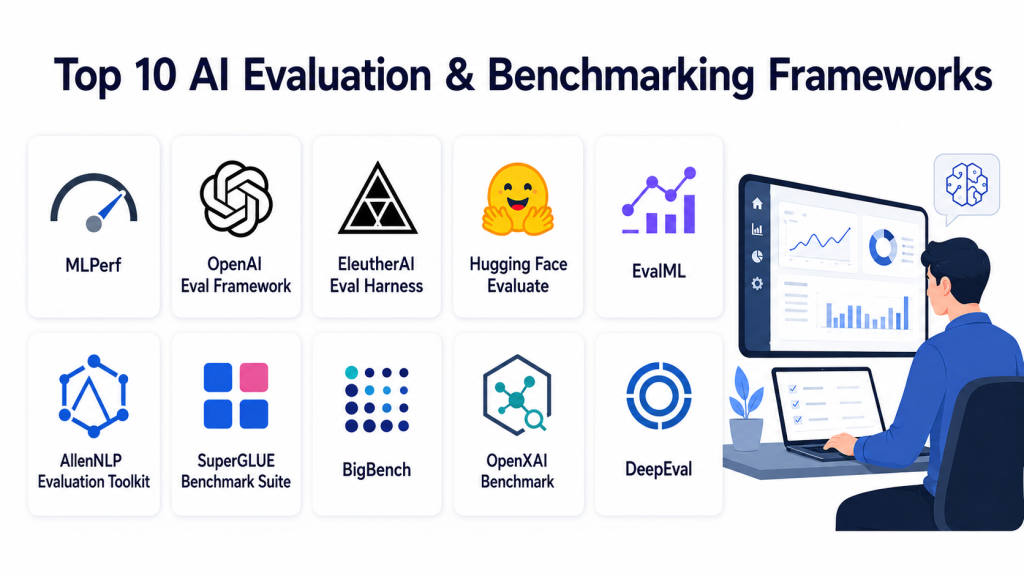
Top 10 AI Evaluation & Benchmarking Frameworks
#1 — MLPerf
Short description: MLPerf provides standardized benchmarking for machine learning hardware and models, focusing on performance metrics for training and inference across tasks and frameworks.
Key Features
- Standardized evaluation benchmarks
- Supports training and inference measurement
- Cross-framework compatibility
- Public leaderboard comparisons
- Dataset standardization
- Multi-task evaluation (vision, language, recommendation)
Pros
- Industry-standard benchmarking
- Comprehensive dataset and metric coverage
Cons
- Focused primarily on performance rather than fairness
- Requires familiarity with benchmarking procedures
Platforms / Deployment
- Linux, Cloud
- Local / Cloud
Security & Compliance
- Not publicly stated
Integrations & Ecosystem
- Compatible with TensorFlow, PyTorch, ONNX models
- Cloud deployment for large-scale benchmarking
- Leaderboard tracking
Support & Community
- Community-driven documentation
- Industry adoption
- Forums for discussion
#2 — OpenAI Evals
Short description: OpenAI Evals is a framework for evaluating AI model capabilities across NLP and reasoning tasks, supporting automated scoring and human-in-the-loop assessment.
Key Features
- Evaluation of language models
- Support for custom benchmarks
- Automated and human evaluation
- Dataset and metric flexibility
- Reporting and visualization
Pros
- Integrates automated and manual evaluation
- Supports customized task definitions
Cons
- Focused on NLP and reasoning
- Less support for multi-modal models
Platforms / Deployment
- Web, Cloud
- Managed
Security & Compliance
- Not publicly stated
Integrations & Ecosystem
- API for model evaluation
- Custom task import
- Reporting dashboards
Support & Community
- Documentation
- Community support
- Tutorials
#3 — EvaluAI
Short description: EvaluAI provides a platform for hosting AI challenges and evaluating models across datasets and tasks, supporting reproducibility and leaderboard tracking.
Key Features
- Challenge creation and hosting
- Standardized scoring metrics
- Leaderboard and ranking
- Support for multiple AI tasks
- Submission validation and reproducibility
Pros
- Facilitates benchmarking competitions
- Supports multiple task types
Cons
- Designed for challenge-based evaluation
- Less suited for production monitoring
Platforms / Deployment
- Web, Cloud
- Managed
Security & Compliance
- Not publicly stated
Integrations & Ecosystem
- Submission APIs
- Dataset hosting
- Leaderboard visualization
Support & Community
- Documentation and tutorials
- Community forums
- Challenge examples
#4 — CheckList
Short description: CheckList is a behavioral testing framework for NLP models, enabling evaluation across capabilities such as robustness, consistency, and fairness.
Key Features
- Behavioral testing for NLP
- Test case templates and scenario generation
- Metric evaluation and visualization
- Integration with ML pipelines
- Supports robustness and bias testing
Pros
- Effective for detailed NLP analysis
- Flexible and extensible test framework
Cons
- NLP-focused
- Requires test case design expertise
Platforms / Deployment
- Python, Linux
- Local / Cloud
Security & Compliance
- Not publicly stated
Integrations & Ecosystem
- Integration with PyTorch and TensorFlow
- Custom test scenarios
- Reporting dashboards
Support & Community
- Documentation and tutorials
- GitHub community
- Examples
#5 — DeepChecks
Short description: DeepChecks provides pre-deployment and post-deployment evaluation for machine learning models, focusing on data integrity, model performance, and drift detection.
Key Features
- Pre-deployment and post-deployment checks
- Data integrity testing
- Performance and drift monitoring
- Reporting and visualization
- Multi-framework support
Pros
- Combines evaluation and monitoring
- Detects data and model drift
Cons
- Requires Python expertise
- Limited support for multi-modal evaluation
Platforms / Deployment
- Python, Linux
- Local / Cloud
Security & Compliance
- Not publicly stated
Integrations & Ecosystem
- TensorFlow, PyTorch support
- CI/CD pipelines
- Reporting integrations
Support & Community
- Docs and tutorials
- GitHub community
- Use-case examples
#6 — Fiddler AI
Short description: Fiddler AI provides explainability and performance benchmarking tools for deployed ML models, emphasizing fairness, interpretability, and drift analysis.
Key Features
- Model explainability
- Fairness evaluation
- Performance monitoring
- Drift detection
- Dashboard visualization
Pros
- Strong focus on responsible AI
- Production monitoring support
Cons
- Enterprise-focused
- May be complex for small teams
Platforms / Deployment
- Cloud
- Managed / Hybrid
Security & Compliance
- TLS encryption and authentication
- Not publicly stated
Integrations & Ecosystem
- API access for model metrics
- Dashboard integrations
- Reporting pipelines
Support & Community
- Documentation
- Customer support
- Community examples
#7 — Weights & Biases Evaluate
Short description: W&B Evaluate enables performance tracking, comparison, and benchmarking across ML experiments, providing visual insights and metrics dashboards.
Key Features
- Model comparison and evaluation
- Experiment tracking
- Visualization dashboards
- Custom metrics
- Integration with ML pipelines
Pros
- Strong visualization and experiment tracking
- Easy integration with CI/CD
Cons
- Limited open-source customization
- Primarily Python-focused
Platforms / Deployment
- Web, Cloud
- Managed
Security & Compliance
- TLS, secure access
- Not publicly stated
Integrations & Ecosystem
- PyTorch, TensorFlow
- CI/CD pipelines
- Cloud storage
Support & Community
- Documentation
- Community forums
- Tutorials
#8 — EvalML
Short description: EvalML automates model evaluation for classical ML models, providing benchmarking metrics, comparison, and visualization to streamline workflow.
Key Features
- Automated model evaluation
- Benchmark metrics for regression, classification
- Visualization and reports
- Integration with ML pipelines
- Multi-model comparison
Pros
- Simplifies evaluation of multiple models
- Open-source and flexible
Cons
- Focused on tabular ML
- Less suited for deep learning and multi-modal tasks
Platforms / Deployment
- Python, Linux
- Local / Cloud
Security & Compliance
- Not publicly stated
Integrations & Ecosystem
- Scikit-learn, XGBoost
- Reporting integration
- Experiment pipelines
Support & Community
- Docs and tutorials
- GitHub community
- Examples
#9 — OpenML
Short description: OpenML is a collaborative platform for benchmarking ML models across datasets and tasks, supporting reproducible experiments and meta-learning research.
Key Features
- Dataset and task repository
- Model benchmarking
- Leaderboards
- Reproducible experiment sharing
- API access
Pros
- Open-source community platform
- Extensive dataset coverage
Cons
- Academic/research focus
- Less production integration
Platforms / Deployment
- Web, Python
- Cloud / Local
Security & Compliance
- Not publicly stated
Integrations & Ecosystem
- Python SDK
- API for benchmarking
- Leaderboards
Support & Community
- Community forums
- Documentation
- Research examples
#10 — IBM AI OpenScale
Short description: IBM AI OpenScale monitors AI models in production for fairness, bias, accuracy, and drift, enabling enterprise-grade evaluation and benchmarking.
Key Features
- Model monitoring for fairness and drift
- Explainability and interpretability metrics
- Automated alerts and dashboards
- Multi-framework support
- Enterprise-grade logging and reporting
Pros
- Comprehensive production monitoring
- Supports responsible AI metrics
Cons
- Enterprise-focused and complex
- Costly for small teams
Platforms / Deployment
- Cloud, Hybrid
- Managed
Security & Compliance
- Enterprise-grade security
- Not publicly stated for certifications
Integrations & Ecosystem
- IBM Cloud services
- CI/CD integration
- Reporting pipelines
Support & Community
- IBM documentation
- Support portal
- Community examples
Comparison Table
| Tool Name | Best For | Platform(s) Supported | Deployment | Standout Feature | Public Rating |
|---|---|---|---|---|---|
| MLPerf | Standardized ML benchmarks | Linux, Cloud | Local / Cloud | Training & inference benchmarking | N/A |
| OpenAI Evals | NLP and reasoning evaluation | Web, Cloud | Managed | Automated & human evaluation | N/A |
| EvaluAI | AI challenges and leaderboards | Web, Cloud | Managed | Challenge-based benchmarking | N/A |
| CheckList | Behavioral NLP testing | Python, Linux | Local / Cloud | Robust NLP scenario testing | N/A |
| DeepChecks | Pre/post-deployment checks | Python, Linux | Local / Cloud | Drift & data integrity monitoring | N/A |
| Fiddler AI | Model explainability & fairness | Cloud | Managed | Responsible AI monitoring | N/A |
| W&B Evaluate | Experiment tracking | Web, Cloud | Managed | Visual dashboards & model comparison | N/A |
| EvalML | Classical ML benchmarking | Python, Linux | Local / Cloud | Automated tabular model evaluation | N/A |
| OpenML | Collaborative benchmarking | Web, Python | Cloud / Local | Dataset and leaderboards | N/A |
| IBM AI OpenScale | Production AI monitoring | Cloud, Hybrid | Managed | Fairness & drift monitoring | N/A |
Evaluation & Scoring
| Tool Name | Core (25%) | Ease (15%) | Integrations (15%) | Security (10%) | Performance (10%) | Support (10%) | Value (15%) | Weighted Total |
|---|---|---|---|---|---|---|---|---|
| MLPerf | 9 | 7 | 7 | 7 | 9 | 7 | 8 | 8.0 |
| OpenAI Evals | 8 | 8 | 7 | 7 | 8 | 7 | 7 | 7.6 |
| EvaluAI | 8 | 7 | 7 | 7 | 8 | 7 | 7 | 7.5 |
| CheckList | 8 | 7 | 7 | 7 | 8 | 6 | 7 | 7.4 |
| DeepChecks | 8 | 7 | 7 | 7 | 8 | 6 | 7 | 7.4 |
| Fiddler AI | 8 | 7 | 7 | 8 | 8 | 7 | 7 | 7.6 |
| W&B Evaluate | 8 | 8 | 7 | 7 | 8 | 7 | 7 | 7.6 |
| EvalML | 7 | 7 | 6 | 7 | 7 | 6 | 7 | 6.9 |
| OpenML | 7 | 7 | 6 | 7 | 7 | 6 | 7 | 6.9 |
| IBM AI OpenScale | 9 | 7 | 8 | 8 | 8 | 7 | 7 | 7.9 |
Which AI Evaluation & Benchmarking Framework Is Right for You?
Solo / Researchers
EvalML, OpenAI Evals, and CheckList provide flexible frameworks for experimentation and evaluation on NLP and tabular ML tasks.
SMB
DeepChecks and W&B Evaluate provide integrated evaluation and monitoring pipelines for teams deploying models in production.
Mid-Market
MLPerf, OpenML, and EvaluAI offer benchmarking, standardization, and challenge-based evaluation across tasks and datasets.
Enterprise
IBM AI OpenScale and Fiddler AI provide production-grade monitoring for fairness, drift detection, and responsible AI metrics.
Budget vs Premium
Open-source platforms like EvalML, CheckList, and OpenML reduce cost while providing flexible evaluation, whereas enterprise-grade solutions offer managed services at higher cost.
Feature Depth vs Ease of Use
Open-source frameworks provide depth and flexibility; managed platforms provide ease of deployment, dashboards, and integrated reporting.
Integrations & Scalability
Platforms supporting APIs and CI/CD pipelines scale effectively with multiple models and large teams.
Security & Compliance
Enterprise frameworks provide TLS, authentication, and access controls for regulated AI deployments.
Frequently Asked Questions
1. What is AI benchmarking?
AI benchmarking is evaluating models across datasets and metrics to assess performance, robustness, fairness, and reliability in production scenarios.
2. Do these platforms support multiple frameworks?
Yes, many frameworks support TensorFlow, PyTorch, ONNX, and other ML formats.
3. Can they handle multi-modal models?
Yes. Modern platforms like Fiddler AI, IBM AI OpenScale, and MLPerf support multi-modal evaluation including NLP, vision, and audio.
4. Are they suitable for production monitoring?
Enterprise-grade frameworks like IBM AI OpenScale and Fiddler AI provide ongoing monitoring of deployed models for drift, fairness, and performance.
5. Can I integrate with CI/CD pipelines?
Yes, most platforms provide APIs or deployment scripts to integrate with automated ML workflows.
6. How do they measure fairness?
Frameworks evaluate bias and fairness metrics across sensitive attributes and subpopulations using standardized or custom metrics.
7. Can evaluation be automated?
Yes. Many frameworks support automated evaluation, batch testing, and leaderboard generation.
8. Do they include visual reporting?
Yes. Dashboards, charts, and metrics reporting are provided for comparing model performance and behavior.
9. Are these frameworks open-source or commercial?
Several are open-source like EvalML, CheckList, and OpenML, while enterprise solutions like IBM AI OpenScale and Fiddler AI are commercial.
10. How do I choose the right framework?
Consider your model types, evaluation needs, integration requirements, and team expertise. Trial open-source tools for experimentation and enterprise solutions for production.
Conclusion
AI Evaluation & Benchmarking Frameworks enable reliable, reproducible, and responsible AI deployment by providing structured measurement of performance, fairness, and robustness. Open-source platforms such as EvalML and OpenML provide flexibility for experimentation, while enterprise-grade tools like IBM AI OpenScale and Fiddler AI ensure monitoring and accountability for production models. Teams should select frameworks based on scale, supported tasks, ease of integration, and reporting needs. The next step is to shortlist two or three frameworks, test evaluations on sample models, and validate their metrics and dashboards before full adoption. Proper benchmarking ensures trustworthy and high-performing AI systems in real-world applications.

This article does an excellent job of comparing AI evaluation and benchmarking frameworks in a structured and easy-to-follow manner. The detailed insights into features, strengths, and limitations help readers make more informed decisions when selecting a framework.