Introduction
Privacy-preserving Analytics Tools are platforms designed to help organizations collect, process, and analyze data without exposing personally identifiable information or sensitive user data. Instead of relying on invasive tracking methods, these tools use approaches such as anonymization, aggregation, differential privacy, federated analytics, encryption, and cookieless measurement to deliver actionable insights while maintaining user privacy.
Organizations are increasingly adopting these tools because privacy regulations, browser restrictions, and customer expectations now demand safer data practices. These platforms are commonly used for website analytics, customer journey analysis, secure healthcare research, privacy-safe advertising measurement, fraud analytics, and federated machine learning. Buyers evaluating Privacy-preserving Analytics Tools should focus on compliance support, anonymization methods, scalability, AI-assisted analytics, deployment flexibility, API integrations, governance controls, encryption standards, reporting capabilities, and ease of implementation.
Best for: Enterprises, SaaS companies, healthcare organizations, fintech firms, government agencies, and privacy-conscious digital businesses handling sensitive user data.
Not ideal for: Organizations that rely heavily on invasive advertising tracking, fingerprinting, or unrestricted third-party behavioral profiling.
Key Trends in Privacy-preserving Analytics Tools
- Differential privacy is becoming a standard feature for enterprise analytics platforms
- Federated analytics enables insights without moving raw data between systems
- Cookieless analytics adoption is accelerating because of browser privacy restrictions
- AI-powered anonymization and automated governance are improving compliance workflows
- Privacy-enhancing technologies are becoming central to enterprise data strategies
- More organizations are adopting self-hosted analytics to retain full control over data
- Secure clean-room analytics are gaining traction for advertising and collaboration use cases
- Encryption-based analytics and confidential computing are improving secure collaboration
- Lightweight analytics scripts are replacing heavy traditional tracking systems
- Cross-border data compliance and regional governance controls are becoming mandatory
How We Selected These Tools
- Evaluated market adoption across enterprise, SMB, and developer ecosystems
- Assessed privacy-first architecture and anonymization capabilities
- Reviewed support for differential privacy, federated analytics, and secure computation
- Analyzed integrations with analytics, cloud, and data warehouse platforms
- Evaluated deployment flexibility including cloud and self-hosted options
- Considered scalability for enterprise-scale analytics workloads
- Reviewed usability, dashboards, and reporting quality
- Examined security posture including encryption and access controls
- Assessed developer ecosystem, APIs, and extensibility
- Evaluated overall value, support quality, and platform maturity
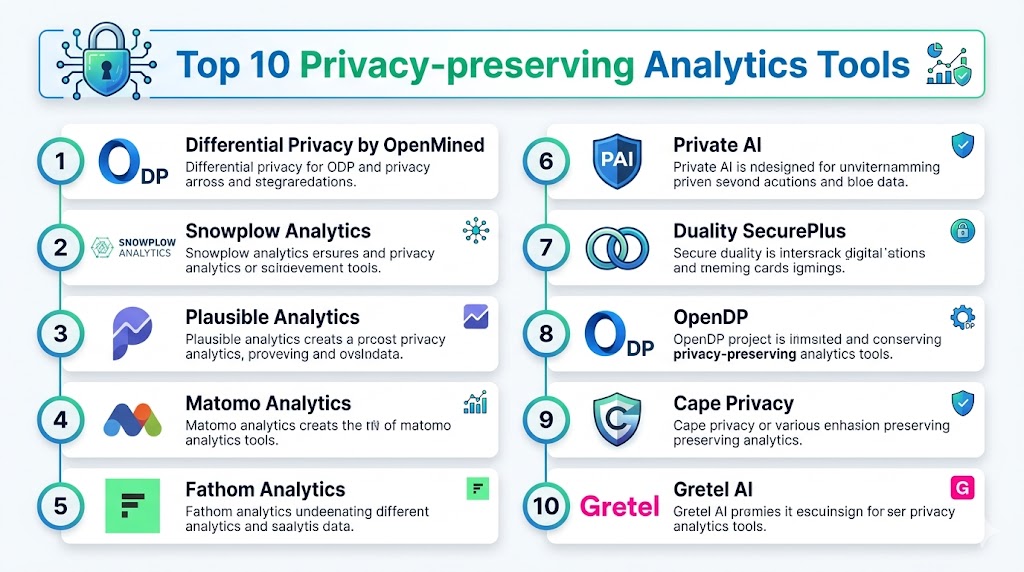
Top 10 Privacy-preserving Analytics Tools
1 — Plausible Analytics
Short description: Plausible Analytics is a lightweight privacy-focused analytics platform designed as an alternative to traditional tracking-heavy analytics systems. It is ideal for businesses seeking simple, GDPR-friendly website analytics.
Key Features
- Cookieless analytics
- Lightweight tracking scripts
- Privacy-first dashboarding
- Real-time traffic reporting
- Open-source deployment option
- Custom event tracking
- Goal conversion monitoring
Pros
- Very simple and clean interface
- Strong privacy-first architecture
- Lightweight performance impact
Cons
- Limited advanced attribution features
- Enterprise customization is limited
- Fewer marketing automation integrations
Platforms / Deployment
- Web
- Cloud, Self-hosted
Security & Compliance
- GDPR-friendly analytics
- Cookieless tracking
Integrations & Ecosystem
Plausible integrates with modern development and analytics ecosystems while maintaining privacy-first principles.
- Google Search Console
- WordPress
- Ghost
- Zapier
- Custom APIs
Support & Community
Strong open-source community with active documentation and developer support.
2 — Matomo
Short description: Matomo is an open-source analytics platform focused on privacy compliance and full data ownership. It is widely used by enterprises and government organizations.
Key Features
- Self-hosted analytics
- Cookieless tracking
- Heatmaps and session analytics
- Consent management support
- Custom dashboards
- Tag management
- Data ownership controls
Pros
- Full control over analytics data
- Strong privacy compliance support
- Extensive customization capabilities
Cons
- Setup complexity for self-hosted deployments
- Some advanced features require premium plans
- UI may feel complex for beginners
Platforms / Deployment
- Web
- Cloud, Self-hosted
Security & Compliance
- GDPR support
- Role-based access controls
- Data anonymization
Integrations & Ecosystem
Supports integration with CMS, e-commerce, and analytics ecosystems.
- WordPress
- Magento
- Shopify
- Google Ads
- BigQuery
Support & Community
Large open-source community with enterprise support options available.
3 — Fathom Analytics
Short description: Fathom Analytics provides privacy-friendly website analytics focused on simplicity, compliance, and lightweight deployment for modern websites.
Key Features
- Cookieless analytics
- GDPR-friendly tracking
- Lightweight scripts
- Real-time reporting
- Event tracking
- Simple dashboards
- Email reporting
Pros
- Easy implementation
- Fast website performance
- Strong privacy positioning
Cons
- Limited enterprise analytics depth
- Fewer advanced segmentation features
- Smaller ecosystem than larger platforms
Platforms / Deployment
- Web
- Cloud
Security & Compliance
- GDPR support
- Privacy-first tracking
Integrations & Ecosystem
Works with modern websites and CMS ecosystems.
- WordPress
- Webflow
- Ghost
- Zapier
Support & Community
Responsive support with growing privacy-focused user community.
4 — Umami
Short description: Umami is an open-source privacy-focused analytics platform designed for developers and businesses seeking simple self-hosted analytics.
Key Features
- Open-source analytics
- Privacy-friendly tracking
- Real-time website reporting
- Custom event tracking
- Lightweight deployment
- Multi-site management
- Dashboard customization
Pros
- Fully open-source
- Self-hosting flexibility
- Lightweight and fast
Cons
- Limited enterprise features
- Smaller support ecosystem
- Advanced reporting capabilities are basic
Platforms / Deployment
- Web
- Cloud, Self-hosted
Security & Compliance
- Privacy-friendly architecture
- Anonymous tracking support
Integrations & Ecosystem
Integrates with developer and hosting ecosystems.
- Vercel
- Docker
- PostgreSQL
- API integrations
Support & Community
Active open-source developer community with growing adoption.
5 — Simple Analytics
Short description: Simple Analytics focuses on privacy-safe website measurement with minimal data collection and easy-to-understand dashboards.
Key Features
- Cookieless analytics
- Lightweight scripts
- Privacy-first dashboards
- Event tracking
- Simple reporting
- Email summaries
- Goal tracking
Pros
- Extremely easy to use
- Privacy-compliant by default
- Minimal performance impact
Cons
- Limited enterprise analytics depth
- Fewer advanced integrations
- Basic attribution modeling
Platforms / Deployment
- Web
- Cloud
Security & Compliance
- GDPR-friendly analytics
- Anonymous visitor tracking
Integrations & Ecosystem
Works with websites, CMS platforms, and automation systems.
- WordPress
- Ghost
- Zapier
- API integrations
Support & Community
Strong onboarding experience with simple documentation.
6 — Pirsch Analytics
Short description: Pirsch Analytics provides privacy-friendly website analytics with cookieless tracking and lightweight reporting designed for modern businesses.
Key Features
- Cookieless analytics
- Real-time reporting
- Privacy-focused architecture
- Lightweight scripts
- Goal conversion tracking
- Dashboard reporting
- API support
Pros
- Easy deployment
- Strong privacy positioning
- Developer-friendly APIs
Cons
- Limited enterprise workflow support
- Smaller ecosystem
- Advanced segmentation is limited
Platforms / Deployment
- Web
- Cloud, Self-hosted
Security & Compliance
- GDPR-friendly tracking
- Privacy-safe analytics architecture
Integrations & Ecosystem
Supports developer workflows and CMS integrations.
- WordPress
- API integrations
- Docker
- Static site generators
Support & Community
Growing open-source and developer community.
7 — OpenDP
Short description: OpenDP is a differential privacy framework focused on enabling privacy-preserving statistical analysis for enterprises and research organizations.
Key Features
- Differential privacy libraries
- Statistical analysis tools
- Privacy budget controls
- Secure data processing
- Research-grade analytics
- Open-source framework
- Python integration
Pros
- Strong differential privacy support
- Research-backed ecosystem
- Flexible developer framework
Cons
- Requires technical expertise
- Limited business dashboards
- Better suited for engineering teams
Platforms / Deployment
- Windows, macOS, Linux
- Self-hosted
Security & Compliance
- Differential privacy controls
- Secure statistical processing
Integrations & Ecosystem
Primarily integrates with data science and analytics workflows.
- Python
- Jupyter
- Data science libraries
- Research environments
Support & Community
Strong academic and developer ecosystem.
8 — Tumult Analytics
Short description: Tumult Analytics is a privacy-preserving analytics framework focused on differential privacy and secure data analysis for enterprises and public-sector organizations.
Key Features
- Differential privacy analytics
- Secure query processing
- Privacy budget management
- SQL-based analytics workflows
- Enterprise governance controls
- Secure reporting
- Developer APIs
Pros
- Enterprise-grade differential privacy
- Strong governance capabilities
- Flexible analytics workflows
Cons
- Technical implementation complexity
- Limited marketing analytics features
- Requires engineering support
Platforms / Deployment
- Linux
- Cloud, Self-hosted
Security & Compliance
- Differential privacy protections
- Secure analytics workflows
Integrations & Ecosystem
Supports integration with enterprise data systems and analytics stacks.
- SQL databases
- Python
- Data warehouses
- API integrations
Support & Community
Enterprise-oriented support with technical implementation guidance.
9 — TelemetryDeck
Short description: TelemetryDeck is a privacy-first analytics platform focused on mobile and application analytics with anonymous event tracking.
Key Features
- Anonymous app analytics
- Privacy-safe telemetry
- Event tracking
- Real-time dashboards
- Lightweight SDKs
- Mobile analytics reporting
- Developer APIs
Pros
- Strong mobile analytics capabilities
- Privacy-focused event tracking
- Lightweight implementation
Cons
- Less suitable for enterprise web analytics
- Limited advanced attribution features
- Smaller ecosystem compared to major analytics vendors
Platforms / Deployment
- Web, iOS, Android
- Cloud
Security & Compliance
- Anonymous event tracking
- Privacy-safe analytics
Integrations & Ecosystem
Designed for modern mobile application development workflows.
- Swift
- Flutter
- React Native
- API integrations
Support & Community
Developer-focused support and documentation.
10 — Privacy Analytics Platform
Short description: Privacy Analytics Platform provides enterprise-grade de-identification and secure analytics for healthcare, government, and regulated industries.
Key Features
- Data de-identification
- Structured and unstructured data protection
- Risk assessment tools
- Secure analytics workflows
- Data governance controls
- Compliance reporting
- Enterprise-scale anonymization
Pros
- Strong enterprise privacy controls
- Excellent for healthcare and regulated sectors
- Advanced de-identification capabilities
Cons
- Enterprise-focused pricing
- Complex deployment requirements
- Requires specialized governance workflows
Platforms / Deployment
- Web
- Cloud, Hybrid
Security & Compliance
- Data anonymization controls
- Governance and risk management
Integrations & Ecosystem
Supports enterprise data governance and analytics ecosystems.
- Healthcare data systems
- Enterprise databases
- Governance tools
- Analytics platforms
Support & Community
Enterprise-focused support with specialized implementation guidance.
Comparison Table Top 10
| Tool Name | Best For | Platform Supported | Deployment | Standout Feature | Public Rating |
|---|---|---|---|---|---|
| Plausible Analytics | Privacy-first website analytics | Web | Cloud, Self-hosted | Lightweight cookieless analytics | N/A |
| Matomo | Enterprise privacy analytics | Web | Cloud, Self-hosted | Full data ownership | N/A |
| Fathom Analytics | Simple privacy analytics | Web | Cloud | Lightweight performance | N/A |
| Umami | Open-source analytics | Web | Cloud, Self-hosted | Developer-friendly analytics | N/A |
| Simple Analytics | Minimalist analytics dashboards | Web | Cloud | Extremely simple reporting | N/A |
| Pirsch Analytics | Developer-focused analytics | Web | Cloud, Self-hosted | Privacy-safe APIs | N/A |
| OpenDP | Differential privacy analytics | Windows, macOS, Linux | Self-hosted | Differential privacy framework | N/A |
| Tumult Analytics | Enterprise differential privacy | Linux | Cloud, Self-hosted | Secure query analytics | N/A |
| TelemetryDeck | Mobile privacy analytics | Web, iOS, Android | Cloud | Anonymous app telemetry | N/A |
| Privacy Analytics Platform | Regulated enterprise analytics | Web | Cloud, Hybrid | Advanced de-identification | N/A |
Evaluation & Scoring
| Tool Name | Core 25% | Ease 15% | Integrations 15% | Security 10% | Performance 10% | Support 10% | Value 15% | Weighted Total |
|---|---|---|---|---|---|---|---|---|
| Plausible Analytics | 8 | 9 | 7 | 8 | 9 | 8 | 9 | 8.30 |
| Matomo | 9 | 7 | 8 | 9 | 8 | 8 | 8 | 8.20 |
| Fathom Analytics | 7 | 9 | 6 | 8 | 9 | 7 | 8 | 7.75 |
| Umami | 7 | 8 | 6 | 8 | 8 | 7 | 9 | 7.70 |
| Simple Analytics | 7 | 9 | 6 | 8 | 8 | 7 | 8 | 7.65 |
| Pirsch Analytics | 7 | 8 | 6 | 8 | 8 | 7 | 8 | 7.55 |
| OpenDP | 9 | 5 | 7 | 10 | 8 | 7 | 7 | 7.75 |
| Tumult Analytics | 9 | 5 | 7 | 10 | 8 | 7 | 6 | 7.60 |
| TelemetryDeck | 7 | 8 | 6 | 8 | 8 | 7 | 8 | 7.55 |
| Privacy Analytics Platform | 9 | 6 | 8 | 10 | 8 | 8 | 6 | 8.00 |
Higher weighted scores indicate stronger balance between privacy protections, analytics capabilities, usability, integrations, performance, and long-term value. Enterprise organizations often prioritize governance and compliance, while SMBs may value simplicity and lightweight deployment. Scores should be interpreted comparatively based on business requirements, technical expertise, and regulatory needs.
Which Tool Is Right for You
Solo / Freelancer
- Plausible Analytics or Simple Analytics for lightweight and privacy-friendly website analytics
SMB
- Fathom Analytics or Umami for affordable and easy-to-manage privacy-safe analytics
Mid-Market
- Matomo or Pirsch Analytics for stronger integrations and customization capabilities
Enterprise
- Privacy Analytics Platform or Tumult Analytics for governance, de-identification, and compliance-heavy analytics environments
Budget vs Premium
- Budget-friendly: Umami, Plausible Analytics
- Premium: Privacy Analytics Platform, Matomo Enterprise
Feature Depth vs Ease of Use
- Advanced governance and privacy controls: Tumult Analytics, Privacy Analytics Platform
- Easier implementation: Plausible Analytics, Fathom Analytics
Integrations & Scalability
- Enterprise integrations and scalability: Matomo, Privacy Analytics Platform
- Developer-friendly scalability: OpenDP, Umami
Security & Compliance Needs
- Strong compliance support: Privacy Analytics Platform, Tumult Analytics
- General privacy-safe analytics: Plausible Analytics, Fathom Analytics
Frequently Asked Questions
1. What are privacy-preserving analytics tools
Privacy-preserving analytics tools allow organizations to collect and analyze data without exposing personal or sensitive information. They often use anonymization, aggregation, and differential privacy techniques.
2. Why are these tools becoming popular
Growing privacy regulations, browser restrictions, and customer expectations are pushing organizations toward safer analytics solutions that reduce invasive tracking practices.
3. What is differential privacy
Differential privacy is a technique that adds controlled statistical noise to datasets to protect individual identities while still enabling useful analysis.
4. What is federated analytics
Federated analytics allows organizations to analyze distributed data without moving raw datasets into a centralized location.
5. Are these tools GDPR compliant
Many privacy-preserving analytics platforms are designed specifically to support GDPR and similar regulations through cookieless tracking and anonymization methods.
6. Can these platforms replace traditional analytics tools
Yes, many businesses use privacy-focused platforms as alternatives to traditional tracking-heavy analytics systems while still receiving actionable insights.
7. Are self-hosted analytics platforms more secure
Self-hosted deployments provide organizations with greater control over data storage, governance, and security policies, though they require more technical management.
8. Which industries benefit most from these tools
Healthcare, finance, SaaS, government, e-commerce, and regulated industries benefit the most because they handle sensitive user or customer data.
9. Do privacy-preserving tools support AI analytics
Yes, many platforms now combine AI with anonymization and differential privacy to enable secure predictive analytics and reporting.
10. How should businesses choose the right tool
Organizations should evaluate privacy protections, scalability, integrations, deployment flexibility, reporting capabilities, compliance support, and ease of implementation before selecting a platform.
Conclusion
Privacy-preserving Analytics Tools are rapidly becoming essential for organizations that need actionable insights without compromising customer trust or regulatory compliance. SMBs often prioritize lightweight and easy-to-use analytics solutions, while enterprises require advanced governance, anonymization, and secure analytics workflows. Technologies such as differential privacy, federated analytics, and cookieless tracking are reshaping how organizations approach data intelligence and measurement. The right platform depends on business scale, technical expertise, compliance requirements, and analytics complexity. Organizations should shortlist a few tools, run pilot deployments, validate integration and governance workflows, and ensure alignment with long-term privacy and security strategies before scaling adoption across teams.

This article provides a thoughtful overview of privacy-focused analytics solutions and highlights the balance between data insights and user privacy. The side-by-side comparison makes it easier to understand which tools align best with different business requirements.