Introduction
Pricing intelligence tools help businesses track, analyze, and optimize product pricing based on market trends, competitor activity, and customer behavior. These platforms provide insights that enable dynamic pricing, maximize revenue, and maintain competitiveness across e-commerce, retail, and B2B markets. In 2026+, with highly competitive online marketplaces and dynamic consumer expectations, these tools are essential for data-driven pricing strategies.
Real-world use cases include:
- Monitoring competitor prices in real-time for strategic adjustments
- Dynamic pricing optimization for e-commerce and retail products
- Price recommendation and margin optimization
- Market trend and consumer demand analysis
- Automated alerts for price changes, stock levels, or competitive threats
Key evaluation criteria for buyers:
- Real-time competitor and market monitoring
- Dynamic pricing and automated recommendation capabilities
- Integration with e-commerce platforms, ERP, and POS systems
- Historical data and trend analysis
- Margin and profitability analytics
- Alerts, notifications, and exception management
- Multi-channel pricing management
- Scalability for large product catalogs
- User-friendly dashboards and reporting
- Security, compliance, and data accuracy
Best for: E-commerce brands, retailers, marketplaces, and pricing teams aiming to optimize revenue and remain competitive.
Not ideal for: Businesses with small inventories or markets where competitor data is limited or irrelevant.
Key Trends in Pricing Intelligence Tools
- AI-driven dynamic pricing and predictive analytics
- Real-time competitor monitoring and market intelligence
- Integration with e-commerce platforms, marketplaces, and ERP systems
- Alerts for price changes, stock levels, and competitor actions
- Multi-channel pricing strategies and automation
- Customer segmentation and personalized pricing
- Analytics dashboards with margin, revenue, and profitability metrics
- Cloud-based solutions with API access
- Compliance with regional pricing and competition regulations
- SaaS subscription models and usage-based pricing
How We Selected These Tools (Methodology)
- Evaluated adoption across e-commerce, retail, and marketplace industries
- Assessed dynamic pricing and competitor monitoring capabilities
- Reviewed integration with ERP, e-commerce, and analytics platforms
- Measured data accuracy, speed, and frequency of updates
- Considered AI and automation features for pricing recommendations
- Analyzed alerting, exception handling, and workflow support
- Reviewed multi-channel and multi-region pricing capabilities
- Evaluated reporting, dashboards, and analytics insights
- Considered scalability for large catalogs and diverse markets
- Reviewed support, onboarding, and training resources
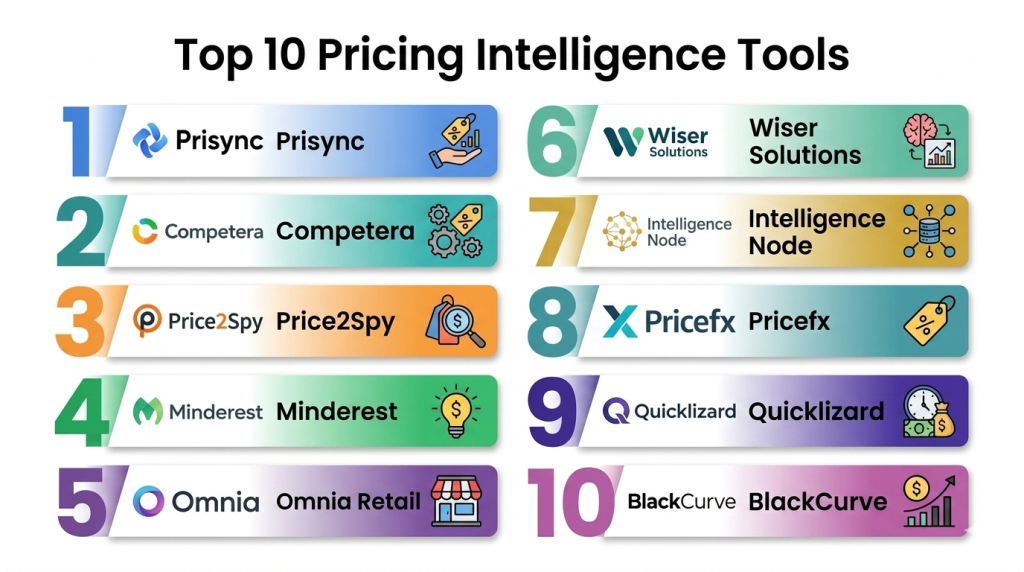
Top 10 Pricing Intelligence Tools
#1 — Prisync
Short description (4–5 lines):
Prisync provides real-time competitor price tracking and automated pricing recommendations. Ideal for e-commerce and online retailers seeking market-driven price optimization.
Key Features
- Real-time competitor monitoring
- Price change alerts
- Automated pricing recommendations
- Analytics dashboards for margin and revenue
- Multi-channel integration
Pros
- Easy-to-use interface
- Supports multiple currencies and markets
Cons
- Limited predictive analytics on smaller plans
- Advanced automation requires higher-tier subscription
Platforms / Deployment
- Web; Cloud-based
Security & Compliance
- Not publicly stated
Integrations & Ecosystem
- Shopify, WooCommerce, Magento
- API integration
- Analytics and reporting platforms
Support & Community
Documentation, tutorials, and customer support.
#2 — Intelligence Node
Short description (4–5 lines):
Intelligence Node provides AI-driven pricing intelligence and competitive insights for large retailers and e-commerce brands. Suitable for enterprise-scale pricing operations.
Key Features
- AI-driven price optimization
- Market intelligence and competitor tracking
- Dynamic pricing engine
- Multi-channel pricing management
- Analytics and trend reporting
Pros
- Strong AI and predictive capabilities
- Enterprise-grade scalability
Cons
- Premium pricing
- Implementation may require professional services
Platforms / Deployment
- Web; Cloud-based
Security & Compliance
- Not publicly stated
Integrations & Ecosystem
- ERP and e-commerce integrations
- API access for custom workflows
- Analytics dashboards
Support & Community
Enterprise support, training, and documentation.
#3 — Wiser
Short description (4–5 lines):
Wiser offers price monitoring, competitive insights, and dynamic pricing recommendations for retailers, brands, and marketplaces. Ideal for multi-channel e-commerce.
Key Features
- Competitor price and assortment tracking
- Dynamic pricing recommendations
- Analytics dashboards
- Multi-channel pricing management
- Alert notifications
Pros
- Scalable for large catalogs
- Integration with multiple e-commerce platforms
Cons
- Learning curve for advanced features
- Premium plans required for full functionality
Platforms / Deployment
- Web; Cloud-based
Security & Compliance
- Not publicly stated
Integrations & Ecosystem
- Shopify, Magento, BigCommerce, marketplaces
- API access for automation
- Analytics and reporting tools
Support & Community
Documentation, tutorials, and customer support.
#4 — Competera
Short description (4–5 lines):
Competera is a pricing optimization platform leveraging AI and competitor data to recommend optimal pricing strategies for e-commerce brands.
Key Features
- AI-based pricing optimization
- Competitor monitoring and benchmarking
- Rule-based and dynamic pricing
- Multi-channel support
- Analytics dashboards
Pros
- Strong predictive analytics
- Flexible pricing rules
Cons
- Enterprise-focused pricing
- Setup may require technical expertise
Platforms / Deployment
- Web; Cloud-based
Security & Compliance
- Not publicly stated
Integrations & Ecosystem
- Shopify, Magento, ERP systems
- API for custom integration
- Analytics and reporting
Support & Community
Documentation, onboarding, and support.
#5 — Pricefx
Short description (4–5 lines):
Pricefx delivers pricing analytics, optimization, and management solutions for B2B and B2C companies. Ideal for businesses seeking data-driven price strategies.
Key Features
- Pricing analytics and reporting
- Price optimization and modeling
- Quote and deal management
- Multi-channel pricing
- Integration with ERP and CRM
Pros
- Enterprise-grade capabilities
- Flexible pricing models
Cons
- High cost for smaller businesses
- Requires technical expertise
Platforms / Deployment
- Web; Cloud-based
Security & Compliance
- Not publicly stated
Integrations & Ecosystem
- ERP, CRM, and e-commerce platforms
- API integration
- Analytics dashboards
Support & Community
Enterprise support and documentation.
#6 — BlackCurve
Short description (4–5 lines):
BlackCurve provides automated price optimization, competitive monitoring, and margin management for e-commerce retailers. Suitable for mid-to-large e-commerce brands.
Key Features
- Automated price recommendations
- Competitor tracking
- Profit and margin analytics
- Multi-channel support
- Dynamic pricing rules
Pros
- Easy-to-use interface
- Scales with catalog size
Cons
- Smaller customer base
- Some advanced features require premium plans
Platforms / Deployment
- Web; Cloud-based
Security & Compliance
- Not publicly stated
Integrations & Ecosystem
- Shopify, Magento, WooCommerce
- ERP integration
- Analytics dashboards
Support & Community
Documentation and support team.
#7 — Omnia Retail
Short description (4–5 lines):
Omnia Retail specializes in pricing intelligence, automation, and analytics for retailers, enabling competitive pricing strategies at scale.
Key Features
- Dynamic pricing automation
- Competitor monitoring
- Margin and revenue analytics
- Multi-channel pricing
- Rule-based pricing engine
Pros
- Advanced automation features
- Enterprise scalability
Cons
- Premium pricing
- Learning curve for configuration
Platforms / Deployment
- Web; Cloud-based
Security & Compliance
- Not publicly stated
Integrations & Ecosystem
- E-commerce and ERP platforms
- API integrations
- Analytics and reporting
Support & Community
Documentation, tutorials, and enterprise support.
#8 — Incompetitor
Short description (4–5 lines):
Incompetitor provides price tracking, competitor analysis, and alerts for e-commerce sellers to adjust pricing strategically.
Key Features
- Competitor price monitoring
- Price change alerts
- Analytics dashboards
- Multi-channel support
- Trend reporting
Pros
- Quick setup
- Affordable for SMBs
Cons
- Limited advanced optimization
- Fewer integrations than enterprise tools
Platforms / Deployment
- Web; Cloud-based
Security & Compliance
- Not publicly stated
Integrations & Ecosystem
- Shopify, WooCommerce, marketplaces
- Analytics integration
- API support
Support & Community
Documentation and customer support.
#9 — Minderest
Short description (4–5 lines):
Minderest offers price intelligence, competitive benchmarking, and analytics for retail and online brands, helping optimize pricing strategy.
Key Features
- Competitor tracking
- Dynamic pricing recommendations
- Analytics and reporting
- Multi-channel support
- Alert notifications
Pros
- Easy visualization of market trends
- Scalable for large catalogs
Cons
- Limited integrations
- Premium pricing
Platforms / Deployment
- Web; Cloud-based
Security & Compliance
- Not publicly stated
Integrations & Ecosystem
- E-commerce and marketplace platforms
- Analytics dashboards
- API access
Support & Community
Documentation and support team.
#10 — Competitor Monitor Pro
Short description (4–5 lines):
Competitor Monitor Pro provides price tracking, market intelligence, and alerts for retailers and e-commerce brands, supporting real-time decision-making.
Key Features
- Real-time competitor tracking
- Price alerts and notifications
- Analytics and reporting
- Multi-channel monitoring
- Market trend analysis
Pros
- Quick competitor insights
- Simple interface
Cons
- Limited automation
- Fewer integrations
Platforms / Deployment
- Web; Cloud-based
Security & Compliance
- Not publicly stated
Integrations & Ecosystem
- Shopify, Magento, WooCommerce
- Analytics dashboards
- API access
Support & Community
Documentation and support.
Comparison Table (Top 10)
| Tool Name | Best For | Platforms Supported | Deployment | Standout Feature | Public Rating |
|---|---|---|---|---|---|
| Prisync | E-commerce retailers | Web | Cloud | Competitor price tracking | N/A |
| Intelligence Node | Enterprise brands | Web | Cloud | AI-driven price optimization | N/A |
| Wiser | Multi-channel retailers | Web | Cloud | Dynamic pricing | N/A |
| Competera | E-commerce & B2C brands | Web | Cloud | Predictive pricing | N/A |
| Pricefx | B2B & B2C companies | Web | Cloud | Pricing analytics & optimization | N/A |
| BlackCurve | Mid-to-large retailers | Web | Cloud | Automated price recommendations | N/A |
| Omnia Retail | Enterprise retailers | Web | Cloud | Rule-based automation | N/A |
| Incompetitor | SMB e-commerce sellers | Web | Cloud | Price alerts | N/A |
| Minderest | Online retail brands | Web | Cloud | Market trend analytics | N/A |
| Competitor Monitor Pro | Retail & e-commerce | Web | Cloud | Real-time competitor tracking | N/A |
Evaluation & Scoring of Pricing Intelligence Tools
| Tool Name | Core (25%) | Ease (15%) | Integrations (15%) | Security (10%) | Performance (10%) | Support (10%) | Value (15%) | Weighted Total |
|---|---|---|---|---|---|---|---|---|
| Prisync | 9 | 8 | 8 | 8 | 8 | 7 | 7 | 7.90 |
| Intelligence Node | 9 | 7 | 8 | 8 | 8 | 7 | 7 | 7.85 |
| Wiser | 8 | 8 | 8 | 8 | 8 | 7 | 7 | 7.80 |
| Competera | 9 | 8 | 8 | 8 | 8 | 7 | 7 | 7.85 |
| Pricefx | 9 | 7 | 8 | 8 | 8 | 7 | 7 | 7.85 |
| BlackCurve | 8 | 8 | 7 | 8 | 8 | 7 | 7 | 7.75 |
| Omnia Retail | 9 | 7 | 8 | 8 | 8 | 7 | 7 | 7.80 |
| Incompetitor | 8 | 9 | 7 | 8 | 8 | 7 | 7 | 7.75 |
| Minderest | 8 | 8 | 7 | 8 | 8 | 7 | 7 | 7.75 |
| Competitor Monitor Pro | 8 | 8 | 7 | 8 | 8 | 7 | 7 | 7.75 |
Which Pricing Intelligence Tool Is Right for You?
Solo / SMB E-commerce Sellers
Incompetitor, Prisync, and BlackCurve provide affordable and easy-to-use solutions for small catalogs and local markets.
Mid-Sized Brands
Wiser, Competera, and Omnia Retail offer AI-driven pricing, trend monitoring, and automation to optimize revenue across multiple channels.
Enterprise / Large Brands
Intelligence Node, Pricefx, Minderest, and Competitor Monitor Pro provide advanced analytics, predictive optimization, and large catalog management for global operations.
Budget vs Premium
SMB tools offer core monitoring and alerting. Enterprise solutions provide AI-driven insights, automation, and integration at higher subscription tiers.
Feature Depth vs Ease of Use
Enterprise platforms offer comprehensive automation, analytics, and multi-channel support. SMB tools prioritize quick setup and intuitive dashboards.
Integrations & Scalability
Platforms with API and e-commerce integrations scale as product portfolios and sales channels grow.
Security & Compliance Needs
Ensure secure pricing data handling, audit trails, and compliance with internal controls.
Frequently Asked Questions (FAQs)
1. What is a pricing intelligence tool?
A platform that tracks market prices, competitor activity, and customer behavior to optimize pricing strategies.
2. Can it track competitors in real-time?
Yes, most platforms provide real-time or near real-time competitor pricing data.
3. Are dynamic pricing capabilities included?
Many tools provide AI-driven or rule-based dynamic pricing recommendations.
4. Can these tools integrate with e-commerce stores?
Yes, integration with Shopify, Magento, WooCommerce, and marketplaces is common.
5. Are analytics dashboards included?
Yes, all top platforms provide insights into pricing trends, margins, and competitive landscape.
6. Do these tools support multi-channel pricing?
Yes, enterprise solutions can synchronize prices across online stores, marketplaces, and offline channels.
7. Can small businesses use these tools?
Yes, tools like Incompetitor, BlackCurve, and Prisync are suitable for SMBs.
8. Are alerts and notifications available?
Yes, most platforms allow users to set price change or stock alerts.
9. Are multi-currency and international prices supported?
Enterprise-grade tools support multiple currencies and regional pricing strategies.
10. How do I choose the right tool?
Evaluate catalog size, market coverage, integration needs, AI capabilities, and budget when selecting a solution.
Conclusion
Pricing intelligence tools empower businesses to make data-driven pricing decisions, improve margins, and stay competitive. Small businesses can leverage Incompetitor, Prisync, and BlackCurve for simple, cost-effective monitoring. Mid-sized brands benefit from Wiser, Competera, and Omnia Retail for AI-driven insights and automation. Enterprises with global operations should consider Intelligence Node, Pricefx, Minderest, or Competitor Monitor Pro for advanced analytics and predictive pricing. Evaluate your product catalog, channels, and market requirements before selecting a platform. Start by shortlisting 2–3 tools, testing dynamic pricing workflows, and validating integration and analytics capabilities for effective revenue optimization.

This article provides a valuable comparison of pricing intelligence tools and their role in monitoring market pricing strategies. The structured feature overview and pros-and-cons analysis make it easier to assess the best option for different business needs.