Introduction
Long-term care (LTC) management systems are specialized enterprise software solutions designed to coordinate the clinical, administrative, and financial operations of facilities such as skilled nursing homes, assisted living communities, and memory care centers. Unlike standard hospital EHRs, these platforms are engineered for the longitudinal nature of senior care, where the relationship between the provider and the resident often spans years. Modern systems integrate electronic health records (EHR), electronic medication administration records (eMAR), resident billing, and family engagement portals into a single “source of truth.” This centralized approach is critical for maintaining compliance with complex state and federal regulations while ensuring high-quality person-centered care.
The necessity for these tools has reached a critical point as the aging population grows and staffing shortages become more prevalent. Digital management systems allow for automated charting, real-time vital tracking, and sophisticated incident reporting, which significantly reduces the administrative burden on caregivers. By utilizing data-driven insights, facilities can predict potential health declines, manage medication accurately to prevent adverse events, and streamline the reimbursement cycle. In an era where interoperability is a requirement, these systems act as the connective tissue between the LTC facility, hospitals, and outpatient providers.
Real-world use cases include:
- Medication Administration Tracking: Using eMAR to scan barcodes at the bedside, ensuring the “five rights” of medication safety.
- Regulatory Compliance Reporting: Automatically generating documentation for state surveys and federal audits to ensure facility licensing.
- Resident Lifecycle Management: Managing everything from initial lead inquiry and prospect touring to clinical assessment and eventual discharge.
- Interdisciplinary Care Coordination: Enabling nurses, therapists, and dietitians to share notes and update care plans in real-time.
What buyers should evaluate:
- Clinical Documentation Depth: Does the system support specific LTC frameworks like MDS (Minimum Data Set) and care plan automation?
- Financial Management & Billing: Can it handle complex Medicare, Medicaid, and private pay billing cycles seamlessly?
- Interoperability Standards: Does the software connect with local hospitals and pharmacies via HL7 or FHIR protocols?
- User Experience & Adoption: Is the interface intuitive enough for staff with varying levels of technical proficiency?
- Mobile Accessibility: Can nurses and aides document care at the point of service via tablets or mobile devices?
- Family & Resident Engagement: Does the platform offer a portal for families to view updates and communicate with staff?
- Security & Compliance: Does the vendor provide robust encryption, MFA, and a signed BAA for data protection?
- Customer Support & Training: What is the quality of the implementation and ongoing technical support?
Mandatory paragraph
- Best for: Skilled Nursing Facilities (SNFs), Assisted Living (AL) operators, Continuing Care Retirement Communities (CCRCs), and multi-site senior living organizations looking for clinical and financial integration.
- Not ideal for: Acute care hospitals, outpatient specialty clinics, or very small, independent adult family homes that may find the cost and complexity of enterprise systems prohibitive.
Key Trends in Long-Term Care Management Systems
- AI-Powered Predictive Analytics: Modern platforms are using machine learning to identify patterns in resident data that predict falls, urinary tract infections, or hospital readmission risks before they occur.
- Voice-First Care Documentation: There is a significant shift toward voice-to-text and ambient sensing technology, allowing caregivers to document observations without taking their hands off the resident.
- Wearable and Remote Patient Monitoring (RPM): Systems are increasingly integrating data from wearable sensors that track vitals, sleep patterns, and movement, providing a 24/7 view of resident health.
- Interoperability and Data Exchange: The industry is moving toward “frictionless” data sharing between acute and post-acute settings, reducing errors during resident transitions.
- Staff Retention and Training Modules: Management systems are incorporating HR tools to track caregiver burnout and provide on-demand training to help stabilize the workforce.
- Focus on Value-Based Care: Software is evolving to help facilities track the specific quality metrics required for participation in value-based reimbursement programs.
- Telehealth as a Native Feature: Remote physician visits are being built directly into the management dashboard, rather than existing as a separate third-party application.
- Mobile-First eMAR and Charting: There is a move away from desktop kiosks toward mobile devices that stay with the caregiver throughout their shift.
How We Selected These Tools (Methodology)
The selection of the top ten long-term care management systems is based on a multi-faceted evaluation of the current software landscape. Our methodology includes the following criteria:
- Market Prevalence and Trust: We prioritized systems that have established long-term track records and high adoption rates among reputable senior living providers.
- Clinical and Financial Integration: Preference was given to “all-in-one” solutions that bridge the gap between nursing care and back-office accounting.
- Regulatory Readiness: We evaluated each tool’s ability to handle state-specific and federal compliance requirements, including complex reporting.
- Integration Ecosystem: Assessment of how well the software connects with pharmacies, laboratories, and external diagnostic tools.
- Scalability and Flexibility: The ability for the system to grow from a single community to a multi-state portfolio.
- Vendor Innovation: We looked for companies that are actively investing in modern technology like AI, mobile apps, and interoperability.
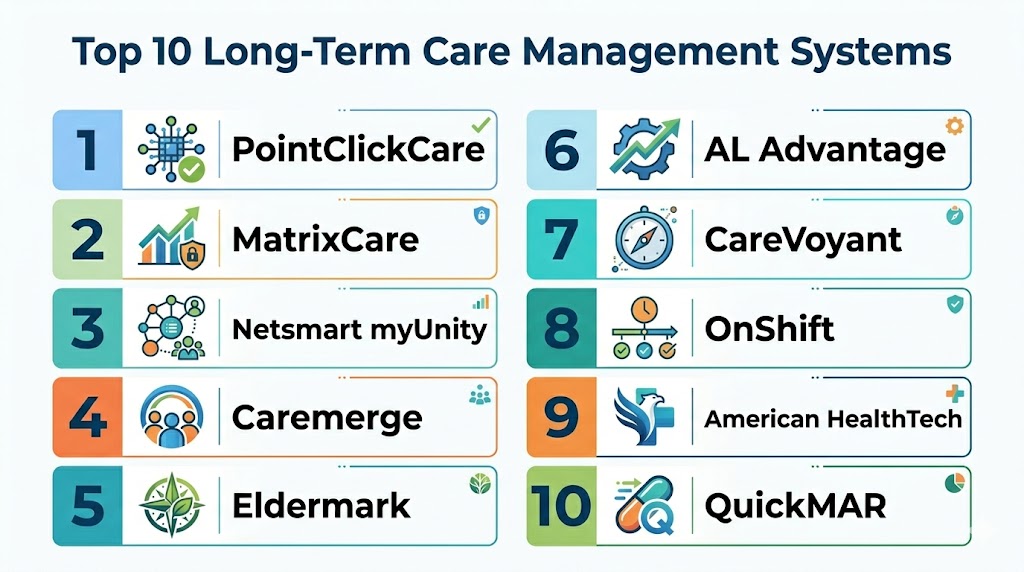
Top 10 Long-Term Care Management Systems
#1 — MatrixCare
MatrixCare is a comprehensive EHR and management solution designed specifically for the post-acute care spectrum. It is known for its robust clinical documentation and financial management tools, making it a favorite for both skilled nursing and senior living operators. The platform emphasizes driving better clinical outcomes through data-driven insights and a highly organized user interface that centralizes all resident information.
Key Features
- Full-Spectrum EHR: Comprehensive clinical documentation tailored for SNFs, Assisted Living, and Home Health.
- Intelligent Billing: Advanced revenue cycle management that handles Medicare, Medicaid, and private insurance.
- Care Plan Automation: Tools that automatically update care plans based on assessments and clinical observations.
- Advanced Reporting: A wide variety of pre-built reports for clinical, financial, and operational dimensions.
- Interoperability: Deep connections with pharmacy and laboratory partners for seamless data flow.
Pros
- Highly user-friendly filter system for individualized dashboards.
- “Copy Observations” feature reduces repetitive data entry for quarterly assessments.
- Excellent security settings that ensure HIPAA compliance while maintaining accessibility.
Cons
- Customization options are somewhat limited for specific facility types.
- The reporting engine can be challenging to navigate, often requiring search resets.
Platforms / Deployment
- Web / Windows / iOS / Android
- Cloud
Security & Compliance
- MFA, encryption at rest, SSO/SAML support.
- HIPAA compliant.
Integrations & Ecosystem
MatrixCare offers a broad range of integrations through its open API architecture.
- Major pharmacy partners
- Diagnostic laboratory services
- Third-party payroll and HR vendors
Support & Community
Provides regular software updates and a dedicated support portal, though some users find the initial implementation process complex for multi-level facilities.
#2 — PointClickCare
PointClickCare is widely considered the market leader in the long-term care software space. Its cloud-based platform connects thousands of providers across the care continuum, focusing on care coordination, medication management, and financial optimization. The system is built to reduce readmissions and improve transitions of care through real-time data visibility.
Key Features
- Integrated Care Coordination: Tools designed to track patient status and transitions across various care settings.
- Medication Management: A purpose-built eMAR system that integrates directly with pharmacy providers to reduce errors.
- Revenue Cycle Management: Automated billing workflows that support quality metrics and maximize reimbursements.
- Real-Time Intelligence: Dashboards that provide near-real-time visibility into resident health and facility performance.
- Hospital-to-Post-Acute Connectivity: Facilitates smooth handoffs from hospitals to LTC facilities.
Pros
- Extensive market share makes finding trained staff easier.
- Exceptionally strong focus on medication safety and pharmacy coordination.
- High uptime and stable performance across large portfolios.
Cons
- The extensive feature set can lead to a significant learning curve for new users.
- Pricing is typically at the higher end of the market spectrum.
Platforms / Deployment
- Web / iOS / Android
- Cloud
Security & Compliance
- SOC 2 Type II, HIPAA, and industry-standard encryption.
- Multi-factor authentication.
Integrations & Ecosystem
PointClickCare features one of the most expansive integration marketplaces in the LTC industry.
- Health Information Exchanges (HIEs)
- Extensive pharmacy and lab network
- CRM and marketing tools
Support & Community
Robust training via PointClickCare University and a massive user community that shares best practices.
#3 — Netsmart (myUnity)
Netsmart’s myUnity is an EHR purpose-built to simplify care management across every level of senior living, including independent living, assisted living, and memory care. The platform is designed around the concept of a single resident record that follows the individual regardless of where they are in the facility, ensuring clinical continuity and accurate billing.
Key Features
- Single Resident Record: A unified clinical and financial record that moves with the resident through levels of care.
- Intuitive Workflows: Role-based dashboards that reflect the actual workflows of clinicians and aides.
- HIE Connectivity: Advanced connectivity with CareQuality and other health information exchanges.
- Flexibility in Billing: Supports service-level billing for various care models within one platform.
- Referral Management: End-to-end electronic referral tracking from inquiry to admission.
Pros
- Near-seamless connections with hospitals and external healthcare partners.
- Excellent for multi-level facilities (CCRCs) that need a unified view of the resident.
- Strong focus on person-centered care documentation.
Cons
- The implementation process can be intensive for larger organizations.
- Some users find the interface less “modern” compared to newer SaaS competitors.
Platforms / Deployment
- Web / iOS / Android
- Cloud / Mobile
Security & Compliance
- ONC-certified, HIPAA compliant.
- SSO and role-based access controls.
Integrations & Ecosystem
Netsmart prioritizes interoperability through its CareConnect facilitating data exchange.
- CommonWell and CareQuality
- Billing clearinghouses
- Pharmacy and e-prescribing services
Support & Community
Offers dedicated support teams and a strong focus on CCBHC model advocacy and support.
#4 — ALIS (Assisted Living Intelligent Solutions)
ALIS (pronounced “Alice”) is a comprehensive suite of EHR tools specifically designed for the challenges faced by assisted living and memory care communities. It is particularly valued by organizations with portfolios spanning multiple states, as it helps manage varying compliance requirements while maintaining a focus on family engagement and resident wellness.
Key Features
- eMAR Management: Full medication administration management, including drug counting and pharmacy sync.
- Compliance Management: Tools designed to track state-specific regulatory requirements across multiple lines.
- Integrated Assessments: Automated clinical assessments that drive care plans and billing levels.
- Family Engagement: A dedicated portal for communicating updates and activities to resident families.
- Activity Tracking: Comprehensive logs for social and wellness activities within the community.
Pros
- Very easy for staff to learn and use, even those without prior computer experience.
- Strong focus on assisted living-specific workflows rather than skilled nursing.
- Excellent customer support with proactive implementation assistance.
Cons
- System requires admitting a resident before medication data can be entered, which can slow pre-admission prep.
- Manual MAR backups are currently required, adding a small administrative task.
Platforms / Deployment
- Web
- Cloud
Security & Compliance
- HIPAA compliant.
- Role-based permissions and secure data hosting.
Integrations & Ecosystem
ALIS offers core integrations focused on assisted living operations.
- Pharmacy software providers
- Marketing CRM integrations
- Billing and accounting software sync
Support & Community
Highly responsive support team known for personalized service and regular product updates.
#5 — Experience.care
Experience.care (formerly known as NetSolutions) provides a clinically-focused EHR and financial management system tailored for the long-term care industry. It is known for its “clinical first” approach, providing nurses and practitioners with the tools they need to document care accurately while ensuring the facility captures all appropriate reimbursements.
Key Features
- Advanced Charting: Deep clinical documentation capabilities with a focus on nursing workflows.
- Financial Management: A full suite of tools for accounts receivable, general ledger, and resident billing.
- Quality Reporting: Dashboards that track key quality metrics and survey readiness.
- MDS Management: Comprehensive tools for managing and submitting Minimum Data Set reports.
- Security Framework: Built-in compliance tools to mitigate security threats and protect data.
Pros
- High degree of customizability for clinical forms and templates.
- Strong focus on the financial health of the facility through accurate billing.
- Stable, time-tested platform with a deep understanding of LTC regulations.
Cons
- Some aspects of the user interface feel dated compared to newer cloud-native competitors.
- Can require significant manual configuration during the initial setup.
Platforms / Deployment
- Web / Windows
- Cloud / Hybrid
Security & Compliance
- HIPAA compliant, focuses on organizational accountability.
- Incident response planning and continuous monitoring.
Integrations & Ecosystem
Experience.care supports standard healthcare integrations to ensure clinical continuity.
- Pharmacy interfaces
- Laboratory result syncing
- Financial clearinghouses
Support & Community
Provides professional services for implementation and a library of training resources.
#6 — Eldermark
Eldermark is a purpose-built software suite for senior living that combines sales and marketing tools with clinical care management. It is designed to help facilities increase occupancy while simultaneously improving the quality of care and operational efficiency. It is particularly strong for organizations that want to integrate the business and clinical sides of their operation.
Key Features
- Combined Sales & Health Platform: Integrates CRM data with clinical health records.
- Medication Management: Mobile-friendly eMAR for error-free medication passes.
- Service Plan Tracking: Real-time verification of services provided via an app.
- Financial Analytics: Detailed reporting on costs of services and revenue per resident.
- Marketing & CRM: Full-service lead management specifically for the senior living industry.
Pros
- Users frequently praise the exceptional customer support during integration.
- The software is highly user-friendly and intuitive for frontline staff.
- Allows for easy verification of services at the point of care via mobile devices.
Cons
- Some clinical entries and order transcriptions still require manual data entry.
- Reporting features, while good, can sometimes feel rigid for complex queries.
Platforms / Deployment
- Web / iOS / Android
- Cloud
Security & Compliance
- HIPAA compliant.
- Secure mobile access for caregivers.
Integrations & Ecosystem
Eldermark emphasizes ease of integration with external programs and vendors.
- Pharmacy systems
- Marketing tools
- Billing and accounting integrations
Support & Community
Outstanding reputation for customer support and implementation assistance.
#7 — Yardi Voyager Senior Living
Yardi Voyager for Senior Living is an end-to-end enterprise solution that unifies community management, finance, sales, marketing, and clinical care. Known primarily for its roots in property management, Yardi has built a powerful senior living suite that offers unmatched financial and operational visibility for large-scale portfolio owners.
Key Features
- Unified ERP Platform: Combines EHR, CRM, and financial accounting on a single database.
- Single Resident Record: Ensures that data entered in sales flows seamlessly into clinical and billing.
- Advanced Clinical Reporting: Powerful business intelligence tools for tracking portfolio-wide quality.
- Mobile Wellness Tools: Tablets and apps for caregivers to document wellness and care on the go.
- Family Portal: Secure online portal for family engagement and payment processing.
Pros
- Excellent for large portfolios that need a “single landing place” for all modules.
- Unmatched financial accounting and investment optimization tools.
- Eliminates error-prone manual entry between disconnected systems.
Cons
- Can be overwhelming for smaller, single-community operations.
- Higher cost and more complex implementation compared to lighter SaaS tools.
Platforms / Deployment
- Web / iOS / Android
- Cloud
Security & Compliance
- SOC 1 & 2, HIPAA compliant.
- Enterprise-level security and data governance.
Integrations & Ecosystem
Yardi offers a massive suite of internal modules (Aspire, Procure to Pay, Energy Suite) plus external APIs.
- Full-service EHR and eMAR
- Marketing and leasing tools
- Property management and energy suites
Support & Community
Extensive training through Yardi Aspire and a global support network.
#8 — Cantata Health (Arize)
Cantata Health’s Arize platform is a cloud-based EHR designed for the post-acute care market, including long-term care and behavioral health. It focuses on flexibility and ease of use, providing a modern interface that helps clinicians focus more on residents and less on screen time.
Key Features
- Activity Dashboard: Real-time visibility into incidents and ongoing facility processes.
- Assessment Management: Streamlined creation and evaluation of clinical assessments.
- Claims Management: Built-in claims scrubbing and insurance eligibility verification.
- API First Approach: Designed for easy integration with other systems and databases.
- E-Prescribing: Seamless electronic transmission of prescriptions to pharmacies.
Pros
- Very clean and modern user interface that improves clinician satisfaction.
- Strong focus on claims accuracy to prevent revenue leakage.
- Mobile access is robust, allowing for charting at the point of service.
Cons
- Being a newer platform, its integration marketplace is still growing.
- Support community is smaller compared to industry giants.
Platforms / Deployment
- Web / iOS / Android
- Cloud
Security & Compliance
- HIPAA compliant.
- Secure file sharing and encrypted communications.
Integrations & Ecosystem
Arize uses an API-first philosophy to facilitate external connectivity.
- EHR/EMR integrations
- Pharmacy and laboratory links
- Financial clearinghouses
Support & Community
Direct support model with a focus on individualized customer success.
#9 — CareCloud (Wellness Suite)
CareCloud offers a cloud-native platform that provides EHR and practice management solutions. While it serves many healthcare segments, its wellness and chronic care modules are becoming increasingly popular in long-term care settings that prioritize patient engagement and revenue cycle management.
Key Features
- Interactive Patient Portal: Allows families and residents to manage demographics, payments, and appointments.
- Revenue Cycle Management (RCM): Advanced medical billing with automated reminders and contactless payments.
- Mobile Kiosks: Breeze add-on allows for digital check-in and checkout to reduce front-office workload.
- Secure Messaging: Internal tools for HIPAA-compliant communication between staff and families.
- Loyalty Campaigns: Tools to encourage engagement and return visits for wellness services.
Pros
- Exceptionally efficient appointment scheduling and real-time availability tracking.
- Excellent patient-facing features that enhance the overall resident experience.
- Automated reminders significantly reduce administrative follow-up time.
Cons
- The platform’s complexity can be challenging for users who prefer simple, linear workflows.
- Some customization limitations exist for very specific LTC niche needs.
Platforms / Deployment
- Web / iOS / Android
- Cloud
Security & Compliance
- HIPAA compliant.
- Stringent measures for data access and breach prevention.
Integrations & Ecosystem
CareCloud integrates seamlessly across various clinical and financial modules.
- Billing and clearinghouse systems
- Laboratory and imaging centers
- Patient engagement tools
Support & Community
Strong onboarding support, though some users report a temporary dip in productivity during the initial learning curve.
#10 — Caremerge (part of the K4Connect ecosystem)
Caremerge, now often integrated with broader senior living technology ecosystems, focuses heavily on the engagement and communication aspects of long-term care. While it includes clinical and management features, its standout capability is its ability to connect residents, families, and staff in a cohesive digital community.
Key Features
- Family Engagement Portal: Real-time updates, photo sharing, and messaging for families.
- Resident Wellness & Engagement: Tools for activity calendars, community dining, and social events.
- Clinical Records Integration: Basic EHR functionality that connects with the engagement portal.
- Integration with Voice Assistants: Support for tools like Amazon Alexa to assist residents in their rooms.
- Video Storytelling: Automated tools for sharing resident and staff stories with the community.
Pros
- Best-in-class for improving family satisfaction and resident social engagement.
- Very modern interface that appeals to tech-savvy families and staff.
- Excellent API toolkit for sharing data across multiple systems.
Cons
- As a standalone, it lacks the deep clinical/billing depth of MatrixCare or PointClickCare.
- Best used as part of a larger tech stack rather than a solo management system.
Platforms / Deployment
- Web / iOS / Android
- Cloud
Security & Compliance
- Single Sign-On (SSO) and secure ADT integration.
- HIPAA compliant data transfers.
Integrations & Ecosystem
Caremerge shines in its ability to connect with diverse lifestyle and operation tools.
- TheWorxHub for operations management
- Amazon Alexa for voice control
- spirometer and fitness video streaming services
Support & Community
Focuses on “partnership” support with regular webinars and client success resources.
Comparison Table (Top 10)
| Tool Name | Best For | Platform(s) Supported | Deployment | Standout Feature | Public Rating |
|---|---|---|---|---|---|
| MatrixCare | Clinical & Billing Integration | Web, iOS, Android | Cloud | “Copy Observations” Assessment | N/A |
| PointClickCare | Market-Leading eMAR | Web, iOS, Android | Cloud | Real-Time Care Coordination | N/A |
| Netsmart (myUnity) | CCRCs & Interoperability | Web, iOS, Android | Cloud | Single Resident Record Lifecycle | N/A |
| ALIS | Assisted Living Specialists | Web | Cloud | State-Specific Compliance Tools | N/A |
| Experience.care | Clinical-First Workflows | Web, Windows | Hybrid | High Clinical Customizability | N/A |
| Eldermark | Sales & Care Integration | Web, iOS, Android | Cloud | Integrated CRM/EHR Dashboard | N/A |
| Yardi Voyager | Large Portfolio ERP | Web, iOS, Android | Cloud | Property Management/Accounting | N/A |
| Cantata Health | Cloud-Native Flexibility | Web, iOS, Android | Cloud | API-First Architecture | N/A |
| CareCloud | Patient Portal & RCM | Web, iOS, Android | Cloud | Breeze Digital Check-In Kiosks | N/A |
| Caremerge | Resident/Family Engagement | Web, iOS, Android | Cloud | Voice Assistant Integration | N/A |
Evaluation & Scoring of Long-Term Care Management Systems
| Tool Name | Core (25%) | Ease (15%) | Integrations (15%) | Security (10%) | Performance (10%) | Support (10%) | Value (15%) | Weighted Total |
|---|---|---|---|---|---|---|---|---|
| MatrixCare | 10 | 8 | 9 | 9 | 9 | 8 | 8 | 8.9 |
| PointClickCare | 10 | 7 | 10 | 10 | 10 | 9 | 7 | 9.0 |
| Netsmart | 9 | 8 | 10 | 9 | 9 | 8 | 8 | 8.7 |
| ALIS | 8 | 10 | 8 | 9 | 9 | 10 | 9 | 8.8 |
| Experience.care | 9 | 7 | 8 | 9 | 8 | 8 | 8 | 8.1 |
| Eldermark | 8 | 9 | 8 | 9 | 9 | 10 | 9 | 8.7 |
| Yardi Voyager | 10 | 6 | 9 | 10 | 9 | 8 | 7 | 8.3 |
| Cantata Health | 8 | 9 | 8 | 9 | 9 | 8 | 8 | 8.2 |
| CareCloud | 7 | 8 | 8 | 9 | 9 | 8 | 8 | 7.8 |
| Caremerge | 6 | 10 | 9 | 8 | 9 | 9 | 8 | 7.7 |
How to Interpret the Scores
The scoring model above is designed to provide a comprehensive comparison based on the specific needs of long-term care environments. A high Core (25%) score indicates that the tool offers the essential “all-in-one” functionality including EHR, eMAR, and complex billing. The Weighted Total represents the overall balance of the platform. For example, PointClickCare scores highest overall due to its market-leading integration and clinical depth, while ALIS and Eldermark score high because of their exceptional ease of use and support, which are critical for frontline caregiver adoption.
When evaluating these scores, consider your specific organizational profile. If you manage a large enterprise, the Security (10%) and Integrations (15%) scores are non-negotiable. If you are a single-site assisted living facility, the Ease of Use (15%) and Value (15%) scores should be your primary drivers. The weighted total is a global benchmark, but your individual results will vary based on which criterion you weigh most heavily in your unique search.
Which Long-Term Care Management System Is Right for You?
Solo / Independent Community
For a single, independent assisted living community, ease of implementation and staff training are the most critical factors. ALIS or Eldermark are excellent choices because they are designed with a focused interface that doesn’t overwhelm smaller teams with unnecessary enterprise features. They offer a “high-touch” support model that is beneficial when you don’t have a large in-house IT department.
SMB (Small to Mid-Market)
Organizations managing 5–20 facilities need tools that offer portfolio-wide visibility without the extreme cost of a full ERP. Netsmart (myUnity) or Experience.care offer the clinical depth required for skilled nursing while remaining flexible enough for assisted living levels of care. These systems provide centralized reporting that allows regional managers to monitor quality across multiple sites effectively.
Mid-Market / Regional Portfolios
Regional operators moving toward a unified clinical and financial model should look at MatrixCare. Its ability to handle multi-level care settings (CCRCs) while providing robust billing makes it a strong contender for organizations that are professionalizing their back-office operations.
Enterprise / National Portfolios
Large, national organizations with hundreds of facilities need the stability and “standardization” of a market leader. PointClickCare or Yardi Voyager are the primary choices here. Yardi is particularly advantageous if the organization also focuses heavily on property management and real estate investment, while PointClickCare is the gold standard for clinical care coordination at scale.
Budget vs Premium
- Budget: Kalix (for smaller clinics) or focused modules from Eldermark offer high value at a lower price point.
- Premium: PointClickCare and MatrixCare are premium solutions that offer extensive feature sets and market-leading reliability for a higher investment.
Feature Depth vs Ease of Use
- Feature Depth: MatrixCare and Experience.care provide the most granular control over clinical documentation and financial settings.
- Ease of Use: ALIS and Caremerge are designed with the frontline caregiver in mind, prioritizing simple interfaces and mobile accessibility.
Integrations & Scalability
If your organization relies on a complex web of pharmacy, lab, and therapy partners, PointClickCare offers the most mature integration ecosystem. For organizations building a custom tech stack, Cantata Health (Arize) with its API-first approach provides the most flexibility for external connectivity.
Security & Compliance Needs
Every long-term care provider must prioritize HIPAA. However, if you are part of a larger healthcare system that requires SOC 2 or HITRUST certifications, SimplePractice or Yardi Voyager provide the highest levels of documented security protocols to satisfy corporate governance requirements.
Frequently Asked Questions (FAQs)
1. What are the typical pricing models for long-term care software?
Most long-term care management systems utilize a “Per Resident Per Month” (PRPM) or “Per Bed Per Month” pricing model. This allows the cost to scale up or down based on your facility’s occupancy. Some enterprise solutions may also charge a base implementation fee and additional costs for specific modules like eMAR, CRM, or advanced financial reporting.
2. How long does it usually take to implement a new system?
Implementation typically ranges from 60 to 120 days depending on the size of the organization and the complexity of the data migration. A single facility might be up and running in two months, while a large multi-site organization requires a phased rollout that can take six months or longer to ensure all staff are properly trained.
3. Can these systems handle both Skilled Nursing and Assisted Living?
Yes, many of the top systems like MatrixCare and PointClickCare are designed for “multi-level” facilities. They provide specific clinical modules for the high-intensity needs of skilled nursing (like MDS) while also offering lighter, social-model documentation tools for assisted living and independent living residents within the same platform.
4. What is the difference between an EHR and a full management system?
An EHR (Electronic Health Record) focuses primarily on the clinical documentation and health history of the resident. A full management system (often called an ERP) includes the EHR but also incorporates financial accounting, marketing/CRM, HR/payroll, and building maintenance, providing a single platform for the entire business operation.
5. How do these tools help with state and federal surveys?
These systems include built-in “survey readiness” dashboards that flag missing documentation, overdue assessments, or medication errors in real-time. By keeping all resident data organized and easily retrievable, facilities can provide surveyors with precise reports immediately, demonstrating a high level of oversight and compliance.
6. Do these systems require an active internet connection to work?
Most modern systems are cloud-based and require a stable internet connection. However, some enterprise solutions offer a “hybrid” model or “offline mode” for their eMAR and basic charting, which allows staff to continue documenting care during an outage and sync the data once the connection is restored.
7. Can families really see clinical notes in the family portal?
Usually, facilities can choose exactly what information is shared with families. Most portals show activity schedules, photos, and basic wellness updates. Clinical notes are typically restricted or summarized to protect resident privacy, although some platforms allow families to view medication lists and vital signs if the facility enables those permissions.
8. How do these systems integrate with local pharmacies?
Most LTC systems use a bi-directional interface with major pharmacy software providers. When a doctor enters a new order in the EHR, it is transmitted directly to the pharmacy. Once the pharmacy dispenses the medication, the information is sent back to the facility’s eMAR, ensuring that the medication list is always accurate.
9. What kind of hardware is required for staff to use these systems?
Most cloud-based systems are “hardware agnostic,” meaning they can run on standard PCs, laptops, and tablets. However, for eMAR, many facilities prefer ruggedized tablets or wall-mounted kiosks. Some mobile-first systems are optimized specifically for iPads or Android tablets to allow for charting at the bedside.
10. Is it possible to migrate data from an old paper-based system?
Yes, but it is a manual process. Implementation teams will typically help you “back-load” the last 30 to 60 days of clinical data and all current resident demographics. Transitioning from paper to digital is the best time to clean up your data and establish new, more efficient workflows for your care team.
Conclusion
The transition to a sophisticated long-term care management system is no longer a choice but a necessity for facilities aiming to thrive in a regulated and staff-constrained environment. By unifying clinical care, financial operations, and resident engagement into a single digital ecosystem, providers can significantly improve safety, reduce administrative burnout, and ensure financial viability. Whether you are a small assisted living community or a national skilled nursing portfolio, the right software will act as a partner in delivering high-quality, person-centered care. Your next step should be to identify your top three priorities—such as ease of use, billing accuracy, or family engagement—and schedule deep-dive demos with the vendors that best align with those specific goals.
