Introduction
Shadow IT discovery tools are security and SaaS governance platforms that identify, monitor, and control unauthorized applications, cloud services, browser tools, and AI apps being used inside an organization without IT approval. In simple terms, they help companies see “what software is actually being used” beyond officially approved systems.
These tools have become extremely important in 2026 because SaaS adoption has exploded across organizations, and employees frequently sign up for tools without IT involvement. This creates hidden risks such as data leaks, compliance violations, duplicate subscriptions, and uncontrolled software spending. Modern workplaces now also face “Shadow AI,” where employees use unapproved AI tools that process sensitive company data, increasing security exposure.
Common real-world use cases include detecting unauthorized SaaS apps, identifying shadow AI usage, tracking software spending, managing license waste, monitoring browser-based app usage, enforcing security policies, and improving SaaS governance.
When evaluating Shadow IT discovery tools, buyers should consider discovery depth, integration coverage, real-time monitoring, identity and SSO integration, financial data mapping, AI-driven insights, compliance reporting, automation capabilities, scalability, and ease of deployment.
Best for: IT security teams, SaaS governance teams, FinOps teams, enterprise security architects, compliance officers, and organizations with large SaaS ecosystems.
Not ideal for: very small companies with minimal SaaS usage, offline-first organizations, or teams without cloud-based identity systems.
Key Trends in Shadow IT Discovery Tools
- AI-powered detection of shadow SaaS and shadow AI usage across organizations
- Browser-level monitoring for SaaS usage visibility
- Identity-driven discovery using SSO and IAM integrations
- Financial data correlation for detecting unsanctioned subscriptions
- Real-time SaaS inventory generation and continuous monitoring
- Integration with CASB, SIEM, and DLP systems for unified security
- Automated risk scoring for shadow applications and tools
- SaaS sprawl detection and duplicate tool consolidation
- Expansion into AI tool governance and usage tracking
- Shift toward unified SaaS management + security platforms
Shadow IT detection is increasingly tied to broader SaaS governance strategies because organizations often discover dozens or even hundreds of unapproved applications during audits.
How We Selected These Tools
- Focused on platforms specifically designed for Shadow IT and SaaS discovery
- Included tools with strong SaaS visibility and governance capabilities
- Prioritized identity, browser, and API-based discovery methods
- Evaluated integration with SSO, IAM, and financial systems
- Considered real-time monitoring and continuous discovery features
- Included both SaaS Management Platforms and security-focused CASBs
- Assessed scalability for enterprise environments
- Reviewed AI-driven insights and automation capabilities
- Focused on tools actively used in production environments
- Avoided generic IT tools without SaaS discovery depth
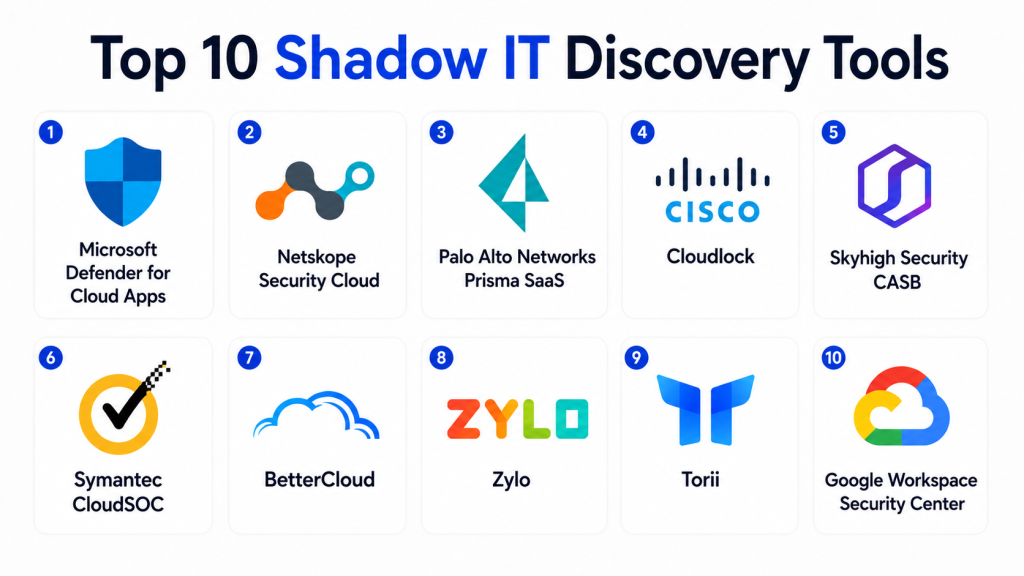
Top 10 Shadow IT Discovery Tools
1- Microsoft Defender for Cloud Apps
Short description: Microsoft Defender for Cloud Apps is a CASB and Shadow IT discovery platform that helps organizations identify and control unsanctioned SaaS usage. It provides deep visibility into cloud application usage across users, devices, and networks. It is widely used in Microsoft-centric enterprise environments for governance and compliance.
Key Features
- Cloud app discovery using traffic analysis
- SaaS usage monitoring and classification
- Risk scoring for cloud applications
- Policy-based access control and enforcement
- Integration with Microsoft security ecosystem
- Real-time alerting for unsanctioned apps
- OAuth app governance
Pros
- Strong integration with Microsoft ecosystem
- Powerful cloud app visibility
- Good enterprise security controls
- Strong compliance reporting capabilities
Cons
- Best suited for Microsoft environments
- Complex configuration for multi-cloud setups
- Requires tuning for accurate discovery
- Less intuitive for non-technical users
Platforms / Deployment
Cloud SaaS. Microsoft Azure ecosystem.
Security & Compliance
Supports enterprise RBAC, audit logs, and compliance frameworks depending on configuration. Not publicly stated for all certifications.
Integrations & Ecosystem
- Microsoft 365
- Azure Active Directory
- SIEM systems
- SaaS applications
- Endpoint security tools
Support & Community
Strong enterprise support through Microsoft ecosystem and global documentation.
2- Zylo
Short description: Zylo is a leading SaaS management platform focused on discovering, managing, and optimizing SaaS usage across enterprises. It provides strong visibility into shadow IT, SaaS spend, and license utilization. Zylo is widely used for SaaS governance and cost optimization.
Key Features
- SaaS application discovery and inventory
- Shadow IT detection across enterprise environments
- License optimization and usage tracking
- SaaS spend analytics and cost insights
- Contract and renewal management
- Department-level SaaS visibility
- Automated SaaS reporting
Pros
- Excellent SaaS visibility and governance
- Strong financial and usage analytics
- Helps reduce SaaS waste significantly
- Enterprise-grade scalability
Cons
- Enterprise pricing model
- Requires onboarding and setup effort
- Less suitable for small organizations
- Advanced features require training
Platforms / Deployment
Web. Cloud SaaS.
Security & Compliance
Supports enterprise security controls including SSO, RBAC, and audit logs. Compliance certifications not publicly stated.
Integrations & Ecosystem
- Okta
- Microsoft Azure AD
- Google Workspace
- Finance systems
- SaaS APIs
Support & Community
Strong enterprise onboarding and customer success support.
3- BetterCloud
Short description: BetterCloud is a SaaS operations platform that helps organizations manage SaaS applications, automate workflows, and detect shadow IT. It focuses on lifecycle automation, security enforcement, and SaaS governance.
Key Features
- SaaS application lifecycle management
- Shadow IT detection and monitoring
- Automated onboarding and offboarding workflows
- Security policy enforcement
- SaaS usage tracking and analytics
- Workflow automation engine
- Access management controls
Pros
- Strong SaaS automation capabilities
- Good identity and access governance
- Excellent workflow automation
- Strong enterprise adoption
Cons
- Complex setup for advanced workflows
- Requires IAM maturity
- Enterprise pricing structure
- Learning curve for new users
Platforms / Deployment
Cloud SaaS.
Security & Compliance
Supports SSO, MFA, audit logging, and enterprise security controls. Compliance varies by setup.
Integrations & Ecosystem
- Google Workspace
- Microsoft 365
- Okta
- SaaS APIs
- ITSM tools
Support & Community
Strong enterprise support with automation-focused documentation.
4- Torii
Short description: Torii is a SaaS management platform focused on automation and discovery of shadow IT applications. It helps organizations uncover hidden apps, manage SaaS usage, and automate workflows across IT systems.
Key Features
- SaaS discovery and mapping
- Shadow IT detection using identity and financial signals
- Automated onboarding and offboarding
- SaaS usage analytics
- Workflow automation builder
- License optimization
- SaaS inventory management
Pros
- Strong automation capabilities
- Easy workflow creation
- Good SaaS discovery coverage
- Fast deployment
Cons
- Limited financial planning depth
- Enterprise scaling requires tuning
- Pricing can grow with usage
- Advanced customization may be limited
Platforms / Deployment
Cloud SaaS.
Security & Compliance
Supports enterprise authentication and role-based access control. Not publicly stated for certifications.
Integrations & Ecosystem
- Okta
- Azure AD
- Google Workspace
- HR systems
- SaaS APIs
Support & Community
Good documentation and enterprise support availability.
5- Zluri
Short description: Zluri is a SaaS management and shadow IT discovery platform that provides visibility into SaaS usage, licensing, and security risks. It helps IT teams manage SaaS sprawl and improve governance.
Key Features
- SaaS discovery and inventory management
- Shadow IT detection
- License optimization and usage tracking
- SaaS access management
- Compliance monitoring
- SaaS analytics dashboard
- Workflow automation
Pros
- Strong SaaS visibility
- Good cost optimization tools
- Easy integration with identity systems
- Useful reporting dashboards
Cons
- Requires setup for accurate discovery
- Enterprise pricing model
- Learning curve for advanced features
- Limited offline capability
Platforms / Deployment
Cloud SaaS.
Security & Compliance
Supports RBAC, SSO, and audit logging. Certifications vary by deployment.
Integrations & Ecosystem
- Okta
- Azure AD
- Google Workspace
- SaaS APIs
- HR tools
Support & Community
Enterprise support with onboarding assistance.
6- Productiv
Short description: Productiv is a SaaS intelligence platform that focuses on application usage analytics and shadow IT discovery. It helps organizations understand SaaS adoption, usage trends, and business value.
Key Features
- SaaS usage tracking and analytics
- Shadow IT detection
- Application adoption monitoring
- License optimization insights
- Department-level SaaS reporting
- SaaS spend visibility
- SaaS portfolio intelligence
Pros
- Strong usage analytics
- Good adoption insights
- Helps optimize SaaS ROI
- Useful enterprise reporting
Cons
- Limited automation capabilities
- Requires mature data environment
- Enterprise pricing structure
- Less workflow flexibility
Platforms / Deployment
Cloud SaaS.
Security & Compliance
Supports enterprise access controls. Not publicly stated.
Integrations & Ecosystem
- Okta
- Microsoft 365
- Google Workspace
- Finance systems
- SaaS APIs
Support & Community
Enterprise-level support and customer success programs.
7- Lumos
Short description: Lumos is a modern identity-first SaaS management platform focused on shadow IT detection and access governance. It combines SaaS visibility with identity lifecycle automation.
Key Features
- SaaS discovery using identity signals
- Shadow IT detection
- Automated access provisioning
- License optimization
- Access request workflows
- SaaS usage tracking
- Compliance reporting
Pros
- Strong identity-first architecture
- Good automation workflows
- Modern UI and experience
- Strong security alignment
Cons
- Newer platform with evolving features
- Limited enterprise maturity
- Requires IAM integration
- Pricing may scale quickly
Platforms / Deployment
Cloud SaaS.
Security & Compliance
Supports SSO, RBAC, and audit logging. Not publicly stated for certifications.
Integrations & Ecosystem
- Okta
- Azure AD
- Google Workspace
- HR systems
- SaaS APIs
Support & Community
Growing enterprise adoption and support coverage.
8- CloudEagle.ai
Short description: CloudEagle.ai is an AI-driven SaaS management platform that focuses on shadow IT discovery, SaaS optimization, and procurement automation. It helps organizations reduce SaaS waste using intelligent analytics.
Key Features
- AI-based SaaS discovery
- Shadow IT detection
- License optimization
- SaaS spend analysis
- Contract and renewal management
- Procurement workflow automation
- Usage-based optimization
Pros
- Strong AI-driven insights
- Good cost optimization features
- Helps reduce SaaS waste
- Useful procurement automation
Cons
- Requires setup for accuracy
- Enterprise pricing model
- Limited workflow customization
- Newer platform compared to competitors
Platforms / Deployment
Cloud SaaS.
Security & Compliance
Supports enterprise authentication and access control. Not publicly stated.
Integrations & Ecosystem
- Okta
- Azure AD
- Google Workspace
- Finance tools
- SaaS APIs
Support & Community
Enterprise onboarding and support assistance.
9- Auvik SaaS Management
Short description: Auvik SaaS Management is a visibility platform that discovers SaaS usage through identity and browser activity signals. It helps organizations detect shadow IT and optimize SaaS usage.
Key Features
- SaaS discovery across organization
- Browser-based usage tracking
- Shadow IT detection
- SaaS inventory management
- Usage analytics and reporting
- Offboarding automation support
- SaaS risk visibility
Pros
- Strong SaaS discovery capabilities
- Good visibility into hidden apps
- Easy deployment
- Useful for IT teams
Cons
- Limited financial optimization features
- Less advanced automation
- Enterprise features may vary
- Smaller ecosystem
Platforms / Deployment
Cloud SaaS.
Security & Compliance
Supports standard enterprise security controls. Not publicly stated.
Integrations & Ecosystem
- SaaS applications
- Identity providers
- ITSM tools
- Cloud systems
Support & Community
Good enterprise support with SaaS visibility focus.
10- CoreView
Short description: CoreView is a SaaS governance platform focused on Microsoft 365 and enterprise SaaS environments. It provides visibility, automation, and shadow IT detection for Microsoft-heavy organizations.
Key Features
- SaaS governance for Microsoft ecosystem
- Shadow IT detection
- License optimization
- User lifecycle management
- SaaS usage reporting
- Compliance monitoring
- Role-based access control
Pros
- Strong Microsoft ecosystem integration
- Good governance and compliance features
- Strong automation capabilities
- Useful for enterprise IT teams
Cons
- Best suited for Microsoft environments
- Limited broader SaaS ecosystem coverage
- Requires configuration effort
- Enterprise pricing model
Platforms / Deployment
Cloud SaaS.
Security & Compliance
Supports enterprise security controls and compliance reporting. Not publicly stated.
Integrations & Ecosystem
- Microsoft 365
- Azure AD
- SaaS APIs
- ITSM tools
- HR systems
Support & Community
Strong enterprise support for Microsoft-centric organizations.
Comparison Table
| Tool Name | Best For | Platforms Supported | Deployment | Standout Feature | Public Rating |
|---|---|---|---|---|---|
| Microsoft Defender for Cloud Apps | Enterprise cloud governance | Microsoft ecosystem | Cloud | CASB-based discovery | N/A |
| Zylo | SaaS optimization | SaaS ecosystems | Cloud | SaaS spend visibility | N/A |
| BetterCloud | SaaS automation | SaaS platforms | Cloud | Workflow automation | N/A |
| Torii | SaaS discovery automation | SaaS ecosystems | Cloud | Shadow IT workflows | N/A |
| Zluri | SaaS governance | SaaS ecosystems | Cloud | License optimization | N/A |
| Productiv | SaaS intelligence | SaaS ecosystems | Cloud | Usage analytics | N/A |
| Lumos | Identity SaaS control | SaaS ecosystems | Cloud | Identity-first governance | N/A |
| CloudEagle.ai | AI SaaS optimization | SaaS ecosystems | Cloud | AI discovery engine | N/A |
| Auvik SaaS Mgmt | SaaS visibility | SaaS ecosystems | Cloud | Browser-based discovery | N/A |
| CoreView | Microsoft SaaS governance | Microsoft ecosystem | Cloud | M365 control | N/A |
Evaluation and Scoring of Shadow IT Discovery Tools
| Tool Name | Core 25% | Ease 15% | Integrations 15% | Security 10% | Performance 10% | Support 10% | Value 15% | Weighted Total |
|---|---|---|---|---|---|---|---|---|
| Microsoft Defender | 10 | 8 | 10 | 10 | 9 | 10 | 9 | 9.40 |
| Zylo | 9 | 8 | 9 | 9 | 9 | 9 | 8 | 8.85 |
| BetterCloud | 9 | 8 | 9 | 9 | 9 | 9 | 8 | 8.85 |
| Torii | 8 | 9 | 9 | 8 | 9 | 8 | 9 | 8.60 |
| Zluri | 8 | 9 | 9 | 8 | 9 | 8 | 9 | 8.60 |
| Productiv | 8 | 8 | 9 | 8 | 8 | 8 | 8 | 8.15 |
| Lumos | 8 | 9 | 9 | 9 | 8 | 8 | 8 | 8.40 |
| CloudEagle.ai | 8 | 8 | 9 | 8 | 9 | 8 | 9 | 8.45 |
| Auvik SaaS Mgmt | 8 | 8 | 8 | 8 | 8 | 8 | 8 | 8.00 |
| CoreView | 8 | 9 | 9 | 9 | 8 | 9 | 8 | 8.65 |
These scores reflect discovery depth, SaaS visibility, automation capabilities, identity integration, and enterprise governance strength. Microsoft Defender leads due to deep cloud and identity integration, while Zylo and BetterCloud excel in SaaS governance. AI-driven platforms like CloudEagle and identity-first tools like Lumos are gaining strong adoption in modern SaaS environments.
Which Shadow IT Discovery Tool Is Right for You
Solo / Freelancer
Solo users typically do not require enterprise-grade shadow IT tools. Basic SaaS tracking or manual monitoring is usually sufficient.
SMB
SMBs benefit from lightweight discovery and cost control tools. Torii, Zluri, and CloudEagle.ai are strong choices for balancing visibility and automation.
Mid-Market
Mid-market organizations need visibility, automation, and SaaS governance. Zylo, BetterCloud, Productiv, and Torii are strong options.
Enterprise
Enterprises require deep SaaS discovery, identity integration, compliance, and automation. Microsoft Defender, Zylo, BetterCloud, Okta-based tools, and CoreView are leading choices.
Budget vs Premium
Most tools are SaaS-based enterprise platforms. SMB-friendly tools like Zluri and Torii offer more accessible pricing, while enterprise platforms require larger investment.
Feature Depth vs Ease of Use
Microsoft Defender and Zylo offer deep enterprise capabilities. Torii and Lumos are easier to deploy. BetterCloud provides strong automation but requires configuration expertise.
Integrations & Scalability
Microsoft Defender, Zylo, and BetterCloud offer the strongest enterprise integrations. Identity-first tools like Lumos and Okta-based platforms scale well across SaaS ecosystems.
Security & Compliance Needs
Organizations with strict compliance requirements should prioritize Microsoft Defender, Zylo, BetterCloud, and CoreView due to strong governance, audit, and policy enforcement capabilities.
Frequently Asked Questions FAQs
1. What is shadow IT?
Shadow IT refers to software and SaaS applications used in an organization without IT approval. Employees often use these tools for productivity. However, they create security and compliance risks. Shadow IT discovery tools help identify them.
2. Why is shadow IT a security risk?
Shadow IT is risky because IT teams cannot monitor or secure these applications. This can lead to data leaks and compliance violations. Unauthorized tools may not follow security standards. Discovery tools help reduce these risks.
3. How do shadow IT discovery tools work?
These tools analyze identity data, browser activity, network traffic, and financial records. They identify SaaS applications being used across the organization. They then classify and report them for governance. Some tools also provide automation.
4. What is the difference between SaaS management and shadow IT discovery?
Shadow IT discovery focuses on identifying unknown or unauthorized apps. SaaS management includes discovery plus cost optimization and lifecycle management. SaaS management is a broader category. Shadow IT detection is a key feature within it.
5. Can shadow IT tools detect AI applications?
Yes, modern tools can detect shadow AI usage. They identify unapproved AI tools accessed by employees. This is becoming increasingly important in 2026. AI governance is now part of SaaS discovery.
6. Are shadow IT discovery tools necessary for SMBs?
They are not mandatory but highly useful for growing SMBs. As SaaS usage increases, visibility becomes important. SMB tools help prevent SaaS sprawl early. This reduces future governance issues.
7. Do these tools integrate with identity systems?
Yes, most tools integrate with Okta, Azure AD, and Google Workspace. Identity data helps track SaaS usage per user. This improves accuracy and governance. IAM integration is a core feature.
8. Can shadow IT tools reduce SaaS costs?
Yes, they identify unused and duplicate SaaS subscriptions. This helps organizations eliminate waste. Many companies reduce SaaS spending significantly using these tools. Cost optimization is a major benefit.
9. What is SaaS sprawl?
SaaS sprawl refers to uncontrolled growth of SaaS applications in an organization. It leads to duplicate tools and wasted licenses. It also increases security risks. Shadow IT tools help control SaaS sprawl.
10. How do companies choose the right tool?
Companies choose based on SaaS usage scale, identity integration needs, automation requirements, and budget. Enterprises prefer Zylo or Microsoft Defender. SMBs prefer Torii or Zluri. Identity-focused companies prefer Lumos or Okta-based tools.
Conclusion
Shadow IT discovery tools are essential for modern organizations that rely heavily on SaaS applications and cloud services. They provide visibility into hidden tools, reduce security risks, and improve SaaS governance. Microsoft Defender for Cloud Apps leads in enterprise-grade identity and cloud integration, while Zylo and BetterCloud offer strong SaaS governance and automation. Tools like Torii, Zluri, and CloudEagle.ai provide excellent SMB and mid-market visibility, and identity-first platforms like Lumos and CoreView bring deeper access control. The best approach is to combine shadow IT discovery with SaaS management and IAM systems, continuously monitor usage, and enforce governance policies to reduce risk and optimize software spend.

Good comparison article explaining how shadow IT tools support better asset visibility, compliance tracking, and security management across organizations.
A key gap is how effectively these tools detect and continuously track shadow IT usage without generating excessive false positives in dynamic enterprise environments.