Introduction
Application Security Testing platforms combining SAST and DAST help organizations secure software across the entire development lifecycle. SAST Static Application Security Testing analyzes source code early in development to detect vulnerabilities before deployment, while DAST Dynamic Application Security Testing evaluates running applications to identify runtime security issues such as injection flaws, authentication problems, and configuration weaknesses.
Together, SAST and DAST platforms provide end-to-end application security coverage, ensuring vulnerabilities are identified both in code and in live environments. This is critical in 2026 because applications are built faster, deployed more frequently, and rely heavily on APIs, microservices, cloud infrastructure, and third-party dependencies.
Common real-world use cases include scanning code for insecure coding patterns, detecting runtime vulnerabilities in web applications, securing APIs, validating security in CI CD pipelines, enforcing compliance standards, and reducing security risks in production systems.
When evaluating SAST and DAST platforms, buyers should consider language support, scanning accuracy, false positive rates, CI CD integration, API testing capability, automation features, remediation workflows, cloud readiness, scalability, compliance reporting, developer experience, and overall platform consolidation capabilities.
Best for: DevSecOps teams, application security engineers, cloud-native engineering teams, enterprises with CI CD pipelines, SaaS companies, security compliance teams, and organizations building large scale web or API based applications.
Not ideal for: very small projects without CI CD, static websites with minimal backend logic, or teams without active software development pipelines.
Key Trends in Application Security Testing SAST DAST Platforms
- Shift left security integration directly into IDEs and pull request workflows
- Unified AppSec platforms combining SAST, DAST, SCA, and API security in one system
- AI driven vulnerability detection and remediation suggestions reducing false positives
- Continuous DAST scanning integrated into CI CD pipelines instead of periodic testing
- API security becoming a primary focus due to microservices and distributed architectures
- Improved correlation between SAST and DAST findings for better risk prioritization
- Cloud native security testing designed for containers and Kubernetes environments
- SBOM driven security workflows linking dependency and application vulnerabilities
- Policy based enforcement blocking insecure builds before deployment
- Increased adoption of developer friendly security tools to reduce friction in DevOps
How We Selected These Tools
- Focused on platforms that provide both SAST and DAST capabilities or tightly integrated equivalents
- Included widely adopted enterprise application security testing solutions
- Prioritized CI CD integration and DevSecOps workflow compatibility
- Considered multi language and multi framework support for modern applications
- Evaluated support for API security testing and microservices architectures
- Included tools with strong vulnerability detection and remediation capabilities
- Balanced enterprise platforms and developer friendly tools for broader coverage
- Focused on tools actively used in production environments at scale
- Considered scalability across cloud native and hybrid deployments
- Avoided tools without meaningful real world adoption in AppSec programs
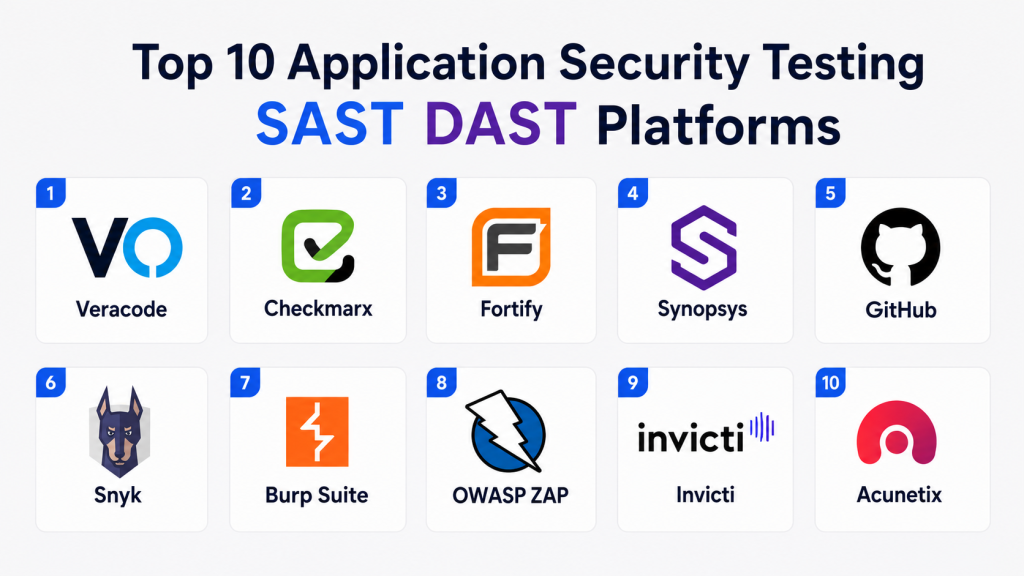
Top 10 Application Security Testing SAST DAST Platforms
1- Veracode
Short description: Veracode is a cloud based application security platform that provides SAST, DAST, SCA, and infrastructure scanning in a unified system. It is widely used in enterprise environments for policy driven application security and compliance enforcement. Veracode helps organizations secure applications across the SDLC with automated scanning and remediation support. It is especially strong in regulated industries and large scale enterprise environments.
Key Features
- Integrated SAST and DAST scanning in a single platform
- Cloud based security testing and analysis
- Policy driven security enforcement workflows
- Support for multiple programming languages and frameworks
- AI assisted remediation recommendations
- API security and dynamic scanning capabilities
- Centralized risk management dashboard
Pros
- Strong enterprise grade application security coverage
- Unified SAST DAST SCA platform reduces tool fragmentation
- Good compliance and governance support
- Suitable for large scale SDLC environments
Cons
- Enterprise pricing may be high for smaller teams
- Setup and onboarding can be complex
- Requires governance alignment for full value
- Some workflows may feel rigid for developers
Platforms / Deployment
Web. Cloud.
Security & Compliance
Supports enterprise security controls including SSO, RBAC, audit logging, and compliance workflows. Specific certifications depend on deployment and configuration. Not publicly stated for all details.
Integrations & Ecosystem
Veracode integrates with DevSecOps pipelines and enterprise development workflows.
- Jenkins
- GitHub
- GitLab
- Azure DevOps
- CI CD pipelines
- Issue tracking systems
Support & Community
Enterprise support model with documentation, onboarding assistance, and security engineering guidance.
2- Checkmarx One
Short description: Checkmarx One is a unified application security platform that combines SAST, DAST, SCA, and API security testing into a single cloud native solution. It is designed for DevSecOps teams that need continuous security testing across the SDLC. Checkmarx focuses on reducing false positives and improving developer productivity through integrated workflows.
Key Features
- Unified SAST and DAST security testing platform
- API security testing for modern applications
- Continuous scanning across CI CD pipelines
- Cloud native application security posture management
- Developer friendly security feedback loops
- Risk prioritization and vulnerability correlation
- Centralized application security dashboard
Pros
- Strong unified platform approach
- Good DevSecOps integration
- Effective for large scale enterprise applications
- Supports modern API driven architectures
Cons
- Complex setup for small teams
- Requires tuning for optimal accuracy
- Enterprise oriented pricing model
- Learning curve for full platform usage
Platforms / Deployment
Web. Cloud. Hybrid options depending on deployment.
Security & Compliance
Supports enterprise governance, audit logs, access controls, and compliance reporting. Exact certifications vary by configuration. Not publicly stated for all details.
Integrations & Ecosystem
Checkmarx integrates with CI CD pipelines, development tools, and enterprise security ecosystems.
- GitHub
- GitLab
- Jenkins
- Azure DevOps
- Bitbucket
- Security orchestration tools
Support & Community
Strong enterprise support with documentation, training, and security advisory services.
3- HCL AppScan
Short description: HCL AppScan is an enterprise application security testing platform that provides SAST, DAST, IAST, and SCA capabilities. It is widely used in large organizations requiring deep security analysis across applications. AppScan supports continuous security testing and compliance focused workflows.
Key Features
- SAST and DAST integrated application testing
- IAST runtime security analysis
- API security testing capabilities
- Compliance focused reporting and dashboards
- Automated vulnerability detection workflows
- CI CD pipeline integration
- Risk based prioritization engine
Pros
- Comprehensive AppSec coverage in one platform
- Strong compliance and enterprise reporting
- Supports multiple testing methodologies
- Suitable for complex application environments
Cons
- Heavy platform for small teams
- Requires setup and tuning for best results
- Interface complexity in large deployments
- Enterprise licensing model
Platforms / Deployment
Web. Cloud. On premise.
Security & Compliance
Supports enterprise security controls, audit trails, and compliance reporting depending on deployment. Not publicly stated for all certifications.
Integrations & Ecosystem
AppScan integrates with DevOps pipelines and enterprise security systems.
- Jenkins
- GitHub
- GitLab
- Azure DevOps
- Container pipelines
- Ticketing systems
Support & Community
Enterprise support with documentation, onboarding, and professional services.
4- Snyk
Short description: Snyk is a developer focused application security platform that provides SAST, DAST, SCA, and container security scanning. It is widely used in modern DevSecOps workflows due to its ease of integration and developer friendly experience. Snyk emphasizes fast feedback and automated remediation in CI CD pipelines.
Key Features
- SAST and SCA scanning for application code
- DAST capabilities for running applications
- Container and infrastructure scanning support
- Continuous vulnerability monitoring
- Automated fix pull requests
- Developer IDE integration
- API security and cloud native support
Pros
- Strong developer experience and usability
- Easy CI CD integration
- Automated remediation workflows
- Broad ecosystem coverage
Cons
- Advanced enterprise governance requires higher plans
- Can generate high alert volume without tuning
- Limited deep customization for some enterprise use cases
- Pricing may scale with usage
Platforms / Deployment
Web. Cloud. CLI. IDE integrations.
Security & Compliance
Supports enterprise authentication, RBAC, audit logs, and security policies depending on plan. Not publicly stated for full compliance certifications.
Integrations & Ecosystem
Snyk integrates widely across development and DevSecOps ecosystems.
- GitHub
- GitLab
- Bitbucket
- Jenkins
- Docker
- Kubernetes
Support & Community
Strong developer community, documentation, and enterprise support options.
5- GitHub Advanced Security CodeQL
Short description: GitHub Advanced Security provides integrated application security testing using CodeQL for SAST along with dependency and secret scanning. It is tightly embedded into GitHub workflows, making it ideal for GitHub centric development teams. It provides security feedback directly in pull requests.
Key Features
- CodeQL based static application security testing
- Dependency vulnerability scanning integration
- Secret detection in repositories
- Security alerts inside GitHub workflows
- Pull request based security analysis
- Continuous code scanning automation
- Multi language support
Pros
- Seamless GitHub integration
- Developer friendly security feedback
- No separate platform required
- Strong automation in CI CD pipelines
Cons
- Limited outside GitHub ecosystem
- Less flexible than standalone AppSec platforms
- Advanced enterprise controls depend on GitHub plan
- Focused more on SAST than full DAST depth
Platforms / Deployment
Web. Cloud native within GitHub.
Security & Compliance
Depends on GitHub enterprise security model including RBAC, audit logs, and organization policies. Not publicly stated for all certifications.
Integrations & Ecosystem
Built directly into GitHub ecosystem and workflows.
- GitHub repositories
- GitHub Actions
- CI CD pipelines
- Developer IDE extensions
- Package ecosystems
Support & Community
Backed by GitHub documentation and large global developer community.
6- SonarQube
Short description: SonarQube is a widely used static analysis platform focused on code quality and security. It is commonly used for SAST within CI CD pipelines. It helps teams identify code vulnerabilities, bugs, and technical debt in applications.
Key Features
- Static code analysis for security and quality
- Multi language support
- CI CD integration
- Security rule sets for vulnerability detection
- Code quality gates for build control
- Developer feedback inside pull requests
- Custom rule configuration
Pros
- Strong code quality and security combination
- Easy CI CD integration
- Open source and enterprise versions available
- Widely adopted in development teams
Cons
- Limited DAST capabilities
- Requires tuning for large codebases
- False positives may require adjustment
- Enterprise features required for advanced governance
Platforms / Deployment
Web. Cloud. Self hosted.
Security & Compliance
Supports role based access control, audit logs, and enterprise governance features depending on version. Not publicly stated for certifications.
Integrations & Ecosystem
SonarQube integrates widely into development pipelines.
- GitHub
- GitLab
- Jenkins
- Azure DevOps
- CI CD systems
- IDE plugins
Support & Community
Strong open source community with enterprise support options.
7- Burp Suite Enterprise
Short description: Burp Suite Enterprise is a dynamic application security testing platform focused on web application and API security. It is widely used for DAST scanning and penetration testing automation. It helps organizations identify runtime vulnerabilities in production like environments.
Key Features
- Automated DAST scanning for web applications
- API security testing support
- Crawling and vulnerability detection engine
- Authentication handling for modern apps
- CI CD integration for continuous testing
- Reporting and vulnerability tracking
- Scalable enterprise scanning capabilities
Pros
- Strong DAST capabilities for runtime testing
- Excellent for API and web application security
- Widely trusted in penetration testing workflows
- Scalable enterprise architecture
Cons
- Focused mainly on DAST rather than full SAST coverage
- Requires configuration for complex applications
- Can generate false positives in some scenarios
- Licensing cost may be high
Platforms / Deployment
Web. Cloud. Self hosted options.
Security & Compliance
Supports enterprise security features such as access control, audit logs, and scanning policies. Not publicly stated for certifications.
Integrations & Ecosystem
Integrates with DevSecOps pipelines and security operations tools.
- Jenkins
- GitHub
- GitLab
- CI CD pipelines
- Security dashboards
- API testing tools
Support & Community
Strong security community support with enterprise documentation and professional support.
8- Invicti
Short description: Invicti is a DAST focused application security testing platform designed for automated vulnerability detection in web applications and APIs. It is known for high accuracy scanning and enterprise scalability. It is widely used for continuous security validation in production environments.
Key Features
- Automated DAST scanning engine
- API security testing
- High accuracy vulnerability detection
- CI CD pipeline integration
- Continuous scanning and monitoring
- Proof based vulnerability validation
- Enterprise reporting dashboards
Pros
- Strong DAST accuracy and coverage
- Low false positive rate compared to many tools
- Good enterprise scalability
- Strong automation features
Cons
- Focused mainly on DAST not full SAST suite
- Requires integration planning for full SDLC coverage
- Enterprise pricing model
- Setup complexity for advanced workflows
Platforms / Deployment
Web. Cloud. Self hosted.
Security & Compliance
Supports enterprise authentication, RBAC, and audit logging. Compliance details vary by deployment. Not publicly stated.
Integrations & Ecosystem
Invicti integrates with CI CD pipelines and DevSecOps systems.
- Jenkins
- GitHub
- GitLab
- Azure DevOps
- Security orchestration tools
- API gateways
Support & Community
Enterprise support with strong documentation and onboarding services.
9- Veracode
Short description: Veracode is a cloud based application security testing platform that provides SAST, DAST, SCA, and IaC scanning in a unified environment. It is widely used in regulated industries for secure software development and compliance enforcement.
Key Features
- Integrated SAST and DAST platform
- AI assisted vulnerability remediation
- CI CD pipeline integration
- Policy driven security testing
- API and application scanning
- Compliance reporting tools
- Centralized security dashboard
Pros
- Strong compliance focused security model
- Unified application security platform
- Good enterprise governance features
- Supports full SDLC security coverage
Cons
- Enterprise complexity and cost
- Requires onboarding effort
- Less flexible for small teams
- Some workflows are rigid
Platforms / Deployment
Web. Cloud.
Security & Compliance
Supports enterprise grade security controls including RBAC, audit logs, and compliance workflows depending on configuration. Not publicly stated for certifications.
Integrations & Ecosystem
Veracode integrates into enterprise DevSecOps environments.
- GitHub
- GitLab
- Jenkins
- Azure DevOps
- CI CD tools
- Issue tracking systems
Support & Community
Strong enterprise support and compliance focused customer programs.
10- Checkmarx One
Short description: Checkmarx One is a unified application security testing platform combining SAST, DAST, SCA, and API security testing. It is designed for DevSecOps teams needing end to end application security coverage. It focuses on reducing risk and improving developer productivity through integrated scanning.
Key Features
- Unified SAST and DAST platform
- API security testing
- Application security posture management
- CI CD integration support
- Continuous vulnerability detection
- Risk prioritization engine
- Developer centric security workflows
Pros
- Strong unified AppSec platform
- Good enterprise scale capabilities
- Supports modern application architectures
- Strong DevSecOps integration
Cons
- Complex setup for small teams
- Requires tuning for large environments
- Enterprise pricing model
- Learning curve for full platform usage
Platforms / Deployment
Web. Cloud. Hybrid options.
Security & Compliance
Supports enterprise governance, audit logging, RBAC, and compliance workflows depending on configuration. Not publicly stated for certifications.
Integrations & Ecosystem
Checkmarx integrates deeply into DevSecOps ecosystems.
- GitHub
- GitLab
- Jenkins
- Azure DevOps
- CI CD pipelines
- Security orchestration tools
Support & Community
Enterprise support with training, documentation, and security advisory services.
Comparison Table
| Tool Name | Best For | Platforms Supported | Deployment | Standout Feature | Public Rating |
|---|---|---|---|---|---|
| Veracode | Enterprise AppSec governance | Web | Cloud | Unified SAST DAST platform | N/A |
| Checkmarx One | DevSecOps security platform | Web | Cloud Hybrid | Unified AppSec coverage | N/A |
| HCL AppScan | Compliance heavy enterprises | Web | Cloud On premise | SAST DAST IAST combination | N/A |
| Snyk | Developer first security | Web CLI IDE | Cloud | Automated remediation | N/A |
| GitHub Advanced Security | GitHub native teams | Web | Cloud | CodeQL integration | N/A |
| SonarQube | Code quality and SAST | Web | Cloud Self hosted | Quality gates | N/A |
| Burp Suite Enterprise | DAST security testing | Web | Cloud Self hosted | Advanced web scanning | N/A |
| Invicti | DAST automation | Web | Cloud Self hosted | High accuracy DAST scanning | N/A |
| Veracode | Regulated industries | Web | Cloud | Policy driven AppSec | N/A |
| Checkmarx One | Unified AppSec | Web | Cloud Hybrid | Full SDLC security | N/A |
Evaluation and Scoring of Application Security Testing Platforms
| Tool Name | Core 25% | Ease 15% | Integrations 15% | Security 10% | Performance 10% | Support 10% | Value 15% | Weighted Total |
|---|---|---|---|---|---|---|---|---|
| Veracode | 9 | 8 | 9 | 9 | 8 | 9 | 7 | 8.40 |
| Checkmarx One | 9 | 8 | 9 | 9 | 8 | 9 | 8 | 8.60 |
| HCL AppScan | 9 | 7 | 8 | 9 | 8 | 8 | 7 | 8.10 |
| Snyk | 8 | 9 | 10 | 9 | 9 | 9 | 9 | 8.95 |
| GitHub Advanced Security | 8 | 10 | 10 | 8 | 9 | 9 | 10 | 9.05 |
| SonarQube | 8 | 9 | 9 | 8 | 9 | 8 | 10 | 8.70 |
| Burp Suite Enterprise | 8 | 8 | 9 | 9 | 9 | 8 | 8 | 8.40 |
| Invicti | 8 | 8 | 9 | 9 | 9 | 8 | 8 | 8.45 |
| Veracode | 9 | 8 | 9 | 9 | 8 | 9 | 7 | 8.40 |
| Checkmarx One | 9 | 8 | 9 | 9 | 8 | 9 | 8 | 8.60 |
These scores are comparative and based on real world enterprise adoption, CI CD integration, vulnerability detection capability, developer experience, and platform maturity. SAST focused tools like SonarQube and Snyk perform strongly in developer workflows, while DAST leaders like Invicti and Burp Suite excel in runtime security. Unified platforms like Checkmarx One and Veracode provide the most complete coverage for enterprise environments.
Which Application Security Testing Platform Is Right for You
Solo / Freelancer
Solo developers should focus on simplicity and fast feedback. GitHub Advanced Security, Snyk, and SonarQube are strong choices because they integrate easily into development workflows without heavy setup.
SMB
SMBs need balance between automation and cost. Snyk, SonarQube, Burp Suite Community workflows, and Invicti are good choices depending on whether the focus is code security or runtime testing.
Mid-Market
Mid-market teams require better coverage across SAST and DAST. Checkmarx One, Snyk, Invicti, and Veracode offer strong combinations of automation, scalability, and CI CD integration.
Enterprise
Enterprises need full SDLC coverage, compliance reporting, governance, and scalability. Veracode, Checkmarx One, HCL AppScan, Invicti, and Burp Suite Enterprise are leading choices.
Budget vs Premium
Open source or developer focused tools like SonarQube and GitHub Advanced Security offer strong value. Premium enterprise tools like Veracode and Checkmarx provide governance, compliance, and full lifecycle security.
Feature Depth vs Ease of Use
Snyk and GitHub Advanced Security are easiest for developers. Veracode and Checkmarx provide deeper enterprise control but require more setup. Burp Suite excels in DAST depth but is more specialized.
Integrations & Scalability
Snyk, Checkmarx, and Veracode provide the strongest CI CD integrations and scalability. GitHub Advanced Security is best for GitHub native workflows. Invicti and Burp Suite scale well for runtime application security testing.
Security & Compliance Needs
Enterprises in regulated industries should prioritize Veracode, Checkmarx One, HCL AppScan, and Invicti due to strong governance, reporting, and compliance alignment capabilities.
Frequently Asked Questions FAQs
1. What is SAST in application security?
SAST stands for Static Application Security Testing. It analyzes source code before the application runs to find vulnerabilities early in development. It helps developers fix issues before deployment. It is a key part of shift left security.
2. What is DAST in application security?
DAST stands for Dynamic Application Security Testing. It tests running applications to find vulnerabilities from an external perspective. It simulates real attack scenarios. It helps detect runtime issues that SAST cannot find.
3. Why do organizations need both SAST and DAST?
Organizations need both because they cover different stages of security. SAST finds issues in code early, while DAST finds issues in running applications. Together they provide full lifecycle security coverage. This reduces overall risk significantly.
4. What is the difference between SAST and DAST tools?
SAST tools analyze code without running it, while DAST tools test live applications. SAST is used during development and DAST is used during testing or production stages. Both complement each other in DevSecOps pipelines. They address different types of vulnerabilities.
5. Which tool is best for beginners?
GitHub Advanced Security, Snyk, and SonarQube are best for beginners. They integrate easily into existing workflows. They provide clear vulnerability reports and remediation guidance. They require minimal setup compared to enterprise platforms.
6. Do these tools slow down CI CD pipelines?
Modern tools are optimized for CI CD environments and usually have minimal impact. Lightweight tools like Snyk and SonarQube run quickly in pipelines. More advanced enterprise tools may take longer but provide deeper analysis. Overall impact is manageable.
7. Are SAST and DAST tools enough for application security?
They are important but not enough alone. Organizations also need dependency scanning, API security testing, and runtime protection. A complete AppSec strategy includes multiple layers. SAST and DAST are core but not complete solutions.
8. What is a unified application security platform?
A unified platform combines SAST, DAST, SCA, and API security into one system. It reduces tool fragmentation and improves visibility. Platforms like Checkmarx One and Veracode follow this model. It simplifies security management.
9. What are common mistakes when using these tools?
Common mistakes include ignoring false positives, not integrating tools into CI CD, and failing to act on findings. Another mistake is using only one type of testing. Proper tuning and workflow integration are essential for success.
10. How do organizations choose the right AppSec platform?
Organizations choose based on development workflow, team size, compliance needs, and integration requirements. GitHub-native teams prefer GitHub Advanced Security. Enterprises prefer Veracode or Checkmarx. Developers prefer Snyk or SonarQube.
Conclusion
Application Security Testing platforms combining SAST and DAST are essential for securing modern software systems built on fast CI CD pipelines, APIs, and cloud-native architectures. SAST helps detect vulnerabilities early in code, while DAST identifies runtime issues in live applications. Tools like Snyk, GitHub Advanced Security, and SonarQube are ideal for developer-first workflows, while Invicti and Burp Suite excel in runtime security testing. Enterprise platforms like Veracode, Checkmarx One, and HCL AppScan provide full lifecycle security and compliance support. The best approach is to combine both SAST and DAST capabilities, integrate them into CI CD pipelines, and continuously refine security policies to reduce risk and improve software resilience.
