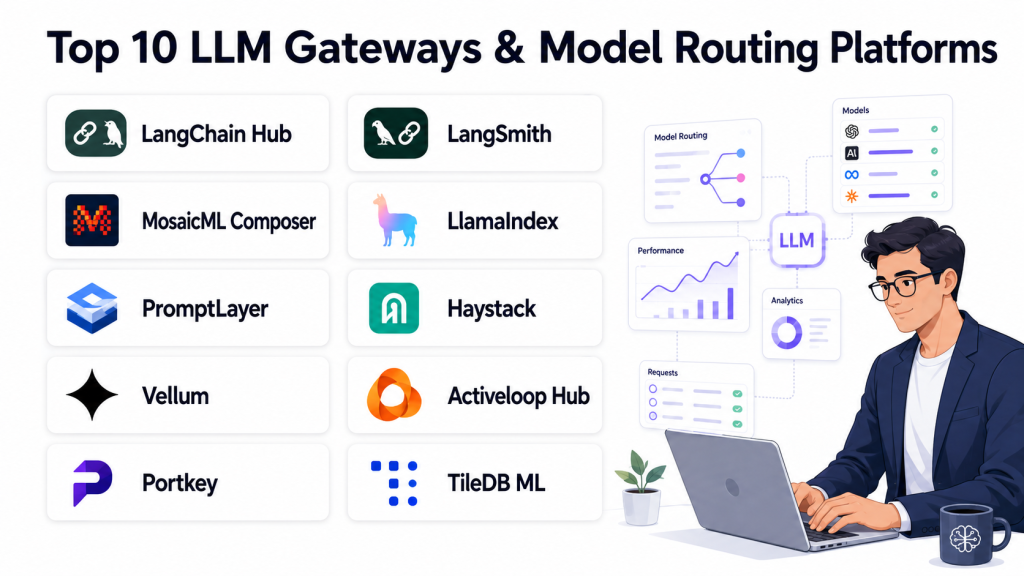
Introduction
LLM gateways and model routing platforms are tools that manage, orchestrate, and route requests to large language models (LLMs) across different providers, versions, or specialized models. They simplify multi-model deployment, ensure reliability, optimize costs, and provide consistent API access. With the explosion of AI usage in enterprises, these platforms help teams manage multiple LLMs for specific tasks like summarization, chat, and embeddings efficiently.
Real-world use cases include:
- Routing user queries to specialized LLMs for customer support, legal, or technical domains
- Managing model versions to ensure performance consistency and fallback options
- Optimizing API costs by directing queries to appropriate models
- Monitoring latency, usage, and model performance in production
- Integrating LLMs into internal applications with abstraction layers
Key evaluation criteria for buyers:
- Multi-model support and routing flexibility
- Latency and performance monitoring
- Failover and fallback mechanisms
- API standardization and developer usability
- Security, privacy, and compliance
- Observability and logging
- Cost optimization and usage control
- Cross-platform and cloud support
- Integration with orchestration pipelines and APIs
- Documentation and community support
Best for: Enterprises, AI teams, developers, and organizations running multiple LLMs in production.
Not ideal for: Teams experimenting with a single model or small-scale AI projects that do not require routing or multi-model orchestration.
Key Trends in LLM Gateways & Model Routing Platforms
- Multi-LLM orchestration with real-time routing decisions
- AI-driven load balancing and cost optimization
- Observability dashboards for monitoring latency and usage
- Failover and fallback to alternative models for reliability
- Role-based access control and secure API management
- Integration with prompt evaluation and testing frameworks
- Dynamic routing based on query type or domain
- Cloud-native, containerized deployment for scalability
- Versioning and model lifecycle management
- Standardized API abstraction for multi-provider compatibility
How We Selected These Tools (Methodology)
- Evaluated market adoption and reliability in enterprise AI projects
- Assessed multi-model orchestration and routing flexibility
- Measured latency, failover, and performance metrics
- Reviewed security, authentication, and compliance measures
- Analyzed API usability and developer experience
- Considered integration with pipelines, orchestration frameworks, and observability tools
- Examined monitoring, logging, and alerting capabilities
- Evaluated cost optimization and billing features
- Reviewed documentation, SDKs, and support channels
- Compared pricing, deployment flexibility, and scalability
Top 10 LLM Gateways & Model Routing Platforms
#1 — LangSmith
Short description (4–5 lines): LangSmith is an LLM observability and routing platform providing tracing, logging, and model evaluation. Ideal for enterprises needing monitoring and reliability across multiple LLMs.
Key Features
- Model request tracing and logs
- Error tracking and fallback routing
- Integration with prompt evaluation frameworks
- Multi-model routing policies
- Analytics dashboards
Pros
- Strong observability and logging
- Flexible routing options for multi-model setups
Cons
- Learning curve for configuration
- Pricing not publicly stated
Platforms / Deployment
- Web, API; Cloud-based
Security & Compliance
- Not publicly stated
Integrations & Ecosystem
- LangChain, Python SDK, API access, prompt evaluation frameworks
Support & Community
Documentation, SDK support, active developer community.
#2 — Portkey
Short description (4–5 lines): Portkey provides routing and reliability features for LLM requests with monitoring and performance controls. Suitable for AI teams managing multiple model endpoints in production.
Key Features
- Request routing with failover
- Latency monitoring and metrics
- Multi-model versioning
- API abstraction for uniform access
- Cost optimization tools
Pros
- Reliable routing for production LLMs
- Observability dashboards included
Cons
- Limited public documentation
- Some enterprise features require subscription
Platforms / Deployment
- Web, API; Cloud-based
Security & Compliance
- Not publicly stated
Integrations & Ecosystem
- LangChain, Python/Node SDK, logging pipelines, custom routing rules
Support & Community
Support channels, tutorials, community forums.
#3 — Vellum
Short description (4–5 lines): Vellum provides visual LLM workflow orchestration with routing, logging, and API monitoring. Ideal for teams managing complex AI applications with multiple model endpoints.
Key Features
- Visual workflow design
- Multi-model orchestration
- Request logging and metrics
- Retry and fallback mechanisms
- Integration with evaluation tools
Pros
- Visual design simplifies complex routing
- Integrated observability
Cons
- Can be complex for small projects
- Documentation may require technical expertise
Platforms / Deployment
- Web, API; Cloud-based
Security & Compliance
- Not publicly stated
Integrations & Ecosystem
- LangChain, Python SDK, logging & monitoring tools
Support & Community
Tutorials, active developer community, support channels.
#4 — Helicone
Short description (4–5 lines): Helicone focuses on observability and cost insights for LLM API usage. Ideal for teams needing detailed logging and analytics for prompt-level performance evaluation.
Key Features
- LLM API request logging
- Performance metrics and latency analysis
- Prompt evaluation support
- Cost and usage analytics
- Integration with monitoring tools
Pros
- Detailed analytics for prompt and model behavior
- Supports cost monitoring
Cons
- Does not handle complex routing itself
- Advanced features may require paid plans
Platforms / Deployment
- Web, API; Cloud-based
Security & Compliance
- Not publicly stated
Integrations & Ecosystem
- LangChain, Python SDK, dashboards, alerting tools
Support & Community
Documentation, email support, developer forums.
#5 — PromptLayer
Short description (4–5 lines): PromptLayer is a prompt versioning and observability platform that logs LLM requests and tracks model outputs. Ideal for prompt engineering and iterative model evaluation.
Key Features
- Prompt logging and version control
- Multi-model compatibility
- Output tracking and metrics
- Integration with AI development workflows
- Analytics dashboards
Pros
- Focused on prompt management
- Easy integration with LangChain and custom pipelines
Cons
- Limited routing capabilities
- Cloud dependency for logging
Platforms / Deployment
- Web, API; Cloud-based
Security & Compliance
- Not publicly stated
Integrations & Ecosystem
- LangChain, Python SDK, AI evaluation frameworks, API access
Support & Community
Documentation, community support, SDK examples.
#6 — LangFlow
Short description (4–5 lines): LangFlow is a visual orchestration tool for LLM pipelines and routing with workflow nodes. Ideal for AI teams designing model routing and orchestration visually.
Key Features
- Node-based workflow design
- Multi-model routing
- Logging and performance monitoring
- API access for automation
- Retry and fallback support
Pros
- Visual orchestration simplifies complex flows
- Supports multiple models
Cons
- Requires technical expertise
- Cloud deployment for full features
Platforms / Deployment
- Web, API; Cloud-based
Security & Compliance
- Not publicly stated
Integrations & Ecosystem
- LangChain, Python SDK, prompt evaluation pipelines
Support & Community
Tutorials, developer forums, documentation.
#7 — LangSmith Routing
Short description (4–5 lines): LangSmith Routing provides programmable routing of LLM requests with fallback logic. Ideal for production systems needing reliability and multi-model orchestration.
Key Features
- Conditional model routing
- Failover and fallback
- Metrics and monitoring
- Multi-version support
- API and SDK integration
Pros
- Reliable routing in production
- Supports complex multi-model workflows
Cons
- May require developer expertise
- Cloud-based licensing
Platforms / Deployment
- Web, API; Cloud-based
Security & Compliance
- Not publicly stated
Integrations & Ecosystem
- LangChain, SDKs, API monitoring, logging tools
Support & Community
Documentation, email support, developer forums.
#8 — Portkey Enterprise
Short description (4–5 lines): Portkey Enterprise offers high-scale routing, failover, and observability for multiple LLMs. Suitable for large organizations managing several model endpoints.
Key Features
- Enterprise-grade routing
- Observability dashboards
- API standardization
- Load balancing across models
- Cost optimization
Pros
- Scalable for large deployments
- Centralized model management
Cons
- Premium product with higher cost
- Configuration complexity
Platforms / Deployment
- Web, API; Cloud-based
Security & Compliance
- Not publicly stated
Integrations & Ecosystem
- LangChain, internal APIs, logging and monitoring
Support & Community
Official support, documentation, enterprise onboarding.
#9 — Helicone Insights
Short description (4–5 lines): Helicone Insights focuses on analytics and metrics for LLM usage, ideal for teams monitoring prompt performance, latency, and model efficiency.
Key Features
- Detailed API metrics
- Latency monitoring
- Prompt evaluation analytics
- Dashboard for model usage
- Integration with logging tools
Pros
- Excellent observability
- Supports cost analysis
Cons
- Not a routing solution
- Cloud-dependent
Platforms / Deployment
- Web, API; Cloud-based
Security & Compliance
- Not publicly stated
Integrations & Ecosystem
- LangChain, Python SDK, dashboards, alerting pipelines
Support & Community
Documentation, community forums, tutorials.
#10 — Vellum Enterprise
Short description (4–5 lines): Vellum Enterprise provides visual multi-model routing and observability with analytics dashboards. Ideal for large-scale LLM deployments requiring reliability and monitoring.
Key Features
- Visual workflow and routing
- Multi-model orchestration
- Logging and metrics
- Failover and retry logic
- API integration
Pros
- Visual routing simplifies complex orchestration
- Supports enterprise-scale deployments
Cons
- Premium pricing
- Requires technical expertise
Platforms / Deployment
- Web, API; Cloud-based
Security & Compliance
- Not publicly stated
Integrations & Ecosystem
- LangChain, SDKs, API monitoring, logging systems
Support & Community
Documentation, tutorials, enterprise support channels.
Comparison Table (Top 10)
| Tool Name | Best For | Platforms Supported | Deployment | Standout Feature | Public Rating |
|---|---|---|---|---|---|
| LangSmith | Observability & routing | Web, API | Cloud | Model tracing & analytics | N/A |
| Portkey | Reliability & failover | Web, API | Cloud | Multi-model routing | N/A |
| Vellum | Visual orchestration | Web, API | Cloud | Node-based workflow design | N/A |
| Helicone | Analytics & cost monitoring | Web, API | Cloud | LLM API analytics | N/A |
| PromptLayer | Prompt versioning | Web, API | Cloud | Prompt logging & version control | N/A |
| LangFlow | Workflow visualization | Web, API | Cloud | Node-based orchestration | N/A |
| LangSmith Routing | Conditional routing | Web, API | Cloud | Multi-model failover | N/A |
| Portkey Enterprise | Enterprise-scale routing | Web, API | Cloud | Scalable multi-model management | N/A |
| Helicone Insights | Prompt & latency monitoring | Web, API | Cloud | Detailed LLM metrics | N/A |
| Vellum Enterprise | Enterprise orchestration | Web, API | Cloud | Visual routing dashboards | N/A |
Evaluation & Scoring of LLM Gateways & Model Routing Platforms
| Tool Name | Core (25%) | Ease (15%) | Integrations (15%) | Security (10%) | Performance (10%) | Support (10%) | Value (15%) | Weighted Total |
|---|---|---|---|---|---|---|---|---|
| LangSmith | 9 | 7 | 8 | 7 | 8 | 7 | 7 | 7.85 |
| Portkey | 9 | 7 | 8 | 7 | 8 | 7 | 7 | 7.85 |
| Vellum | 8 | 6 | 8 | 7 | 8 | 7 | 7 | 7.60 |
| Helicone | 8 | 7 | 7 | 7 | 8 | 7 | 7 | 7.45 |
| PromptLayer | 8 | 7 | 7 | 7 | 8 | 7 | 7 | 7.45 |
| LangFlow | 8 | 6 | 7 | 7 | 8 | 7 | 7 | 7.40 |
| LangSmith Routing | 9 | 7 | 8 | 7 | 8 | 7 | 7 | 7.85 |
| Portkey Enterprise | 9 | 6 | 8 | 7 | 8 | 7 | 7 | 7.75 |
| Helicone Insights | 8 | 7 | 7 | 7 | 8 | 7 | 7 | 7.45 |
| Vellum Enterprise | 8 | 6 | 8 | 7 | 8 | 7 | 7 | 7.50 |
Interpretation: Weighted totals indicate overall strength in multi-model orchestration, routing, and observability. Higher scores suggest better suitability for enterprise or production-scale LLM deployments.
Which LLM Gateways & Model Routing Platform Is Right for You?
Solo / Freelancer
PromptLayer, Helicone, or LangFlow suit independent developers and small AI projects requiring observability and prompt evaluation.
SMB
LangSmith, Portkey, or Helicone Insights support teams managing multiple models and routing decisions with moderate scale and reliability requirements.
Mid-Market
Vellum, LangSmith Routing, or Portkey Enterprise are ideal for medium-sized organizations needing routing, monitoring, and fallback policies for production AI workloads.
Enterprise
Vellum Enterprise, Portkey Enterprise, and LangSmith provide large-scale multi-model orchestration, observability, and API standardization for critical AI applications.
Budget vs Premium
Open-source or small-scale platforms like Helicone Insights or PromptLayer work for budget-conscious teams; enterprise-scale solutions require subscriptions with advanced features.
Feature Depth vs Ease of Use
Vellum and Portkey Enterprise offer deep functionality but may require technical expertise; LangFlow and Helicone provide simpler setup for smaller teams.
Integrations & Scalability
LangSmith, Portkey, and Vellum Enterprise integrate with LangChain, Python SDKs, logging pipelines, and monitoring tools, supporting scaling to large deployments.
Security & Compliance Needs
Ensure API access control, encryption, and compliance for sensitive AI workloads. Most platforms rely on cloud deployment; check organizational standards.
Frequently Asked Questions (FAQs)
1. What is an LLM gateway or model routing platform?
It is a tool that orchestrates requests to multiple LLMs, enabling routing, failover, and observability for large-scale AI applications.
2. Can these platforms manage multiple models simultaneously?
Yes, they support routing to different LLMs based on use case, query type, or performance, allowing teams to utilize specialized models effectively.
3. Do these platforms provide observability?
Most provide logging, metrics dashboards, latency tracking, and usage monitoring to ensure performance and reliability.
4. Can they optimize API costs?
Many include routing and fallback policies to direct queries to cost-efficient models, minimizing expensive API calls.
5. Are these platforms secure?
Cloud deployments are standard; teams should verify encryption, authentication, and compliance with privacy or regulatory standards.
6. Do they support prompt versioning?
Yes, platforms like PromptLayer log prompts, track changes, and evaluate outputs across versions for reproducibility.
7. Can I integrate these platforms with pipelines?
Yes, API and SDK support enable integration with LangChain workflows, prompt evaluation frameworks, and custom AI pipelines.
8. Are they suitable for small teams?
Yes, platforms like Helicone or LangFlow support small team usage, while enterprise platforms are better for large-scale deployments.
9. Do these tools provide failover and fallback?
Yes, they can automatically route queries to alternative models if a primary model fails or exceeds latency thresholds.
10. How should I choose the right platform?
Consider scale, number of models, integration requirements, monitoring needs, budget, and team expertise when selecting an LLM gateway.
Conclusion
LLM gateways and model routing platforms streamline multi-model orchestration, providing reliability, observability, and cost optimization for AI workloads. Small teams and freelancers may start with Helicone or PromptLayer for logging and prompt evaluation, while SMBs and mid-market organizations benefit from LangSmith or Portkey for routing and monitoring. Enterprises with production-scale AI systems should consider Vellum Enterprise or Portkey Enterprise for advanced multi-model orchestration, API standardization, and observability. Evaluate integration, security, and fallback features to ensure stable operations. Start by shortlisting 2–3 platforms, testing routing and monitoring workflows, and confirming scalability for your AI applications.

This is a well-crafted comparison of LLM gateways and model routing platforms that simplifies a rapidly evolving space. The clear feature breakdown and practical pros-and-cons analysis make it easier to understand which platform best fits different AI workflows.