Introduction
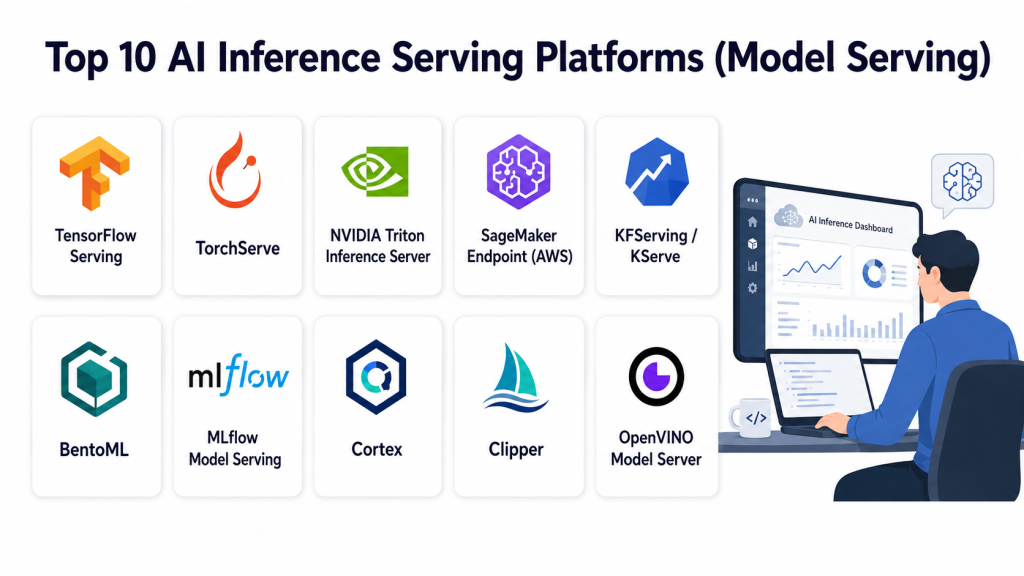
AI Inference Serving Platforms, also known as Model Serving Platforms, enable organizations to deploy, scale, and manage trained machine learning models for real-time or batch predictions. These platforms handle the operational aspects of serving models, such as API endpoints, load balancing, monitoring, and scaling, allowing data scientists and ML engineers to focus on model development rather than infrastructure. They are essential in productionizing AI workflows efficiently and reliably.
Real-world use cases include deploying computer vision models for autonomous systems, serving recommendation models for e-commerce platforms, providing real-time fraud detection in finance, running NLP models for chatbots and virtual assistants, and scaling predictive maintenance models in industrial IoT. Organizations rely on inference serving platforms to ensure low latency, high throughput, and robust monitoring for production ML workloads.
Evaluation criteria include latency and throughput performance, framework and model compatibility, scalability, deployment flexibility, API and integration support, monitoring and logging features, model versioning, security and compliance, cost efficiency, and ease of use.
Best for: Data scientists, ML engineers, DevOps teams, and organizations deploying AI models to production environments, across industries including technology, finance, healthcare, and retail.
Not ideal for: Teams that only run offline batch inference, small-scale experimentation without production requirements, or organizations without cloud or infrastructure capabilities.
Key Trends in AI Inference Serving Platforms
- Integration with Kubernetes and serverless infrastructure for dynamic scaling
- Support for multiple ML frameworks including TensorFlow, PyTorch, ONNX, and XGBoost
- Low-latency, high-throughput inference for real-time applications
- GPU and hardware acceleration for optimized performance
- Multi-model and multi-version deployment support
- Model monitoring, logging, and observability dashboards
- Automated scaling and load balancing for cloud and hybrid deployments
- Integration with CI/CD pipelines for continuous model delivery
- Secure endpoints with authentication, encryption, and RBAC
- Support for edge and on-premise inference alongside cloud services
How We Selected These Tools
- Assessed market adoption among ML teams and enterprise deployments
- Evaluated framework and model compatibility
- Reviewed latency, throughput, and performance benchmarks
- Checked deployment flexibility across cloud, hybrid, and edge environments
- Considered API support and integration with production workflows
- Weighed observability, logging, and monitoring capabilities
- Examined model versioning, rollback, and multi-model management
- Evaluated scalability and automated load handling
- Reviewed security, compliance, and endpoint access controls
- Considered ease of setup, usability, and documentation quality
Top 10 AI Inference Serving Platforms
#1 — NVIDIA Triton Inference Server
Short description: NVIDIA Triton provides high-performance inference for deep learning models with GPU acceleration and multi-framework support. Ideal for real-time and batch inference in production ML systems.
Key Features
- GPU and CPU acceleration
- Multi-framework support (TensorFlow, PyTorch, ONNX)
- Multi-model and multi-version management
- Model ensemble and pipeline support
- Metrics, logging, and monitoring
- REST and gRPC endpoints
Pros
- High-performance GPU inference
- Flexible deployment for various frameworks
Cons
- Complexity for new users
- GPU resources required for optimal performance
Platforms / Deployment
- Linux, Docker, Kubernetes
- Cloud / On-prem / Edge
Security & Compliance
- TLS encryption, authentication
- Not publicly stated for certifications
Integrations & Ecosystem
Supports integration with orchestration and ML pipelines
- Kubernetes
- Prometheus monitoring
- CI/CD pipelines
Support & Community
- NVIDIA documentation
- Community forums
- Enterprise support available
#2 — TensorFlow Serving
Short description: TensorFlow Serving is a flexible platform for serving TensorFlow models with high performance and dynamic batching, suited for production ML systems.
Key Features
- Optimized TensorFlow model serving
- REST and gRPC APIs
- Model versioning and rollback
- Batch and streaming inference
- Metrics and logging support
Pros
- Native TensorFlow integration
- Production-ready and scalable
Cons
- Limited framework support beyond TensorFlow
- Requires configuration for multi-version management
Platforms / Deployment
- Linux, Docker, Kubernetes
- Cloud / On-prem
Security & Compliance
- Authentication via TLS
- Not publicly stated for certifications
Integrations & Ecosystem
- Kubernetes deployment
- Prometheus monitoring
- TensorFlow ecosystem tools
Support & Community
- TensorFlow documentation
- Community forums
- Developer guides
#3 — TorchServe
Short description: TorchServe is an open-source PyTorch model serving framework providing multi-model deployment, logging, and metrics. Ideal for PyTorch users needing production-grade inference.
Key Features
- Multi-model serving
- Model versioning and rollback
- Logging and metrics
- REST and gRPC APIs
- Batch and streaming support
Pros
- Native PyTorch integration
- Easy deployment of multiple models
Cons
- Limited to PyTorch models
- GPU optimization requires setup
Platforms / Deployment
- Linux, Docker, Kubernetes
- Cloud / On-prem
Security & Compliance
- TLS, authentication supported
- Not publicly stated for certifications
Integrations & Ecosystem
- Kubernetes
- Prometheus
- ML workflow pipelines
Support & Community
- PyTorch docs
- GitHub community
- Tutorials and examples
#4 — Amazon SageMaker Endpoint
Short description: AWS SageMaker provides managed inference endpoints for deploying machine learning models with auto-scaling and monitoring capabilities.
Key Features
- Managed endpoint deployment
- Auto-scaling for high throughput
- Multi-framework support
- Logging and monitoring
- Integration with AWS ecosystem
Pros
- Fully managed service
- Auto-scaling reduces operational overhead
Cons
- Cloud-bound; dependent on AWS
- Cost scales with usage
Platforms / Deployment
- AWS cloud
- Managed
Security & Compliance
- IAM controls, TLS encryption
- AWS compliance certifications
Integrations & Ecosystem
- AWS Lambda, S3, CloudWatch
- CI/CD pipelines
- SageMaker ecosystem
Support & Community
- AWS documentation
- Support plans
- AWS developer forums
#5 — Google AI Platform Prediction
Short description: Google AI Platform provides model serving with scalable endpoints, batch prediction, and AI Platform Jobs, suited for cloud-first production ML workflows.
Key Features
- Online and batch predictions
- Auto-scaling endpoints
- Multi-framework support
- Logging and monitoring
- Integration with GCP services
Pros
- Scalable managed service
- Integration with Google Cloud ecosystem
Cons
- Cloud dependency
- Pricing complexity
Platforms / Deployment
- Google Cloud
- Managed
Security & Compliance
- GCP IAM, TLS
- Not publicly stated for certifications
Integrations & Ecosystem
- BigQuery, Cloud Functions
- AI Platform pipelines
- Monitoring dashboards
Support & Community
- Google Cloud docs
- Community forums
- Support plans
#6 — MLflow Model Serving
Short description: MLflow provides lightweight model serving for multiple frameworks with versioning and API endpoints. Ideal for teams already using MLflow for tracking and experimentation.
Key Features
- Multi-framework support
- Model versioning and rollback
- REST API endpoints
- Logging and monitoring
- Batch and real-time inference
Pros
- Integrates with MLflow tracking
- Open-source and flexible
Cons
- Requires operational setup for scaling
- Limited managed deployment
Platforms / Deployment
- Linux, Docker, Kubernetes
- Cloud / On-prem
Security & Compliance
- Not publicly stated
Integrations & Ecosystem
- MLflow tracking
- CI/CD pipelines
- Orchestration frameworks
Support & Community
- MLflow docs
- GitHub community
- Examples and tutorials
#7 — BentoML
Short description: BentoML is a model serving framework that packages ML models for deployment with APIs, Docker containers, and cloud-native integrations.
Key Features
- Multi-framework support
- REST/gRPC API endpoints
- Docker containerization
- Cloud and edge deployment
- Model versioning and packaging
Pros
- Flexible deployment options
- Cloud-native ready
Cons
- Requires operational knowledge for scaling
- Community support primarily
Platforms / Deployment
- Linux, Docker, Kubernetes
- Cloud / On-prem / Edge
Security & Compliance
- TLS supported
- Not publicly stated
Integrations & Ecosystem
- Cloud providers
- CI/CD pipelines
- Orchestration tools
Support & Community
- Docs and guides
- GitHub community
- Tutorials
#8 — KFServing / KServe
Short description: KFServing (now KServe) provides Kubernetes-native serverless inference for machine learning models with autoscaling and monitoring.
Key Features
- Kubernetes-native deployment
- Serverless autoscaling
- Multi-framework support
- Model versioning
- Logging and metrics
Pros
- Cloud-native serverless inference
- Scales automatically
Cons
- Requires Kubernetes knowledge
- Operational setup complexity
Platforms / Deployment
- Kubernetes
- Cloud / On-prem
Security & Compliance
- TLS, authentication
- Not publicly stated
Integrations & Ecosystem
- Kubeflow pipelines
- CI/CD integration
- Monitoring dashboards
Support & Community
- Docs and examples
- GitHub community
- Kubeflow ecosystem
#9 — NVIDIA Triton Inference Server (Enterprise Edition)
Short description: Enterprise-grade Triton provides enhanced performance, multi-tenant support, and integration for mission-critical deployments.
Key Features
- Multi-GPU support
- Multi-model and multi-version deployment
- Metrics, logging, and monitoring
- Model ensembles and pipeline execution
Pros
- High performance
- Enterprise-grade deployment support
Cons
- Enterprise pricing
- Requires GPU infrastructure
Platforms / Deployment
- Linux, Docker, Kubernetes
- Cloud / On-prem
Security & Compliance
- TLS, authentication
- Not publicly stated
Integrations & Ecosystem
- Kubernetes
- Prometheus metrics
- CI/CD pipelines
Support & Community
- NVIDIA support
- Enterprise documentation
- Forums
#10 — Replicate
Short description: Replicate provides a simple platform for hosting and deploying ML models as APIs with automatic scaling.
Key Features
- Cloud-hosted model APIs
- Automatic scaling
- REST endpoints
- Multi-framework support
- Model versioning
Pros
- Easy to deploy models
- No operational overhead
Cons
- Cloud-dependent
- Limited advanced monitoring
Platforms / Deployment
- Web, Cloud
- Managed
Security & Compliance
- TLS, secure endpoints
- Not publicly stated
Integrations & Ecosystem
- API integration
- Webhooks
- CI/CD pipelines
Support & Community
- Documentation
- Community forum
- Examples
Comparison Table
| Tool Name | Best For | Platform(s) Supported | Deployment | Standout Feature | Public Rating |
|---|---|---|---|---|---|
| NVIDIA Triton | GPU-optimized inference | Linux, Docker, Kubernetes | Cloud / On-prem | High-performance multi-GPU | N/A |
| TensorFlow Serving | TensorFlow models | Linux, Docker, Kubernetes | Cloud / On-prem | Native TensorFlow optimization | N/A |
| TorchServe | PyTorch models | Linux, Docker, Kubernetes | Cloud / On-prem | Multi-model serving | N/A |
| Amazon SageMaker | Managed endpoints | AWS Cloud | Managed | Auto-scaling endpoints | N/A |
| Google AI Platform | Cloud-first inference | Google Cloud | Managed | Batch and online predictions | N/A |
| MLflow Model Serving | Multi-framework experiments | Linux, Docker, Kubernetes | Cloud / On-prem | Integration with MLflow pipelines | N/A |
| BentoML | Containerized deployments | Linux, Docker, Kubernetes | Cloud / On-prem | Cloud-native and Docker ready | N/A |
| KServe | Kubernetes-native serverless | Kubernetes | Cloud / On-prem | Auto-scaling serverless inference | N/A |
| Triton Enterprise | Mission-critical GPU workloads | Linux, Docker, Kubernetes | Cloud / On-prem | Multi-tenant enterprise support | N/A |
| Replicate | Simple cloud APIs | Web, Cloud | Managed | Automatic scaling and APIs | N/A |
Evaluation & Scoring
| Tool Name | Core (25%) | Ease (15%) | Integrations (15%) | Security (10%) | Performance (10%) | Support (10%) | Value (15%) | Weighted Total |
|---|---|---|---|---|---|---|---|---|
| NVIDIA Triton | 10 | 7 | 8 | 8 | 10 | 8 | 8 | 8.8 |
| TensorFlow Serving | 9 | 7 | 7 | 8 | 9 | 7 | 7 | 8.0 |
| TorchServe | 9 | 7 | 7 | 8 | 9 | 7 | 7 | 8.0 |
| Amazon SageMaker | 9 | 8 | 8 | 9 | 8 | 8 | 8 | 8.3 |
| Google AI Platform | 9 | 8 | 8 | 9 | 8 | 8 | 8 | 8.3 |
| MLflow Model Serving | 8 | 7 | 7 | 8 | 8 | 7 | 7 | 7.6 |
| BentoML | 8 | 7 | 8 | 8 | 8 | 7 | 7 | 7.7 |
| KServe | 9 | 6 | 8 | 8 | 9 | 7 | 7 | 7.9 |
| Triton Enterprise | 10 | 7 | 8 | 9 | 10 | 8 | 8 | 8.9 |
| Replicate | 8 | 9 | 7 | 8 | 8 | 7 | 7 | 7.8 |
Which AI Inference Serving Platform Is Right for You?
Solo / Experimentation
Replicate and MLflow Model Serving provide quick deployment for prototypes or small-scale model serving.
SMB
BentoML and TorchServe provide flexible multi-framework support with moderate operational complexity for smaller teams.
Mid-Market
TensorFlow Serving and Google AI Platform provide scalable production deployment with managed endpoints and monitoring.
Enterprise
NVIDIA Triton Enterprise, Amazon SageMaker, and KServe offer high-throughput, multi-GPU, and multi-model management with robust monitoring and auto-scaling for mission-critical workloads.
Budget vs Premium
Open-source frameworks like TorchServe, MLflow, and BentoML reduce licensing costs, whereas managed cloud services offer convenience at premium pricing.
Feature Depth vs Ease of Use
Managed platforms like SageMaker or AI Platform maximize ease of use, while open-source frameworks provide deeper control at the expense of setup complexity.
Integrations & Scalability
Triton, KServe, and BentoML scale effectively with Kubernetes, GPUs, and CI/CD pipelines for large-scale deployments.
Security & Compliance Needs
Endpoints supporting TLS, authentication, and role-based access (Triton, SageMaker, KServe) are suitable for regulated production environments.
Frequently Asked Questions
1. What is AI inference serving?
AI inference serving is deploying trained ML models to production for generating predictions or decisions in real-time or batch workloads.
2. Do these platforms support multiple frameworks?
Yes. Platforms like Triton, BentoML, and KServe support TensorFlow, PyTorch, ONNX, XGBoost, and other formats.
3. Can I deploy models on-premises and cloud?
Many tools like Triton, TorchServe, and KServe support cloud, on-prem, and hybrid deployments for flexible infrastructure choices.
4. How is performance measured?
Latency, throughput, and GPU utilization are key metrics. Some platforms provide monitoring dashboards for observability.
5. Can multiple models run simultaneously?
Yes. Platforms support multi-model serving, versioning, and model ensembles for complex production workloads.
6. Do they provide auto-scaling?
Managed platforms and Kubernetes-native frameworks support auto-scaling to handle fluctuating inference requests.
7. Are endpoints secure?
Most provide TLS, authentication, and RBAC to secure endpoints, though exact compliance may vary.
8. Can I monitor models in production?
Yes. Metrics, logging, and observability dashboards help track model performance, error rates, and usage.
9. Is GPU support required?
For high-performance deep learning models, GPU acceleration is recommended, though CPU inference is supported in most frameworks.
10. How do I choose the right platform?
Consider model type, expected throughput, deployment infrastructure, scaling needs, framework compatibility, and operational expertise before selection.
Conclusion
AI Inference Serving Platforms are critical for deploying ML models in production efficiently and reliably. The right platform depends on factors like scale, infrastructure, latency requirements, framework support, and operational expertise. Open-source frameworks like TorchServe and BentoML provide flexibility for small teams, while managed platforms like Amazon SageMaker and Google AI Platform reduce operational complexity. Enterprise-grade solutions like NVIDIA Triton Enterprise and KServe offer high throughput, multi-model management, and GPU acceleration for mission-critical workloads. Teams should shortlist platforms, test deployment workflows, and validate performance and security before production adoption. Proper inference serving ensures ML models deliver consistent and scalable value in real-world applications.

This article provides a clear and informative comparison of AI inference serving platforms, highlighting the capabilities that matter most for deployment and scalability. The structured analysis makes it easy to compare solutions and understand their strengths for different use cases.