Introduction
Public health surveillance systems help governments, health departments, hospitals, laboratories, and public health agencies collect, monitor, analyze, and respond to health-related data. These systems support disease tracking, outbreak detection, immunization monitoring, syndromic surveillance, lab reporting, environmental health alerts, and population-level risk analysis.
They are essential for early detection of public health threats, faster response coordination, and evidence-based decision-making. Instead of relying on manual reporting or fragmented spreadsheets, public health teams use surveillance platforms to centralize data from hospitals, labs, clinics, emergency departments, and community sources.
Real-world use cases:
- Infectious disease case reporting
- Outbreak detection and response coordination
- Immunization and vaccination monitoring
- Syndromic surveillance from emergency visits
- Environmental and occupational health tracking
Evaluation Criteria for Buyers:
- Disease and event-based surveillance
- Lab and clinical data integration
- Real-time dashboards and alerts
- Case investigation workflows
- Reporting and analytics
- Interoperability with health systems
- Data privacy and security controls
- Mobile and field data collection
- Scalability for regional or national programs
- Support, training, and implementation quality
Best for: Public health departments, ministries of health, hospitals, epidemiology teams, labs, emergency preparedness units, and NGOs managing population health programs.
Not ideal for: Small clinics that only need basic patient record systems without population-level monitoring or outbreak response workflows.
Key Trends in Public Health Surveillance Systems
- Real-time disease monitoring and outbreak alerts
- Integration with electronic health records and lab systems
- Syndromic surveillance using emergency department data
- AI-assisted anomaly detection and risk forecasting
- Mobile data collection for field epidemiology teams
- GIS-based mapping for hotspot identification
- Cloud-based public health data platforms
- Interoperability using health data standards
- Privacy-first design for sensitive health data
- Dashboards for public health leadership and response teams
How We Selected These Tools
- Adoption across public health and healthcare organizations
- Surveillance depth for disease, syndromic, and event tracking
- Interoperability with labs, hospitals, and government systems
- Reporting, dashboards, and analytics quality
- Security and privacy readiness
- Scalability for local, regional, and national programs
- Case investigation and response workflow support
- Mobile and field data collection capabilities
- Vendor or community maturity
- Support, documentation, and implementation resources
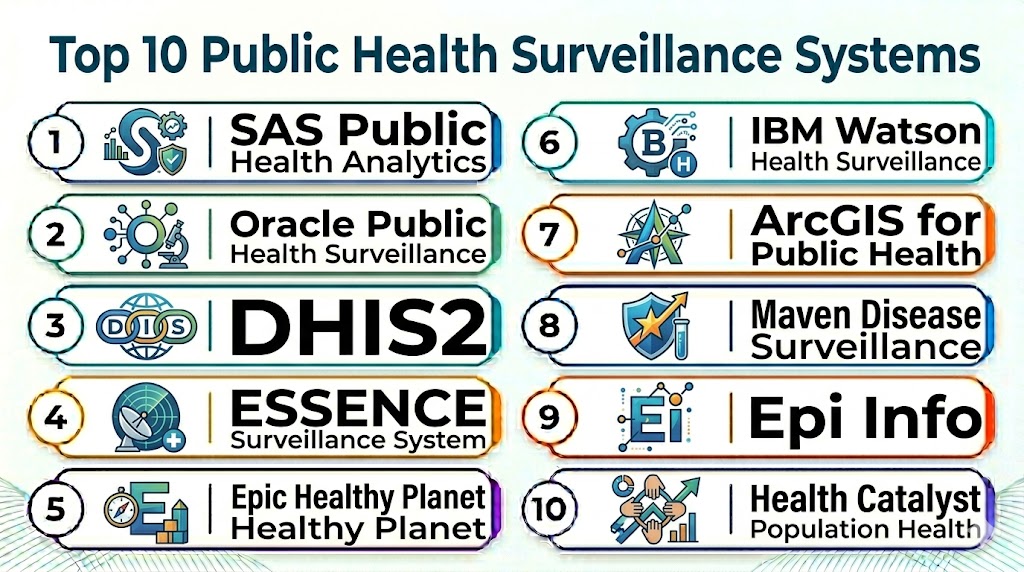
Top 10 Public Health Surveillance Systems
#1 — DHIS2
Short description: DHIS2 is a widely used open-source health information platform for public health reporting, disease surveillance, immunization tracking, and program monitoring. It is used by governments and health organizations that need configurable data collection and analytics across regions.
Key Features
- Disease surveillance workflows
- Custom data collection forms
- Dashboards and analytics
- GIS mapping and visualization
- Mobile data collection
- Program and indicator tracking
Pros
- Open-source and highly configurable
- Strong global public health adoption
- Good for national and regional programs
Cons
- Requires implementation expertise
- Customization can be complex
- Hosting and support depend on deployment model
Platforms / Deployment
- Web / Android
- Cloud / Self-hosted / Hybrid
Security & Compliance
- Role-based access controls
- Encryption depends on deployment
- Audit logging support
Integrations & Ecosystem
DHIS2 integrates with lab systems, EHRs, mobile data tools, GIS systems, and analytics platforms through APIs and health data exchange workflows.
- Laboratory systems
- Health information exchanges
- GIS platforms
- Mobile data tools
Support & Community
- Strong open-source community
- Documentation and implementation partners
- Training resources available
#2 — Epi Info
Short description: Epi Info is a public health data collection, analysis, and visualization tool designed for epidemiologists and public health professionals. It is useful for outbreak investigations, surveys, and field data analysis.
Key Features
- Survey and form creation
- Epidemiological data analysis
- Outbreak investigation workflows
- Statistical tools
- Mapping and visualization
- Field data collection support
Pros
- Useful for field epidemiology
- No-cost public health tool
- Strong analysis features
Cons
- Interface can feel dated
- Less suited for enterprise-scale surveillance
- Integration options are limited
Platforms / Deployment
- Windows / Web / Mobile
- Local / Cloud options vary
Security & Compliance
- Not publicly stated
- Security depends on deployment setup
Integrations & Ecosystem
- Data export tools
- Mapping platforms
- Public health reporting workflows
Support & Community
- Documentation and training resources
- Public health user community
#3 — CommCare
Short description: CommCare is a mobile data collection and case management platform used in public health programs, community health worker workflows, and disease surveillance projects. It is especially useful for field-based programs.
Key Features
- Mobile data collection
- Case management workflows
- Offline data capture
- Program monitoring dashboards
- Form logic and validations
- Field worker task management
Pros
- Strong mobile-first design
- Good offline capabilities
- Useful for community health surveillance
Cons
- Advanced analytics may require integrations
- Setup requires workflow design
- Enterprise features may add cost
Platforms / Deployment
- Web / Android
- Cloud
Security & Compliance
- Encryption and role-based access
- Audit logging support
Integrations & Ecosystem
- DHIS2
- Analytics platforms
- SMS tools
- Health program systems
Support & Community
- Documentation and training
- Implementation support available
#4 — OpenMRS
Short description: OpenMRS is an open-source medical record system often used in public health programs, disease tracking, and clinical surveillance workflows. It supports patient-level health data and can be configured for surveillance reporting.
Key Features
- Patient record management
- Disease program tracking
- Clinical data capture
- Reporting modules
- Custom forms and workflows
- Integration APIs
Pros
- Open-source and flexible
- Strong global health community
- Useful for clinical surveillance
Cons
- Requires technical implementation
- Surveillance features need configuration
- User experience varies by deployment
Platforms / Deployment
- Web
- Self-hosted / Cloud / Hybrid
Security & Compliance
- Role-based access controls
- Audit logging support
- Security depends on implementation
Integrations & Ecosystem
- Lab systems
- DHIS2
- Health information exchanges
- Reporting tools
Support & Community
- Strong open-source community
- Documentation and implementation partners
#5 — SORMAS
Short description: SORMAS is a public health surveillance and outbreak response system designed for infectious disease case management, contact tracing, lab workflows, and response coordination.
Key Features
- Infectious disease surveillance
- Case and contact management
- Laboratory workflow integration
- Outbreak response coordination
- Dashboards and reporting
- Mobile field data collection
Pros
- Purpose-built for outbreak response
- Strong case investigation workflows
- Good field surveillance capabilities
Cons
- Implementation may require technical support
- Best suited for infectious disease programs
- Customization can be complex
Platforms / Deployment
- Web / Mobile
- Cloud / Self-hosted / Hybrid
Security & Compliance
- Role-based access controls
- Audit logging support
- Encryption depends on deployment
Integrations & Ecosystem
- Laboratory systems
- Health reporting platforms
- Mobile field tools
- GIS systems
Support & Community
- Documentation and implementation partners
- Public health user community
#6 — Maven Disease Surveillance & Outbreak Management
Short description: Maven provides disease surveillance, case management, outbreak response, immunization, and public health workflow tools for government health agencies.
Key Features
- Disease case management
- Outbreak investigation workflows
- Contact tracing support
- Immunization tracking
- Reporting and dashboards
- Public health workflow automation
Pros
- Strong public health workflow coverage
- Useful for government agencies
- Configurable disease programs
Cons
- Premium platform pricing
- Implementation planning required
- Advanced configuration may need services
Platforms / Deployment
- Web / Mobile
- Cloud / Hybrid
Security & Compliance
- Encryption and role-based access
- Audit logging support
Integrations & Ecosystem
- EHR and lab systems
- Public health databases
- Reporting tools
- Case management systems
Support & Community
- Vendor support and implementation services
- Training and documentation resources
#7 — Epic Cosmos
Short description: Epic Cosmos is a health data and analytics platform that helps healthcare organizations analyze large-scale clinical trends, population health patterns, and disease insights using de-identified health data.
Key Features
- Population health analytics
- Clinical trend monitoring
- Large-scale health data insights
- Research and reporting workflows
- Data visualization
- Health outcome analysis
Pros
- Strong clinical data depth
- Useful for health system analytics
- Supports population-level insights
Cons
- Best suited for Epic ecosystem users
- Not a traditional field surveillance tool
- Access and use depend on organization setup
Platforms / Deployment
- Web
- Cloud
Security & Compliance
- Not publicly stated
- Uses healthcare data governance controls
Integrations & Ecosystem
- Epic EHR ecosystem
- Analytics workflows
- Clinical research tools
Support & Community
- Epic support ecosystem
- Training and customer resources
#8 — Oracle Health Public Health Management
Short description: Oracle Health Public Health Management supports health agencies and organizations with public health data coordination, reporting, analytics, and healthcare interoperability workflows.
Key Features
- Public health data management
- Health reporting workflows
- Interoperability support
- Analytics dashboards
- Population health insights
- Data exchange capabilities
Pros
- Enterprise-grade scalability
- Strong healthcare data ecosystem
- Good analytics and interoperability support
Cons
- Complex implementation
- Premium enterprise pricing
- Best for larger health organizations
Platforms / Deployment
- Web / Mobile
- Cloud / Hybrid
Security & Compliance
- Encryption and access controls
- Audit logging support
Integrations & Ecosystem
- EHR systems
- Health information exchanges
- Analytics platforms
- Public health reporting tools
Support & Community
- Enterprise support
- Implementation and training resources
#9 — ArcGIS for Public Health
Short description: ArcGIS for Public Health supports disease mapping, spatial analysis, outbreak visualization, and public health dashboards. It is valuable for agencies that need geospatial intelligence in surveillance workflows.
Key Features
- Disease mapping and hotspot analysis
- Public health dashboards
- Spatial data visualization
- Field data collection support
- Environmental health mapping
- Real-time location analytics
Pros
- Excellent GIS and mapping capabilities
- Strong dashboard visualization
- Useful for outbreak hotspot analysis
Cons
- Not a full case management system
- Requires GIS skills for advanced use
- Licensing may be costly for large deployments
Platforms / Deployment
- Web / iOS / Android
- Cloud / Hybrid
Security & Compliance
- Role-based access controls
- Encryption and secure sharing
Integrations & Ecosystem
- Health data systems
- Dashboards and reporting tools
- Field data collection apps
- Environmental data sources
Support & Community
- Strong documentation and training
- Large GIS user community
#10 — REDCap
Short description: REDCap is a secure data collection and research platform used by hospitals, universities, and public health organizations for surveys, registries, and program data collection.
Key Features
- Secure survey and form builder
- Research registry support
- Data exports and reporting
- Role-based access
- Audit trails
- Longitudinal data collection
Pros
- Strong research and registry workflows
- Secure data collection
- Widely used in healthcare research
Cons
- Not purpose-built for full surveillance operations
- Workflow automation can be limited
- Requires institutional setup
Platforms / Deployment
- Web
- Cloud / Self-hosted
Security & Compliance
- Role-based access controls
- Audit logging support
- Compliance depends on institutional deployment
Integrations & Ecosystem
- Statistical tools
- EHR data workflows
- Survey systems
- Research databases
Support & Community
- Strong academic and healthcare community
- Documentation and institutional support
Comparison Table
| Tool Name | Best For | Platform(s) Supported | Deployment | Standout Feature | Public Rating |
|---|---|---|---|---|---|
| DHIS2 | National health programs | Web / Android | Cloud / Self-hosted / Hybrid | Configurable surveillance reporting | N/A |
| Epi Info | Field epidemiology | Windows / Web / Mobile | Local / Cloud varies | Epidemiological analysis | N/A |
| CommCare | Community health programs | Web / Android | Cloud | Offline mobile data collection | N/A |
| OpenMRS | Clinical surveillance | Web | Cloud / Self-hosted / Hybrid | Open-source patient records | N/A |
| SORMAS | Outbreak response | Web / Mobile | Cloud / Self-hosted / Hybrid | Case and contact management | N/A |
| Maven | Government disease surveillance | Web / Mobile | Cloud / Hybrid | Public health workflows | N/A |
| Epic Cosmos | Health system analytics | Web | Cloud | Large-scale clinical insights | N/A |
| Oracle Health | Enterprise health agencies | Web / Mobile | Cloud / Hybrid | Interoperability and analytics | N/A |
| ArcGIS Public Health | Geospatial surveillance | Web / iOS / Android | Cloud / Hybrid | Disease mapping | N/A |
| REDCap | Research and registries | Web | Cloud / Self-hosted | Secure data collection | N/A |
Evaluation & Scoring of Public Health Surveillance Systems
| Tool Name | Core (25%) | Ease (15%) | Integrations (15%) | Security (10%) | Performance (10%) | Support (10%) | Value (15%) | Weighted Total (0–10) |
|---|---|---|---|---|---|---|---|---|
| DHIS2 | 9 | 7 | 8 | 8 | 8 | 8 | 9 | 8.2 |
| Epi Info | 7 | 7 | 6 | 7 | 7 | 7 | 9 | 7.2 |
| CommCare | 8 | 8 | 7 | 8 | 8 | 8 | 8 | 7.9 |
| OpenMRS | 8 | 6 | 8 | 8 | 7 | 8 | 9 | 7.7 |
| SORMAS | 9 | 7 | 8 | 8 | 8 | 8 | 8 | 8.1 |
| Maven | 9 | 7 | 8 | 9 | 8 | 8 | 7 | 8.1 |
| Epic Cosmos | 8 | 7 | 8 | 9 | 9 | 8 | 7 | 8.0 |
| Oracle Health | 8 | 6 | 9 | 9 | 9 | 8 | 6 | 7.9 |
| ArcGIS Public Health | 8 | 7 | 8 | 8 | 9 | 8 | 7 | 7.9 |
| REDCap | 7 | 8 | 7 | 8 | 7 | 8 | 9 | 7.7 |
Weighted scores compare surveillance depth, usability, integration strength, security, performance, support, and value. Higher scores usually indicate stronger suitability for public health programs and large-scale surveillance. Buyers should still prioritize fit based on disease programs, data sources, deployment model, and reporting requirements.
Which Public Health Surveillance System Is Right for You?
Solo / Small Program
- Epi Info, REDCap, or CommCare for surveys, field data collection, and smaller surveillance projects.
SMB
- CommCare, OpenMRS, or ArcGIS Public Health for community health, mapping, and clinical surveillance workflows.
Mid-Market
- DHIS2, SORMAS, or Maven for structured surveillance, case tracking, and outbreak response.
Enterprise
- Oracle Health, Epic Cosmos, Maven, or DHIS2 for large-scale public health analytics, interoperability, and multi-program surveillance.
Budget vs Premium
- Budget: DHIS2, Epi Info, OpenMRS, REDCap
- Premium: Maven, Oracle Health, Epic Cosmos
Feature Depth vs Ease of Use
- High feature depth: DHIS2, SORMAS, Maven
- High ease of use: REDCap, CommCare, Epi Info
Integrations & Scalability
- Extensive: Oracle Health, DHIS2, OpenMRS
- Limited: Epi Info, REDCap
Security & Compliance Needs
- Enterprise-grade: Oracle Health, Epic Cosmos, Maven
- Program-focused: DHIS2, SORMAS, REDCap
Frequently Asked Questions
1. What is a public health surveillance system?
A public health surveillance system collects, analyzes, and reports health data to detect disease patterns, outbreaks, and population health risks. It helps health agencies respond faster and make data-driven decisions. These systems can monitor infectious diseases, immunization, lab reports, syndromes, and environmental health events.
2. How is public health surveillance different from hospital software?
Hospital software focuses mainly on individual patient care, billing, and clinical workflows. Public health surveillance systems focus on population-level monitoring, disease reporting, outbreak response, and public health program management. Some systems integrate with hospital EHRs to collect reportable health data.
3. Can these systems detect outbreaks automatically?
Many platforms support alert rules, trend monitoring, and dashboard-based anomaly detection. More advanced systems may use analytics or AI-assisted methods to detect unusual patterns. However, public health experts still need to validate signals before declaring or responding to an outbreak.
4. Do these tools integrate with laboratories?
Yes, many public health surveillance systems integrate with laboratory information systems for electronic lab reporting. This helps agencies receive test results faster and reduce manual data entry. Integration depth depends on health data standards, local infrastructure, and vendor capabilities.
5. Are open-source surveillance systems reliable?
Open-source tools like DHIS2, OpenMRS, SORMAS, and Epi Info can be reliable when properly implemented, hosted, secured, and supported. They offer flexibility and strong public health communities. Agencies should plan for configuration, hosting, training, and long-term maintenance.
6. Can field teams collect data offline?
Yes, tools like CommCare, DHIS2 Android, and SORMAS can support mobile field data collection with offline functionality. This is useful for rural areas, outbreak investigations, and community health programs. Offline sync quality should be tested before large field deployment.
7. What security features are important?
Important features include encryption, role-based access, audit logs, secure authentication, data retention controls, and privacy governance. Health surveillance data can be sensitive, so agencies must carefully manage permissions and data sharing. Compliance requirements depend on region and program type.
8. Can these systems show disease maps?
Yes, many platforms include GIS mapping or integrate with GIS tools. ArcGIS is especially strong for spatial analysis, hotspot mapping, and public health dashboards. Mapping is valuable for outbreak response, resource planning, and public communication.
9. Which system is best for national public health programs?
DHIS2, SORMAS, Maven, and Oracle Health can support large-scale public health programs depending on requirements. DHIS2 is highly configurable and widely used for national reporting, while SORMAS is strong for outbreak response. Enterprise agencies may prefer commercial platforms for vendor-led implementation and support.
10. What should agencies evaluate before buying?
Agencies should evaluate data sources, interoperability needs, disease workflows, field collection requirements, dashboards, privacy controls, and scalability. They should also consider implementation capacity, training, support, and long-term maintenance. A pilot with real reporting workflows is recommended before full rollout.
Conclusion
Public health surveillance systems help agencies monitor disease trends, detect outbreaks, manage case investigations, coordinate field teams, and make faster evidence-based decisions. Smaller programs can start with Epi Info, REDCap, or CommCare for practical data collection and analysis, while mid-sized health departments may benefit from DHIS2, SORMAS, or Maven for structured surveillance workflows. Enterprise health agencies and large healthcare networks should evaluate Oracle Health, Epic Cosmos, or DHIS2 for interoperability, analytics, and scalable public health reporting. Start by mapping your disease reporting workflows, shortlist 2–3 systems, pilot integrations with labs and health records, validate privacy controls, and then scale after training and operational review.

An exceptionally well-structured comparison of public health surveillance systems. The clear insights into features, advantages, and limitations make this a highly valuable resource for healthcare professionals and decision-makers.