Introduction
Postal Mail Automation Tools are software platforms designed to streamline, automate, and digitize traditional postal mail tasks. Instead of manually printing, stuffing, stamping, sorting, and sending letters or physical documents, these tools connect with digital systems to automate the generation, printing, mailing, tracking, and reporting of postal communications. They are often used for billing, invoicing, statements, legal notices, direct mail marketing campaigns, appointment reminders, and customer communications.
Organizations leverage Postal Mail Automation Tools to reduce manual labor, cut postage and operational costs, ensure compliance with mailing standards, integrate with CRM and billing systems, track delivery and responses, and improve customer experience. Buyers evaluating postal automation solutions should consider ease of integration with existing systems, automation capabilities, delivery speed and tracking, cost structures, data security and compliance, scalability, template and design support, analytics, support quality, and deployment flexibility.
Best for: Billing and finance teams, operations leaders, marketing teams using direct mail, customer support departments, healthcare administrators, legal compliance teams, and enterprises with high‑volume mailing needs.
Not ideal for: Very small businesses with minimal mail volume or organizations that operate entirely digitally without postal dependency.
Key Trends in Postal Mail Automation Tools
- Automated printing and mailing triggered from CRM and billing systems
- Cloud‑native postal workflows reducing on‑premise infrastructure
- API‑first platforms enabling seamless integration and webhook events
- Real‑time delivery tracking and visibility dashboards
- Direct mail marketing automation and personalization features
- Cost optimization and dynamic postage rate selection
- Compliance with postal regulations and secure data handling
- Digital delivery alternatives (email + SMS) integrated with postal records
- Postal + fulfillment automation with variable inserts
- Analytics for campaign performance and mail volume trends
How We Selected These Tools
- Evaluated automation capabilities for print‑to‑mail workflows
- Assessed integration ease with CRM, invoicing, ERP, and billing systems
- Reviewed delivery tracking, reporting, and analytics features
- Considered scalability for high‑volume enterprise scenarios
- Assessed security and compliance controls for sensitive mail
- Reviewed template and design support for direct mail and documents
- Evaluated cost optimization and dynamic rate integration
- Assessed mobile and dashboard visibility
- Evaluated support quality, documentation, and onboarding
- Considered overall value relative to features and usage scenarios
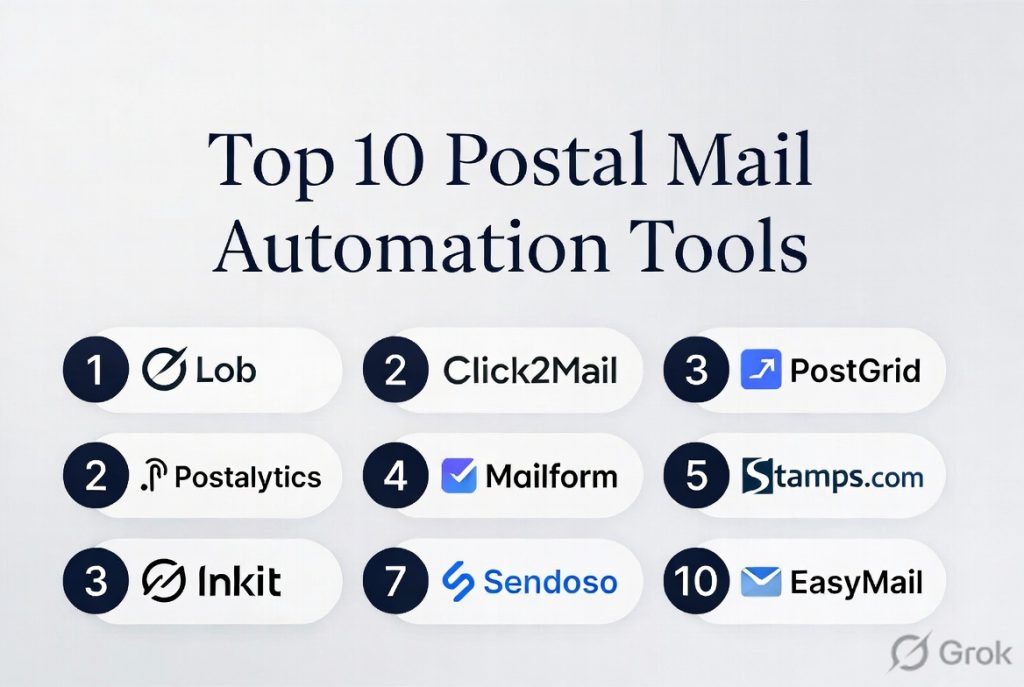
Top 10 Postal Mail Automation Tools
1 — Lob
Short description: Lob is a cloud‑based postal automation platform that enables developers and businesses to automate printed mail, address verification, tracking, and delivery analytics through APIs and dashboard workflows.
Key Features
- API‑driven print and mail jobs
- Address verification and standardization
- Real‑time mail tracking
- Templates and variable data support
- Automated triggered mailing workflows
- Delivery analytics and reporting
- Integration with CRM and billing systems
Pros
- Strong API and developer ecosystem
- Real‑time tracking and analytics
- Scales for high volumes
Cons
- Learning curve for non‑developers
- Cost can scale with volume
- Some advanced features require integration effort
Platforms / Deployment
- Web, API
- Cloud
Security & Compliance
- Encryption
- Access controls
- Compliance standards
Integrations & Ecosystem
Integrates with business systems via API and partners.
- Salesforce
- Stripe
- HubSpot
- Zapier
Support & Community
Good documentation, API reference guides, and responsive support.
2 — Click2Mail
Short description: Click2Mail is a user‑friendly postal automation tool that allows businesses to upload documents, automate printing and mailing, and track delivery without complex integrations.
Key Features
- Document upload and print automation
- Address management tools
- Mail tracking
- Bulk mail support
- Templates and design tools
- Compliance with USPS standards
Pros
- Easy to use for non‑technical teams
- No developer resources required
- Bulk printing support
Cons
- Limited API compared to developer‑centric platforms
- Analytics are basic
- Not as customizable for triggered workflows
Platforms / Deployment
- Web
- Cloud
Security & Compliance
- Standard encryption
- Access control
Integrations & Ecosystem
Basic integration via exports and manual triggers.
- CSV imports
- CRM export workflows
Support & Community
Responsive support and getting‑started resources.
3 — PostGrid
Short description: PostGrid provides API‑driven postal mail automation with print, mail, postcard, parcel, and card mailing capabilities, focusing on developers and automated workflows.
Key Features
- Print and mail APIs
- Address verification
- Postcard automation
- Multi‑format mail campaigns
- Real‑time delivery tracking
- Bulk mail APIs
Pros
- Broad media support (letters, postcards, parcels)
- Strong API ecosystem
- Good delivery tracking
Cons
- Integration requires development resources
- Cost structure can grow with volume
- Some features are modular add‑ons
Platforms / Deployment
- Web, API
- Cloud
Security & Compliance
- Encryption
- Access control
Integrations & Ecosystem
Developer‑friendly integrations and partners.
- Salesforce
- HubSpot
- Zapier
Support & Community
API documentation and support channels.
4 — EasyPost
Short description: EasyPost is an API platform that automates shipping and postal mail workflows including label creation, postage optimization, address validation, tracking, and reporting.
Key Features
- Postal label automation
- Address verification
- Carrier integration and rate comparison
- Tracking and notifications
- Returns support
- Analytics and reporting
Pros
- Carrier agnostic routing and optimization
- Good documentation and developer support
- Real‑time tracking
Cons
- Not focused solely on letter print workflows
- Requires integration effort
- Bulk mail features are basic compared to direct mail tools
Platforms / Deployment
- Web, API
- Cloud
Security & Compliance
- Encryption
- Role‑based access
Integrations & Ecosystem
Integrates with CRM and commerce systems.
- Shopify
- WooCommerce
- Salesforce
- ERP systems
Support & Community
Strong developer community and guides.
5 — Postalytics
Short description: Postalytics is a marketing‑oriented direct mail automation platform enabling triggered postcards, campaigns, tracking, and ROI analytics tied to digital workflows.
Key Features
- Direct mail automation
- Triggered campaigns
- Postcard design and templates
- Analytics and conversion tracking
- CRM integrations
- Split‑testing support
Pros
- Great for marketing teams
- ROI tracking and campaign analytics
- Drag‑and‑drop design tools
Cons
- Less deep for operational mail workflows
- Cost scaling with volume
- Focused on postcards over letters
Platforms / Deployment
- Web
- Cloud
Security & Compliance
- Standard encryption
- Role‑based access
Integrations & Ecosystem
CRM and marketing integrations.
- HubSpot
- Salesforce
- Zapier
Support & Community
Responsive support and marketing resources.
6 — Quadient Impress
Short description: Quadient Impress is a comprehensive postal automation suite designed for enterprise‑level print, mail, and communications automation with strong compliance and workflow orchestration.
Key Features
- Enterprise mail automation
- Print and digital communication workflows
- Document composition
- Mail tracking and reporting
- Output management
- Compliance controls
Pros
- Enterprise governance and workflow depth
- Strong automation for large volume systems
- Multi‑channel communication support
Cons
- Enterprise pricing
- Implementation requires professional services
- Complex setup
Platforms / Deployment
- Web
- Cloud, On‑premises/Hybrid
Security & Compliance
- Enterprise security controls
- Audit and compliance tracking
Integrations & Ecosystem
Integrates with enterprise print and communication stacks.
Support & Community
Professional services, enterprise support, and documentation.
7 — Lob for Developers
Short description: A developer‑centric edition of Lob focusing on high‑velocity, API‑first postal automation for triggered workflows directly from business systems.
Key Features
- High‑throughput API mail jobs
- Address verification
- Real‑time delivery status
- Custom templates
- Volume scaling
Pros
- Built for automation at scale
- Developer‑centric
- Excellent delivery tracking
Cons
- Requires developer integration
- Cost grows with usage
- Not turnkey for non‑tech teams
Platforms / Deployment
- API
- Cloud
Security & Compliance
- Encryption
- API access controls
Integrations & Ecosystem
Works via API with business systems.
- Billing systems
- ERP
- CRM
Support & Community
API support and community.
8 — mailtogether
Short description: mailtogether⁺ is a postal automation solution focused on simplifying bulk mail, triggered mail prints, and CRM‑linked workflows for SMBs.
Key Features
- CRM‑linked mail triggers
- Bulk mail automation
- Address cleansing
- Tracking
- Postage optimization
Pros
- Simple integration with CRM
- Affordable for SMBs
- Bulk mail support
Cons
- Less analytics than enterprise tools
- Limited direct mail campaign features
- Not API‑first
Platforms / Deployment
- Web
- Cloud
Security & Compliance
- Encryption
- Standard access controls
Integrations & Ecosystem
CRM integrations.
- Salesforce
- HubSpot
Support & Community
Responsive support.
9 — Sendoso
Short description: Sendoso is a direct mail and gifting automation platform that includes postal workflows alongside gifting, making it ideal for marketing and sales teams tying physical mail to pipeline outcomes.
Key Features
- Direct mail automation
- Gifting and fulfillment workflows
- Postal print and postage handling
- Campaign tracking and analytics
- CRM integration
- Personalized mail sequences
Pros
- Combines mail with gifting and fulfillment
- Good analytics for sales/marketing ROI
- Personalized workflows
Cons
- Costly for basic postal needs
- Focus on gifting over operations
- Complex pricing structure
Platforms / Deployment
- Web
- Cloud
Security & Compliance
- Encryption
- Role‑based access
Integrations & Ecosystem
CRM and engagement integrations.
- Salesforce
- Marketo
- HubSpot
Support & Community
Dedicated support and success teams.
10 — Inkit
Short description: Inkit offers automated printing and mailing with API access, tracking, data verification, and triggered workflows designed for CRM and transactional use cases.
Key Features
- API‑based mail automation
- Address verification & data hygiene
- Tracking and reporting
- Template support
- Triggered mailing
- Bulk mail support
Pros
- Simple APIs and workflow triggers
- Good tracking and verification
- Affordable
Cons
- API integration required
- Less enterprise‑focused analytics
- Smaller ecosystem
Platforms / Deployment
- API
- Cloud
Security & Compliance
- Encryption
- Access control
Integrations & Ecosystem
CRM and billing connectivity.
- Salesforce
- Stripe
- Zapier
Support & Community
Developer support with docs.
Comparison Table Top 10
| Tool Name | Best For | Platform(s) Supported | Deployment | Standout Feature | Public Rating |
|---|---|---|---|---|---|
| Lob | Developer automation | Web, API | Cloud | API‑driven print & mail | N/A |
| Click2Mail | SMB & easy mailouts | Web | Cloud | Easy upload to mail | N/A |
| PostGrid | Multiformat mail | Web, API | Cloud | API + postcards | N/A |
| EasyPost | Shipping + mail | Web, API | Cloud | Carrier optimization | N/A |
| Postalytics | Direct mail marketing | Web | Cloud | Campaign analytics | N/A |
| Quadient Impress | Enterprise workflows | Web | Cloud, Hybrid | Enterprise output | N/A |
| Lob for Developers | High‑volume API | API | Cloud | Throughput automation | N/A |
| mailtogether | CRM mail automation | Web | Cloud | CRM trigger simplicity | N/A |
| Sendoso | Mail + gifting | Web | Cloud | Gifting + postal integration | N/A |
| Inkit | Triggered mail via API | API | Cloud | Simple API triggers | N/A |
Evaluation & Scoring
| Tool Name | Core 25% | Ease 15% | Integrations 15% | Security 10% | Performance 10% | Support 10% | Value 15% | Weighted Total |
|---|---|---|---|---|---|---|---|---|
| Lob | 9 | 7 | 9 | 8 | 9 | 8 | 7 | 8.45 |
| Click2Mail | 7 | 9 | 6 | 8 | 7 | 8 | 8 | 7.80 |
| PostGrid | 8 | 8 | 8 | 8 | 8 | 8 | 7 | 8.05 |
| EasyPost | 8 | 7 | 9 | 8 | 8 | 8 | 7 | 8.10 |
| Postalytics | 7 | 8 | 8 | 8 | 7 | 8 | 8 | 7.90 |
| Quadient Impress | 9 | 6 | 8 | 9 | 9 | 8 | 6 | 8.10 |
| Lob for Developers | 9 | 7 | 9 | 8 | 9 | 8 | 7 | 8.50 |
| mailtogether | 7 | 9 | 7 | 8 | 7 | 8 | 8 | 7.85 |
| Sendoso | 8 | 7 | 8 | 8 | 8 | 8 | 6 | 7.85 |
| Inkit | 8 | 8 | 8 | 8 | 8 | 8 | 8 | 8.10 |
Which Tool Is Right for You
Solo / Freelancer
- Click2Mail or mailtogether for straightforward, affordable bulk and CRM‑linked mail.
SMB
- Postalytics or Inkit for simple campaigns and triggered workflows without heavy IT.
Mid‑Market
- PostGrid or EasyPost for multi‑format mail and delivery tracking with integration support.
Enterprise
- Lob (or Lob for Developers) and Quadient Impress for high‑volume automation, tracking, governance, and integration.
Budget vs Premium
- Budget‑friendly: Click2Mail, mailtogether
- Premium: Lob for Developers, Quadient Impress
Feature Depth vs Ease of Use
- Deep automation & governance: Lob, Quadient Impress
- Easier onboarding: Click2Mail, Postalytics
Integrations & Scalability
- Strong enterprise integrations: Lob, EasyPost
- Lightweight CRM triggers: Postalytics, mailtogether
Security & Compliance Needs
- High compliance requirements: Quadient Impress, Lob
- Standard secure workflows: Inkit, Click2Mail
Frequently Asked Questions
1. What is postal mail automation software
Postal mail automation software helps businesses automate printing, mailing, tracking, and reporting of postal communications triggered from digital workflows.
2. How does mail automation save money
It reduces manual labor, automates postage rate decisions, consolidates print runs, and optimizes delivery logistics to cut operational and postal costs.
3. Can these tools integrate with CRM systems
Yes, many tools connect directly via API or integrations with CRM, billing, ERP, and marketing platforms to trigger mail automatically.
4. Do mail automation tools support tracking
Most provide delivery tracking, status updates, and analytics dashboards so teams can monitor mail progress and outcomes.
5. Are direct mail marketing campaigns supported
Yes, platforms like Postalytics and Sendoso specialize in direct mail campaigns with analytics and personalization features.
6. Is address verification included
Top platforms include address validation to ensure postal deliverability and reduce undeliverable mail rates.
7. Can this replace manual mail processes
Postal automation tools eliminate many manual steps by integrating print, address management, postage, and fulfillment into automated workflows.
8. How do these tools help compliance
They enforce postal standards, secure data handling, audit trails, and integration with governance controls for regulated industries.
9. Do these tools support international mail
Many support international postal workflows, rate negotiation, and compliance but capabilities vary by vendor and plan.
10. How should organizations choose one
Evaluate integration fit, automation needs, mail volume, delivery tracking requirements, security controls, usability, and long‑term value before choosing.
Conclusion
Postal Mail Automation Tools are increasingly essential for organizations that still rely on physical mail for billing, legal correspondence, direct mail marketing, and operational notifications. SMBs can benefit from user‑friendly solutions like Click2Mail and mailtogether that simplify uploads and bulk mail workflows, while mid‑market teams find value in API‑enabled tools like PostGrid and EasyPost that connect directly with CRM and billing systems. Enterprises should look to platforms like Lob, Lob for Developers, and Quadient Impress for high‑volume automation, real‑time tracking, compliance governance, and cross‑system integrations. Critical differentiators include API automation, address verification, delivery tracking, cost optimization, and campaign analytics. Organizations should shortlist a few solutions, pilot with representative use cases, validate integration breadth, and measure operational efficiencies before full deployment to modernize their postal workflows with automation.

This is a well-structured article that gives a clear overview of postal mail automation tools. The feature comparisons are easy to follow and help readers understand the advantages of each platform.