Introduction
In the rush to achieve rapid deployment capabilities, modern enterprise engineering organizations have invested heavily in building complex toolchains. Teams routinely deploy combinations of GitHub, GitLab, Jenkins, ArgoCD, Terraform, Kubernetes, Jira, and various observability stacks. Yet, despite these substantial technology investments, technology leaders frequently face systemic visibility gaps.
CTOs and VPs of Engineering regularly grapple with crucial questions: Are our delivery pipelines truly secure, or are we inheriting silent vulnerabilities? Why do deployments stall despite automated CI/CD? Is our infrastructure as code compliant with enterprise standards? How do we measure the actual return on our platform engineering efforts?
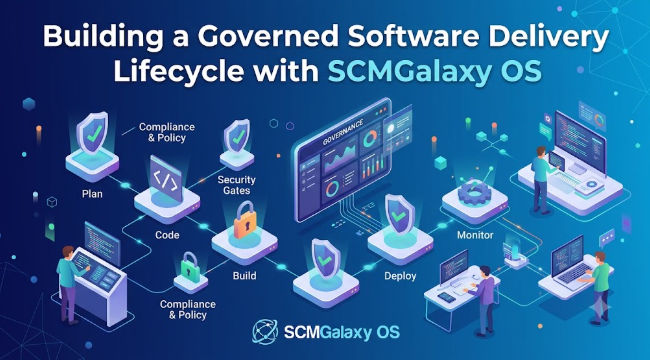
The core issue is rarely a lack of tools; rather, it is a lack of structured orchestration and oversight above those tools. This is where SCMGalaxy OS steps in. As a premier Software Delivery Governance Platform, SCMGalaxy OS doesn’t replace your existing DevOps investments—it empowers them, providing the critical engineering governance layer required to transform fragmented automation into a scalable, secure, and elite delivery ecosystem.
The Tooling Paradox in Modern DevOps
Many organizations operate under the assumption that implementing advanced continuous integration and continuous delivery (CI/CD) pipelines automatically equates to delivery maturity. This misconception creates a distinct tooling paradox: an organization can have automated pipelines running hundreds of times a day while simultaneously suffering from high deployment failure rates, security vulnerabilities, configuration drift, and developer burnout.
Without centralized engineering governance, decentralized teams often build fragmented workflows. One business unit might utilize advanced GitOps patterns with Terraform and Kubernetes, while another relies on legacy shell scripts and manual approvals. This fragmentation introduces significant delivery risks, obfuscates technical debt, and prevents leadership from establishing unified engineering metrics across the enterprise.
To bridge this gap, organizations must implement a layer that sits above the execution tools—evaluating, measuring, and continuously validating the health of the entire software delivery lifecycle (SDLC).
Smarter Oversight: Introducing SCMGalaxy OS
SCMGalaxy OS is specifically designed to eliminate the visibility gaps plaguing modern engineering ecosystems. By acting as an overarching governance umbrella, it continuously assesses engineering maturity, identifies delivery risks, and generates automated maturity scores across your entire portfolio.
Rather than relying on subjective manual surveys, SCMGalaxy OS connects directly to your toolchain to deliver data-driven insights. It answers whether your delivery ecosystem is genuinely secure, scalable, efficient, reliable, and compliant, making it an indispensable asset for enterprise architects, CTOs, and platform teams.
Execution vs. Governance: A Technical Comparison
| Capability Domain | Execution Layer (e.g., Jenkins, GitLab, Terraform) | SCMGalaxy OS Governance Platform |
| Primary Objective | Run builds, run tests, provision infrastructure, and deploy artifacts. | Assess process compliance, calculate maturity scores, and identify delivery risks. |
| Scope of View | Isolated to specific repositories, branches, pipelines, or clusters. | Holistic view across enterprise portfolios, teams, and business units. |
| Risk Detection | Catches immediate execution errors (e.g., broken builds, syntax errors). | Identifies structural vulnerabilities (e.g., lack of branch protection, configuration drift patterns). |
| Output Type | Log files, binaries, test reports, and running infrastructure. | Strategic maturity assessments, compliance audits, and transformation roadmaps. |
The Core Pillars of Engineering Maturity
A robust engineering governance framework evaluates maturity across several interdependent engineering domains. SCMGalaxy OS provides holistic visibility across all major pillars to ensure an optimized, well-balanced delivery ecosystem.
1. Software Configuration Management & SCM Maturity Assessment
Effective governance begins at the source code level. SCMGalaxy OS evaluates your source code management to ensure sustainable development habits:
- Branching Strategies: Ensuring teams follow sustainable models (such as trunk-based development or structured Gitflow) to minimize long-lived feature branches and merge conflicts.
- Access Control & Protection: Verifying that branch protection rules are systematically enforced across all repositories, requiring mandatory peer reviews and green status checks before code integration.
- Repository Hygiene: Detecting orphaned repositories, unmaintained dependencies, and committed secrets or sensitive configuration data.
2. CI/CD and Release Management Maturity Assessment
Automating a bad process simply accelerates bad outcomes. SCMGalaxy OS governs the release pipeline by analyzing:
- Pipeline Consistency: Ensuring standardized, reusable pipeline templates are deployed across teams to eliminate custom, unverified scripts.
- Deployment Gate Validation: Verifying that automated testing, quality gates (e.g., SonarQube metrics), and compliance checks cannot be bypassed during critical production deployments.
- Release Traceability: Maintaining an immutable audit trail linking every production artifact back to its exact source commit, approved pull request, and testing history.
3. DevSecOps Maturity Assessment
Rather than treating security as an afterthought, SCMGalaxy OS ensures that security controls are natively embedded into every stage of the lifecycle. Key evaluation areas include:
- Static & Dynamic Analysis Integration: Ensuring SAST, DAST, and Software Composition Analysis (SCA) scanners run automatically on every relevant commit.
- Vulnerability Remediation Velocity: Tracking how quickly teams remediate critical and high vulnerabilities relative to established SLAs.
- Infrastructure as Code (IaC) Security: Automatically auditing Terraform, CloudFormation, or Kubernetes configurations for misconfigured security groups, unencrypted storage buckets, and over-privileged IAM roles before deployment.
4. Observability and SRE Maturity Assessment
True delivery capability extends far beyond the initial deployment; it encompasses how a system behaves under production load. SCMGalaxy OS assesses:
- SLO/SLI Alignment: Verifying that teams have explicitly defined Service Level Indicators (SLIs) and Service Level Objectives (SLOs) tied directly to business outcomes.
- Alert Hygiene: Monitoring alert noise and actionable alerting structures to prevent team fatigue and reduce Mean Time to Resolution (MTTR).
- Chaos Engineering & Resilience: Evaluating how systematically teams test infrastructure failure modes to proactively ensure high availability.
Evaluating the Software Delivery Ecosystem
To successfully improve performance, engineering organizations must establish a baseline using an objective DevOps Maturity Assessment. SCMGalaxy OS replaces error-prone, manual developer questionnaires with real-time, automated analysis.
[Toolchain APIs] ---> [SCMGalaxy OS Engine] ---> [Risk & Capability Mapping] ---> [Automated Maturity Scores]
- Automated Discovery and Data Aggregation: SCMGalaxy OS connects via APIs to your version control systems, CI/CD pipelines, cloud environments, and project management tools to gather objective operational metadata.
- Risk and Capability Mapping: The platform correlates metrics against industry baselines like DORA and the SPACE framework, instantly highlighting hidden technical debt and pipeline vulnerabilities.
- Maturity Score Generation: Leaders receive comprehensive, multi-dimensional scores that isolate organizational bottlenecks, allowing for targeted, high-impact improvements.
Next-Gen Readiness: AI Code and Architecture Governance
The widespread adoption of AI coding assistants (such as GitHub Copilot or Amazon Q) has fundamentally altered software delivery dynamics. While these tools drastically increase code generation velocity, they introduce unique challenges for engineering governance, including code quality degradation, licensing risks, and algorithmic vulnerabilities.
As an advanced AI Code Governance Platform, SCMGalaxy OS evaluates how AI-generated code impacts your system over time. It measures the balance between developer velocity and code maintainability, ensuring that accelerated output does not compromise long-term architectural stability or security compliance.
Accelerate Growth with a 30/90/180-Day Transformation Roadmap
Identifying delivery risks is only half the battle; the ultimate value of SCMGalaxy OS lies in its ability to generate an actionable, phased transformation strategy tailored to your organization.
The 30-Day Window: Immediate Risk Mitigation
- Focus: Address critical security, compliance, and stability vulnerabilities.
- Action Items: Enforce mandatory branch protection on all core repositories; eliminate hardcoded secrets discovered in active pipelines; implement basic linting and static analysis checks on high-risk projects.
- Outcome: Immediate reduction in critical delivery risks and accidental production outages.
The 90-Day Window: Standardizing Core Capabilities
- Focus: Eliminate process fragmentation across teams.
- Action Items: Roll out standardized, reusable pipeline templates for core microservices; introduce automated IaC scanning across Terraform or Kubernetes repositories; define baseline SLIs and SLOs for production applications.
- Outcome: Improved deployment predictability, reduced pipeline maintenance overhead, and unified visibility for platform teams.
The 180-Day Window: Optimization and Continuous Improvement
- Focus: Drive engineering excellence and cultural maturity.
- Action Items: Automate advanced delivery patterns like canary or blue-green deployments; integrate AI code governance metrics to balance development velocity with code quality; institutionalize continuous feedback loops using insights from the governance platform.
- Outcome: A scalable, highly reliable delivery ecosystem capable of rapid, secure innovation.
Frequently Asked Questions
1. How does a Software Delivery Governance Platform differ from standard CI/CD tools?
CI/CD tools (like Jenkins or GitLab CI) focus purely on execution—running builds, executing tests, and moving artifacts. A governance platform like SCMGalaxy OS sits above these systems to evaluate the configuration, quality, security, and process compliance of those executions across the entire enterprise portfolio.
2. Will introducing SCMGalaxy OS slow down our engineering teams?
No. Traditional manual governance gates slow down delivery. SCMGalaxy OS integrates directly into existing workflows via APIs, analyzing configurations and pipelines asynchronously to remove friction while ensuring compliance guardrails remain intact.
3. What are the dangers of managing an enterprise DevOps stack without centralized governance?
Without governance, organizations suffer from toolchain fragmentation, invisible technical debt, inconsistent security practices, and lack of systemic visibility. This leads to configuration drift, elevated deployment failure rates, and an inability to accurately measure engineering productivity.
4. How can we ensure our AI-assisted software development remains secure and compliant?
Organizations should utilize an AI code governance framework like SCMGalaxy OS to continuously analyze AI-generated code. This ensures that the velocity gained from generative tools doesn’t introduce licensing compliance issues, security vulnerabilities, or architectural decay.
5. What are DORA metrics, and how do they fit into engineering governance?
DORA metrics consist of four key indicators: Deployment Frequency, Lead Time for Changes, Mean Time to Recovery (MTTR), and Change Failure Rate. SCMGalaxy OS uses these metrics as a foundational baseline, expanding upon them to evaluate underlying process maturity, security health, and infrastructure compliance.
6. Can a governance assessment help optimize infrastructure costs?
Yes. By reviewing Infrastructure as Code (IaC) governance patterns, a maturity assessment can identify over-provisioned cloud environments, orphan test infrastructure, and inefficient deployment strategies, helping platform engineering teams control cloud spend.
Conclusion & Key Takeaways
Achieving elite software delivery performance requires moving beyond simple automation. Toolchains alone cannot resolve systemic bottlenecks, architectural fragmentation, or compliance risks.
Organizations must implement a dedicated layer of oversight that continuously monitors, measures, and refines the entire lifecycle. By adopting a comprehensive governance model—leveraging the SCMGalaxy OS platform—enterprise engineering teams can confidently eliminate delivery risks, secure their software supply chain, and build an actionable roadmap toward long-term operational excellence.

Governance initiatives are most successful when they evolve alongside engineering practices instead of becoming periodic assessment exercises. As organizations adopt new platforms, AI-assisted development, and changing compliance requirements, governance models must continuously adapt without creating delivery bottlenecks. Discussing feedback-driven governance, score trend analysis over time, and mechanisms for validating that recommended improvements actually translate into better engineering outcomes would add valuable long-term perspective to the article.