Introduction
Asset Performance Management Industrial Platforms help asset-heavy organizations monitor, analyze, maintain, and optimize the performance of critical industrial equipment. These platforms combine asset health monitoring, predictive maintenance, reliability analytics, risk management, condition monitoring, work order intelligence, and operational dashboards into one connected environment.
They are widely used in manufacturing, energy, utilities, oil and gas, chemicals, mining, transportation, and heavy infrastructure. Instead of waiting for equipment failures, teams use APM platforms to predict risks earlier, reduce downtime, extend asset life, and make better maintenance decisions.
Real-world use cases include:
- Predictive maintenance for industrial equipment
- Asset health monitoring across plants
- Reliability-centered maintenance planning
- Risk-based inspection and failure analysis
- Maintenance optimization and downtime reduction
Key evaluation criteria buyers should consider:
- Predictive maintenance accuracy
- Asset health scoring
- Integration with EAM and CMMS systems
- Industrial IoT and historian connectivity
- Reliability and risk analytics
- Work order and maintenance workflow support
- Scalability across plants and regions
- Security and access controls
- Ease of deployment
- Vendor support and industry expertise
Best for: industrial manufacturers, utilities, oil and gas operators, mining companies, chemical plants, energy companies, maintenance leaders, reliability engineers, and asset-intensive enterprises.
Not ideal for: small teams needing only basic maintenance scheduling, simple inventory tracking, or lightweight CMMS functionality without advanced analytics or industrial asset complexity.
Key Trends in Asset Performance Management Industrial Platforms
- AI-driven predictive maintenance is helping teams detect equipment failure risks earlier.
- Digital twin integration is improving asset simulation, reliability modeling, and lifecycle planning.
- Industrial IoT connectivity is becoming essential for real-time asset health monitoring.
- Cloud and hybrid deployment models are improving scalability across multi-site operations.
- Risk-based maintenance strategies are replacing purely calendar-based maintenance.
- Prescriptive maintenance recommendations are helping teams move from alerts to action.
- EAM, CMMS, and ERP integration is becoming a core buying requirement.
- Edge analytics is improving real-time monitoring for remote and high-risk assets.
- Cybersecurity and role-based governance are becoming more important for connected industrial systems.
- Sustainability and energy efficiency analytics are increasingly part of asset performance programs.
How We Selected These Tools
The tools in this list were selected based on industrial relevance, enterprise adoption, product depth, and practical asset performance capabilities.
- Evaluated adoption across manufacturing, energy, utilities, oil and gas, and heavy industry.
- Reviewed predictive maintenance and asset health analytics capabilities.
- Considered integration with EAM, CMMS, ERP, SCADA, historians, and industrial IoT systems.
- Assessed reliability engineering and risk-based maintenance workflows.
- Reviewed scalability for multi-site and enterprise environments.
- Considered deployment flexibility including cloud, hybrid, and edge use cases.
- Evaluated usability for reliability engineers, maintenance teams, and operations leaders.
- Reviewed reporting, dashboards, and decision-support capabilities.
- Considered vendor maturity and industrial domain expertise.
- Assessed support quality, documentation, and implementation ecosystem.
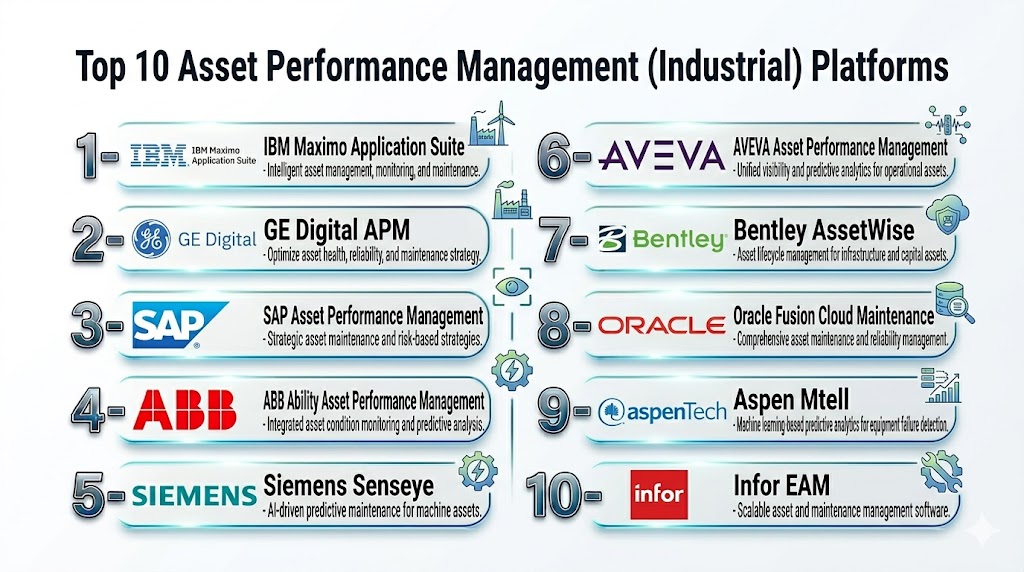
Top 10 Asset Performance Management Industrial Platforms
#1 — IBM Maximo Application Suite
Short description: IBM Maximo Application Suite is a leading enterprise asset management and asset performance management platform for asset-intensive industries. It combines EAM, asset health, predictive maintenance, reliability workflows, inspections, mobility, and AI-driven analytics into one integrated environment. It is widely used by utilities, manufacturing firms, transportation operators, energy companies, and industrial enterprises. The platform is best suited for organizations that want to connect maintenance execution with asset performance intelligence.
Key Features
- Asset health monitoring
- Predictive maintenance analytics
- Reliability-centered maintenance support
- Work order and inspection workflows
- Mobile maintenance capabilities
- IoT and sensor data integration
- AI-assisted asset insights
Pros
- Strong EAM and APM combination
- Good fit for large asset-heavy enterprises
- Mature industrial ecosystem
- Strong analytics and workflow depth
Cons
- Implementation can be complex
- Requires proper data governance
- Enterprise pricing may be high
- Advanced configuration may need specialists
Platforms / Deployment
- Web / iOS / Android
- Cloud / Hybrid
Security & Compliance
- SSO
- MFA
- RBAC
- Audit logging
- Encryption
Integrations & Ecosystem
IBM Maximo integrates with industrial systems, enterprise applications, IoT platforms, and maintenance workflows.
- ERP integrations
- SCADA and historian connectivity
- IoT sensor data
- Work order systems
- APIs and enterprise data platforms
Support & Community
IBM provides enterprise-grade support, implementation partners, documentation, training, and a large industrial customer ecosystem.
#2 — GE Vernova Asset Performance Management
Short description: GE Vernova Asset Performance Management is designed for industrial organizations that need asset reliability, risk reduction, and operational performance improvement. It supports asset health monitoring, predictive analytics, risk-based strategies, and reliability workflows across energy, utilities, manufacturing, and heavy industry. The platform is especially strong for organizations managing critical equipment and complex operational environments. It helps maintenance and reliability teams move from reactive maintenance to proactive decision-making.
Key Features
- Asset health analytics
- Predictive maintenance workflows
- Risk-based inspection support
- Reliability strategy management
- Industrial equipment monitoring
- Operational dashboards
- Maintenance decision support
Pros
- Strong industrial reliability focus
- Good for utilities and energy environments
- Mature APM feature set
- Useful risk and reliability workflows
Cons
- Enterprise implementation effort
- Requires strong asset data foundation
- Configuration can be complex
- Pricing may be premium
Platforms / Deployment
- Web
- Cloud / Hybrid
Security & Compliance
- RBAC
- MFA
- Audit logging
- Encryption
Integrations & Ecosystem
GE Vernova APM integrates with operational data sources, industrial systems, and enterprise maintenance environments.
- Historian systems
- Industrial IoT platforms
- EAM and CMMS systems
- SCADA environments
- Enterprise reporting tools
Support & Community
GE Vernova provides enterprise support, industrial implementation expertise, and strong domain knowledge for asset-heavy sectors.
#3 — AVEVA Asset Performance Management
Short description: AVEVA Asset Performance Management helps industrial organizations monitor equipment health, identify emerging issues, and prioritize maintenance actions. It is commonly used in process industries, utilities, manufacturing, energy, and infrastructure environments. The platform connects real-time operational data with reliability analytics and maintenance decision workflows. It is a strong choice for organizations already using AVEVA operations and historian technologies.
Key Features
- Real-time asset monitoring
- Predictive analytics
- Failure mode analysis
- Maintenance prioritization
- Equipment diagnostics
- Industrial data integration
- Operational performance dashboards
Pros
- Strong real-time monitoring capability
- Good fit for process industries
- Mature industrial data ecosystem
- Useful predictive maintenance workflows
Cons
- Best value within AVEVA ecosystem
- Advanced setup may need expert support
- Enterprise licensing can be costly
- Requires reliable operational data
Platforms / Deployment
- Web
- Cloud / Hybrid
Security & Compliance
- RBAC
- User authentication
- Audit logging
- Encryption
Integrations & Ecosystem
AVEVA APM integrates well with industrial operations, historian systems, plant data, and enterprise maintenance workflows.
- AVEVA PI System integration
- SCADA and historian connectivity
- CMMS and EAM integration
- Industrial IoT systems
- API-based data workflows
Support & Community
AVEVA has a strong industrial software ecosystem, large user base, documentation, training, and partner support.
#4 — SAP Asset Performance Management
Short description: SAP Asset Performance Management helps organizations connect asset strategy, maintenance planning, reliability insights, and enterprise operations within the SAP ecosystem. It is designed for companies that want to align asset performance with maintenance execution, procurement, finance, and supply chain processes. The platform is especially valuable for SAP-centric enterprises. It supports asset health, risk analysis, maintenance recommendations, and performance optimization.
Key Features
- Asset strategy management
- Asset health monitoring
- Predictive maintenance support
- Risk and criticality assessment
- Maintenance recommendation workflows
- SAP ERP integration
- Enterprise reporting and analytics
Pros
- Excellent SAP ecosystem integration
- Strong enterprise governance
- Good maintenance planning alignment
- Scalable for large organizations
Cons
- Best suited for SAP customers
- Implementation can be complex
- Requires strong process maturity
- Customization may need SAP expertise
Platforms / Deployment
- Web
- Cloud
Security & Compliance
- SSO
- MFA
- RBAC
- Audit logging
- Encryption
Integrations & Ecosystem
SAP APM integrates deeply with SAP enterprise applications and industrial operations environments.
- SAP ERP integration
- SAP EAM workflows
- SAP analytics tools
- IoT and sensor data
- Enterprise data platforms
Support & Community
SAP offers strong enterprise support, partner implementation services, documentation, and a broad global user ecosystem.
#5 — AspenTech Mtell
Short description: AspenTech Mtell is an industrial predictive maintenance and asset performance platform focused on early warning detection for equipment failures. It uses machine learning models to identify abnormal patterns and provide advance alerts before failures occur. The platform is particularly useful for process industries, energy, chemicals, and manufacturing organizations with rich operational data. It is best suited for companies that want deep predictive analytics for critical assets.
Key Features
- Machine learning-based failure prediction
- Early warning notifications
- Asset behavior modeling
- Process equipment analytics
- Root cause investigation support
- Maintenance prioritization
- Industrial data integration
Pros
- Strong predictive maintenance capability
- Useful for critical process equipment
- Good early warning functionality
- Strong industrial analytics depth
Cons
- Needs high-quality historical data
- Less broad than full EAM platforms
- Requires analytics implementation effort
- Best suited for data-mature organizations
Platforms / Deployment
- Web
- Cloud / Hybrid
Security & Compliance
- RBAC
- User authentication
- Encryption
- Not publicly stated for certifications
Integrations & Ecosystem
AspenTech Mtell connects with industrial data sources, historians, plant systems, and enterprise reliability workflows.
- Historian integration
- Industrial IoT systems
- Plant data platforms
- Maintenance systems
- Analytics environments
Support & Community
AspenTech provides enterprise support, industrial analytics expertise, documentation, and professional services.
#6 — Honeywell Forge Asset Performance Management
Short description: Honeywell Forge Asset Performance Management helps industrial organizations improve asset reliability, operational performance, and maintenance planning. It combines asset monitoring, predictive analytics, operational intelligence, and connected worker capabilities. The platform is especially relevant for process industries, energy, manufacturing, aviation, and large industrial facilities. It is designed for organizations that want connected operations and performance visibility across sites.
Key Features
- Asset performance monitoring
- Predictive maintenance analytics
- Operational intelligence dashboards
- Industrial IoT connectivity
- Reliability workflows
- Multi-site visibility
- Connected worker support
Pros
- Strong industrial automation background
- Good multi-site monitoring
- Useful operational dashboards
- Mature enterprise support
Cons
- Best fit for Honeywell-oriented environments
- Enterprise deployment effort
- Pricing may vary significantly
- Advanced customization may require services
Platforms / Deployment
- Web
- Cloud / Hybrid
Security & Compliance
- MFA
- RBAC
- Encryption
- Audit logging
Integrations & Ecosystem
Honeywell Forge integrates with industrial automation systems, sensors, historians, and operational platforms.
- Honeywell automation systems
- SCADA and historians
- Industrial IoT
- APIs
- Enterprise maintenance systems
Support & Community
Honeywell provides strong industrial support, implementation services, and global operational technology expertise.
#7 — Bentley AssetWise
Short description: Bentley AssetWise is an asset lifecycle and performance platform for infrastructure-heavy industries such as utilities, transportation, energy, and public infrastructure. It helps organizations manage asset reliability, lifecycle planning, risk, inspections, and operational performance. The platform is particularly strong for linear assets, infrastructure networks, and engineering-heavy environments. It connects asset information with engineering, maintenance, and operational decision-making.
Key Features
- Asset lifecycle management
- Reliability and risk analysis
- Inspection and maintenance planning
- Infrastructure asset intelligence
- Engineering data integration
- Compliance workflow support
- Performance reporting
Pros
- Strong infrastructure asset focus
- Good engineering data integration
- Useful for utilities and transportation
- Supports lifecycle planning
Cons
- Less focused on general manufacturing
- Implementation can be specialized
- Best value within Bentley ecosystem
- Requires structured asset data
Platforms / Deployment
- Web
- Cloud / Hybrid
Security & Compliance
- RBAC
- User authentication
- Audit controls
- Not publicly stated for certifications
Integrations & Ecosystem
Bentley AssetWise integrates with engineering, infrastructure, GIS, and enterprise asset systems.
- Bentley engineering tools
- GIS integrations
- EAM systems
- Inspection workflows
- Reporting systems
Support & Community
Bentley offers strong infrastructure-focused support, professional services, documentation, and partner resources.
#8 — ABB Ability Asset Performance Management
Short description: ABB Ability Asset Performance Management helps industrial organizations improve reliability, safety, and operational efficiency across critical equipment. It supports asset condition monitoring, predictive maintenance, risk analysis, and lifecycle optimization. The platform is suited for energy, utilities, mining, process industries, and industrial automation environments. It is especially relevant for organizations using ABB equipment and automation systems.
Key Features
- Asset condition monitoring
- Predictive maintenance insights
- Reliability analytics
- Risk-based asset strategies
- Equipment health dashboards
- Industrial automation integration
- Lifecycle optimization support
Pros
- Strong industrial automation expertise
- Good equipment monitoring capability
- Useful for utilities and process industries
- Strong operational technology alignment
Cons
- Best value with ABB ecosystem
- Advanced setup may require services
- Pricing is not always transparent
- Smaller teams may find it complex
Platforms / Deployment
- Web
- Cloud / Hybrid
Security & Compliance
- RBAC
- MFA
- Audit logging
- Encryption
Integrations & Ecosystem
ABB Ability integrates with industrial automation, control systems, sensors, and enterprise maintenance workflows.
- ABB automation systems
- Industrial IoT
- SCADA environments
- EAM and CMMS systems
- API-based integrations
Support & Community
ABB provides strong industrial support, domain expertise, and global implementation resources.
#9 — C3 AI Reliability
Short description: C3 AI Reliability is an AI-driven asset performance and predictive maintenance platform designed for industrial enterprises. It uses machine learning, sensor data, and operational history to predict failures, detect anomalies, and recommend maintenance actions. The platform is suitable for energy, manufacturing, aerospace, utilities, and asset-heavy enterprises. It is best for organizations with mature data infrastructure and strong AI transformation goals.
Key Features
- AI-driven predictive maintenance
- Failure prediction models
- Anomaly detection
- Asset health monitoring
- Enterprise AI workflows
- Operational data integration
- Maintenance recommendation support
Pros
- Strong enterprise AI capabilities
- Good predictive analytics depth
- Scalable for large organizations
- Useful for complex asset environments
Cons
- Requires strong data readiness
- Implementation can be complex
- Premium enterprise positioning
- May require AI and data engineering support
Platforms / Deployment
- Web
- Cloud / Hybrid
Security & Compliance
- RBAC
- MFA
- Encryption
- Audit logging
Integrations & Ecosystem
C3 AI Reliability integrates with industrial data platforms, enterprise systems, and sensor environments.
- Enterprise data lakes
- IoT systems
- Historian platforms
- EAM and CMMS tools
- API integrations
Support & Community
C3 AI provides enterprise implementation support, technical services, and AI-focused customer success resources.
#10 — Uptake
Short description: Uptake is an industrial intelligence and predictive analytics platform focused on improving asset reliability, maintenance planning, and operational performance. It is used in industries such as transportation, energy, mining, construction, and heavy equipment operations. The platform helps teams identify failure patterns, prioritize maintenance, and improve fleet or equipment performance. It is particularly useful for organizations managing distributed industrial assets.
Key Features
- Predictive maintenance analytics
- Asset health monitoring
- Fleet and equipment intelligence
- Failure pattern detection
- Maintenance prioritization
- Operational dashboards
- Data integration workflows
Pros
- Strong predictive analytics focus
- Useful for distributed assets
- Good operational dashboards
- Practical maintenance insights
Cons
- Not as broad as full enterprise EAM suites
- Best fit depends on asset type
- Integration scope should be validated
- Public pricing is not simple
Platforms / Deployment
- Web
- Cloud
Security & Compliance
- User authentication
- Access controls
- Encryption
- Not publicly stated for certifications
Integrations & Ecosystem
Uptake integrates with industrial data sources, fleet systems, maintenance tools, and operational platforms.
- Sensor data sources
- Fleet management systems
- Maintenance platforms
- API integrations
- Analytics dashboards
Support & Community
Uptake provides vendor-led onboarding and industrial analytics support. Public community depth is more limited than larger enterprise platforms.
Comparison Table
| Tool Name | Best For | Platform(s) Supported | Deployment | Standout Feature | Public Rating |
|---|---|---|---|---|---|
| IBM Maximo Application Suite | Enterprise EAM and APM | Web, iOS, Android | Cloud, Hybrid | Unified asset management and performance intelligence | N/A |
| GE Vernova Asset Performance Management | Energy and heavy industry | Web | Cloud, Hybrid | Risk and reliability-focused APM | N/A |
| AVEVA Asset Performance Management | Process industries | Web | Cloud, Hybrid | Real-time asset monitoring | N/A |
| SAP Asset Performance Management | SAP-centric enterprises | Web | Cloud | Enterprise asset strategy integration | N/A |
| AspenTech Mtell | Predictive maintenance analytics | Web | Cloud, Hybrid | Early warning failure prediction | N/A |
| Honeywell Forge APM | Connected industrial operations | Web | Cloud, Hybrid | Multi-site operational intelligence | N/A |
| Bentley AssetWise | Infrastructure asset lifecycle management | Web | Cloud, Hybrid | Engineering and infrastructure asset intelligence | N/A |
| ABB Ability APM | Industrial automation environments | Web | Cloud, Hybrid | Equipment condition and reliability monitoring | N/A |
| C3 AI Reliability | Enterprise AI-based reliability | Web | Cloud, Hybrid | AI-driven failure prediction | N/A |
| Uptake | Distributed industrial assets | Web | Cloud | Predictive equipment intelligence | N/A |
Evaluation & Scoring of Asset Performance Management Industrial Platforms
| Tool Name | Core 25% | Ease 15% | Integrations 15% | Security 10% | Performance 10% | Support 10% | Value 15% | Weighted Total |
|---|---|---|---|---|---|---|---|---|
| IBM Maximo Application Suite | 9 | 7 | 9 | 9 | 9 | 9 | 7 | 8.4 |
| GE Vernova Asset Performance Management | 9 | 7 | 8 | 8 | 9 | 8 | 7 | 8.1 |
| AVEVA Asset Performance Management | 8 | 7 | 9 | 8 | 9 | 8 | 7 | 8.0 |
| SAP Asset Performance Management | 8 | 7 | 10 | 9 | 8 | 9 | 7 | 8.2 |
| AspenTech Mtell | 9 | 7 | 8 | 7 | 9 | 8 | 7 | 7.9 |
| Honeywell Forge APM | 8 | 8 | 8 | 8 | 8 | 8 | 7 | 7.9 |
| Bentley AssetWise | 8 | 7 | 8 | 7 | 8 | 8 | 7 | 7.6 |
| ABB Ability APM | 8 | 7 | 8 | 8 | 8 | 8 | 7 | 7.8 |
| C3 AI Reliability | 9 | 6 | 8 | 9 | 9 | 8 | 6 | 7.9 |
| Uptake | 7 | 8 | 7 | 7 | 8 | 7 | 8 | 7.4 |
These scores are comparative and should be interpreted based on your asset type, industry, integration needs, and maintenance maturity. Enterprise platforms score higher when they combine asset strategy, EAM integration, predictive analytics, governance, and scalability. AI-focused tools may score strongly in predictive maintenance but may require better data readiness. The best platform is the one that fits your operating model, not simply the one with the highest total score.
Which Asset Performance Management Industrial Platform Is Right for You?
Solo / Freelancer
Solo consultants and small reliability teams usually do not need a full enterprise APM platform. They may be better served by lightweight CMMS, analytics tools, or focused predictive maintenance platforms for specific equipment classes. If a formal APM platform is needed, Uptake or a focused analytics-first solution may be easier to evaluate than a large enterprise suite.
SMB
Small and mid-sized industrial firms should prioritize ease of deployment, practical asset health monitoring, and integration with current maintenance systems. Honeywell Forge APM, Uptake, or ABB Ability APM can be suitable depending on equipment ecosystem and industry. The goal should be to start with a focused predictive maintenance use case rather than a full transformation program.
Mid-Market
Mid-market manufacturers, utilities, and process operators often need stronger reliability workflows, historian integration, and multi-site asset visibility. AVEVA APM, AspenTech Mtell, and GE Vernova APM can provide strong value when operational data is available and maintenance teams are ready to act on insights. These organizations should validate integration with CMMS, historians, and plant systems early.
Enterprise
Large asset-heavy enterprises usually need governance, scalability, advanced analytics, work order integration, and cross-site standardization. IBM Maximo Application Suite, SAP Asset Performance Management, GE Vernova APM, and AVEVA APM are strong options for enterprise environments. These tools are best when organizations have mature maintenance processes and structured asset data.
Budget vs Premium
Budget-focused teams should avoid buying a broad enterprise suite before proving value with a focused asset class or plant-level pilot. Premium platforms provide stronger governance, scalability, integration depth, and support, but they require larger implementation investment. A phased rollout often delivers better value than a big-bang deployment.
Feature Depth vs Ease of Use
Deep APM platforms provide advanced reliability, risk, and predictive analytics, but they may require more training and data preparation. Easier tools can help teams start faster but may not support complex asset strategies. Buyers should match feature depth with the skills of maintenance, reliability, operations, and IT teams.
Integrations & Scalability
Integration is one of the most important success factors in APM adoption. Buyers should validate connectivity with EAM, CMMS, ERP, SCADA, historians, IoT platforms, and data lakes. Scalability matters when the platform needs to support multiple plants, regions, asset classes, and maintenance teams.
Security & Compliance Needs
Industrial APM platforms often connect to sensitive operational data and critical equipment environments. Buyers should prioritize SSO, MFA, RBAC, audit logging, encryption, and strong data governance. For regulated or critical infrastructure sectors, cybersecurity and operational access controls should be reviewed before deployment.
Frequently Asked Questions
1- What is an Asset Performance Management Industrial Platform?
An Asset Performance Management Industrial Platform helps organizations monitor asset health, predict failures, optimize maintenance, and improve reliability. It connects operational data, maintenance history, sensor readings, risk models, and analytics. The goal is to reduce downtime, extend asset life, and improve operational performance.
2- How is APM different from EAM or CMMS?
EAM and CMMS systems mainly manage maintenance execution, work orders, schedules, inventory, and asset records. APM focuses more on asset health, predictive maintenance, risk analysis, reliability strategy, and performance optimization. In many enterprises, APM works alongside EAM or CMMS rather than replacing them.
3- Which industries benefit most from APM platforms?
Industries with expensive, critical, or failure-prone assets benefit most from APM platforms. This includes manufacturing, utilities, oil and gas, chemicals, mining, transportation, energy, water, and infrastructure. Any organization where downtime creates safety, cost, or production risk can benefit from APM.
4- What data is needed for APM success?
Useful data includes asset master data, work order history, failure records, sensor readings, inspection results, process data, historian data, and maintenance cost information. Better data quality improves prediction accuracy and reliability recommendations. Poor data can limit the value of even the best APM platform.
5- Can APM platforms predict equipment failures?
Yes, many APM platforms use machine learning, statistical models, condition monitoring, and historical failure data to identify early warning signals. However, prediction quality depends on data availability, asset type, model quality, and operational follow-through. APM works best when predictions are connected to maintenance action.
6- Are APM platforms only for large enterprises?
No, but large enterprises often gain the most value because they manage many assets, sites, and maintenance teams. Smaller organizations can still use focused APM tools for critical equipment or predictive maintenance projects. SMBs should start with a limited pilot instead of deploying a broad enterprise suite immediately.
7- What are common implementation mistakes?
Common mistakes include starting without clean asset data, ignoring technician workflows, failing to integrate with CMMS, and treating APM as only an IT project. Another mistake is buying advanced AI features before defining clear maintenance use cases. Successful teams align operations, reliability, maintenance, and IT from the beginning.
8- How do APM platforms integrate with plant systems?
APM platforms commonly integrate with EAM, CMMS, ERP, SCADA, historians, IoT sensors, condition monitoring systems, and data lakes. These integrations allow the platform to connect real-time operating data with maintenance records and reliability models. Integration planning should be done before vendor selection.
9- What security features should buyers look for?
Buyers should look for SSO, MFA, RBAC, encryption, audit logging, secure APIs, and strong data governance. Industrial environments should also review how the platform connects to operational technology systems. Security is especially important when APM platforms use real-time plant data or remote monitoring.
10- How should companies measure APM ROI?
APM ROI can be measured through reduced unplanned downtime, lower maintenance cost, improved asset availability, fewer emergency repairs, extended equipment life, and better production reliability. Teams should define baseline metrics before deployment. A focused pilot on critical assets usually makes ROI easier to prove.
Conclusion
Asset Performance Management Industrial Platforms are becoming essential for organizations that depend on reliable equipment, continuous production, and safe operations. The strongest platforms combine asset health monitoring, predictive maintenance, reliability analytics, risk-based strategies, and enterprise maintenance integration. The right choice depends on industry, asset complexity, existing systems, data maturity, and maintenance culture. Large enterprises may need IBM Maximo, SAP, GE Vernova, or AVEVA for governance and scale, while focused teams may prefer AspenTech Mtell, Uptake, or Honeywell Forge for predictive maintenance and operational insights. Buyers should avoid choosing based only on brand recognition and instead validate integrations, data readiness, user workflows, security controls, and support quality. A practical next step is to shortlist two or three tools, test them on critical assets, confirm CMMS and historian integration, and scale only after proving measurable reliability and downtime improvement

A very insightful overview of asset performance management platforms—this article clearly explains how these tools help industries improve equipment reliability, maintenance planning, and operational performance.