Introduction
Solar Asset Monitoring Software helps solar energy operators track, analyze, and optimize the performance of solar plants, rooftop installations, battery systems, and distributed energy assets. These platforms collect operational data from inverters, sensors, weather stations, and grid infrastructure to provide real-time visibility into power generation, equipment health, and operational efficiency.
As solar deployments continue expanding across utility-scale, commercial, and residential sectors, monitoring platforms have become critical for reducing downtime, improving ROI, and supporting predictive maintenance strategies. Modern platforms increasingly include AI-driven analytics, automated fault detection, remote diagnostics, and energy forecasting capabilities to help operators manage large and geographically distributed portfolios efficiently.
Real-world use cases include:
- Utility-scale solar farm monitoring
- Commercial rooftop solar management
- Predictive maintenance for solar assets
- Energy production forecasting
- Multi-site renewable portfolio optimization
Key evaluation criteria buyers should consider:
- Real-time monitoring accuracy
- Scalability across multiple sites
- AI-based fault detection capabilities
- Integration with inverters and SCADA systems
- Mobile accessibility
- Reporting and analytics depth
- Security and user access controls
- API and third-party integrations
- Ease of deployment and onboarding
- Cost efficiency for portfolio size
Best for: utility operators, renewable energy companies, EPC providers, O&M teams, energy consultants, commercial facility managers, and enterprises managing distributed solar infrastructure.
Not ideal for: very small residential users with single installations who only require basic inverter apps or simple generation dashboards.
Key Trends in Solar Asset Monitoring Software
- AI-driven predictive maintenance is becoming standard for identifying panel degradation, inverter anomalies, and performance loss.
- Digital twin technology is increasingly used for modeling solar asset performance and operational simulations.
- Cloud-native architectures are replacing legacy on-premise monitoring systems for better scalability and remote accessibility.
- Battery and hybrid energy integration is becoming critical as solar-plus-storage deployments increase globally.
- Advanced weather analytics and forecasting are improving generation prediction accuracy and grid balancing.
- IoT sensor expansion is enabling granular asset-level visibility for modules, trackers, and environmental conditions.
- Cybersecurity requirements are increasing due to critical infrastructure regulations and grid connectivity risks.
- Mobile-first operational workflows are helping field technicians manage alerts and maintenance remotely.
- Unified renewable asset platforms are combining solar, wind, battery, and EV infrastructure monitoring into a single dashboard.
- Performance benchmarking and ESG reporting are becoming major procurement factors for enterprises and investors.
How We Selected These Tools
The tools in this list were selected using a balanced evaluation framework focused on real-world operational requirements.
- Assessed global market adoption and visibility within renewable energy operations.
- Evaluated monitoring depth across utility-scale and distributed solar environments.
- Reviewed AI analytics, predictive maintenance, and automation capabilities.
- Considered integration compatibility with major inverter and SCADA vendors.
- Examined deployment flexibility including cloud, hybrid, and enterprise environments.
- Evaluated reporting, visualization, and operational dashboard quality.
- Considered scalability for multi-site and multi-gigawatt portfolios.
- Reviewed mobile usability and field technician support features.
- Evaluated vendor ecosystem maturity and enterprise readiness.
- Considered support quality, onboarding experience, and platform stability.
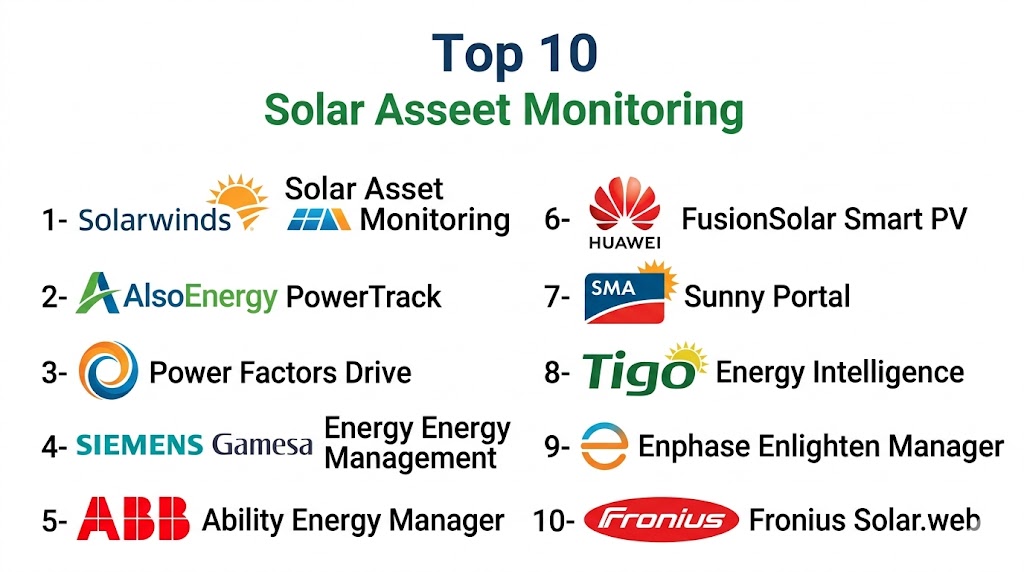
Top 10 Solar Asset Monitoring Software Tools
1- Power Factors Drive
Short description: Power Factors Drive is a widely used renewable energy asset monitoring and performance management platform designed for utility-scale solar and wind operations. It provides centralized operational visibility, advanced analytics, and automated incident management. The platform is commonly used by IPPs, asset owners, and large renewable operators managing geographically distributed portfolios.
Key Features
- Real-time renewable asset monitoring
- AI-powered anomaly detection
- Automated ticketing and workflow management
- Portfolio-level analytics dashboards
- SCADA integration capabilities
- Performance benchmarking tools
- Predictive maintenance insights
Pros
- Strong enterprise-scale capabilities
- Excellent renewable portfolio visibility
- Advanced automation workflows
- Mature operational analytics
Cons
- Can be complex for smaller teams
- Enterprise pricing may be expensive
- Requires onboarding and configuration effort
- Best suited for larger deployments
Platforms / Deployment
- Web / iOS / Android
- Cloud / Hybrid
Security & Compliance
- RBAC
- MFA
- Audit logging
- Not publicly stated for certifications
Integrations & Ecosystem
Power Factors supports integrations with SCADA systems, inverter vendors, weather services, and enterprise operational systems.
- API integrations
- SCADA connectivity
- Weather data platforms
- ERP integration support
- Renewable operations systems
Support & Community
Strong enterprise onboarding and implementation support. Widely used in utility-scale renewable operations with established professional services.
2- AlsoEnergy PowerTrack
Short description: AlsoEnergy PowerTrack is a solar monitoring and analytics platform focused on commercial and utility-scale solar operations. It offers detailed energy production monitoring, fleet management, and operational intelligence features for asset owners and O&M providers.
Key Features
- Fleet-wide solar monitoring
- Performance analytics
- Alarm management
- Weather normalization tools
- Mobile monitoring access
- Historical trend analysis
- Asset performance benchmarking
Pros
- Strong visualization capabilities
- Reliable operational monitoring
- Good support for distributed assets
- Easy dashboard customization
Cons
- Advanced analytics may require training
- Reporting customization can vary
- Enterprise-focused pricing
- Some integrations require additional setup
Platforms / Deployment
- Web / iOS / Android
- Cloud
Security & Compliance
- RBAC
- Encryption
- MFA
- Not publicly stated for certifications
Integrations & Ecosystem
The platform integrates with multiple inverter vendors, environmental monitoring systems, and operational platforms.
- API access
- Inverter integrations
- SCADA support
- Weather service integrations
- Reporting exports
Support & Community
Well-established support organization with renewable-focused implementation expertise and training resources.
3- Solar-Log
Short description: Solar-Log is a solar monitoring solution designed for residential, commercial, and industrial solar deployments. It provides real-time monitoring, energy management, and performance analysis through a flexible cloud-based environment.
Key Features
- Real-time solar monitoring
- Multi-vendor inverter support
- Energy management dashboards
- Automated alerts and notifications
- Consumption monitoring
- Remote diagnostics
- Battery integration support
Pros
- Broad inverter compatibility
- Suitable for multiple deployment sizes
- User-friendly dashboards
- Flexible monitoring options
Cons
- Some advanced features require premium licensing
- Enterprise analytics are limited
- UI can feel dated in some modules
- Custom reporting varies by plan
Platforms / Deployment
- Web / Android / iOS
- Cloud / Hybrid
Security & Compliance
- User authentication
- Encryption
- RBAC
- Not publicly stated for certifications
Integrations & Ecosystem
Solar-Log integrates with energy management systems, inverters, and smart metering solutions.
- API support
- Smart meter integrations
- Inverter compatibility
- Battery system integrations
- Monitoring exports
Support & Community
Strong installer ecosystem and extensive documentation for deployment and configuration.
4- Enphase Enlighten
Short description: Enphase Enlighten is a monitoring platform optimized for Enphase solar and battery ecosystems. It provides homeowners, installers, and commercial operators with real-time production monitoring and system diagnostics.
Key Features
- Real-time production monitoring
- Microinverter-level analytics
- Battery monitoring
- Mobile notifications
- Remote diagnostics
- Consumption insights
- Installer management portal
Pros
- Excellent user experience
- Strong mobile application
- Detailed microinverter visibility
- Seamless Enphase ecosystem integration
Cons
- Best suited for Enphase hardware
- Limited flexibility outside ecosystem
- Enterprise-scale functionality is limited
- Advanced analytics may vary
Platforms / Deployment
- Web / iOS / Android
- Cloud
Security & Compliance
- MFA
- Encrypted communication
- User authentication
- Not publicly stated for certifications
Integrations & Ecosystem
Designed primarily around Enphase hardware but supports integration with energy storage and smart home technologies.
- Enphase battery integration
- Smart energy systems
- Mobile ecosystem support
- Installer APIs
Support & Community
Large installer community and strong educational documentation for deployment and maintenance.
5- SMA Sunny Portal
Short description: SMA Sunny Portal is a solar monitoring platform focused on SMA inverter ecosystems. It provides residential, commercial, and utility-scale monitoring features including performance analysis and energy management.
Key Features
- Real-time system monitoring
- Detailed reporting dashboards
- Energy production analytics
- Alarm management
- Weather-based analysis
- Fleet management tools
- Mobile access
Pros
- Reliable SMA hardware integration
- Good reporting functionality
- Scalable monitoring environment
- Strong global presence
Cons
- Best experience within SMA ecosystem
- UI modernization could improve
- Third-party integration flexibility varies
- Enterprise customization may be limited
Platforms / Deployment
- Web / iOS / Android
- Cloud
Security & Compliance
- Authentication controls
- Encryption
- RBAC
- Not publicly stated for certifications
Integrations & Ecosystem
SMA supports integration with energy management systems and operational reporting tools.
- SMA hardware ecosystem
- API integrations
- Smart energy systems
- Metering integrations
Support & Community
Well-established documentation and international installer support network.
6- Huawei FusionSolar
Short description: Huawei FusionSolar combines solar monitoring, smart PV management, and AI-powered analytics into a centralized renewable operations platform. It is commonly used in commercial and utility-scale environments.
Key Features
- AI-powered fault diagnosis
- Smart inverter monitoring
- Real-time energy analytics
- Mobile operational dashboards
- Energy storage integration
- Smart IV curve diagnostics
- Fleet management capabilities
Pros
- Strong AI analytics features
- Integrated solar-plus-storage visibility
- Modern interface design
- Good scalability
Cons
- Best optimized for Huawei ecosystem
- Regional availability can vary
- Some enterprise integrations require customization
- Vendor ecosystem dependency
Platforms / Deployment
- Web / Android / iOS
- Cloud / Hybrid
Security & Compliance
- MFA
- Encryption
- RBAC
- Not publicly stated for certifications
Integrations & Ecosystem
FusionSolar integrates with Huawei smart energy infrastructure and operational systems.
- API support
- Energy storage systems
- Smart inverter ecosystem
- Monitoring integrations
Support & Community
Strong enterprise support presence in global renewable deployments.
7- Tigo Energy Intelligence
Short description: Tigo Energy Intelligence focuses on module-level solar monitoring, optimization, and rapid shutdown visibility. It is particularly valuable for distributed commercial and residential installations requiring granular monitoring.
Key Features
- Module-level monitoring
- Rapid shutdown visibility
- AI-based diagnostics
- Fleet management tools
- Mobile monitoring
- Energy optimization insights
- Automated alerts
Pros
- Excellent module-level visibility
- Strong safety functionality
- Good for distributed installations
- Flexible monitoring tools
Cons
- Enterprise-scale capabilities are limited
- Best with compatible hardware
- Reporting customization varies
- Utility-scale depth is limited
Platforms / Deployment
- Web / iOS / Android
- Cloud
Security & Compliance
- User authentication
- Encryption
- RBAC
- Not publicly stated for certifications
Integrations & Ecosystem
Tigo integrates with solar hardware vendors and energy management systems.
- Inverter integrations
- Module-level APIs
- Monitoring exports
- Smart energy ecosystem support
Support & Community
Strong installer support and growing ecosystem adoption.
8- Fronius Solar.web
Short description: Fronius Solar.web is a monitoring and analytics platform designed for Fronius inverter users across residential and commercial solar deployments. It provides visualization, diagnostics, and operational reporting features.
Key Features
- Solar performance monitoring
- Energy consumption tracking
- Mobile monitoring
- Automated alerts
- Historical analytics
- Energy optimization tools
- Fleet monitoring support
Pros
- User-friendly interface
- Strong visualization dashboards
- Reliable mobile applications
- Good residential and SMB support
Cons
- Primarily optimized for Fronius hardware
- Enterprise analytics are limited
- Advanced customization varies
- Large-scale portfolio management is less mature
Platforms / Deployment
- Web / iOS / Android
- Cloud
Security & Compliance
- Authentication controls
- Encryption
- RBAC
- Not publicly stated for certifications
Integrations & Ecosystem
Fronius supports integrations with smart home systems and energy management tools.
- API connectivity
- Smart meter support
- Energy storage integrations
- Monitoring exports
Support & Community
Strong documentation and installer-focused support resources.
9- SenseHawk
Short description: SenseHawk is a renewable asset management and analytics platform focused on solar site intelligence, inspections, and operational analytics. It combines drone data, AI analytics, and monitoring workflows for solar asset operators.
Key Features
- AI-driven inspection analytics
- Drone imagery analysis
- Solar site digital twins
- Asset performance workflows
- Defect detection
- Mobile field operations
- GIS-enabled visualization
Pros
- Advanced inspection analytics
- Strong AI and visual intelligence
- Excellent field workflow capabilities
- Useful for utility-scale operations
Cons
- Monitoring depth may vary compared to SCADA-first platforms
- Specialized workflows require training
- Pricing may not suit smaller operators
- Advanced functionality depends on deployment scope
Platforms / Deployment
- Web / Android / iOS
- Cloud
Security & Compliance
- RBAC
- User authentication
- Encryption
- Not publicly stated for certifications
Integrations & Ecosystem
SenseHawk integrates with GIS systems, drones, renewable asset platforms, and analytics environments.
- GIS integrations
- Drone platform connectivity
- API ecosystem
- Renewable operational tools
Support & Community
Growing renewable operations ecosystem with implementation-focused support.
10- ABB Ability Energy and Asset Manager
Short description: ABB Ability Energy and Asset Manager provides enterprise energy monitoring and optimization capabilities for industrial and renewable energy environments. It supports large-scale operational visibility across energy assets.
Key Features
- Enterprise energy monitoring
- Asset performance analytics
- Real-time operational dashboards
- Predictive maintenance tools
- Multi-site energy visibility
- Alarm and incident management
- AI-driven analytics
Pros
- Strong industrial scalability
- Mature enterprise capabilities
- Broad energy management support
- Good operational visibility
Cons
- Can be complex for smaller teams
- Enterprise implementation effort required
- Pricing may be premium
- Some features require ABB ecosystem alignment
Platforms / Deployment
- Web
- Cloud / Hybrid
Security & Compliance
- RBAC
- MFA
- Audit logging
- Not publicly stated for certifications
Integrations & Ecosystem
ABB integrates with industrial automation systems, SCADA infrastructure, and operational technology platforms.
- Industrial automation integrations
- SCADA support
- API ecosystem
- Operational analytics integrations
Support & Community
Strong enterprise implementation and global industrial support capabilities.
Comparison Table
| Tool Name | Best For | Platform(s) Supported | Deployment | Standout Feature | Public Rating |
|---|---|---|---|---|---|
| Power Factors Drive | Utility-scale renewable portfolios | Web, iOS, Android | Cloud, Hybrid | AI-powered renewable operations | N/A |
| AlsoEnergy PowerTrack | Commercial and utility solar | Web, iOS, Android | Cloud | Fleet-wide solar analytics | N/A |
| Solar-Log | Mixed-size solar deployments | Web, iOS, Android | Cloud, Hybrid | Broad inverter compatibility | N/A |
| Enphase Enlighten | Enphase ecosystems | Web, iOS, Android | Cloud | Microinverter-level analytics | N/A |
| SMA Sunny Portal | SMA-based solar deployments | Web, iOS, Android | Cloud | Detailed reporting tools | N/A |
| Huawei FusionSolar | Smart PV operations | Web, iOS, Android | Cloud, Hybrid | AI fault diagnosis | N/A |
| Tigo Energy Intelligence | Module-level monitoring | Web, iOS, Android | Cloud | Granular panel visibility | N/A |
| Fronius Solar.web | Residential and SMB solar | Web, iOS, Android | Cloud | User-friendly dashboards | N/A |
| SenseHawk | AI-driven inspections | Web, iOS, Android | Cloud | Drone-based solar analytics | N/A |
| ABB Ability Energy and Asset Manager | Enterprise energy operations | Web | Cloud, Hybrid | Industrial-scale monitoring | N/A |
Evaluation & Scoring of Solar Asset Monitoring Software
| Tool Name | Core 25% | Ease 15% | Integrations 15% | Security 10% | Performance 10% | Support 10% | Value 15% | Weighted Total |
|---|---|---|---|---|---|---|---|---|
| Power Factors Drive | 9 | 7 | 9 | 8 | 9 | 8 | 7 | 8.2 |
| AlsoEnergy PowerTrack | 8 | 8 | 8 | 7 | 8 | 8 | 7 | 7.8 |
| Solar-Log | 8 | 8 | 8 | 7 | 8 | 7 | 8 | 7.8 |
| Enphase Enlighten | 8 | 9 | 6 | 7 | 8 | 8 | 8 | 7.8 |
| SMA Sunny Portal | 8 | 8 | 7 | 7 | 8 | 8 | 8 | 7.7 |
| Huawei FusionSolar | 9 | 8 | 8 | 7 | 8 | 7 | 8 | 8.0 |
| Tigo Energy Intelligence | 7 | 8 | 7 | 7 | 7 | 7 | 8 | 7.3 |
| Fronius Solar.web | 7 | 9 | 7 | 7 | 7 | 7 | 8 | 7.5 |
| SenseHawk | 8 | 7 | 8 | 7 | 8 | 7 | 7 | 7.6 |
| ABB Ability Energy and Asset Manager | 9 | 6 | 9 | 8 | 9 | 8 | 6 | 8.0 |
These scores are comparative rather than absolute and are intended to help buyers evaluate strengths across different operational scenarios. Enterprise platforms typically score higher in integrations and scalability, while residential-focused tools often perform better in usability and value. Organizations should prioritize criteria aligned with their operational goals, deployment size, and technical maturity. A higher score does not automatically mean a better fit for every use case.
Which Solar Asset Monitoring Software Tool Is Right for You?
Solo / Freelancer
Freelancers and independent solar installers usually benefit most from lightweight, easy-to-manage platforms like Fronius Solar.web or Solar-Log. These platforms provide sufficient monitoring visibility without requiring enterprise-scale operational complexity. Mobile accessibility and simplified deployment are often more important than advanced automation.
SMB
Small and mid-sized solar operators should prioritize usability, flexible deployment, and manageable pricing. Solar-Log, SMA Sunny Portal, and Huawei FusionSolar provide balanced functionality for growing portfolios while keeping operational workflows relatively simple.
Mid-Market
Mid-market organizations managing distributed solar assets often need centralized monitoring, stronger reporting, and predictive maintenance features. AlsoEnergy PowerTrack and SenseHawk are strong choices for organizations balancing operational scale with advanced analytics.
Enterprise
Large renewable operators and utility-scale portfolios typically require sophisticated automation, SCADA integrations, AI diagnostics, and multi-site visibility. Power Factors Drive and ABB Ability Energy and Asset Manager are particularly strong for enterprise renewable infrastructure operations.
Budget vs Premium
Budget-oriented buyers should focus on ecosystem-specific tools bundled with inverter platforms, such as Enphase Enlighten or Fronius Solar.web. Premium enterprise solutions deliver deeper operational intelligence and scalability but may involve significant implementation and licensing investments.
Feature Depth vs Ease of Use
Platforms with extensive automation and analytics often require more onboarding and operational expertise. Simpler monitoring tools may reduce training overhead but provide less operational depth. Buyers should align platform complexity with internal technical capabilities.
Integrations & Scalability
Organizations operating heterogeneous solar environments should prioritize platforms with broad inverter compatibility and API ecosystems. Enterprise buyers should also evaluate SCADA interoperability and future scalability requirements.
Security & Compliance Needs
Critical infrastructure operators should prioritize RBAC, MFA, audit logging, and enterprise-grade operational controls. Security maturity becomes increasingly important for utility-scale renewable infrastructure connected to grid operations.
Frequently Asked Questions
1- What is Solar Asset Monitoring Software?
Solar Asset Monitoring Software helps operators monitor solar generation, equipment health, operational performance, and energy analytics in real time. These platforms collect data from inverters, sensors, and weather systems to improve operational efficiency and reduce downtime. Many modern platforms also include AI-driven analytics and predictive maintenance capabilities.
2- Who typically uses these platforms?
These tools are commonly used by solar farm operators, renewable energy companies, EPC firms, O&M providers, facility managers, and enterprises managing distributed solar infrastructure. Residential users may also use simplified versions integrated with inverter ecosystems.
3- Are cloud-based monitoring platforms replacing on-premise systems?
Cloud-based deployment models are increasingly common because they simplify remote monitoring, scalability, and software updates. However, some utility operators and regulated environments still prefer hybrid or partially on-premise architectures for operational control and security requirements.
4- How important are AI features in modern solar monitoring platforms?
AI capabilities are becoming highly valuable for predictive maintenance, fault detection, anomaly identification, and energy forecasting. These features help operators reduce operational costs, minimize downtime, and improve energy production efficiency across large renewable portfolios.
5- Can these platforms integrate with existing SCADA systems?
Many enterprise-grade platforms support SCADA integration through APIs and industrial protocols. Buyers should verify compatibility with existing operational technology infrastructure, inverter vendors, and monitoring hardware before deployment.
6- What are common implementation challenges?
Common challenges include hardware compatibility issues, inconsistent site connectivity, incomplete data collection, and onboarding complexity. Large organizations may also face integration challenges when consolidating data from multiple renewable vendors and operational systems.
7- How do pricing models usually work?
Pricing models vary significantly depending on deployment scale, number of monitored assets, feature depth, and enterprise requirements. Some vendors charge per site or inverter, while enterprise platforms may use portfolio-based licensing structures.
8- How secure are Solar Asset Monitoring Software platforms?
Security maturity varies between vendors. Enterprise platforms increasingly support MFA, RBAC, audit logging, and encrypted communications. Buyers operating critical infrastructure should carefully evaluate cybersecurity controls and operational governance capabilities.
9- Is it difficult to switch monitoring platforms later?
Switching platforms can involve operational disruption, historical data migration, retraining, and hardware compatibility reviews. Organizations should prioritize vendors with open APIs and export functionality to reduce future migration challenges.
10- Are inverter vendor monitoring apps enough for most organizations?
Vendor-specific apps may work well for smaller or homogeneous deployments. However, organizations managing multiple vendors, utility-scale portfolios, or advanced operational workflows often require dedicated monitoring platforms with broader integration and analytics capabilities.
Conclusion
Solar Asset Monitoring Software has evolved from basic generation tracking into a critical operational layer for renewable energy infrastructure. Modern platforms now support AI-driven diagnostics, predictive maintenance, digital inspections, fleet-wide analytics, and integrated renewable operations management across distributed energy portfolios. The right solution depends heavily on deployment scale, hardware ecosystem, operational complexity, and long-term scalability requirements. Smaller organizations may prioritize ease of use and bundled inverter ecosystems, while enterprise operators typically require advanced automation, SCADA interoperability, and portfolio-wide intelligence. Security, integrations, and analytics depth are becoming increasingly important as renewable infrastructure expands globally. Instead of searching for a single universal winner, organizations should shortlist two or three platforms that align with their operational goals, run a pilot deployment, validate integration compatibility, and evaluate long-term support and scalability before making a final decision.

A very helpful comparison of solar asset monitoring software—this article clearly explains how these tools improve performance tracking, maintenance management, and energy efficiency.
Solar asset monitoring software delivers the greatest return when it helps operators optimize energy production instead of simply reporting performance metrics. Small issues such as gradual panel degradation, tracker misalignment, or soiling losses can significantly impact annual revenue if they go unnoticed. Including insights on automated root-cause analysis, weather-normalized performance benchmarking, revenue-loss estimation, and integration with maintenance scheduling would provide readers with a more practical framework for selecting a platform that improves both operational efficiency and long-term financial performance.