Introduction
Oil & Gas Field Service Tools help upstream, midstream, and downstream energy companies manage field operations, asset maintenance, inspections, workforce scheduling, safety compliance, and real-time operational workflows. These platforms are designed to support technicians, engineers, dispatchers, and operations teams working across drilling sites, pipelines, refineries, and remote production facilities.
The category has become increasingly important as oil and gas operators modernize legacy operations, improve workforce productivity, reduce downtime, and strengthen ESG and regulatory compliance requirements. Modern platforms now include AI-assisted scheduling, predictive maintenance analytics, IoT integrations, offline mobile support, digital work orders, and remote asset monitoring capabilities.
Real-world use cases include:
- Managing field technicians across remote drilling sites
- Scheduling maintenance for pipelines and production assets
- Digital inspection and compliance workflows
- Real-time monitoring of oilfield equipment
- Contractor and workforce coordination
Buyers should evaluate:
- Mobile and offline functionality
- Asset management depth
- Scheduling and dispatch optimization
- GIS and mapping support
- IoT and SCADA integrations
- AI and predictive maintenance capabilities
- Compliance and audit readiness
- Security and access controls
- Scalability across regions
- ERP and operational integrations
Best for: Large oil & gas enterprises, field operations teams, drilling contractors, pipeline operators, EPC firms, and energy service providers requiring centralized visibility into field operations and maintenance workflows.
Not ideal for: Very small field teams with limited digital requirements, organizations needing only basic ticketing software, or businesses outside industrial asset-heavy operations where simpler FSM platforms may be more cost-effective.
Key Trends in Oil & Gas Field Service Tools
- AI-driven predictive maintenance is becoming standard for reducing equipment downtime and unplanned shutdowns.
- More vendors are embedding IoT and edge analytics into field service workflows for remote monitoring.
- Offline-first mobile applications are improving technician productivity in remote oilfield environments.
- GIS-based dispatching and geospatial asset visualization are becoming critical for pipeline and utility management.
- Cloud-native deployment models are replacing many on-premise legacy systems.
- ESG reporting and compliance tracking features are increasingly integrated into operational workflows.
- Drone inspection data and digital twin integrations are expanding in asset inspection programs.
- Hybrid workforce management for employees and contractors is becoming a larger focus area.
- Integration with SCADA, ERP, CMMS, and EAM platforms is now a core buyer requirement.
- AI copilots and workflow automation are improving work order generation, scheduling, and incident reporting.
How We Selected These Tools
The tools in this list were selected using a practical enterprise-focused evaluation methodology:
- Strong market presence in oil & gas and industrial field service operations
- Proven enterprise-scale deployments and operational maturity
- Mobile workforce and offline capabilities
- Asset management and maintenance depth
- Integration ecosystem with ERP, SCADA, GIS, and IoT systems
- Reliability and operational performance signals
- Security and access management capabilities
- AI, automation, and predictive analytics innovation
- Support for complex field environments and compliance workflows
- Flexibility across upstream, midstream, and downstream operations
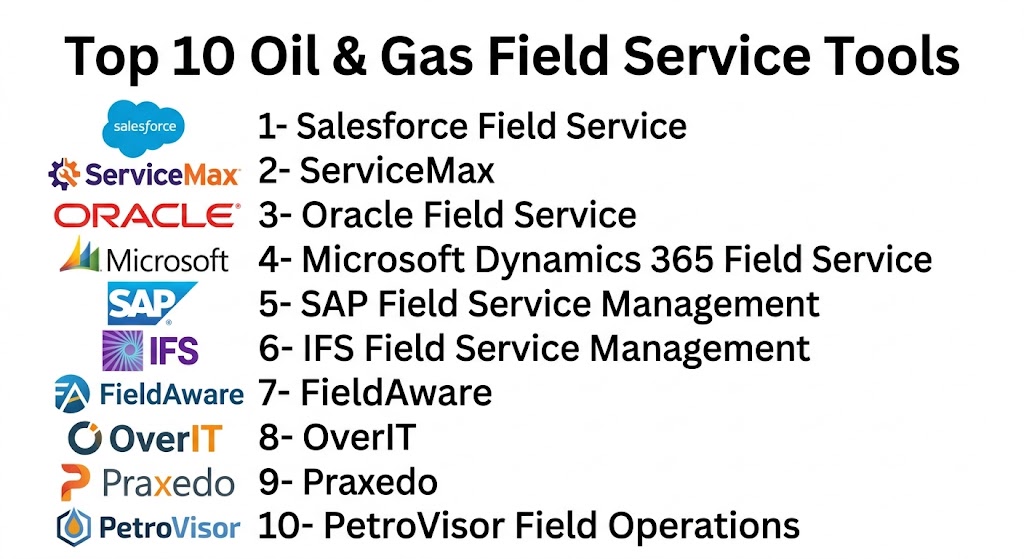
Top 10 Oil & Gas Field Service Tools
1- Salesforce Field Service
Short description: Salesforce Field Service is a cloud-based field operations platform widely used across energy, utilities, and industrial sectors. It combines workforce scheduling, asset visibility, mobile workflows, and AI-driven dispatch optimization. The platform is particularly strong for organizations already invested in the Salesforce ecosystem. Large enterprises benefit from its scalability, automation, and analytics capabilities.
Key Features
- AI-powered scheduling and dispatching
- Mobile technician applications
- Offline field operations support
- Asset and work order management
- GIS and mapping integrations
- Real-time workforce tracking
- Customer and service analytics
Pros
- Strong ecosystem and extensibility
- Excellent mobile user experience
- Advanced automation capabilities
- Highly scalable for enterprise environments
Cons
- Can become expensive at scale
- Complex implementation for large deployments
- Requires configuration expertise
- Some advanced modules add extra licensing costs
Platforms / Deployment
- Web / iOS / Android
- Cloud
Security & Compliance
- SSO/SAML
- MFA
- RBAC
- Audit logs
- Encryption
- Various enterprise compliance certifications publicly documented
Integrations & Ecosystem
Salesforce Field Service integrates with ERP systems, IoT platforms, customer service tools, and industrial applications. Its AppExchange ecosystem significantly expands customization options.
- SAP
- Oracle
- MuleSoft
- GIS platforms
- IoT integrations
- API framework
Support & Community
Strong enterprise support ecosystem with extensive documentation, implementation partners, and global community resources.
2- SAP Field Service Management
Short description: SAP Field Service Management is designed for complex industrial and energy service operations. It combines workforce scheduling, maintenance workflows, customer interactions, and AI-supported operational visibility. Oil and gas companies often use it alongside SAP ERP and SAP EAM environments. The platform is particularly effective for large-scale asset-intensive operations.
Key Features
- Workforce scheduling optimization
- Mobile service execution
- Digital asset management
- AI-assisted dispatching
- Offline mobile access
- Workflow automation
- Analytics dashboards
Pros
- Deep SAP ecosystem integration
- Strong enterprise-grade scalability
- Good compliance and governance capabilities
- Mature industrial workflows
Cons
- Implementation complexity
- Higher total cost of ownership
- Requires SAP expertise
- Less suitable for small teams
Platforms / Deployment
- Web / iOS / Android
- Cloud / Hybrid
Security & Compliance
- SSO
- RBAC
- Encryption
- Audit capabilities
- Enterprise compliance controls
Integrations & Ecosystem
SAP FSM integrates tightly with SAP ERP, SAP S/4HANA, SAP EAM, and industrial asset management systems.
- SAP ERP
- SAP S/4HANA
- SAP Asset Intelligence
- IoT platforms
- API integrations
- GIS systems
Support & Community
Backed by SAP’s enterprise support network and partner ecosystem. Documentation quality is generally strong.
3- Oracle Field Service
Short description: Oracle Field Service provides AI-driven scheduling and field workforce optimization capabilities for energy and industrial sectors. The platform focuses heavily on predictive scheduling, technician productivity, and operational visibility. Oil and gas companies use it to manage distributed field teams and service operations across geographically dispersed environments.
Key Features
- AI-based dispatch optimization
- Predictive scheduling
- Mobile workforce management
- Real-time route optimization
- Work order management
- SLA tracking
- Performance analytics
Pros
- Strong AI scheduling engine
- Good scalability
- Real-time operational visibility
- Mature cloud architecture
Cons
- Advanced customization can be complex
- Premium pricing for enterprise features
- Steeper learning curve
- Best value often tied to Oracle ecosystem
Platforms / Deployment
- Web / iOS / Android
- Cloud
Security & Compliance
- MFA
- RBAC
- Encryption
- SSO
- Audit logging
Integrations & Ecosystem
Oracle Field Service integrates with Oracle ERP and external enterprise systems using APIs and middleware.
- Oracle ERP
- Oracle CX
- GIS tools
- API integrations
- IoT platforms
- Analytics systems
Support & Community
Enterprise-grade support with structured onboarding and professional services availability.
4- ServiceMax
Short description: ServiceMax specializes in asset-centric field service operations for industrial sectors including oil and gas. The platform focuses on equipment maintenance, technician productivity, service execution, and field asset visibility. Organizations with complex service lifecycles often choose ServiceMax for its strong maintenance management depth.
Key Features
- Asset-centric service management
- Mobile technician workflows
- Preventive maintenance scheduling
- Service contract management
- Equipment history tracking
- Parts inventory management
- Analytics and reporting
Pros
- Strong industrial service workflows
- Excellent asset visibility
- Mature maintenance management capabilities
- Good mobile functionality
Cons
- Implementation can require consulting support
- Interface may feel complex for new users
- Pricing may not suit SMBs
- Custom reporting may require expertise
Platforms / Deployment
- Web / iOS / Android
- Cloud
Security & Compliance
- RBAC
- Encryption
- SSO
- Audit logging
Integrations & Ecosystem
ServiceMax integrates with ERP, CRM, IoT, and industrial systems to support asset-centric operations.
- Salesforce
- SAP
- Oracle
- IoT integrations
- APIs
- ERP connectors
Support & Community
Well-established industrial service community with enterprise support and implementation partners.
5- IFS Field Service Management
Short description: IFS offers a robust field service platform tailored for asset-heavy industries including oil and gas, utilities, and manufacturing. The platform combines scheduling, maintenance management, workforce optimization, and enterprise asset management into a unified operational environment.
Key Features
- Workforce scheduling
- Asset lifecycle management
- Predictive maintenance support
- Mobile workforce applications
- Work order automation
- Resource optimization
- Real-time reporting
Pros
- Strong EAM capabilities
- Good industrial use-case coverage
- Flexible deployment options
- Strong maintenance workflows
Cons
- Complex deployments for large organizations
- Higher learning curve
- Some advanced capabilities require additional modules
- SMB adoption may be limited
Platforms / Deployment
- Web / Windows / iOS / Android
- Cloud / Hybrid
Security & Compliance
- MFA
- RBAC
- Encryption
- SSO
- Audit controls
Integrations & Ecosystem
IFS supports industrial integrations across ERP, asset management, and IoT systems.
- ERP integrations
- GIS platforms
- IoT systems
- API framework
- SCADA integrations
- Reporting tools
Support & Community
Strong enterprise support with a growing industrial customer community.
6- IBM Maximo Mobile
Short description: IBM Maximo Mobile extends IBM’s enterprise asset management ecosystem into field operations. Oil and gas organizations use it for maintenance workflows, inspections, predictive maintenance, and operational visibility. The platform is particularly strong for asset-intensive enterprises seeking centralized operational control.
Key Features
- Mobile asset inspections
- Predictive maintenance
- AI-powered analytics
- Work order execution
- Inventory management
- Offline mobile support
- IoT integration support
Pros
- Excellent asset management depth
- Strong AI and analytics capabilities
- Mature enterprise reliability
- Good IoT integration support
Cons
- Complex implementation
- Can require significant customization
- Higher operational costs
- Training requirements for teams
Platforms / Deployment
- Web / iOS / Android
- Cloud / Hybrid / Self-hosted
Security & Compliance
- SSO
- RBAC
- Encryption
- Audit logging
- Enterprise security capabilities
Integrations & Ecosystem
IBM Maximo integrates with industrial systems, ERP environments, and IoT infrastructure.
- IBM Watson
- SAP
- Oracle
- SCADA systems
- IoT sensors
- APIs
Support & Community
Strong enterprise support and a mature industrial ecosystem backed by IBM consulting and partner services.
7- Microsoft Dynamics 365 Field Service
Short description: Microsoft Dynamics 365 Field Service combines workforce scheduling, predictive maintenance, IoT monitoring, and operational analytics into a cloud-based service management platform. Energy organizations benefit from its strong Microsoft ecosystem integration and collaboration capabilities.
Key Features
- AI scheduling optimization
- IoT-enabled predictive maintenance
- Mobile technician applications
- Work order automation
- Inventory tracking
- Remote assistance support
- Operational dashboards
Pros
- Strong Microsoft ecosystem integration
- Familiar interface for many enterprises
- Good collaboration capabilities
- Flexible automation workflows
Cons
- Advanced customization may require specialists
- Licensing complexity
- Large deployments can become expensive
- Some industrial workflows need additional configuration
Platforms / Deployment
- Web / Windows / iOS / Android
- Cloud
Security & Compliance
- MFA
- RBAC
- SSO
- Encryption
- Audit capabilities
Integrations & Ecosystem
Deep integration with Microsoft business and analytics tools improves operational visibility and collaboration.
- Microsoft Azure
- Power BI
- Teams
- ERP integrations
- IoT Hub
- APIs
Support & Community
Strong documentation and large enterprise partner ecosystem.
8- Praxedo
Short description: Praxedo is a mobile-first field service management platform focused on operational efficiency and technician productivity. While more common in utilities and industrial services, it also supports smaller oil and gas field service teams needing scheduling and mobile workflow automation.
Key Features
- Mobile workforce management
- Scheduling and dispatching
- Digital forms and inspections
- Offline mobile support
- GPS tracking
- Reporting dashboards
- Workflow automation
Pros
- Easier deployment than many enterprise suites
- Strong mobile usability
- Good for SMB and mid-market teams
- Flexible workflow customization
Cons
- Less enterprise depth than SAP or IBM
- Limited advanced industrial analytics
- Smaller ecosystem
- Fewer AI capabilities
Platforms / Deployment
- Web / iOS / Android
- Cloud
Security & Compliance
- Encryption
- RBAC
- MFA
- Not publicly stated for some certifications
Integrations & Ecosystem
Praxedo integrates with ERP and CRM systems through APIs and connectors.
- APIs
- CRM integrations
- ERP connectors
- Mapping tools
- Reporting integrations
Support & Community
Good onboarding support and responsive customer service for mid-market organizations.
9- OverIT
Short description: OverIT specializes in field service management for energy, utilities, telecommunications, and industrial sectors. The platform emphasizes augmented reality support, workforce optimization, and digital field operations. It is often used in technically complex service environments.
Key Features
- AR-assisted field operations
- Workforce optimization
- Mobile field applications
- GIS integration
- Digital work instructions
- Scheduling automation
- Asset visibility
Pros
- Strong utility and energy focus
- Advanced AR capabilities
- Good mobile functionality
- Flexible field workflows
Cons
- Smaller ecosystem than larger enterprise vendors
- Limited mindshare outside industrial sectors
- Advanced deployments may require consulting
- Pricing visibility not always clear
Platforms / Deployment
- Web / iOS / Android
- Cloud / Hybrid
Security & Compliance
- SSO
- Encryption
- RBAC
- Audit controls
Integrations & Ecosystem
OverIT integrates with enterprise asset management, GIS, and ERP systems.
- SAP
- IBM Maximo
- GIS platforms
- APIs
- IoT systems
Support & Community
Focused enterprise support with industry specialization in utilities and energy sectors.
10- FieldAware
Short description: FieldAware delivers cloud-based field service management capabilities for organizations needing scheduling, dispatching, mobile workforce management, and operational tracking. The platform is often used by mid-sized industrial service providers and operational field teams.
Key Features
- Scheduling and dispatch
- Mobile field applications
- Work order tracking
- Asset management
- Customer management
- Reporting dashboards
- Workflow automation
Pros
- Simpler implementation process
- Good usability for smaller teams
- Mobile-friendly workflows
- Flexible customization
Cons
- Less advanced enterprise analytics
- Limited AI capabilities
- Smaller integration ecosystem
- Not ideal for highly complex operations
Platforms / Deployment
- Web / iOS / Android
- Cloud
Security & Compliance
- Encryption
- RBAC
- MFA
- Not publicly stated for some compliance frameworks
Integrations & Ecosystem
FieldAware supports integrations with CRM, ERP, and accounting systems.
- QuickBooks
- CRM systems
- APIs
- ERP integrations
- Reporting tools
Support & Community
Responsive support model with onboarding assistance focused on mid-market deployments.
Comparison Table
| Tool Name | Best For | Platform(s) Supported | Deployment | Standout Feature | Public Rating |
|---|---|---|---|---|---|
| Salesforce Field Service | Large enterprises | Web, iOS, Android | Cloud | AI-driven scheduling | N/A |
| SAP Field Service Management | SAP-centric enterprises | Web, iOS, Android | Cloud, Hybrid | SAP ecosystem integration | N/A |
| Oracle Field Service | AI workforce optimization | Web, iOS, Android | Cloud | Predictive scheduling | N/A |
| ServiceMax | Asset-centric maintenance | Web, iOS, Android | Cloud | Industrial service workflows | N/A |
| IFS Field Service Management | Asset-heavy industries | Web, Windows, iOS, Android | Cloud, Hybrid | EAM integration | N/A |
| IBM Maximo Mobile | Enterprise asset management | Web, iOS, Android | Cloud, Hybrid, Self-hosted | Predictive maintenance | N/A |
| Microsoft Dynamics 365 Field Service | Microsoft ecosystem users | Web, Windows, iOS, Android | Cloud | IoT integration | N/A |
| Praxedo | SMB and mid-market teams | Web, iOS, Android | Cloud | Mobile-first usability | N/A |
| OverIT | Utility and energy operations | Web, iOS, Android | Cloud, Hybrid | AR-assisted field operations | N/A |
| FieldAware | Mid-sized field teams | Web, iOS, Android | Cloud | Simpler deployment | N/A |
Evaluation & Scoring of Oil & Gas Field Service Tools
| Tool Name | Core | Ease | Integrations | Security | Performance | Support | Value | Weighted Total |
|---|---|---|---|---|---|---|---|---|
| Salesforce Field Service | 9.4 | 8.4 | 9.5 | 9.2 | 9.1 | 9.0 | 7.8 | 8.96 |
| SAP Field Service Management | 9.3 | 7.5 | 9.4 | 9.3 | 9.0 | 8.8 | 7.4 | 8.67 |
| Oracle Field Service | 9.1 | 8.0 | 8.9 | 9.0 | 9.0 | 8.5 | 7.7 | 8.55 |
| ServiceMax | 8.9 | 7.9 | 8.8 | 8.8 | 8.9 | 8.4 | 7.8 | 8.43 |
| IFS Field Service Management | 9.0 | 7.6 | 8.9 | 8.9 | 8.8 | 8.5 | 7.9 | 8.46 |
| IBM Maximo Mobile | 9.2 | 7.2 | 8.7 | 9.2 | 9.2 | 8.7 | 7.2 | 8.44 |
| Microsoft Dynamics 365 Field Service | 8.9 | 8.5 | 9.1 | 9.0 | 8.8 | 8.8 | 8.0 | 8.68 |
| Praxedo | 7.8 | 8.8 | 7.5 | 7.8 | 8.0 | 8.1 | 8.7 | 8.09 |
| OverIT | 8.3 | 7.9 | 8.0 | 8.4 | 8.3 | 8.0 | 7.8 | 8.08 |
| FieldAware | 7.7 | 8.5 | 7.4 | 7.7 | 7.9 | 7.9 | 8.5 | 7.97 |
These scores are comparative rather than absolute. Enterprise platforms typically score higher in integrations, security, and scalability, while SMB-focused tools often perform better in ease of use and overall value. Buyers should prioritize the criteria most aligned with their operational requirements. For example, pipeline operators may value compliance and GIS integrations more heavily, while smaller field teams may prioritize usability and deployment speed.
Which Oil & Gas Field Service Tools Tool Is Right for You?
Solo / Freelancer
Independent contractors and very small service teams usually benefit from lightweight platforms such as Praxedo or FieldAware. These tools are easier to deploy, require less administrative overhead, and offer strong mobile usability without enterprise-level complexity.
SMB
Small and mid-sized oilfield service providers often need balanced functionality with manageable implementation costs. Microsoft Dynamics 365 Field Service, Praxedo, and FieldAware provide good operational visibility while remaining relatively accessible for smaller IT teams.
Mid-Market
Mid-market organizations typically require deeper asset management, scheduling automation, and operational reporting. IFS, ServiceMax, and Oracle Field Service offer strong capabilities without necessarily requiring the scale of a massive enterprise transformation project.
Enterprise
Large multinational oil and gas operators should prioritize platforms with mature ecosystem integrations, security controls, predictive maintenance capabilities, and scalability. Salesforce Field Service, SAP Field Service Management, IBM Maximo Mobile, and Oracle Field Service are strong enterprise-focused choices.
Budget vs Premium
Budget-oriented buyers should focus on deployment simplicity and operational efficiency rather than broad platform breadth. Praxedo and FieldAware are generally easier entry points. Premium enterprise suites provide broader integrations, AI capabilities, and asset lifecycle management but come with higher implementation and licensing costs.
Feature Depth vs Ease of Use
Enterprise tools usually deliver deeper functionality but can require specialized implementation expertise. Simpler platforms improve technician adoption and deployment speed. Organizations should balance operational complexity with workforce usability requirements.
Integrations & Scalability
Companies with existing ERP, SCADA, GIS, or IoT ecosystems should prioritize integration maturity. SAP, Oracle, Salesforce, and Microsoft typically provide stronger enterprise integration ecosystems compared to smaller vendors.
Security & Compliance Needs
Operators handling critical infrastructure and regulated environments should prioritize platforms with mature identity management, RBAC, encryption, and audit logging capabilities. Enterprise-grade governance becomes increasingly important for global operations and contractor-heavy environments.
Frequently Asked Questions
1. What are Oil & Gas Field Service Tools?
Oil & Gas Field Service Tools are software platforms designed to manage field operations, technician scheduling, inspections, maintenance workflows, and asset servicing across oilfields, pipelines, and industrial facilities. These tools improve operational visibility, workforce productivity, and compliance management. Many platforms also support mobile operations and remote asset monitoring.
2. Why are mobile capabilities important in this category?
Oil and gas field teams often operate in remote locations with inconsistent connectivity. Mobile applications with offline support allow technicians to complete inspections, update work orders, and access asset data without requiring continuous internet access. This significantly improves operational continuity and productivity.
3. How do AI features help field service operations?
AI capabilities help optimize technician scheduling, predict equipment failures, automate work order prioritization, and improve dispatch efficiency. Predictive maintenance analytics can reduce downtime and improve asset reliability. AI-driven route optimization also improves workforce utilization and operational response times.
4. Are these tools suitable for pipeline operations?
Yes. Many platforms support pipeline inspections, maintenance scheduling, GIS mapping, compliance workflows, and asset tracking. Enterprise platforms such as SAP Field Service Management, IBM Maximo Mobile, and Salesforce Field Service are commonly used in large-scale pipeline and utility operations.
5. What integrations should buyers prioritize?
Important integrations include ERP systems, GIS platforms, IoT infrastructure, SCADA systems, EAM platforms, inventory systems, and analytics tools. Organizations should evaluate API maturity and integration flexibility before selecting a platform.
6. How difficult is implementation?
Implementation complexity varies significantly depending on organizational size and operational requirements. Enterprise deployments may require consulting support, data migration, and process redesign. Smaller cloud-native tools generally offer faster deployment and onboarding timelines.
7. Are cloud deployments replacing on-premise systems?
Cloud adoption is increasing rapidly because of scalability, remote accessibility, and simplified updates. However, some oil and gas operators still prefer hybrid or self-hosted deployments for regulatory, security, or operational control reasons.
8. What are the most common buying mistakes?
Organizations often underestimate integration complexity, technician training requirements, and change management needs. Another common mistake is prioritizing feature quantity over workforce usability and operational fit. Poor mobile performance can also negatively impact adoption.
9. How important is security in field service software?
Security is critical because these platforms often connect to operational technology environments and critical infrastructure systems. Buyers should evaluate identity management, RBAC, encryption, audit logging, and compliance support before deployment.
10. Can smaller oilfield service companies benefit from these tools?
Yes. Smaller service providers can improve scheduling efficiency, reduce paperwork, and gain better operational visibility through lightweight field service platforms. Cloud-based systems also reduce infrastructure requirements and simplify deployment for smaller organizations.
Conclusion
Oil & Gas Field Service Tools have evolved from basic scheduling systems into intelligent operational platforms that support predictive maintenance, mobile workforce management, compliance tracking, IoT integration, and AI-driven optimization. Enterprise buyers typically benefit most from platforms such as Salesforce Field Service, SAP Field Service Management, Oracle Field Service, and IBM Maximo Mobile because of their scalability, ecosystem depth, and industrial capabilities. Mid-market and smaller organizations may find better operational efficiency and faster deployment with solutions like Praxedo or FieldAware. The right platform ultimately depends on operational complexity, existing infrastructure, workforce size, compliance requirements, and integration priorities. Instead of searching for a single universal winner, organizations should shortlist two or three strong candidates, run a focused pilot deployment, validate integration and security requirements, and measure technician adoption before scaling the rollout across operations.

Great overview of oil and gas field service tools—this article does a nice job explaining how these platforms improve field operations, workforce coordination, and service efficiency.
Oil and gas field service platforms are most valuable when they can coordinate people, equipment, and safety requirements in remote environments where connectivity is often unreliable. Beyond scheduling work orders, organizations benefit from solutions that support offline operations, contractor coordination, digital permit-to-work processes, and real-time visibility into field activities. Expanding the comparison to cover these operational capabilities, along with workforce competency tracking and emergency response integration, would provide readers with a more practical framework for evaluating field service solutions.