Introduction
Business Intelligence for Finance Tools are platforms that help finance teams analyze financial data, generate reports, and make data-driven decisions. These tools transform raw financial data into dashboards, insights, and forecasts that support budgeting, profitability analysis, and strategic planning.
In modern finance environments, organizations deal with large volumes of financial data from multiple systems such as ERP, CRM, and accounting tools. BI tools enable finance teams to consolidate this data, automate reporting, and gain real-time visibility into performance. Tools like Power BI and Tableau allow users to create dashboards and analyze trends without heavy technical expertise.
Real-world use cases include:
- Financial reporting and dashboards
- Budgeting and forecasting
- Profitability and cost analysis
- Cash flow monitoring
- Executive decision support
What buyers should evaluate:
- Data integration capabilities
- Ease of dashboard creation
- Financial analytics features
- Real-time reporting
- Security and compliance
- Scalability
- Integration with ERP and accounting systems
- Pricing and licensing
Best for: CFOs, finance teams, analysts, and enterprises managing large financial datasets.
Not ideal for: Small businesses with minimal reporting needs or simple accounting workflows.
Key Trends in Business Intelligence for Finance Tools
- AI-powered financial forecasting and anomaly detection
- Real-time financial dashboards and reporting
- Self-service analytics for finance teams
- Integration with ERP and accounting platforms
- Predictive analytics for revenue and cost trends
- Cloud-based BI platforms with scalability
- Natural language querying for finance data
- Automated report generation
- Embedded analytics within financial systems
- Data governance and compliance focus
How We Selected These Tools
- Evaluated market adoption and industry reputation
- Assessed financial analytics capabilities
- Considered ease of use for finance teams
- Reviewed integration with financial systems
- Analyzed scalability across organizations
- Checked reporting and dashboard capabilities
- Evaluated security and compliance readiness
- Considered overall value and flexibility
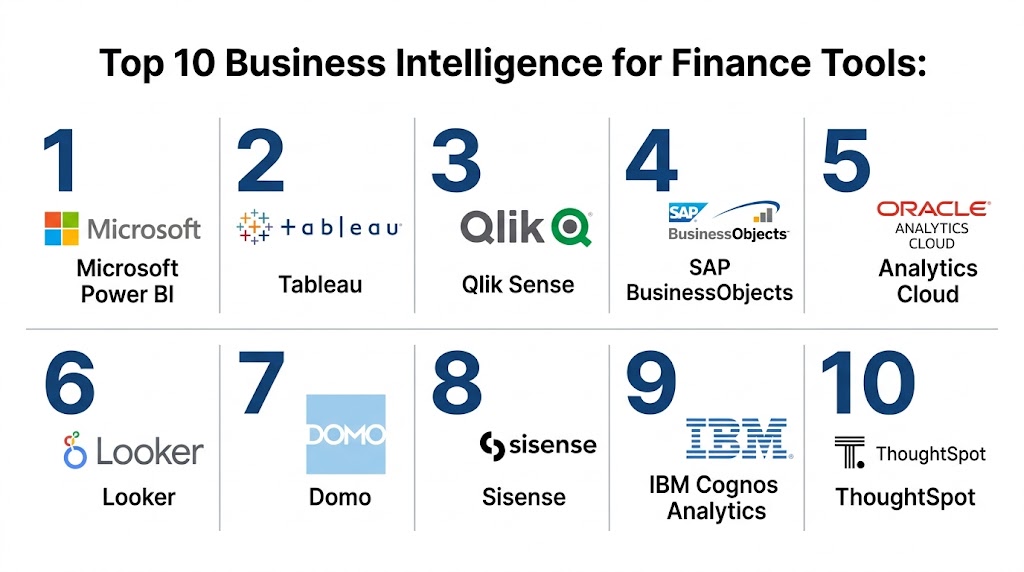
Top 10 Business Intelligence for Finance Tools
#1 — Microsoft Power BI
Short description: Power BI is a widely used BI tool that enables finance teams to create dashboards, automate reporting, and analyze financial data with AI-powered insights.
Key Features
- Real-time dashboards
- Financial data integration
- AI-powered insights
- Data visualization tools
- Custom reporting
- Data connectors
- Mobile access
Pros
- Easy to use
- Strong integration with Microsoft ecosystem
- Affordable
Cons
- Limited advanced customization
- Performance issues with large datasets
- Requires setup
Platforms / Deployment
- Web Windows
- Cloud Hybrid
Security & Compliance
- Encryption, access control
- Not publicly stated
Integrations & Ecosystem
Integrates with multiple data sources including ERP and CRM systems.
- Microsoft tools
- Databases
- APIs
Support & Community
Strong community and documentation.
#2 — Tableau
Short description: Tableau is a leading data visualization tool that helps finance teams analyze complex financial datasets through interactive dashboards.
Key Features
- Advanced visualization
- Financial dashboards
- Data blending
- Real-time analytics
- Reporting tools
Pros
- Powerful visuals
- Flexible analytics
- Widely adopted
Cons
- Expensive
- Learning curve
- Requires training
Platforms / Deployment
- Web Desktop
- Cloud
Security & Compliance
- Not publicly stated
Integrations & Ecosystem
Supports integration with financial systems and databases.
- ERP tools
- Data warehouses
- APIs
Support & Community
Large global community.
#3 — Qlik Sense
Short description: Qlik Sense provides self-service analytics with powerful data exploration and visualization for finance teams.
Key Features
- Self-service analytics
- Data visualization
- Financial dashboards
- AI insights
- Reporting tools
Pros
- Flexible data exploration
- Strong analytics
- Scalable
Cons
- Complex setup
- Learning curve
- Pricing
Platforms / Deployment
- Web
- Cloud Hybrid
Security & Compliance
- Not publicly stated
Integrations & Ecosystem
Integrates with enterprise systems.
- ERP
- CRM
- APIs
Support & Community
Good enterprise support.
#4 — SAP BusinessObjects
Short description: SAP BusinessObjects is an enterprise BI platform designed for reporting and analytics across financial and operational data.
Key Features
- Enterprise reporting
- Financial analytics
- Data integration
- Dashboarding
- Governance tools
Pros
- Enterprise-grade
- Strong reporting
- Reliable
Cons
- Complex
- Expensive
- Requires expertise
Platforms / Deployment
- Web
- Cloud On-premise
Security & Compliance
- Enterprise controls
- Not publicly stated
Integrations & Ecosystem
Integrates with SAP ecosystem.
- SAP systems
- ERP tools
Support & Community
Enterprise-level support.
#5 — Oracle Analytics Cloud
Short description: Oracle Analytics Cloud provides advanced analytics, reporting, and AI-driven insights for finance teams.
Key Features
- Financial analytics
- AI insights
- Data visualization
- Reporting
- Forecasting
Pros
- Strong analytics
- Enterprise-ready
- Scalable
Cons
- Expensive
- Complex
- Requires training
Platforms / Deployment
- Web
- Cloud
Security & Compliance
- Enterprise-level controls
- Not publicly stated
Integrations & Ecosystem
Integrates with Oracle systems.
- Oracle ERP
- Databases
Support & Community
Strong enterprise support.
#6 — Looker
Short description: Looker is a modern BI platform focused on data modeling and real-time analytics for financial decision-making.
Key Features
- Data modeling
- Real-time dashboards
- Financial reporting
- Embedded analytics
- Data governance
Pros
- Strong data governance
- Scalable
- Cloud-native
Cons
- Requires technical knowledge
- Expensive
- Learning curve
Platforms / Deployment
- Web
- Cloud
Security & Compliance
- Not publicly stated
Integrations & Ecosystem
Integrates with cloud data platforms.
- Cloud databases
- APIs
Support & Community
Strong enterprise support.
#7 — Domo
Short description: Domo is a cloud-based BI platform that provides real-time dashboards and analytics for finance teams.
Key Features
- Real-time dashboards
- Data integration
- Financial reporting
- Collaboration tools
- Alerts
Pros
- Easy to use
- Real-time insights
- Cloud-native
Cons
- Expensive
- Limited customization
- Learning curve
Platforms / Deployment
- Web Mobile
- Cloud
Security & Compliance
- Not publicly stated
Integrations & Ecosystem
Supports multiple integrations.
- Data sources
- APIs
Support & Community
Good support.
#8 — Sisense
Short description: Sisense enables finance teams to analyze large datasets and embed analytics into workflows.
Key Features
- Embedded analytics
- Data visualization
- Financial dashboards
- AI insights
- Reporting
Pros
- Scalable
- Strong analytics
- Flexible
Cons
- Complex setup
- Requires expertise
- Pricing
Platforms / Deployment
- Web
- Cloud Hybrid
Security & Compliance
- Not publicly stated
Integrations & Ecosystem
Supports integrations with data systems.
- Databases
- APIs
Support & Community
Enterprise-level support.
#9 — IBM Cognos Analytics
Short description: IBM Cognos Analytics provides enterprise reporting, dashboards, and AI-assisted analytics for finance teams.
Key Features
- AI-assisted analytics
- Reporting tools
- Financial dashboards
- Data integration
- Visualization
Pros
- Enterprise-grade
- Strong reporting
- Scalable
Cons
- Complex
- Expensive
- Learning curve
Platforms / Deployment
- Web
- Cloud On-premise
Security & Compliance
- Enterprise controls
- Not publicly stated
Integrations & Ecosystem
Integrates with enterprise systems.
- ERP
- Data platforms
Support & Community
Strong enterprise support.
#10 — ThoughtSpot
Short description: ThoughtSpot is an AI-powered BI platform that enables finance teams to search and analyze data using natural language queries.
Key Features
- AI-driven analytics
- Natural language search
- Real-time dashboards
- Data visualization
- Reporting
Pros
- Easy querying
- AI-powered insights
- Fast analysis
Cons
- Expensive
- Limited customization
- Learning curve
Platforms / Deployment
- Web
- Cloud
Security & Compliance
- Not publicly stated
Integrations & Ecosystem
Supports integration with data platforms.
- Cloud data sources
- APIs
Support & Community
Growing support ecosystem.
Comparison Table
| Tool Name | Best For | Platform Supported | Deployment | Standout Feature | Public Rating |
|---|---|---|---|---|---|
| Power BI | Financial dashboards | Web Windows | Cloud Hybrid | AI insights | N/A |
| Tableau | Visualization | Web Desktop | Cloud | Advanced visuals | N/A |
| Qlik Sense | Data exploration | Web | Cloud Hybrid | Self-service analytics | N/A |
| SAP BusinessObjects | Enterprise reporting | Web | Cloud On-premise | Reporting | N/A |
| Oracle Analytics | Enterprise analytics | Web | Cloud | AI analytics | N/A |
| Looker | Data modeling | Web | Cloud | Real-time dashboards | N/A |
| Domo | Real-time insights | Web Mobile | Cloud | Live dashboards | N/A |
| Sisense | Embedded analytics | Web | Cloud Hybrid | Embedded BI | N/A |
| IBM Cognos | Enterprise BI | Web | Cloud On-premise | AI reporting | N/A |
| ThoughtSpot | AI analytics | Web | Cloud | Search analytics | N/A |
Evaluation & Scoring of Business Intelligence for Finance Tools
| Tool Name | Core | Ease | Integrations | Security | Performance | Support | Value | Weighted Total |
|---|---|---|---|---|---|---|---|---|
| Power BI | 9 | 9 | 9 | 8 | 9 | 8 | 9 | 8.8 |
| Tableau | 9 | 7 | 8 | 8 | 9 | 8 | 7 | 8.1 |
| Qlik Sense | 8 | 7 | 8 | 8 | 8 | 7 | 7 | 7.8 |
| SAP BusinessObjects | 9 | 6 | 8 | 9 | 9 | 8 | 6 | 8.0 |
| Oracle Analytics | 9 | 6 | 8 | 9 | 9 | 8 | 6 | 8.0 |
| Looker | 8 | 6 | 9 | 8 | 8 | 7 | 7 | 7.9 |
| Domo | 8 | 8 | 7 | 7 | 8 | 7 | 7 | 7.7 |
| Sisense | 8 | 6 | 8 | 8 | 8 | 7 | 7 | 7.7 |
| IBM Cognos | 9 | 6 | 8 | 9 | 9 | 8 | 6 | 8.0 |
| ThoughtSpot | 8 | 8 | 7 | 7 | 8 | 7 | 7 | 7.6 |
Scores are comparative and reflect how tools perform across key finance BI criteria. The best choice depends on your organization’s data complexity and reporting needs.
Which Business Intelligence for Finance Tool Is Right for You
Solo / Freelancer
Power BI is affordable and easy to use.
SMB
Power BI and Tableau provide strong balance.
Mid Market
Qlik Sense and Looker are good choices.
Enterprise
SAP BusinessObjects and Oracle Analytics are ideal.
Budget vs Premium
Power BI is budget-friendly, Oracle is premium.
Feature Depth vs Ease of Use
SAP for depth, Power BI for ease.
Integrations & Scalability
Looker and Power BI are strong options.
Security & Compliance Needs
Enterprise tools offer stronger governance.
Frequently Asked Questions
1. What is business intelligence for finance
Business intelligence for finance refers to tools that analyze financial data and generate insights. These tools help finance teams track performance and make better decisions. They convert raw data into actionable reports.
2. Why do finance teams use BI tools
Finance teams use BI tools to automate reporting and gain real-time insights. These tools improve accuracy and reduce manual work. They also help in forecasting and budgeting.
3. How much do BI tools cost
Pricing varies widely based on features and scale. Some tools offer affordable plans while enterprise solutions are more expensive. Costs depend on users and data volume.
4. Can small businesses use BI tools
Yes, many BI tools are suitable for small businesses. Tools like Power BI are affordable and easy to use. They help improve financial visibility.
5. Are BI tools secure
Most tools include encryption and access control features. Security varies by provider. Enterprises should evaluate compliance features carefully.
6. Do BI tools support financial forecasting
Yes, many BI tools provide forecasting and predictive analytics. These features help plan future financial performance. They are widely used in finance teams.
7. How long does implementation take
Implementation can take from a few days to weeks. It depends on data complexity and integrations. Most vendors provide onboarding support.
8. Do BI tools integrate with ERP systems
Yes, most BI tools integrate with ERP and accounting systems. This allows centralized data analysis. Integration is critical for finance teams.
9. What are common mistakes when using BI tools
Common mistakes include poor data quality and lack of user training. Not aligning dashboards with business goals is also an issue. Proper setup is essential.
10. Are there alternatives to BI tools
Alternatives include spreadsheets or manual reporting. However, these are less efficient and scalable. BI tools provide automation and insights.
Conclusion
Business intelligence tools for finance play a critical role in transforming financial data into meaningful insights that drive better decisions. These platforms help automate reporting, improve accuracy, and provide real-time visibility into financial performance. From user-friendly tools like Power BI to enterprise-grade platforms like SAP BusinessObjects and Oracle Analytics, each solution offers unique capabilities based on business needs. The best tool depends on your organization’s size, data complexity, and integration requirements rather than a single universal choice. Companies should focus on usability, scalability, and financial analytics features when selecting a platform. It is always recommended to shortlist a few tools, test them with real financial data, and ensure they align with long-term strategic goals.
