Introduction
Restaurant Menu Engineering Tools are specialized software platforms that help restaurants analyze, design, and optimize their menus using data-driven insights. These tools combine sales data, food cost analysis, and customer behavior to identify which dishes are profitable, which are popular, and how to improve menu performance.
Menu engineering has become critical because restaurants operate on tight margins. Even small improvements in menu pricing or item placement can significantly increase profitability. In fact, structured menu engineering can improve profits by optimizing pricing, food costs, and demand patterns.
Common use cases include:
- Identifying high-margin and low-performing menu items
- Optimizing pricing strategies
- Reducing food waste and ingredient costs
- Improving menu design and layout
- Forecasting demand and sales trends
Key evaluation criteria:
- Food cost and margin analysis
- Recipe and ingredient tracking
- POS integration
- Analytics and reporting
- Ease of use
- Automation capabilities
- Scalability
- Customization
- Integration ecosystem
- Data accuracy
Best for: Restaurant owners, chefs, finance teams, and multi-location operators focused on profitability and operational efficiency.
Not ideal for: Small restaurants that do not track detailed cost or sales data and rely on simple menu structures.
Key Trends in Restaurant Menu Engineering Tools
- Real-time food cost tracking using supplier data
- AI-driven pricing and menu optimization
- Integration with POS and inventory systems
- Automated menu performance dashboards
- Predictive analytics for demand forecasting
- Cloud-based platforms replacing spreadsheets
- Centralized recipe and cost management
- Dynamic menu updates based on performance
- Data-driven decision-making replacing intuition
- Integration with procurement and supply chain systems
How We Selected These Tools
- Evaluated widely adopted restaurant analytics platforms
- Focused on tools with strong menu costing and profitability features
- Considered real-time data processing capabilities
- Reviewed integration with POS and inventory systems
- Assessed usability for kitchen and management teams
- Included solutions for SMBs and enterprise restaurants
- Considered scalability for multi-location operations
- Evaluated reporting and analytics depth
- Looked at innovation in automation and AI
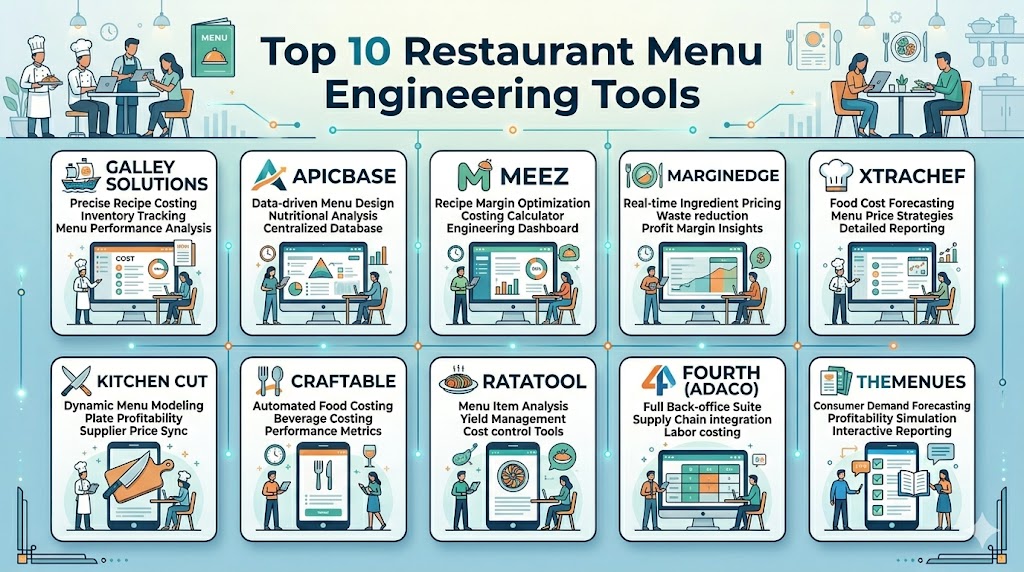
Top 10 Restaurant Menu Engineering Tools
#1 — Galley Solutions
Short description: A data-driven platform focused on recipe management, costing, and kitchen operations. It is ideal for restaurants that treat recipes as core operational data.
Key Features
- Recipe-based data management
- Real-time food cost tracking
- Inventory management
- Forecasting tools
- Centralized recipe database
Pros
- Strong data accuracy
- Advanced forecasting
- Centralized system
Cons
- Learning curve
- Premium pricing
- Requires setup
Platforms / Deployment
Web
Cloud
Security & Compliance
Not publicly stated
Integrations & Ecosystem
Integrates with POS and supplier systems for real-time pricing and inventory tracking.
- POS systems
- Supplier integrations
- Inventory tools
Support & Community
Strong onboarding and enterprise-level support.
#2 — Apicbase
Short description: A comprehensive menu engineering and food cost management platform that provides real-time insights into menu profitability.
Key Features
- Live menu matrix
- Food cost tracking
- Recipe management
- Inventory integration
- Analytics dashboard
Pros
- Real-time insights
- Strong analytics
- Easy reporting
Cons
- Setup required
- Pricing varies
- Training needed
Platforms / Deployment
Web
Cloud
Security & Compliance
Not publicly stated
Integrations & Ecosystem
Connects with POS systems to generate real-time cost and margin insights.
- POS integration
- Inventory tools
- Data analytics
Support & Community
Good documentation and onboarding support.
#3 — Meez
Short description: A modern platform that digitizes recipes and menu data to eliminate spreadsheets and improve visibility into menu performance.
Key Features
- Recipe digitization
- Cost analysis
- Menu insights
- Collaboration tools
- Real-time updates
Pros
- Easy to use
- Eliminates manual work
- Strong collaboration
Cons
- Limited advanced analytics
- Pricing varies
- Requires adoption
Platforms / Deployment
Web
Cloud
Security & Compliance
Not publicly stated
Integrations & Ecosystem
Integrates with POS and inventory systems for real-time financial insights.
- POS systems
- Inventory tools
Support & Community
Growing community with good support resources.
#4 — MarginEdge
Short description: A restaurant management platform that combines menu engineering with inventory and invoice processing.
Key Features
- Invoice processing
- Food cost tracking
- Inventory management
- Reporting tools
- Menu analysis
Pros
- All-in-one platform
- Strong cost tracking
- Automation features
Cons
- Learning curve
- Pricing varies
- Setup required
Platforms / Deployment
Web
Cloud
Security & Compliance
Not publicly stated
Integrations & Ecosystem
Centralizes inventory, recipe, and cost management across locations.
- POS systems
- Supplier integrations
Support & Community
Strong support for multi-location businesses.
#5 — xtraCHEF
Short description: A cost control and analytics tool that helps restaurants optimize food costs and menu profitability.
Key Features
- Invoice automation
- Cost tracking
- Reporting
- Menu insights
- Data analytics
Pros
- Strong automation
- Easy reporting
- Accurate cost tracking
Cons
- Limited customization
- Requires POS integration
- Pricing varies
Platforms / Deployment
Web
Cloud
Security & Compliance
Not publicly stated
Integrations & Ecosystem
Works with POS systems and accounting tools.
- POS integration
- Accounting tools
Support & Community
Reliable support with onboarding.
#6 — Kitchen CUT
Short description: A menu engineering and food cost platform focused on profitability and waste reduction.
Key Features
- Food cost per item
- Profitability analysis
- Waste reduction tools
- Menu optimization
- Reporting
Pros
- Strong analytics
- Reduces waste
- Improves margins
Cons
- Learning curve
- Pricing varies
- Requires data accuracy
Platforms / Deployment
Web
Cloud
Security & Compliance
Not publicly stated
Integrations & Ecosystem
Provides integration with POS and inventory systems.
- POS systems
- Inventory tools
Support & Community
Good support and onboarding.
#7 — Craftable
Short description: A restaurant operations platform with menu engineering capabilities focused on cost control and analytics.
Key Features
- Food cost tracking
- Inventory management
- Reporting
- Menu insights
- Forecasting
Pros
- Strong analytics
- Easy integration
- Scalable
Cons
- Setup required
- Pricing varies
- Learning curve
Platforms / Deployment
Web
Cloud
Security & Compliance
Not publicly stated
Integrations & Ecosystem
Integrates with POS and accounting tools.
- POS systems
- Accounting software
Support & Community
Responsive support with onboarding.
#8 — Ratatool
Short description: A recipe and menu engineering platform that helps restaurants optimize costs and improve profitability.
Key Features
- Recipe costing
- Menu analysis
- Reporting
- Inventory tracking
- Data insights
Pros
- Simple interface
- Affordable
- Easy setup
Cons
- Limited enterprise features
- Basic analytics
- Not highly scalable
Platforms / Deployment
Web
Cloud
Security & Compliance
Not publicly stated
Integrations & Ecosystem
Supports basic integrations with POS and inventory systems.
- POS systems
- Inventory tools
Support & Community
Basic support with limited resources.
#9 — Fourth (Adaco)
Short description: A comprehensive hospitality platform offering recipe management and menu engineering for enterprise operations.
Key Features
- Recipe management
- Cost control
- Inventory management
- Menu optimization
- Analytics
Pros
- Enterprise-grade
- Highly scalable
- Strong reporting
Cons
- Complex setup
- Higher cost
- Requires training
Platforms / Deployment
Web
Cloud
Security & Compliance
Not publicly stated
Integrations & Ecosystem
Provides centralized recipe and cost management across locations.
- POS systems
- Procurement tools
Support & Community
Enterprise-level support and onboarding.
#10 — TheMenues
Short description: A web-based menu engineering platform designed to visualize menu performance and improve decision-making.
Key Features
- Menu visualization
- Cost analysis
- Performance tracking
- Data insights
- Reporting
Pros
- Easy visualization
- User-friendly
- Good for SMBs
Cons
- Limited advanced features
- Not enterprise-focused
- Basic integrations
Platforms / Deployment
Web
Cloud
Security & Compliance
Not publicly stated
Integrations & Ecosystem
Offers basic integrations and visualization tools.
- Basic APIs
- Reporting tools
Support & Community
Basic support with growing adoption.
Comparison Table
| Tool Name | Best For | Platform Supported | Deployment | Standout Feature | Public Rating |
|---|---|---|---|---|---|
| Galley Solutions | Data-driven kitchens | Web | Cloud | Recipe-centric system | N/A |
| Apicbase | Cost tracking | Web | Cloud | Live menu matrix | N/A |
| Meez | Recipe digitization | Web | Cloud | Real-time visibility | N/A |
| MarginEdge | Multi-location ops | Web | Cloud | Invoice automation | N/A |
| xtraCHEF | Cost control | Web | Cloud | Expense automation | N/A |
| Kitchen CUT | Profit optimization | Web | Cloud | Waste reduction | N/A |
| Craftable | Analytics | Web | Cloud | Forecasting | N/A |
| Ratatool | Small restaurants | Web | Cloud | Simplicity | N/A |
| Fourth (Adaco) | Enterprise | Web | Cloud | Scalability | N/A |
| TheMenues | SMB visualization | Web | Cloud | Menu visualization | N/A |
Evaluation & Scoring
| Tool Name | Core | Ease | Integrations | Security | Performance | Support | Value | Weighted Total |
|---|---|---|---|---|---|---|---|---|
| Galley | 9 | 7 | 9 | 7 | 9 | 8 | 7 | 8.3 |
| Apicbase | 9 | 8 | 8 | 7 | 8 | 8 | 7 | 8.1 |
| Meez | 8 | 9 | 7 | 6 | 8 | 7 | 8 | 7.8 |
| MarginEdge | 9 | 8 | 8 | 7 | 8 | 8 | 7 | 8.2 |
| xtraCHEF | 8 | 8 | 7 | 6 | 8 | 7 | 8 | 7.7 |
| Kitchen CUT | 8 | 7 | 7 | 6 | 8 | 7 | 7 | 7.5 |
| Craftable | 8 | 7 | 8 | 6 | 8 | 7 | 7 | 7.6 |
| Ratatool | 7 | 9 | 6 | 5 | 7 | 6 | 9 | 7.2 |
| Fourth | 9 | 6 | 9 | 7 | 9 | 8 | 6 | 8.0 |
| TheMenues | 7 | 9 | 6 | 5 | 7 | 6 | 8 | 7.1 |
These scores are comparative and based on general capabilities. The best choice depends on your operational scale, data maturity, and integration needs.
Which Tool Is Right for You
Solo / Freelancer
Ratatool and TheMenues are simple and affordable options.
SMB
Meez and Kitchen CUT provide good balance of features and usability.
Mid-Market
Apicbase and Craftable offer scalability and integrations.
Enterprise
Galley Solutions, MarginEdge, and Fourth are ideal for complex operations.
Budget vs Premium
Budget users should consider Ratatool, while premium users can choose Galley or Fourth.
Feature Depth vs Ease of Use
Advanced tools provide deeper analytics but require training, while simpler tools prioritize usability.
Integrations & Scalability
Choose tools with strong POS and inventory integrations for long-term growth.
Security & Compliance Needs
Enterprise users should prioritize tools with strong access controls and data security.
Frequently Asked Questions
1. What is menu engineering software
Menu engineering software helps restaurants analyze profitability and popularity of menu items. It uses sales and cost data to optimize pricing and design. This enables better decision-making and improved margins.
2. How does it improve profitability
It identifies high-margin items and low-performing dishes. Restaurants can adjust pricing, portions, or promotions accordingly. This leads to better revenue and cost control.
3. Is it difficult to use
Most tools are designed to be user-friendly, but advanced analytics may require training. Cloud-based platforms simplify adoption. Onboarding support is usually available.
4. Can it integrate with POS systems
Yes, most tools integrate with POS systems to collect sales data. This ensures accurate analysis and reporting. Integration is essential for real-time insights.
5. What data is required
Menu engineering tools require sales data, ingredient costs, and recipes. This data is used to calculate profitability and popularity. Accurate data improves results.
6. Is it suitable for small restaurants
Yes, but simpler tools are better for small operations. Advanced platforms may be unnecessary. It depends on the level of data tracking needed.
7. Can it reduce food waste
Yes, by identifying underperforming items, restaurants can remove or adjust them. This reduces waste and improves efficiency. It also helps with inventory planning.
8. How long does implementation take
Most cloud tools can be implemented quickly. However, full setup with integrations and data may take time. Training also plays a role.
9. Can it handle multiple locations
Yes, many tools support multi-location management. They provide centralized reporting and analytics. This is useful for restaurant chains.
10. What are common mistakes
Not using accurate data is a major mistake. Ignoring integrations and scalability can also cause issues. Always evaluate long-term needs.
Conclusion
Restaurant Menu Engineering Tools play a critical role in helping restaurants maximize profitability and optimize operations. By combining cost analysis, sales data, and customer insights, these platforms enable smarter menu decisions that directly impact revenue. From simple tools for small restaurants to advanced enterprise platforms, the market offers a wide range of solutions tailored to different needs.Choosing the right tool depends on your operational complexity, data maturity, and integration requirements. Instead of relying on intuition, restaurants can now make informed, data-driven decisions that improve efficiency and reduce waste. The best approach is to shortlist a few tools, test them with real data, and evaluate how well they align with your workflows. A well-implemented menu engineering system can significantly improve margins, consistency, and long-term business success.

An interesting factor to consider is how often menu performance is reviewed. Even the best analytics tools are most effective when businesses regularly adjust pricing, placement, and promotions based on changing customer preferences.