Introduction
Restaurant Reservation & Table Management software helps restaurants manage bookings, optimize seating, reduce wait times, and deliver a better guest experience. It replaces traditional manual reservation systems with digital platforms that handle table allocation, guest tracking, and service flow in real time.
In today’s competitive hospitality environment, restaurants need efficient systems to handle increasing customer expectations. These platforms now include automation, guest insights, and integrations with POS and CRM tools, making them essential for modern operations.
Common use cases include:
- Managing online and walk-in reservations
- Optimizing table turnover and seating plans
- Handling waitlists during busy hours
- Personalizing guest experiences
- Integrating bookings with POS and marketing systems
Key evaluation criteria:
- Reservation and waitlist management
- Table layout and optimization
- Guest data and CRM capabilities
- Integration ecosystem
- Ease of use
- Automation features
- Pricing flexibility
- Scalability
- Reporting and analytics
- Security controls
Best for: Restaurant owners, hospitality managers, and multi-location operators looking to streamline operations and improve guest satisfaction.
Not ideal for: Very small food businesses that rely entirely on walk-ins and do not need structured reservation workflows.
Key Trends in Restaurant Reservation & Table Management
- AI-based table allocation for better utilization
- Mobile-first and contactless booking experiences
- Guest data platforms enabling personalization
- Automated waitlist and queue management
- Reservation deposits and dynamic pricing models
- Deep POS and payment integrations
- Cloud-native deployment models
- Predictive analytics for demand planning
- Centralized dashboards for multi-location chains
- Role-based access and improved security controls
How We Selected These Tools
- Strong market adoption and industry presence
- Comprehensive reservation and table management features
- Reliable performance during peak hours
- Security capabilities such as access control and data protection
- Integration support with POS and CRM systems
- Fit for different business sizes from small to enterprise
- Ease of onboarding and usability
- Scalability across locations
- Innovation in automation and analytics
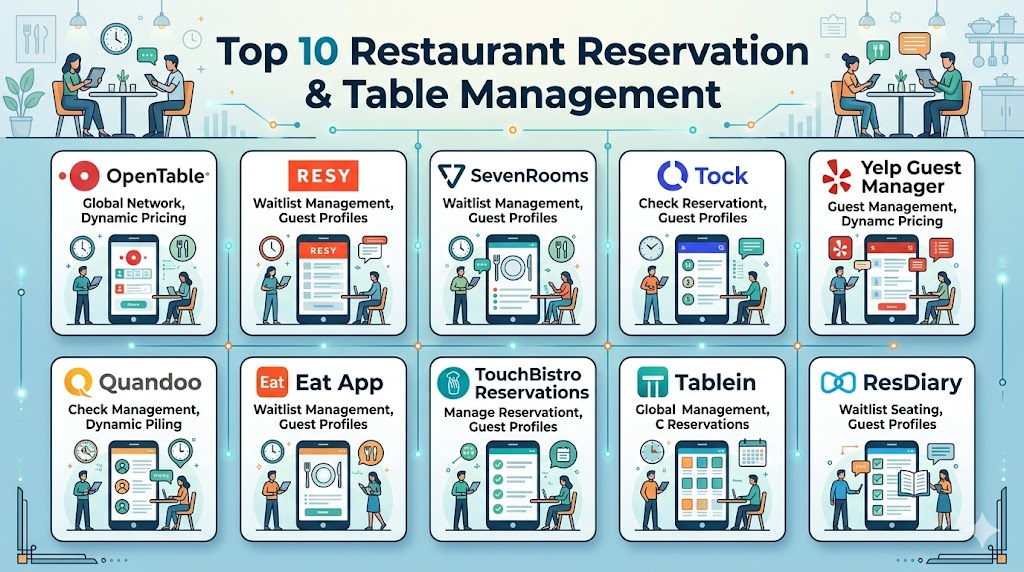
Top 10 Restaurant Reservation & Table Management Tools
#1 — OpenTable
Short description: A widely used reservation platform that helps restaurants manage bookings, optimize seating, and attract customers through its discovery network. It is ideal for mid-sized to large restaurants that want visibility and operational efficiency.
Key Features
- Online reservation system
- Table and floor management
- Guest CRM and dining history
- Waitlist management
- Automated confirmations
- Reporting dashboard
Pros
- Large customer network
- Comprehensive feature set
- Strong analytics
Cons
- Higher cost for smaller restaurants
- Platform dependency
- Limited customization in basic plans
Platforms / Deployment
Web, iOS, Android
Cloud
Security & Compliance
Encryption, role-based access
Other details: Not publicly stated
Integrations & Ecosystem
Supports integrations with POS systems and marketing tools. Provides APIs for extended functionality.
- POS integrations
- CRM tools
- Marketing platforms
Support & Community
Strong onboarding and support for business users.
#2 — Resy
Short description: A modern reservation solution focused on improving guest experience through real-time booking and analytics. It is popular among premium dining establishments.
Key Features
- Real-time reservations
- Guest preference tracking
- Floor management
- Automated notifications
- Analytics tools
Pros
- User-friendly interface
- Strong guest experience features
- Reliable performance
Cons
- Pricing not clearly disclosed
- Limited flexibility for smaller setups
- Requires onboarding
Platforms / Deployment
Web, iOS, Android
Cloud
Security & Compliance
Not publicly stated
Integrations & Ecosystem
Integrates with POS and payment systems with moderate extensibility.
- POS systems
- Payment tools
Support & Community
Responsive support with structured onboarding.
#3 — SevenRooms
Short description: A data-driven platform that combines reservation management with guest experience and marketing tools. It is ideal for restaurants focusing on personalization and customer retention.
Key Features
- Reservation management
- Guest profiles and CRM
- Marketing automation
- Table management
- Analytics dashboard
Pros
- Strong CRM capabilities
- Customizable workflows
- Direct guest ownership
Cons
- Higher complexity
- Premium pricing
- Requires setup effort
Platforms / Deployment
Web, iOS, Android
Cloud
Security & Compliance
Role-based access, encryption
Other details: Not publicly stated
Integrations & Ecosystem
Deep integrations with POS and marketing systems, along with APIs.
- POS systems
- Email marketing tools
- Analytics platforms
Support & Community
Dedicated onboarding with enterprise-level support.
#4 — Tock
Short description: A reservation and ticketing platform designed for restaurants offering experiences and events. It helps optimize revenue through prepaid bookings.
Key Features
- Reservation and ticketing
- Prepaid bookings
- Event management
- Table optimization
- Reporting
Pros
- Great for event-driven dining
- Flexible pricing models
- Revenue optimization tools
Cons
- Not ideal for basic needs
- Learning curve
- Limited entry-level options
Platforms / Deployment
Web, iOS
Cloud
Security & Compliance
Not publicly stated
Integrations & Ecosystem
Works with POS and payment systems with basic extensibility.
- Payment gateways
- POS tools
Support & Community
Reliable support for premium users.
#5 — Yelp Guest Manager
Short description: A reservation and waitlist system integrated with the Yelp ecosystem, helping restaurants increase visibility and manage bookings efficiently.
Key Features
- Reservation system
- Waitlist management
- Table tracking
- Guest notifications
- Basic analytics
Pros
- Built-in customer discovery
- Easy setup
- Cost-effective
Cons
- Limited advanced features
- Dependence on Yelp ecosystem
- Less customization
Platforms / Deployment
Web, iOS, Android
Cloud
Security & Compliance
Not publicly stated
Integrations & Ecosystem
Primarily tied to Yelp with limited third-party integrations.
- Yelp ecosystem
- Basic POS support
Support & Community
Standard support with limited enterprise capabilities.
#6 — Quandoo
Short description: A global reservation platform offering booking management, marketing tools, and customer insights for restaurants of various sizes.
Key Features
- Online reservations
- Table management
- Marketing tools
- Customer insights
- Reporting
Pros
- Global reach
- Easy onboarding
- Built-in marketing
Cons
- Limited advanced analytics
- Pricing varies
- Less customization
Platforms / Deployment
Web, iOS, Android
Cloud
Security & Compliance
Not publicly stated
Integrations & Ecosystem
Supports integrations with POS systems and booking platforms.
- POS tools
- Booking integrations
Support & Community
Good onboarding and responsive support.
#7 — Eat App
Short description: A flexible reservation and guest management system that offers automation and integrations for improving operational efficiency.
Key Features
- Reservation and waitlist
- Table management
- Guest CRM
- Automation workflows
- Analytics
Pros
- Highly customizable
- Strong automation features
- Good integration support
Cons
- Setup effort required
- Learning curve
- Pricing varies
Platforms / Deployment
Web, iOS, Android
Cloud
Security & Compliance
Not publicly stated
Integrations & Ecosystem
Offers integrations with POS, CRM, and marketing systems along with APIs.
- POS systems
- CRM platforms
- API access
Support & Community
Responsive support and onboarding assistance.
#8 — TouchBistro Reservations
Short description: A reservation system built for restaurants using TouchBistro POS, providing seamless table management and booking capabilities.
Key Features
- Reservation management
- Table layout tools
- Waitlist tracking
- POS integration
- Reporting
Pros
- Strong POS integration
- Easy to use
- Suitable for small businesses
Cons
- Limited ecosystem
- Fewer advanced features
- Best with TouchBistro POS
Platforms / Deployment
iOS, Web
Cloud
Security & Compliance
Not publicly stated
Integrations & Ecosystem
Primarily integrated within TouchBistro ecosystem.
- POS integration
- Basic APIs
Support & Community
Good support for small and mid-sized users.
#9 — Tablein
Short description: A lightweight reservation system designed for small restaurants and cafes that need a simple and affordable booking solution.
Key Features
- Online reservations
- Table management
- SMS notifications
- Basic reporting
- Website integration
Pros
- Affordable
- Easy setup
- Simple interface
Cons
- Limited scalability
- Basic features
- Minimal analytics
Platforms / Deployment
Web
Cloud
Security & Compliance
Not publicly stated
Integrations & Ecosystem
Basic integrations with websites and booking tools.
- Website widgets
- Limited APIs
Support & Community
Basic support with limited resources.
#10 — ResDiary
Short description: A cost-effective reservation system offering strong table management and reporting capabilities, suitable for multi-location restaurants.
Key Features
- Reservation management
- Table optimization
- Reporting tools
- Guest CRM
- Multi-location support
Pros
- No commission model
- Strong reporting
- Scalable
Cons
- Interface can feel outdated
- Limited marketing tools
- Setup complexity
Platforms / Deployment
Web, iOS, Android
Cloud
Security & Compliance
Not publicly stated
Integrations & Ecosystem
Supports integrations with POS and CRM systems.
- POS systems
- CRM tools
Support & Community
Reliable support with onboarding assistance.
Comparison Table
| Tool Name | Best For | Platform Supported | Deployment | Standout Feature | Public Rating |
|---|---|---|---|---|---|
| OpenTable | Large restaurants | Web, iOS, Android | Cloud | Customer network | N/A |
| Resy | Premium dining | Web, iOS, Android | Cloud | Guest experience | N/A |
| SevenRooms | CRM-focused | Web, iOS, Android | Cloud | Guest data control | N/A |
| Tock | Event dining | Web, iOS | Cloud | Prepaid bookings | N/A |
| Yelp Guest Manager | Small restaurants | Web, iOS, Android | Cloud | Yelp integration | N/A |
| Quandoo | Global restaurants | Web, iOS, Android | Cloud | Marketing tools | N/A |
| Eat App | Custom workflows | Web, iOS, Android | Cloud | Automation | N/A |
| TouchBistro | POS users | iOS, Web | Cloud | POS sync | N/A |
| Tablein | Small cafes | Web | Cloud | Simplicity | N/A |
| ResDiary | Multi-location | Web, iOS, Android | Cloud | No commission | N/A |
Evaluation & Scoring
| Tool Name | Core | Ease | Integrations | Security | Performance | Support | Value | Weighted Total |
|---|---|---|---|---|---|---|---|---|
| OpenTable | 9 | 8 | 9 | 7 | 9 | 8 | 7 | 8.4 |
| Resy | 8 | 9 | 7 | 6 | 8 | 8 | 7 | 7.8 |
| SevenRooms | 9 | 7 | 9 | 7 | 8 | 8 | 7 | 8.2 |
| Tock | 8 | 7 | 7 | 6 | 8 | 7 | 8 | 7.5 |
| Yelp Guest Manager | 7 | 8 | 6 | 6 | 7 | 7 | 8 | 7.2 |
| Quandoo | 7 | 8 | 7 | 6 | 7 | 7 | 7 | 7.2 |
| Eat App | 8 | 7 | 8 | 6 | 8 | 7 | 7 | 7.6 |
| TouchBistro | 7 | 8 | 7 | 6 | 7 | 7 | 7 | 7.2 |
| Tablein | 6 | 9 | 5 | 5 | 6 | 6 | 9 | 6.8 |
| ResDiary | 8 | 7 | 7 | 6 | 8 | 7 | 8 | 7.6 |
These scores are comparative and based on typical platform capabilities. A higher score indicates stronger overall performance, but the best choice depends on your business size, budget, and integration needs.
Which Tool Is Right for You
Solo / Freelancer
Tablein is a simple and affordable choice for small setups.
SMB
Yelp Guest Manager and TouchBistro offer balanced features with ease of use.
Mid-Market
Eat App and Quandoo provide flexibility and integrations.
Enterprise
OpenTable, SevenRooms, and ResDiary are better for scale and complexity.
Budget vs Premium
Budget users should focus on Tablein and Yelp. Premium users can explore SevenRooms and Resy.
Feature Depth vs Ease of Use
Advanced platforms provide more insights but require training, while simpler tools prioritize usability.
Integrations & Scalability
Choose tools with strong POS and CRM integrations for long-term growth.
Security & Compliance Needs
Larger organizations should prioritize tools with better access control and data protection.
Frequently Asked Questions
1. What is restaurant reservation software
It is a system that helps restaurants manage bookings, seating, and guest experiences digitally. It replaces manual reservation logs with automated workflows and improves operational efficiency. It also provides better visibility into customer preferences.
2. How much does it cost
Pricing varies depending on features, number of locations, and usage. Some platforms charge monthly subscriptions while others include commission-based models. Costs can increase with advanced analytics and integrations.
3. Is it easy to implement
Most cloud-based solutions are quick to deploy and require minimal technical setup. However, advanced configurations such as integrations and workflows may need training. Onboarding support usually helps speed up adoption.
4. Can it integrate with POS systems
Yes, most modern tools offer integration with POS systems. This allows seamless syncing of reservations, orders, and customer data. Integration improves operational efficiency and reporting accuracy.
5. Does it support mobile usage
Most platforms provide mobile applications for both staff and management. This enables real-time updates, booking management, and communication. Mobile support is essential for modern restaurant operations.
6. Is it secure
Security features vary by platform, but most include encryption and access control. Some tools also offer audit logs and user permissions. Always verify security features before selecting a tool.
7. Can it handle multiple locations
Yes, many platforms support centralized management for multiple locations. This includes shared reporting, guest data, and reservation systems. It is especially useful for restaurant chains.
8. What are common mistakes when choosing a tool
Choosing based only on price without considering integrations and scalability is a common mistake. Ignoring staff usability and training requirements can also lead to poor adoption. Always evaluate long-term needs.
9. Can I switch tools later
Yes, switching is possible but may require data migration and retraining staff. Some platforms provide migration support. Planning ahead can reduce disruption during transitions.
10. Are there alternatives to reservation systems
For very small businesses, manual systems or basic POS features may be enough. However, they lack automation and scalability. Digital systems provide better efficiency and customer experience.
Conclusion
Restaurant Reservation & Table Management tools have become essential for improving efficiency and delivering a better dining experience. From simple booking solutions to advanced platforms with CRM and analytics, there are options for every type of restaurant. The right choice depends on your business size, operational complexity, and integration requirements.Instead of focusing only on features, evaluate how well a platform fits into your workflow and long-term growth strategy. Testing a few shortlisted tools in real scenarios can help identify the best fit. A well-chosen system not only improves operations but also enhances customer satisfaction and retention.

A practical aspect that often gets overlooked is how well these systems help manage walk-in guests alongside reservations. Finding the right balance between both can improve table utilization and create a smoother dining experience for customers.