Introduction
Food Safety Compliance (HACCP) Software helps restaurants and food businesses manage safety processes by digitizing hazard analysis, monitoring critical control points, and maintaining audit-ready records. HACCP (Hazard Analysis and Critical Control Points) is a globally recognized framework that ensures food safety by identifying risks and controlling them systematically.
Modern HACCP software replaces manual logs and paperwork with automated workflows, real-time monitoring, and centralized dashboards. This not only improves compliance but also reduces human error and operational overhead.
Common use cases include:
- Monitoring food temperature and storage conditions
- Managing HACCP plans and compliance documentation
- Conducting digital audits and inspections
- Tracking corrective actions and incidents
- Ensuring regulatory compliance across locations
Key evaluation criteria:
- HACCP plan creation and management
- Real-time monitoring and alerts
- Digital record-keeping and audit readiness
- Ease of use for kitchen staff
- Integration with POS and IoT sensors
- Multi-location support
- Automation and workflows
- Reporting and analytics
- Compliance coverage
- Data security
Best for: Restaurants, cloud kitchens, food chains, and food production businesses that need consistent compliance and audit readiness.
Not ideal for: Very small kitchens with minimal compliance requirements and low operational complexity.
Key Trends in Food Safety Compliance (HACCP) Software
- AI-powered HACCP plan builders and predictive compliance alerts
- Real-time temperature monitoring using IoT sensors
- Mobile-first compliance checklists and inspections
- Automated audit preparation and reporting
- Cloud-based centralized compliance dashboards
- Integration with supply chain and traceability systems
- Digital corrective action workflows
- Multi-location compliance visibility
- Paperless compliance replacing manual logs
- Data-driven risk analysis and forecasting
How We Selected These Tools
- Strong adoption in food safety and compliance management
- Comprehensive HACCP and regulatory coverage
- Real-time monitoring and automation capabilities
- Integration with POS, IoT, and supply chain systems
- Usability for frontline staff
- Scalability for multi-location operations
- Reliability and audit readiness
- Innovation in AI and analytics
- Vendor support and onboarding quality
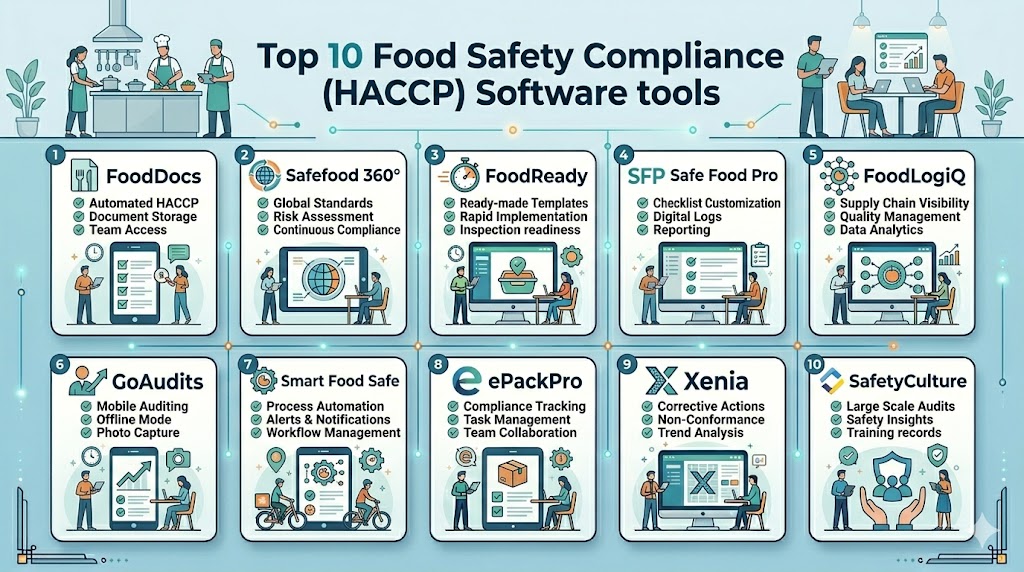
Top 10 Food Safety Compliance (HACCP) Software Tools
#1 — FoodDocs
Short description: A modern food safety management system with an AI-powered HACCP plan builder, designed to simplify compliance and reduce manual work for restaurants and food businesses.
Key Features
- AI HACCP plan builder
- Real-time monitoring
- Food traceability system
- Digital checklists
- Compliance dashboards
Pros
- Easy to use
- Strong automation
- Reduces paperwork
Cons
- Pricing varies
- Limited enterprise customization
- Requires onboarding
Platforms / Deployment
Web, iOS, Android
Cloud
Security & Compliance
Not publicly stated
Integrations & Ecosystem
Integrates with monitoring systems and food safety workflows.
- Traceability systems
- Monitoring tools
Support & Community
Good documentation and onboarding support.
#2 — Safefood 360°
Short description: A comprehensive compliance platform designed for medium to large food businesses with strong HACCP and regulatory management features.
Key Features
- HACCP plan management
- Audit and inspection tools
- Supplier management
- Risk management
- Reporting
Pros
- Comprehensive compliance coverage
- Strong reporting
- Scalable
Cons
- Complex setup
- Higher cost
- Learning curve
Platforms / Deployment
Web, iOS, Android
Cloud
Security & Compliance
Supports compliance workflows; certifications not publicly stated
Integrations & Ecosystem
Integrates with enterprise systems and supplier networks.
- ERP systems
- Supplier tools
Support & Community
Enterprise-level support and onboarding.
#3 — Safe Food Pro
Short description: A digital food safety platform that simplifies HACCP compliance through automation and real-time monitoring.
Key Features
- Temperature monitoring
- Digital checklists
- Real-time dashboards
- Compliance tracking
- Reporting
Pros
- Easy implementation
- Real-time visibility
- Reduces manual tasks
Cons
- Limited advanced features
- Pricing varies
- Customization limits
Platforms / Deployment
Web
Cloud
Security & Compliance
Not publicly stated
Integrations & Ecosystem
Supports integrations with monitoring systems.
- Monitoring tools
- APIs
Support & Community
Good support and documentation.
#4 — FoodReady
Short description: A HACCP-focused platform that helps businesses manage compliance documentation, audits, and workflows efficiently.
Key Features
- HACCP plan builder
- Audit tools
- Digital logs
- Workflow automation
- Reporting
Pros
- Strong compliance features
- Easy record-keeping
- Flexible workflows
Cons
- Setup required
- Pricing varies
- Learning curve
Platforms / Deployment
Web
Cloud
Security & Compliance
Not publicly stated
Integrations & Ecosystem
Supports integration with compliance and reporting tools.
- Compliance tools
- APIs
Support & Community
Reliable onboarding support.
#5 — FoodLogiQ Connect
Short description: A supply chain-focused food safety platform that enhances traceability and compliance across the food ecosystem.
Key Features
- Supply chain traceability
- Compliance management
- Recall management
- Supplier monitoring
- Analytics
Pros
- Strong traceability
- Enterprise-ready
- Scalable
Cons
- Complex implementation
- Higher cost
- Requires training
Platforms / Deployment
Web
Cloud
Security & Compliance
Not publicly stated
Integrations & Ecosystem
Integrates with supply chain and enterprise systems.
- ERP systems
- Supplier networks
Support & Community
Enterprise-level support.
#6 — GoAudits
Short description: A mobile-first HACCP compliance tool focused on inspections, audits, and digital record-keeping.
Key Features
- HACCP plan management
- Audit scheduling
- Mobile inspections
- Reporting tools
- Workflow automation
Pros
- Easy to use
- Mobile-friendly
- Strong audit features
Cons
- Limited enterprise depth
- Basic integrations
- Pricing varies
Platforms / Deployment
Web, iOS, Android
Cloud
Security & Compliance
Not publicly stated
Integrations & Ecosystem
Supports integration with reporting and inspection tools.
- APIs
- Reporting tools
Support & Community
Good support and onboarding.
#7 — Smart Food Safe
Short description: A comprehensive HACCP and compliance platform offering automation, traceability, and supplier management.
Key Features
- HACCP compliance management
- Supplier tracking
- Audit tools
- Traceability
- Analytics
Pros
- Strong compliance coverage
- Flexible workflows
- Scalable
Cons
- Complex setup
- Pricing varies
- Requires training
Platforms / Deployment
Web
Cloud
Security & Compliance
Supports HACCP, ISO, FSMA workflows
Integrations & Ecosystem
Integrates with supply chain and compliance systems.
- Supplier tools
- APIs
Support & Community
Strong enterprise support.
#8 — ePackPro
Short description: A HACCP-focused application designed for traceability and compliance with real-time data access.
Key Features
- HACCP traceability
- Data access across devices
- Compliance tracking
- Reporting
- Workflow automation
Pros
- Easy access
- Strong traceability
- User-friendly
Cons
- Limited advanced analytics
- Pricing varies
- Smaller ecosystem
Platforms / Deployment
Web
Cloud
Security & Compliance
Not publicly stated
Integrations & Ecosystem
Supports integration with compliance workflows.
- APIs
- Reporting tools
Support & Community
Basic support with growing adoption.
#9 — Xenia
Short description: A modern food safety platform with AI-driven compliance monitoring and workflow automation.
Key Features
- HACCP compliance automation
- AI-powered inspections
- Real-time alerts
- Workflow automation
- Dashboard analytics
Pros
- Strong automation
- AI capabilities
- Scalable
Cons
- Learning curve
- Pricing varies
- Setup required
Platforms / Deployment
Web, Mobile
Cloud
Security & Compliance
Enterprise-grade data protection claimed
Integrations & Ecosystem
Integrates with operational and compliance systems.
- POS systems
- IoT tools
Support & Community
Responsive support and onboarding.
#10 — SafetyCulture
Short description: A digital inspection and compliance platform that supports HACCP workflows through customizable checklists and monitoring tools.
Key Features
- Digital inspections
- Custom HACCP workflows
- Real-time alerts
- Analytics
- Task management
Pros
- Flexible platform
- Easy customization
- Strong mobile support
Cons
- Not HACCP-specific
- Requires customization
- Pricing varies
Platforms / Deployment
Web, iOS, Android
Cloud
Security & Compliance
Not publicly stated
Integrations & Ecosystem
Supports integrations with sensors and enterprise tools.
- IoT sensors
- APIs
Support & Community
Large user base with strong documentation.
Comparison Table
| Tool Name | Best For | Platform Supported | Deployment | Standout Feature | Public Rating |
|---|---|---|---|---|---|
| FoodDocs | AI automation | Web, iOS, Android | Cloud | HACCP AI builder | N/A |
| Safefood 360° | Enterprise compliance | Web, Mobile | Cloud | Full compliance suite | N/A |
| Safe Food Pro | SMB compliance | Web | Cloud | Real-time monitoring | N/A |
| FoodReady | Documentation | Web | Cloud | HACCP workflows | N/A |
| FoodLogiQ | Supply chain | Web | Cloud | Traceability | N/A |
| GoAudits | Inspections | Web, Mobile | Cloud | Mobile audits | N/A |
| Smart Food Safe | Compliance | Web | Cloud | Supplier tracking | N/A |
| ePackPro | Traceability | Web | Cloud | HACCP logs | N/A |
| Xenia | Automation | Web, Mobile | Cloud | AI compliance | N/A |
| SafetyCulture | Flexible compliance | Web, Mobile | Cloud | Custom workflows | N/A |
Evaluation & Scoring
| Tool Name | Core | Ease | Integrations | Security | Performance | Support | Value | Weighted Total |
|---|---|---|---|---|---|---|---|---|
| FoodDocs | 9 | 9 | 8 | 7 | 8 | 8 | 8 | 8.4 |
| Safefood 360° | 9 | 7 | 9 | 7 | 9 | 8 | 7 | 8.3 |
| Safe Food Pro | 8 | 8 | 7 | 6 | 8 | 7 | 8 | 7.7 |
| FoodReady | 8 | 8 | 7 | 6 | 8 | 7 | 7 | 7.6 |
| FoodLogiQ | 9 | 6 | 9 | 7 | 9 | 8 | 6 | 8.1 |
| GoAudits | 8 | 9 | 7 | 6 | 8 | 7 | 8 | 7.8 |
| Smart Food Safe | 9 | 7 | 8 | 7 | 8 | 8 | 7 | 8.1 |
| ePackPro | 7 | 8 | 6 | 6 | 7 | 6 | 8 | 7.2 |
| Xenia | 9 | 7 | 8 | 7 | 8 | 7 | 7 | 8.0 |
| SafetyCulture | 8 | 9 | 8 | 6 | 8 | 8 | 8 | 8.1 |
These scores are comparative and reflect general capabilities. The best tool depends on your compliance complexity, scale, and integration requirements.
Which Food Safety Compliance Tool Is Right for You
Solo / Freelancer
GoAudits and SafetyCulture are simple and flexible options.
SMB
FoodDocs and Safe Food Pro offer balanced features and ease of use.
Mid-Market
FoodReady and Xenia provide scalability and automation.
Enterprise
Safefood 360°, FoodLogiQ, and Smart Food Safe are ideal for large operations.
Budget vs Premium
Budget users should consider GoAudits, while premium users can choose Safefood 360°.
Feature Depth vs Ease of Use
Advanced platforms provide deeper compliance features, while simpler tools prioritize usability.
Integrations & Scalability
Choose tools with strong integration capabilities for long-term growth.
Security & Compliance Needs
Enterprise users should prioritize platforms with strong compliance frameworks.
Frequently Asked Questions
1. What is HACCP software
HACCP software helps manage food safety by monitoring critical control points and maintaining compliance records. It replaces manual logs with digital workflows. This improves accuracy and audit readiness.
2. Why is HACCP important for restaurants
HACCP ensures food safety by identifying risks and controlling them systematically. It is widely required or expected in food businesses. It helps prevent foodborne illnesses and compliance issues.
3. How does HACCP software work
It digitizes safety processes such as temperature logging, inspections, and audits. The system tracks compliance in real time. It also generates reports for inspections.
4. Is HACCP software required by law
Requirements vary by region, but HACCP-based systems are widely expected in food businesses. Many regulations align with HACCP principles. It is often mandatory in certain sectors.
5. Can it integrate with sensors
Yes, many tools integrate with IoT sensors for real-time monitoring. This improves accuracy and reduces manual effort. It also enables automated alerts.
6. Is it suitable for small restaurants
Yes, but simpler tools are better for small operations. Advanced systems may be unnecessary. It depends on compliance needs.
7. How long does implementation take
Basic systems can be deployed quickly. Advanced setups with integrations may take longer. Training is also required.
8. Can it reduce compliance risks
Yes, by automating monitoring and documentation. It ensures consistent adherence to safety standards. This reduces audit risks.
9. What are common mistakes
Not using accurate data and ignoring integration needs are common mistakes. Poor staff training can also impact effectiveness. Always plan for scalability.
10. Can it handle multiple locations
Yes, most platforms support multi-location management. They provide centralized dashboards and reporting. This is useful for chains.
Conclusion
Food Safety Compliance (HACCP) Software has become essential for modern restaurants and food businesses aiming to maintain high safety standards and meet regulatory requirements. By digitizing processes such as monitoring, audits, and reporting, these tools reduce manual effort and improve accuracy. From simple mobile-based solutions to enterprise-grade compliance platforms, there are options available for every operational scale. The right choice depends on your business size, compliance complexity, and integration needs. Instead of focusing only on features, evaluate how well a tool fits into your daily operations and long-term growth strategy. Testing a few shortlisted platforms in real-world scenarios can help identify the best fit. A well-implemented HACCP system not only ensures compliance but also builds trust, reduces risk, and enhances overall operational efficiency.

A valuable point to consider is how easy it is for frontline staff to record compliance checks consistently. When data entry is simple and accessible, organizations are more likely to maintain accurate records and strengthen their overall food safety practices.