Introduction
CRM Platforms are software solutions that help businesses manage customer relationships, streamline sales processes, and improve customer engagement. These platforms centralize customer data, track interactions, and automate workflows across marketing, sales, and service teams.
In today’s competitive market, effective CRM usage is critical for driving revenue, retaining customers, and improving team productivity. Modern CRM platforms integrate AI, automation, and analytics to provide real-time insights, predictive forecasting, and personalized customer experiences.
Common use cases include:
- Lead and opportunity management
- Sales pipeline tracking
- Marketing automation and campaign tracking
- Customer service ticketing and support
- Reporting and analytics for decision-making
What buyers should evaluate:
- Ease of use and onboarding
- Integration capabilities with marketing, sales, and finance tools
- Customization and workflow automation
- Analytics and reporting capabilities
- Cloud vs on-premise deployment
- AI and predictive insights
- Scalability across teams and geographies
- Mobile accessibility
- Security and compliance
Best for: Sales teams, marketing teams, customer service departments, SMBs, and enterprises aiming to improve customer relationship management.
Not ideal for: Small businesses with very simple customer data and limited sales processes.
Key Trends in CRM Platforms
- AI-driven insights: Lead scoring, predictive analytics, and sales recommendations
- Automation of workflows: Streamlining repetitive tasks in sales, marketing, and service
- Omnichannel support: Unified customer experience across email, chat, phone, and social media
- Mobile-first CRM: Access on smartphones and tablets
- Integration-first platforms: Seamless connection with ERP, marketing, and finance systems
- Cloud-native deployment: Remote accessibility and scalability
- Enhanced reporting and dashboards: Real-time analytics
- Personalized customer engagement: Using behavioral and transaction data
- No-code customization: Quick adaptation of workflows without developers
- Focus on user experience: Simple UI and intuitive navigation
How We Selected These Tools (Methodology)
- Evaluated market adoption and vendor credibility
- Assessed core CRM capabilities (sales, marketing, service)
- Reviewed automation, AI, and analytics features
- Analyzed integration ecosystem (ERP, marketing, finance)
- Considered ease of use and onboarding
- Checked security and compliance
- Compared scalability from SMB to enterprise
- Reviewed performance and reliability signals
- Ensured coverage across global and regional CRM tools
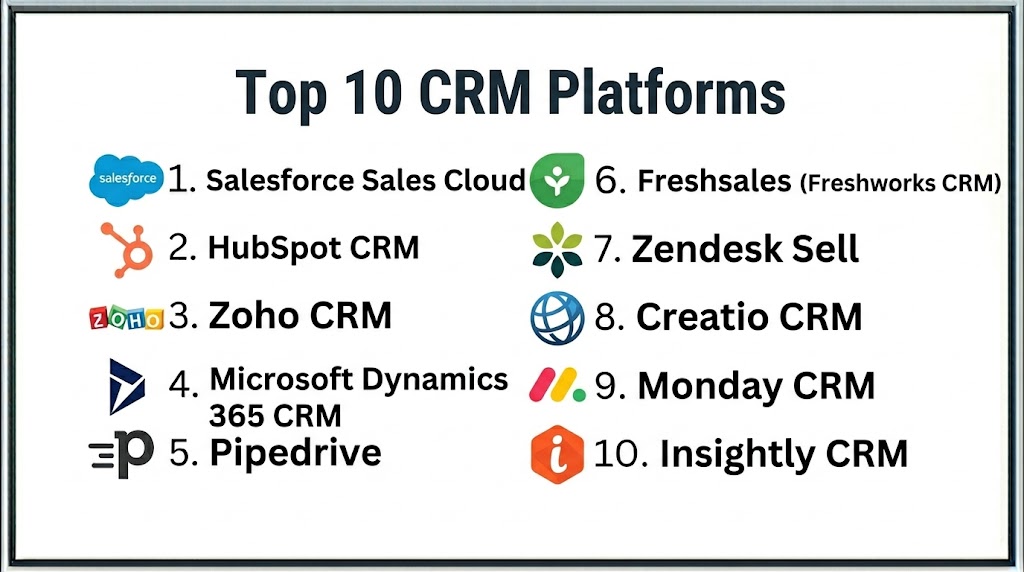
Top 10 CRM Platforms
#1 — Salesforce Sales Cloud
Short description: Salesforce Sales Cloud is a leading CRM platform offering comprehensive sales, service, and marketing automation with AI-driven insights.
Key Features
- Lead and opportunity management
- Workflow automation
- Sales forecasting and analytics
- AI-powered insights (Einstein AI)
- Omnichannel support
Pros
- Highly scalable
- Extensive integrations
- Strong analytics
Cons
- Expensive
- Complex setup
- Requires training
Platforms / Deployment
Web / Mobile, Cloud
Security & Compliance
Encryption, RBAC, audit logs
Integrations & Ecosystem
Extensive marketplace and API support
Support & Community
Very strong global support
#2 — HubSpot CRM
Short description: HubSpot CRM offers a user-friendly platform for managing contacts, deals, and marketing campaigns.
Key Features
- Contact and lead management
- Email tracking and automation
- Reporting dashboards
- Workflow automation
- Marketing integration
Pros
- Easy to use
- Fast implementation
- Free tier available
Cons
- Limited enterprise depth
- Scaling can be costly
- Less advanced analytics
Platforms / Deployment
Web / Mobile, Cloud
Security & Compliance
Encryption
Integrations & Ecosystem
Integrates with marketing and finance tools
Support & Community
Strong SMB support
#3 — Zoho CRM
Short description: Zoho CRM provides a scalable solution for SMBs and mid-market companies with automation and analytics capabilities.
Key Features
- Lead and contact management
- Workflow automation
- Sales forecasting
- Analytics dashboards
- AI assistant (Zia AI)
Pros
- Affordable
- Feature-rich
- Easy integration
Cons
- UI complexity
- Limited enterprise features
- Learning curve
Platforms / Deployment
Web / Mobile, Cloud
Security & Compliance
Encryption, MFA
Integrations & Ecosystem
Part of Zoho ecosystem
Support & Community
Strong documentation
#4 — Microsoft Dynamics 365 CRM
Short description: Dynamics 365 CRM combines sales, marketing, and customer service automation with AI-driven insights and enterprise integration.
Key Features
- Sales and lead management
- Workflow automation
- AI-driven insights
- Reporting dashboards
- Omnichannel engagement
Pros
- Enterprise-ready
- Deep Microsoft integration
- Scalable
Cons
- Complex setup
- Expensive
- Learning curve
Platforms / Deployment
Cloud
Security & Compliance
Encryption, RBAC
Integrations & Ecosystem
Microsoft ecosystem and third-party apps
Support & Community
Enterprise support
#5 — Pipedrive
Short description: Pipedrive is a visual CRM focused on pipeline management for SMBs and sales teams.
Key Features
- Visual sales pipeline
- Lead and deal management
- Email tracking
- Workflow automation
- Reporting dashboards
Pros
- Easy to use
- Visual interface
- Affordable
Cons
- Limited advanced features
- Basic analytics
- Less scalable for enterprises
Platforms / Deployment
Web / Mobile, Cloud
Security & Compliance
Not publicly stated
Integrations & Ecosystem
Integrates with CRM and marketing tools
Support & Community
Good support
#6 — Freshsales (Freshworks)
Short description: Freshsales combines CRM and AI-driven sales automation for small and mid-sized businesses.
Key Features
- Lead scoring and management
- Email and call tracking
- AI-driven insights
- Workflow automation
- Reporting dashboards
Pros
- AI-powered insights
- Affordable
- User-friendly
Cons
- Limited enterprise features
- Smaller ecosystem
- Customization limits
Platforms / Deployment
Cloud
Security & Compliance
Not publicly stated
Integrations & Ecosystem
Freshworks ecosystem
Support & Community
Strong support
#7 — Insightly
Short description: Insightly integrates CRM with project management to streamline sales and service workflows.
Key Features
- Lead and contact management
- Workflow automation
- Sales pipeline tracking
- Project management
- Reporting dashboards
Pros
- Flexible
- Good for SMBs
- Integration-ready
Cons
- Limited enterprise features
- UI complexity
- Pricing varies
Platforms / Deployment
Cloud
Security & Compliance
Not publicly stated
Integrations & Ecosystem
Integrates with HR, marketing, and finance systems
Support & Community
Good support
#8 — SugarCRM
Short description: SugarCRM offers a highly customizable CRM with automation, analytics, and AI capabilities.
Key Features
- Lead and contact management
- Workflow automation
- Reporting dashboards
- AI-driven insights
- Customization tools
Pros
- Customizable
- Enterprise-ready
- Strong analytics
Cons
- Complex setup
- Learning curve
- Pricing varies
Platforms / Deployment
Cloud / Self-hosted
Security & Compliance
Not publicly stated
Integrations & Ecosystem
Enterprise system integrations
Support & Community
Strong support
#9 — Creatio
Short description: Creatio offers a no-code CRM platform with sales automation, workflow automation, and analytics.
Key Features
- No-code automation
- Lead and contact management
- Workflow automation
- Reporting dashboards
- AI insights
Pros
- Flexible
- Scalable
- Modern UI
Cons
- Setup complexity
- Pricing varies
- Learning curve
Platforms / Deployment
Cloud
Security & Compliance
Not publicly stated
Integrations & Ecosystem
Integrates with enterprise apps
Support & Community
Good support
#10 — Close CRM
Short description: Close CRM focuses on sales automation with built-in communication tools for sales teams.
Key Features
- Lead management
- Email and call automation
- Pipeline tracking
- Reporting dashboards
- Workflow automation
Pros
- Strong communication tools
- Easy to use
- Good for SMBs
Cons
- Limited enterprise features
- Smaller ecosystem
- Pricing varies
Platforms / Deployment
Cloud
Security & Compliance
Not publicly stated
Integrations & Ecosystem
Integrates with CRM tools
Support & Community
Good support
Comparison Table
| Tool Name | Best For | Platform(s) Supported | Deployment | Standout Feature | Public Rating |
|---|---|---|---|---|---|
| Salesforce | Enterprise | Web/Mobile | Cloud | AI-driven CRM | N/A |
| HubSpot | SMB | Web/Mobile | Cloud | Ease of use | N/A |
| Zoho CRM | SMB | Web/Mobile | Cloud | Affordability | N/A |
| Microsoft Dynamics | Enterprise | Web | Cloud | Microsoft integration | N/A |
| Pipedrive | SMB | Web/Mobile | Cloud | Visual pipeline | N/A |
| Freshsales | SMB | Web | Cloud | AI insights | N/A |
| Insightly | SMB | Web | Cloud | CRM + projects | N/A |
| SugarCRM | Enterprise | Web | Cloud/Self-hosted | Customization | N/A |
| Creatio | Mid/Enterprise | Web | Cloud | No-code automation | N/A |
| Close CRM | SMB | Web | Cloud | Communication tools | N/A |
Evaluation & Scoring of CRM Platforms
| Tool | Core | Ease | Integrations | Security | Performance | Support | Value | Weighted Total |
|---|---|---|---|---|---|---|---|---|
| Salesforce | 9 | 6 | 10 | 9 | 9 | 9 | 6 | 8.6 |
| HubSpot | 8 | 9 | 8 | 7 | 8 | 8 | 8 | 8.2 |
| Zoho CRM | 8 | 8 | 8 | 7 | 8 | 7 | 9 | 8.1 |
| Microsoft | 9 | 6 | 9 | 9 | 9 | 8 | 6 | 8.4 |
| Pipedrive | 7 | 9 | 7 | 7 | 7 | 7 | 8 | 7.7 |
| Freshsales | 8 | 8 | 7 | 7 | 8 | 7 | 8 | 7.9 |
| Insightly | 7 | 8 | 7 | 7 | 7 | 7 | 8 | 7.6 |
| SugarCRM | 8 | 6 | 8 | 8 | 8 | 7 | 7 | 7.8 |
| Creatio | 8 | 7 | 8 | 7 | 8 | 7 | 7 | 7.8 |
| Close CRM | 7 | 8 | 7 | 7 | 7 | 7 | 8 | 7.6 |
Which CRM Platform Is Right for You?
Solo / Freelancer
Basic tools like HubSpot CRM or Pipedrive are sufficient.
SMB
Zoho CRM, HubSpot, Pipedrive, and Freshsales offer affordability and ease of use.
Mid-Market
Creatio, Insightly, and Close CRM provide balanced features.
Enterprise
Salesforce, Microsoft Dynamics, and SugarCRM offer advanced capabilities.
Budget vs Premium
- Budget: Zoho CRM, Pipedrive
- Premium: Salesforce, Microsoft
Feature Depth vs Ease of Use
- Feature-rich: Salesforce, Microsoft
- Easy-to-use: HubSpot, Pipedrive
Integrations & Scalability
Choose platforms with strong API and ERP integrations.
Security & Compliance Needs
Enterprises should prioritize platforms with strong access control and audit features.
Frequently Asked Questions (FAQs)
1. What is CRM software?
CRM software centralizes customer data, manages interactions, and automates sales, marketing, and service workflows.
2. How does CRM improve sales?
By automating tasks, tracking leads, and providing insights, CRM increases efficiency and improves conversion rates.
3. Who should use CRM platforms?
Sales, marketing, and customer service teams benefit most. Both SMBs and enterprises can use CRM tools.
4. Can CRM integrate with other tools?
Yes, modern CRMs integrate with ERP, marketing, finance, and communication tools.
5. Are CRM platforms cloud-based?
Most are cloud-based, providing scalability and remote access.
6. What features are key in a CRM?
Lead management, sales automation, reporting, analytics, and workflow automation.
7. How long does implementation take?
SMB solutions can be set up quickly; enterprise CRMs take longer.
8. What pricing models exist?
Subscription-based pricing is most common; some offer free tiers for SMBs.
9. How does CRM improve customer experience?
By providing a single source of customer data, teams can personalize interactions and respond faster.
10. What mistakes should be avoided?
Ignoring user adoption and integration requirements can limit CRM effectiveness.
Conclusion
CRM Platforms are essential tools for organizations aiming to streamline sales, marketing, and customer service operations. They centralize customer data, automate workflows, and provide analytics and AI-driven insights to improve decision-making and productivity. Modern CRMs help teams focus on high-value activities, reduce errors, and enhance customer experience. From SMB-friendly platforms like HubSpot and Zoho CRM to enterprise solutions like Salesforce and Microsoft Dynamics, there are options for every organization. Choosing the right platform depends on your business size, complexity, and integration needs. Companies should prioritize usability, automation, scalability, and security when selecting a CRM. Shortlisting and piloting a few tools is the most effective way to ensure adoption, efficiency, and ROI.

One aspect that often has the biggest impact on CRM success is data quality. Even the most advanced platform becomes less effective when customer information is outdated, incomplete, or inconsistent across teams.