Introduction
Smart Home Platforms are centralized systems that connect and control smart devices such as lights, thermostats, security cameras, locks, and appliances. These platforms enable automation, remote control, and intelligent decision-making across home environments. As connected living becomes more mainstream, smart home ecosystems are evolving into powerful, AI-driven platforms that enhance convenience, energy efficiency, and security.
Today’s smart home platforms go beyond simple device control. They offer voice assistants, automation routines, predictive behaviors, and integrations with thousands of devices. Common use cases include home automation, energy savings, security monitoring, remote access, and elderly care assistance.
When evaluating smart home platforms, buyers should consider:
- Device compatibility and ecosystem support
- Automation and rule-building capabilities
- Voice assistant integration
- Mobile and remote access features
- Privacy and security controls
- Ease of setup and usability
- Integration with third-party apps
- Scalability for future devices
Best for: Homeowners, tech enthusiasts, families, property managers, and smart living adopters looking to automate and control connected devices.
Not ideal for: Users with minimal device needs or those uncomfortable with technology setup. Basic standalone devices may be more suitable.
Key Trends in Smart Home Platforms for the Future
- AI-powered automation adapting to user behavior
- Voice-first interfaces becoming the primary control method
- Increased focus on privacy and local data processing
- Interoperability standards improving cross-device compatibility
- Growth of energy-efficient smart home integrations
- Expansion of edge computing for faster automation
- Subscription services for advanced features
- Integration with electric vehicles and renewable energy systems
- Mobile-first and app-centric user experiences
- Increased adoption of open-source smart home platforms
How We Selected These Tools Methodology
We evaluated smart home platforms based on:
- Market adoption and popularity
- Device compatibility and ecosystem size
- Ease of use and onboarding experience
- Automation and customization capabilities
- Security and privacy features
- Integration with voice assistants and apps
- Performance and reliability
- Support and community strength
- Flexibility across different home setups
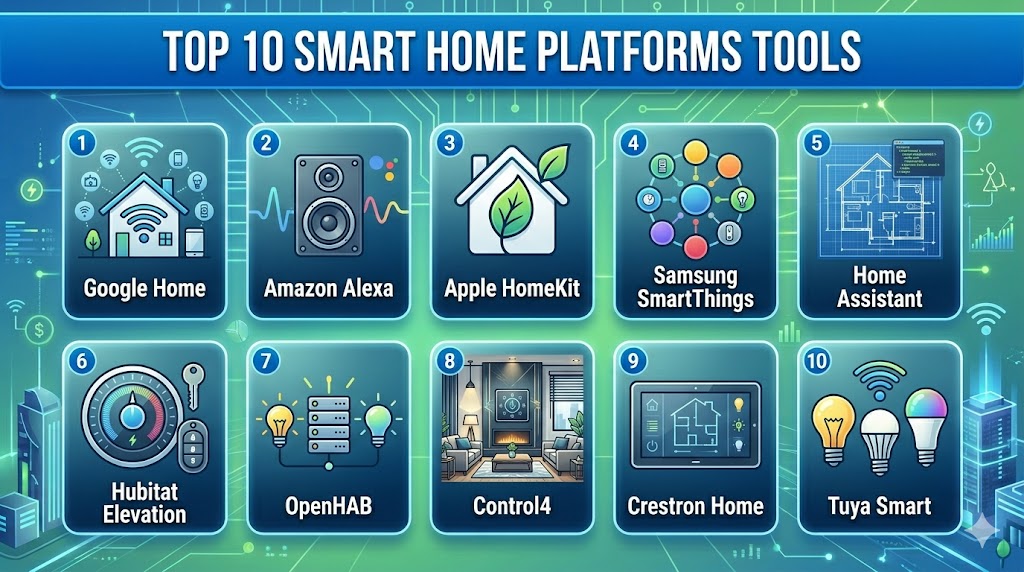
Top 10 Smart Home Platforms Tools
#1 — Google Home
Short description: A widely used smart home platform powered by Google Assistant that connects and controls a wide range of smart devices. It is ideal for users already using Google services and looking for simple automation and voice control.
Key Features
- Voice control with Google Assistant
- Device automation routines
- Multi-device control
- Smart display integration
- Mobile app control
- AI-based recommendations
Pros
- Easy to use
- Strong ecosystem
Cons
- Privacy concerns
- Limited advanced automation
Platforms / Deployment
Web / Android / iOS / Cloud
Security & Compliance
Encryption, account protection features
Integrations & Ecosystem
Works with thousands of smart devices and services
- IoT device compatibility
- Google ecosystem integration
- Third-party apps
Support & Community
Strong documentation and large user base
#2 — Amazon Alexa
Short description: A voice-first smart home platform that integrates with a vast range of devices. Known for its strong ecosystem and skill-based automation system.
Key Features
- Voice assistant control
- Skills marketplace
- Automation routines
- Smart speaker integration
- Multi-room audio
- Device grouping
Pros
- Large device compatibility
- Easy voice commands
Cons
- Requires internet connectivity
- Privacy concerns
Platforms / Deployment
Web / Android / iOS / Cloud
Security & Compliance
Account security features, encryption
Integrations & Ecosystem
Extensive third-party ecosystem
- Smart device integrations
- Skills platform
- API support
Support & Community
Strong community and support
#3 — Apple HomeKit
Short description: A secure smart home platform designed for Apple users, offering seamless integration across Apple devices with strong privacy protections.
Key Features
- Siri voice control
- Secure device pairing
- Automation scenes
- Home app integration
- End-to-end encryption
- Local processing
Pros
- Strong privacy
- Seamless Apple ecosystem
Cons
- Limited device compatibility
- Requires Apple devices
Platforms / Deployment
iOS / macOS / Cloud
Security & Compliance
Strong encryption, secure authentication
Integrations & Ecosystem
Works with certified HomeKit devices
- Apple ecosystem integration
- Smart device support
- API integrations
Support & Community
Reliable support with active community
#4 — Samsung SmartThings
Short description: A versatile smart home platform supporting a wide range of devices and offering strong automation and integration capabilities.
Key Features
- Device automation
- Smart hub support
- Multi-device compatibility
- Mobile control
- Automation rules
- IoT connectivity
Pros
- Wide compatibility
- Flexible automation
Cons
- Setup complexity
- Cloud dependency
Platforms / Deployment
Web / Android / iOS / Cloud
Security & Compliance
Not publicly stated
Integrations & Ecosystem
Supports numerous devices and services
- IoT integrations
- API support
- Smart hub ecosystem
Support & Community
Active community and documentation
#5 — Home Assistant
Short description: An open-source smart home platform offering advanced automation and full control over devices. Ideal for tech-savvy users.
Key Features
- Local control
- Custom automation
- Extensive integrations
- Open-source flexibility
- Dashboard customization
- Privacy-focused design
Pros
- Highly customizable
- No cloud dependency
Cons
- Requires technical knowledge
- Setup can be complex
Platforms / Deployment
Linux / Web / Self-hosted
Security & Compliance
User-managed security
Integrations & Ecosystem
Supports a wide range of integrations
- API integrations
- IoT device support
- Plugin ecosystem
Support & Community
Strong open-source community
#6 — Hubitat Elevation
Short description: A local smart home platform focused on privacy and fast automation without relying heavily on cloud services.
Key Features
- Local automation
- Device compatibility
- Custom rules engine
- Hub-based control
- Fast execution
- Offline functionality
Pros
- Fast performance
- Strong privacy
Cons
- Smaller ecosystem
- Less beginner-friendly
Platforms / Deployment
Self-hosted / Hub
Security & Compliance
Local data processing
Integrations & Ecosystem
Supports various smart devices
- IoT integrations
- API support
- Plugin support
Support & Community
Active niche community
#7 — OpenHAB
Short description: An open-source automation platform that supports a wide variety of smart home devices and protocols with deep customization.
Key Features
- Open-source platform
- Automation rules
- Multi-device support
- Local control
- Flexible integrations
- Custom dashboards
Pros
- Highly flexible
- Strong community
Cons
- Complex setup
- Requires technical skills
Platforms / Deployment
Linux / Windows / macOS / Self-hosted
Security & Compliance
User-managed
Integrations & Ecosystem
Supports many protocols and devices
- API support
- IoT integrations
- Plugin ecosystem
Support & Community
Strong developer community
#8 — Control4
Short description: A premium smart home platform designed for luxury homes with advanced automation and professional installation.
Key Features
- Centralized control
- Custom automation
- High-end device integration
- Security system integration
- Audio and video control
- Remote management
Pros
- Premium experience
- Professional support
Cons
- Expensive
- Requires installation
Platforms / Deployment
Cloud / Hybrid
Security & Compliance
Not publicly stated
Integrations & Ecosystem
Works with high-end devices
- AV integrations
- Security systems
- Custom integrations
Support & Community
Professional support services
#9 — Crestron Home
Short description: A high-end smart home automation system designed for luxury residences and enterprise environments.
Key Features
- Advanced automation
- Lighting and climate control
- AV system integration
- Centralized control
- Remote access
- Custom programming
Pros
- Enterprise-grade performance
- High customization
Cons
- Very expensive
- Requires professional setup
Platforms / Deployment
Hybrid
Security & Compliance
Not publicly stated
Integrations & Ecosystem
Integrates with enterprise-grade systems
- AV integration
- IoT devices
- Custom APIs
Support & Community
Professional support
#10 — Tuya Smart
Short description: A cloud-based IoT platform powering a wide range of affordable smart devices and enabling easy smart home automation.
Key Features
- Device control via app
- Automation routines
- Cloud-based platform
- Wide device compatibility
- Voice assistant support
- IoT connectivity
Pros
- Affordable ecosystem
- Easy setup
Cons
- Cloud dependency
- Privacy concerns
Platforms / Deployment
Android / iOS / Cloud
Security & Compliance
Not publicly stated
Integrations & Ecosystem
Supports many low-cost devices
- IoT integrations
- API support
- Smart device ecosystem
Support & Community
Good support and growing ecosystem
Comparison Table
| Tool Name | Best For | Platform Supported | Deployment | Standout Feature | Public Rating |
|---|---|---|---|---|---|
| Google Home | Beginners | Web Android iOS | Cloud | Voice control | N/A |
| Amazon Alexa | Voice control | Web Android iOS | Cloud | Skills ecosystem | N/A |
| Apple HomeKit | Apple users | iOS macOS | Cloud | Privacy | N/A |
| SmartThings | Versatility | Web Android iOS | Cloud | Device compatibility | N/A |
| Home Assistant | Advanced users | Linux Web | Self-hosted | Custom automation | N/A |
| Hubitat | Privacy users | Hub | Self-hosted | Local control | N/A |
| OpenHAB | Developers | Multi platform | Self-hosted | Open-source | N/A |
| Control4 | Luxury homes | Web | Hybrid | Premium automation | N/A |
| Crestron | Enterprises | Hybrid | Hybrid | Advanced control | N/A |
| Tuya Smart | Budget users | Android iOS | Cloud | Affordable ecosystem | N/A |
Evaluation & Scoring of Smart Home Platforms
| Tool Name | Core | Ease | Integrations | Security | Performance | Support | Value | Weighted Total |
|---|---|---|---|---|---|---|---|---|
| Google Home | 8 | 9 | 9 | 7 | 8 | 8 | 9 | 8.5 |
| Amazon Alexa | 8 | 9 | 9 | 7 | 8 | 8 | 9 | 8.5 |
| Apple HomeKit | 7 | 8 | 7 | 9 | 8 | 8 | 7 | 7.9 |
| SmartThings | 8 | 8 | 9 | 7 | 8 | 7 | 8 | 8.1 |
| Home Assistant | 9 | 6 | 10 | 9 | 9 | 8 | 8 | 8.6 |
| Hubitat | 8 | 6 | 8 | 9 | 9 | 7 | 8 | 8.1 |
| OpenHAB | 8 | 6 | 9 | 8 | 8 | 7 | 8 | 8.0 |
| Control4 | 9 | 7 | 8 | 8 | 9 | 8 | 6 | 8.0 |
| Crestron | 9 | 6 | 8 | 8 | 9 | 8 | 6 | 7.9 |
| Tuya Smart | 7 | 9 | 8 | 6 | 7 | 7 | 9 | 7.9 |
Scores are comparative and reflect typical usage scenarios. Higher scores indicate broader capability and flexibility, while lower scores may reflect niche use or trade-offs. Always evaluate based on your specific requirements.
Which Smart Home Platform Is Right for You
Solo / Freelancer
Google Home and Tuya Smart are simple and cost-effective for basic automation needs.
SMB
Amazon Alexa and SmartThings provide flexibility and broad device compatibility.
Mid-Market
Home Assistant and Hubitat offer more control and customization.
Enterprise
Control4 and Crestron are ideal for large, complex environments.
Budget vs Premium
Budget platforms focus on ease and affordability, while premium tools deliver deeper integration and control.
Feature Depth vs Ease of Use
Advanced platforms provide customization but require setup, while simple platforms focus on usability.
Integrations & Scalability
Choose platforms with strong ecosystem support for future expansion.
Security & Compliance Needs
Privacy-focused users should consider platforms with local processing and strong encryption.
Frequently Asked Questions FAQs
1. What is a smart home platform
A smart home platform connects and controls multiple smart devices from a single interface. It allows users to automate tasks like lighting, temperature, and security. Most platforms also support voice commands and mobile control.
2. Do I need internet for smart home platforms
Most platforms rely on internet connectivity for remote access and cloud automation. However, some platforms support local control and can work offline for basic automation tasks.
3. Are smart home platforms secure
Security depends on the platform and configuration. Many platforms offer encryption and authentication features, but users should also follow best practices like strong passwords and updates.
4. Can I mix devices from different brands
Yes, most platforms support devices from multiple brands. Compatibility depends on the platform and supported standards, so it is important to verify before purchasing.
5. How much does a smart home platform cost
Costs vary widely depending on the platform and devices. Some platforms are free with device purchases, while others require subscriptions or hardware hubs.
6. Is setup difficult for beginners
Some platforms are beginner-friendly with guided setup, while others require technical knowledge. Choosing the right platform depends on your comfort level with technology.
7. Can smart home platforms save energy
Yes, they can optimize energy usage by automating lighting, heating, and cooling. This can lead to noticeable cost savings over time.
8. What is the best platform for privacy
Platforms with local control and minimal cloud dependency are generally better for privacy. Users should review privacy policies before choosing a platform.
9. Can I control my home remotely
Yes, most platforms offer mobile apps that allow remote control of devices from anywhere with internet access.
10. Can I upgrade my system later
Yes, most smart home platforms are scalable. You can add more devices and features as your needs grow.
Conclusion
Smart Home Platforms have transformed the way people interact with their living spaces by enabling automation, convenience, and intelligent control. From voice assistants to advanced automation systems, these platforms cater to a wide range of users with different needs and technical expertise. Choosing the right platform depends on your priorities, whether it is ease of use, customization, privacy, or scalability. Beginner-friendly platforms offer quick setup and simplicity, while advanced solutions provide deep control and flexibility. It is important to evaluate compatibility with existing devices and future expansion plans. Testing a platform with a few devices before full adoption can help ensure the right fit. A thoughtful approach will help you build a smart home system that is efficient, secure, and tailored to your lifestyle.
