Introduction
Healthcare Interoperability APIs (HL7/FHIR) are interfaces and platforms that enable seamless exchange of clinical, administrative, and patient data across healthcare systems. Built on modern standards like FHIR (Fast Healthcare Interoperability Resources) and legacy standards like HL7 v2/v3, these tools help systems talk to each other—connecting EHRs, patient apps, lab systems, pharmacies, imaging systems, and care coordination platforms.
In today’s digital healthcare landscape, interoperability is critical for improving care quality, reducing errors, enabling patient engagement, and supporting population health analytics. Regulations in many regions (including ONC and CMS rules in the U.S.) are pushing providers to adopt standards‑based APIs and give patients control of their health records.
Key real‑world use cases include:
- Patient access APIs for retrieving medical records
- Care coordination across provider networks
- Clinical decision support systems integration
- Medical device data ingestion
- Population health and research data exchange
Evaluation criteria for buyers:
- Support for FHIR, HL7 v2/v3, CDA, and other standards
- Ease of API adoption and developer experience
- Security (OAuth 2.0, SMART on FHIR) and compliance
- Performance, scalability, and uptime
- Analytics and transformation capabilities
- Integration with EHR and clinical systems
- Extensibility and custom resource support
- Documentation and SDK availability
- Support for workflows (e.g., subscriptions, messaging)
- Regulatory and privacy controls (HIPAA, GDPR where applicable)
Best for: Healthcare providers, payers, digital health startups, HIEs (Health Information Exchanges), government health agencies, and interoperability platform vendors.
Not ideal for: Organizations without clinical data exchange needs, very small practices with no digital systems, or teams requiring only simple reporting.
Key Trends in Healthcare Interoperability APIs (HL7/FHIR)
- Widespread adoption of FHIR APIs for patient access and clinical data exchange
- SMART on FHIR gaining adoption for secure app integration
- HL7 v2 still heavily used in lab, radiology, and hospital messaging systems
- Cloud‑native API platforms improving scalability and developer tooling
- Real‑time event subscriptions and notifications via FHIR Subscriptions
- Support for imaging data via DICOM web APIs
- Increased use of terminology services (SNOMED, LOINC, RxNorm)
- Healthcare data normalization and transformation layers
- Regulatory push for patient data access standards
- Expansion of FHIR Bulk Data APIs for population health analytics
How We Selected These Tools
The tools below were selected based on the following criteria:
- Proven support for HL7 and/or FHIR standards
- Strong developer experience and tooling support
- Security, compliance, and patient privacy controls
- Performance and scalability for healthcare integration
- Interoperability features (subscriptions, workflows, mapping)
- Integration support with EHR vendors and clinical systems
- Analytics and transformation capabilities
- Documentation and community adoption
- Enterprise readiness and deployment flexibility
- Support for real‑time and batch data exchange
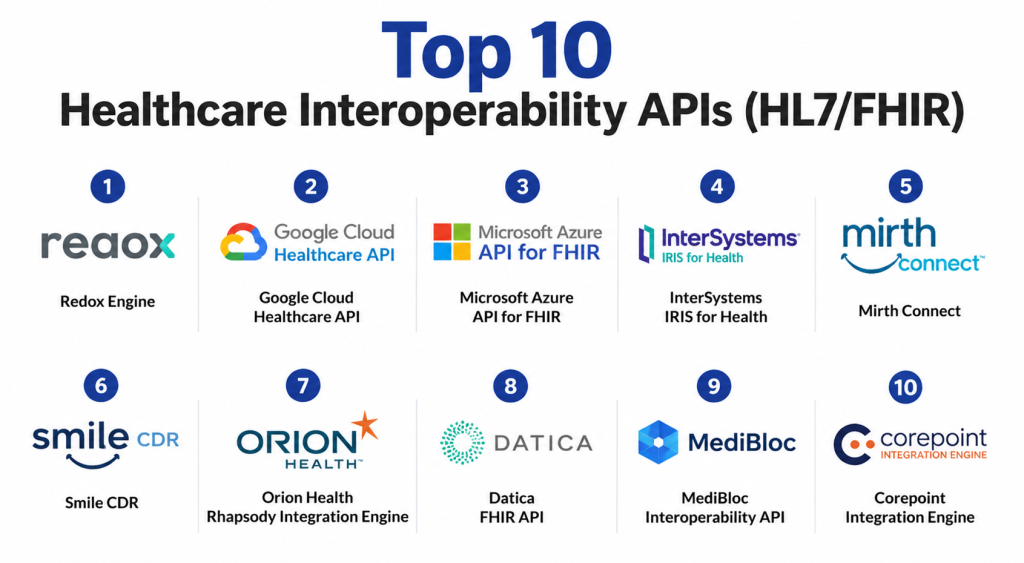
Top 10 Healthcare Interoperability APIs (HL7/FHIR)
1 — Google Cloud Healthcare API
Short description: Google Cloud Healthcare API provides a managed, scalable platform for storing, processing, and exchanging healthcare data using HL7v2, FHIR, and DICOM standards. It empowers developers to build interoperable healthcare applications with strong analytics and cloud integration.
Key Features
- HL7 v2, FHIR, and DICOM support
- Managed FHIR store with versioning
- Smart on FHIR auth support
- Data transformation and mapping
- BigQuery connectivity for analytics
- Cloud storage and IAM integration
- Real‑time streaming (Pub/Sub)
Pros
- Enterprise‑grade scalability
- Tight integration with Google Cloud BigQuery
- Strong analytics and AI linkage
- Managed service reduces operational burden
Cons
- Cloud vendor lock‑in
- Can be complex for small teams
- Cost scales with usage
- Requires cloud expertise
Platforms / Deployment
- Web / Cloud
Security & Compliance
- HIPAA support (BAA required)
- OAuth 2.0 / OpenID Connect
- Encryption at rest and in transit
- Audit logging
Integrations & Ecosystem
Extensive integration with Google Cloud services, data lakes, analytics, and AI platforms.
- BigQuery
- Cloud Pub/Sub
- Cloud Functions
- IAM
- Dataflow
Support & Community
Strong documentation, community samples, and cloud support tiers.
2 — Microsoft Azure API for FHIR
Short description: Azure API for FHIR is a fully managed FHIR service that enables healthcare systems to securely ingest and exchange clinical data. It provides enterprise security, identity management, and integration with Microsoft’s cloud ecosystem.
Key Features
- Native FHIR R4 support
- Enterprise security and governance
- Integration with Azure AD (OAuth/SAML)
- Azure Monitor and logging
- Data export to Synapse Analytics
- Terminology services
Pros
- Strong security and governance controls
- Enterprise integration with Azure ecosystem
- Good analytics support
- Highly scalable
Cons
- Azure‑centric (cloud dependency)
- Requires Azure expertise
- Cost scales with data volume
- Some features require advanced plans
Platforms / Deployment
- Web / Cloud
Security & Compliance
- HIPAA readiness (BAA)
- OAuth 2.0 / SMART on FHIR
- Encryption at rest/in transit
- Audit logging
Integrations & Ecosystem
Integrates with Azure AD, Synapse Analytics, Logic Apps, and Power BI.
- Azure AD
- Synapse
- Logic Apps
- Power BI
- Event Grid
Support & Community
Comprehensive MS documentation and enterprise support.
3 — AWS HealthLake
Short description: AWS HealthLake enables organizations to store, transform, query, and analyze FHIR‑based clinical data at scale. It combines secure FHIR storage with ML‑driven normalization and analytics.
Key Features
- FHIR store with search and indexing
- Natural language processing (NLP) for clinical text
- Analytics via Athena, Redshift, QuickSight
- Security and governance controls
- Real‑time data ingestion
- FHIR Bulk Data support
Pros
- Strong cloud analytics integration
- Scalable and reliable
- Built‑in clinical NLP
- Wide AWS ecosystem support
Cons
- AWS lock‑in
- Learning curve for AWS stack
- Cost management required
- Focus on cloud users
Platforms / Deployment
- Web / Cloud
Security & Compliance
- HIPAA eligible
- Encryption at rest/in transit
- IAM and auditing
- OAuth/SAML support
Integrations & Ecosystem
Connects to AWS analytics, databases, machine learning, and event services.
- Amazon S3
- Athena
- Redshift
- QuickSight
- Comprehend Medical
Support & Community
AWS support plans and strong documentation.
4 — InterSystems IRIS for Health
Short description: InterSystems IRIS for Health is a data platform and interoperability engine designed for healthcare, supporting FHIR, HL7, DICOM, and IHE profiles with real‑time integration capabilities.
Key Features
- FHIR and HL7 message support
- Native interoperability engine
- Analytics and data transformation
- Event handling and integration workflows
- High‑performance CDB
- REST and messaging APIs
Pros
- Robust enterprise integration engine
- Real‑time connectivity
- Strong legacy support
- Proven healthcare deployments
Cons
- Enterprise complexity
- Requires specialist skills
- Licensing cost
- Heavier platform footprint
Platforms / Deployment
- Web / Cloud / On‑Premises / Hybrid
Security & Compliance
- RBAC
- Encryption
- Audit logging
- Compliance frameworks per deployment
Integrations & Ecosystem
Integrates hospital systems, EHRs, lab systems, and data warehouses.
- EHR systems
- Messaging systems
- Analytics tools
- Workflow engines
Support & Community
Global support with healthcare specialty resources.
5 — Redox Engine
Short description: Redox is a healthcare integration platform that standardizes data exchange using FHIR and HL7 across EHRs and third‑party applications. It simplifies interoperability across complex healthcare networks.
Key Features
- Adapter for EHR systems
- FHIR and HL7 v2 support
- API mapping and normalization
- Event‑driven notifications
- Developer‑friendly dashboard
- Security and audit logs
Pros
- Great EHR connectivity
- Simplifies integration complexity
- Developer‑friendly APIs
- Proven in health systems
Cons
- Usage fees can scale
- Integration setup needed
- Cloud dependency
- Not a full analytics suite
Platforms / Deployment
- Web / Cloud
Security & Compliance
- HIPAA support
- OAuth 2.0
- Encryption at rest/in transit
- Audit trails
Integrations & Ecosystem
Redox integrates with major EHR vendors and interoperability partners.
- Epic
- Cerner
- Allscripts
- athenahealth
- APIs
Support & Community
Healthcare integration support and developer resources.
6 — Smile CDR
Short description: Smile CDR is an enterprise‑grade FHIR server and clinical data repository that supports interoperability, data governance, and regulatory compliance for scaled healthcare platforms.
Key Features
- Full FHIR R4 API
- Multi‑tenant and role‑based support
- SMART on FHIR support
- Terminology services
- Analytics APIs
- Integration modules
Pros
- Strong standards compliance
- Multi‑tenant architecture
- Good developer tooling
- Flexible deployment
Cons
- Enterprise cost
- Setup complexity
- Requires expertise for customization
- Not full business suite
Platforms / Deployment
- Web / Cloud / On‑Premises
Security & Compliance
- RBAC
- OAuth 2.0
- Encryption
- Audit logs
Integrations & Ecosystem
Integrates hospital data, clinic systems, research apps, and apps ecosystem.
- EHR systems
- Analytics tools
- Research platforms
- APIs
Support & Community
Active community with healthcare interoperability resources.
7 — Datica Clinical API
Short description: Datica provides managed FHIR and healthcare API services designed to make interoperability easier for digital health apps and healthcare integrations.
Key Features
- Managed FHIR APIs
- Security and compliance controls
- EHR integration connectors
- Data transform and normalization
- App hosting options
- Real‑time APIs
Pros
- Managed service reduces operational burden
- Compliance focus
- Easy developer onboarding
- App ecosystem support
Cons
- Cloud dependency
- Limited standalone analytics
- Service‑based pricing
- Focused scope
Platforms / Deployment
- Web / Cloud
Security & Compliance
- HIPAA
- Encryption
- OAuth 2.0
- Audit logs
Integrations & Ecosystem
Connects apps with EHRs and clinical data systems.
- EHR connectors
- FHIR APIs
- Event streams
- Data normalization
Support & Community
Developer‑centric documentation and support.
8 — SmileHX
Short description: SmileHX offers APIs and tooling for healthcare interoperability, focusing on real‑time FHIR data exchange, messaging, and clinical workflows.
Key Features
- FHIR API support
- Messaging workflows
- Real‑time data streaming
- Analytics dashboard
- Integration templates
- OAuth/Security control
Pros
- Focus on real‑time workflows
- Developer‑friendly
- Strong APIs
- Rapid onboarding
Cons
- Smaller ecosystem
- Cloud‑only
- Limited enterprise modules
- Mid‑market focus
Platforms / Deployment
- Web / Cloud
Security & Compliance
- OAuth 2.0
- Encryption
- Audit logs
- HIPAA alignment
Integrations & Ecosystem
Connects clinical systems and digital health apps via open APIs.
- FHIR endpoints
- Data streaming
- EHR connectors
- App ecosystem
Support & Community
Good developer docs with support channels.
9 — Better API (FHIR Services)
Short description: Better API provides healthcare‑centric FHIR APIs to enable developers to build patient‑facing and clinical applications with secure access to clinical data.
Key Features
- FHIR API as a service
- SMART on FHIR support
- Data indexing and search
- Subscription support
- OAuth security
- Developer tools
Pros
- Easy developer focus
- Quick to integrate
- Strong FHIR compliance
- Ideal for digital apps
Cons
- Less enterprise‑grade features
- Cloud dependency
- Performance varies with usage
- Not broad enterprise suite
Platforms / Deployment
- Web / Cloud
Security & Compliance
- OAuth 2.0
- Encryption
- Audit logging
- HIPAA alignment
Integrations & Ecosystem
Useful for patient apps and clinical interfaces.
- FHIR tooling
- App dashboards
- API services
- EHR connectors
Support & Community
Developer libraries and sample code.
10 — Red Hat Fuse (with HL7 Connectors)
Short description: Red Hat Fuse is an integration platform that supports HL7 messaging, FHIR APIs, and enterprise service buses, enabling organizations to build custom interoperability solutions.
Key Features
- HL7 v2 / v3 messaging
- FHIR API support
- Enterprise integration patterns
- Connectors and adapters
- Event streaming
- Transformation capabilities
Pros
- Highly flexible
- Supports legacy and modern standards
- Enterprise integration power
- Open‑source foundation
Cons
- Requires integration expertise
- Larger development effort
- Not healthcare‑specific out of the box
- Operational maintenance
Platforms / Deployment
- Web / Cloud / On‑Premises
Security & Compliance
- RBAC
- Encryption
- OAuth / SAML via extension
- Audit capabilities
Integrations & Ecosystem
Integrates systems, messaging, and clinical data pipelines.
- EHR adapters
- Messaging engines
- FHIR endpoints
- Analytics tools
Support & Community
Open‑source community plus enterprise support options.
Comparison Table
| Tool Name | Best For | Platform(s) Supported | Deployment | Standout Feature | Public Rating |
|---|---|---|---|---|---|
| Google Cloud Healthcare API | Cloud interoperability | Web | Cloud | Broad standards support | N/A |
| Microsoft Azure API for FHIR | Enterprise healthcare | Web | Cloud | Enterprise security | N/A |
| AWS HealthLake | Analytics + FHIR | Web | Cloud | ML & analytics | N/A |
| InterSystems IRIS for Health | Real‑time integration | Web | Cloud/Hybrid/On‑Prem | Legacy + FHIR support | N/A |
| Redox Engine | EHR connectivity | Web | Cloud | EHR adapters | N/A |
| Smile CDR | Enterprise FHIR | Web | Cloud/On‑Prem | Standards compliance | N/A |
| Datica Clinical API | Managed FHIR APIs | Web | Cloud | Managed service | N/A |
| SmileHX | Real‑time APIs | Web | Cloud | Workflow focus | N/A |
| Better API | Developer‑centric FHIR | Web | Cloud | Developer tooling | N/A |
| Red Hat Fuse | Custom integration | Web | Cloud/On‑Prem | Integration flexibility | N/A |
Evaluation & Scoring of Healthcare Interoperability APIs
| Tool Name | Core | Ease | Integrations | Security | Performance | Support | Value | Weighted Total |
|---|---|---|---|---|---|---|---|---|
| Google Cloud Healthcare API | 9.3 | 8.0 | 9.1 | 9.2 | 9.0 | 8.9 | 8.0 | 8.77 |
| Microsoft Azure API for FHIR | 9.2 | 8.2 | 9.0 | 9.3 | 8.9 | 8.8 | 8.1 | 8.79 |
| AWS HealthLake | 9.1 | 7.9 | 8.9 | 9.2 | 8.8 | 8.6 | 8.0 | 8.64 |
| InterSystems IRIS for Health | 9.0 | 7.5 | 9.2 | 9.1 | 9.1 | 8.7 | 7.8 | 8.65 |
| Redox Engine | 8.8 | 8.1 | 9.0 | 9.0 | 8.9 | 8.8 | 8.2 | 8.61 |
| Smile CDR | 8.7 | 7.8 | 8.8 | 8.9 | 8.8 | 8.6 | 8.0 | 8.48 |
| Datica Clinical API | 8.5 | 8.3 | 8.6 | 8.8 | 8.6 | 8.4 | 8.1 | 8.33 |
| SmileHX | 8.3 | 8.4 | 8.5 | 8.7 | 8.5 | 8.3 | 8.2 | 8.30 |
| Better API | 8.0 | 8.5 | 8.3 | 8.6 | 8.3 | 8.2 | 8.3 | 8.20 |
| Red Hat Fuse | 8.5 | 7.2 | 8.7 | 8.5 | 8.7 | 8.5 | 7.9 | 8.19 |
Which Healthcare Interoperability API Is Right for You?
Solo / Freelancer
Developer‑centric FHIR services like Better API or Datica Clinical API are ideal for quickly building clinical or patient‑facing apps with secure access to FHIR data.
SMB
Small to mid‑sized healthcare providers benefit from managed APIs like Redox Engine or Datica Clinical API that reduce integration complexity.
Mid‑Market
Mid‑tier organizations needing EHR connectivity and broader clinical workflows should consider Redox Engine, Smile CDR, or SmileHX with strong interoperability support.
Enterprise
Large health systems and payers should prioritize Google Cloud Healthcare API, Azure API for FHIR, AWS HealthLake, or InterSystems IRIS for Health for scalability, security, and integration depth.
Budget vs Premium
Budget‑focused teams can start with cloud‑hosted, developer‑friendly APIs, while premium enterprise solutions provide advanced security, analytics, and integration governance.
Feature Depth vs Ease of Use
Highly flexible platforms like InterSystems IRIS for Health and Red Hat Fuse require deeper expertise, while managed APIs such as Datica and Better API offer faster onboarding.
Integrations & Scalability
Healthcare interoperability requires robust integration with EHRs, clinical systems, apps, and analytics platforms. Solutions with broad connectors and standards compliance provide long‑term scalability.
Security & Compliance Needs
Interoperability APIs must support HIPAA, OAuth/SAML, SMART on FHIR, encryption, RBAC, and audit trails to ensure secure clinical data exchange and regulatory compliance.
Frequently Asked Questions
1. What are Healthcare Interoperability APIs?
Healthcare Interoperability APIs are standardized interfaces (often FHIR or HL7) that allow disparate healthcare systems to exchange clinical and administrative data securely and reliably.
2. What is FHIR?
FHIR (Fast Healthcare Interoperability Resources) is a modern standard designed for web‑based healthcare data exchange using RESTful APIs, JSON, and XML.
3. Why are interoperability APIs important?
They enable seamless data sharing across EHRs, apps, labs, payers, and devices—improving care coordination, reducing duplication, and empowering patient access.
4. What is SMART on FHIR?
SMART on FHIR is an app authorization framework that allows third‑party apps to securely access healthcare data via FHIR APIs using OAuth 2.0.
5. Are HL7 v2 and FHIR compatible?
HL7 v2 and FHIR serve different purposes—HL7 v2 is widely used for messaging in hospitals (lab, radiology), while FHIR is modern REST APIs designed for web integration.
6. How do APIs ensure security?
Interoperability platforms use encryption, OAuth/SAML, RBAC, audit logs, and compliance controls to secure data and control access.
7. What integrations matter most?
Connections to EHR systems, clinical data repositories, analytics tools, and mobile apps are key for full interoperability.
8. What challenges exist in interoperability?
Challenges include legacy system constraints, data normalization, regulatory compliance, vendor lock‑in, and governance policies.
9. Can small healthcare teams adopt these APIs?
Yes, cloud‑hosted managed APIs are making it easier for smaller teams to build interoperable applications without heavy infrastructure.
10. What is Bulk FHIR?
Bulk FHIR APIs allow organizations to export large volumes of healthcare data (e.g., for analytics or research) in a standardized fashion.
Conclusion
Healthcare Interoperability APIs built on HL7 and FHIR standards are foundational for modern connected care. Platforms like Google Cloud Healthcare API, Azure API for FHIR, and AWS HealthLake provide scalable, secure infrastructure for enterprise needs, while developer‑friendly options like Redox Engine, Datica Clinical API, and Better API make building connected healthcare apps easier. The right choice depends on technical needs, integration scope, regulatory demands, and organizational scale. Prioritize robust standards support, security controls, developer tooling, and real‑time capabilities to ensure sustainable interoperability success.

Very informative and well-structured blog on healthcare interoperability APIs like HL7 and FHIR. The comparison of features, pros, and cons is clear and practical, making complex healthcare integration solutions easier to understand.
Very well explained comparison of healthcare interoperability APIs—especially useful for understanding how HL7 and FHIR standards improve secure data sharing across healthcare systems.
Interoperability is not only about exchanging healthcare data—it is also about ensuring that the receiving system interprets the information consistently. Variations in FHIR implementation, custom extensions, and evolving standards can create compatibility challenges even when APIs are technically compliant. Including practical guidance on interoperability testing, conformance validation, and version management would give readers a deeper understanding of deploying HL7 FHIR solutions successfully across diverse healthcare ecosystems.