Introduction
Core Banking Systems are the central software platforms used by banks and financial institutions to manage daily banking operations such as accounts, deposits, loans, payments, and customer data. These systems act as the backbone of modern banking, connecting branches, mobile apps, ATMs, and online banking into a single unified system.
In simple terms, a core banking system ensures that a customer can access their money anytime, anywhere, while banks maintain real-time visibility and control over transactions. It replaces fragmented legacy systems with a centralized platform that improves speed, accuracy, and efficiency.
Core banking platforms are essential because they enable real-time transaction processing, centralized data management, and seamless digital banking experiences across channels.
Common use cases include:
- Account management and customer onboarding
- Loan and deposit processing
- Payment and transaction handling
- Ledger and financial reporting
- Multi-branch and digital banking operations
Key evaluation criteria:
- Real-time processing capabilities
- Scalability and performance
- Integration with digital banking channels
- Security and compliance features
- API and ecosystem support
- Flexibility and customization
- Deployment options cloud or hybrid
- Reporting and analytics
- Core product coverage loans deposits payments
- Vendor stability and support
Best for: Banks, credit unions, financial institutions, and fintech companies managing large-scale financial operations.
Not ideal for: Small businesses or organizations that do not require full banking infrastructure.
Key Trends in Core Banking Systems
- Shift from legacy systems to cloud-native core banking
- API-first architecture enabling open banking ecosystems
- Real-time transaction processing replacing batch systems
- Modular and composable banking platforms
- AI-powered risk and fraud detection
- Microservices-based banking architecture
- Embedded finance and Banking as a Service models
- Increased focus on cybersecurity and data protection
- Faster product launch cycles for banks
- Integration with fintech and third-party ecosystems
Modern core systems are evolving into flexible digital platforms that support innovation and rapid scaling.
How We Selected These Tools
- Global adoption across banking institutions
- Ability to support full banking lifecycle
- Proven reliability and scalability
- Strong security and compliance capabilities
- Cloud readiness and modernization support
- Integration with digital banking ecosystems
- Vendor reputation and enterprise usage
- Flexibility in deployment and configuration
- API and ecosystem strength
- Support for multi-product banking operations
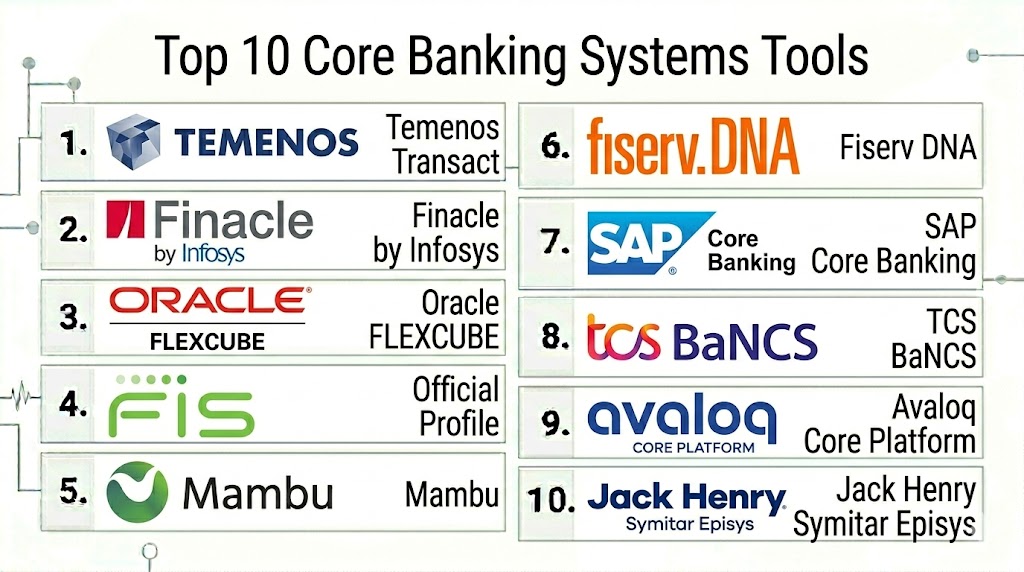
Top 10 Core Banking Systems Tools
#1 — Temenos Transact
Short description:
A leading global core banking platform used by hundreds of banks worldwide. It supports retail, corporate, and digital banking with strong scalability and modular architecture.
Key Features
- Core account management system
- Real-time transaction processing
- Loan and deposit management
- Digital banking integration
- API-based architecture
- Risk and compliance tools
Pros
- Highly scalable
- Strong global adoption
- Flexible modular design
- Rich banking functionality
Cons
- Complex implementation
- High cost
- Requires technical expertise
- Long deployment cycles
Platforms / Deployment
Cloud / Hybrid / On-premise
Security & Compliance
Encryption, RBAC, audit logs. Compliance not publicly stated.
Integrations & Ecosystem
- Core banking APIs
- Payment systems
- CRM platforms
- Fintech integrations
Support & Community
Strong global enterprise support.
#2 — Finacle by Infosys
Short description:
A modern core banking system offering digital transformation capabilities for banks across retail, corporate, and wealth segments.
Key Features
- Real-time banking operations
- Product configuration engine
- Lending and deposits management
- Digital banking support
- API-first architecture
- Analytics and reporting
Pros
- Strong scalability
- Reliable performance
- Flexible product design
- Good digital banking support
Cons
- Complex setup
- High implementation effort
- Learning curve
- Costly for smaller banks
Platforms / Deployment
Cloud / Hybrid
Security & Compliance
Encryption and RBAC. Compliance not publicly stated.
Integrations & Ecosystem
- Core banking APIs
- ERP systems
- Payment gateways
- Third-party fintech apps
Support & Community
Strong enterprise support globally.
#3 — Oracle FLEXCUBE
Short description:
A widely used core banking platform that supports retail, corporate, and investment banking operations with strong automation and scalability.
Key Features
- Account and transaction management
- Loan processing
- Payment systems
- Treasury management
- Risk and compliance tools
- Multi-channel integration
Pros
- Strong enterprise adoption
- Scalable architecture
- Robust functionality
- Good regulatory support
Cons
- Complex deployment
- High cost
- Requires expertise
- Customization effort
Platforms / Deployment
Cloud / Hybrid
Security & Compliance
Encryption, RBAC. Compliance not publicly stated.
Integrations & Ecosystem
- ERP systems
- Payment networks
- CRM tools
- APIs
Support & Community
Global enterprise support network.
#4 — FIS Profile
Short description:
A core banking solution designed for financial institutions to manage deposits, loans, and customer accounts efficiently.
Key Features
- Account management
- Payment processing
- Lending systems
- Reporting tools
- Compliance support
- Digital banking integration
Pros
- Reliable performance
- Strong banking features
- Scalable
- Good compliance tools
Cons
- Complex implementation
- Outdated interface in some modules
- Integration effort
- High cost
Platforms / Deployment
Cloud / Hybrid
Security & Compliance
Encryption and RBAC. Compliance not publicly stated.
Integrations & Ecosystem
- Core banking systems
- CRM platforms
- Financial networks
- APIs
Support & Community
Strong enterprise support.
#5 — Mambu
Short description:
A cloud-native core banking platform designed for modern digital banks and fintech companies.
Key Features
- Cloud-based core banking
- Lending and deposits
- API-first architecture
- Workflow automation
- Real-time processing
- Modular banking system
Pros
- Highly flexible
- Fast deployment
- Modern architecture
- Strong API ecosystem
Cons
- Requires configuration
- Integration complexity
- Learning curve
- Pricing not transparent
Platforms / Deployment
Cloud
Security & Compliance
Encryption, RBAC. Compliance not publicly stated.
Integrations & Ecosystem
- Payment systems
- Fintech APIs
- CRM tools
- Data platforms
Support & Community
Strong fintech ecosystem support.
#6 — Fiserv DNA
Short description:
A core banking platform widely used by credit unions and financial institutions for centralized banking operations.
Key Features
- Account processing
- Loan management
- Payment systems
- Reporting tools
- Digital banking integration
Pros
- Strong reliability
- Scalable architecture
- Good banking features
- Stable ecosystem
Cons
- Complex setup
- Limited flexibility
- Integration effort
- High cost
Platforms / Deployment
Cloud / Hybrid
Security & Compliance
Encryption, RBAC. Compliance not publicly stated.
Integrations & Ecosystem
- Banking APIs
- CRM systems
- Financial platforms
- Third-party tools
Support & Community
Strong institutional support.
#7 — SAP Core Banking
Short description:
A banking solution integrated with SAP ecosystem, designed for enterprise-grade financial operations.
Key Features
- Core banking operations
- Financial processing
- Risk management
- Compliance tools
- Reporting analytics
- ERP integration
Pros
- Strong SAP integration
- Enterprise-ready
- Scalable
- Reliable
Cons
- Complex implementation
- High cost
- Requires SAP ecosystem
- Customization effort
Platforms / Deployment
Cloud / Hybrid
Security & Compliance
Encryption and RBAC. Compliance not publicly stated.
Integrations & Ecosystem
- SAP ERP systems
- Financial tools
- CRM systems
- APIs
Support & Community
Enterprise-level SAP support.
#8 — TCS BaNCS
Short description:
A comprehensive core banking system used globally for retail, corporate, and digital banking operations.
Key Features
- Multi-channel banking
- Loan and deposit management
- Payment processing
- Risk management
- Analytics tools
- API integration
Pros
- Strong global adoption
- Scalable
- Reliable
- Rich features
Cons
- Complex implementation
- High cost
- Learning curve
- Customization effort
Platforms / Deployment
Cloud / Hybrid
Security & Compliance
Encryption, RBAC. Compliance not publicly stated.
Integrations & Ecosystem
- Banking systems
- ERP platforms
- CRM tools
- APIs
Support & Community
Strong enterprise support.
#9 — Avaloq Core Platform
Short description:
A core banking system focused on wealth management and private banking with strong automation capabilities.
Key Features
- Wealth management tools
- Core banking operations
- Portfolio management
- Reporting analytics
- Workflow automation
Pros
- Strong wealth focus
- Scalable
- Reliable
- Good automation
Cons
- Limited retail focus
- Complex setup
- High cost
- Integration effort
Platforms / Deployment
Cloud / Hybrid
Security & Compliance
Encryption, RBAC. Compliance not publicly stated.
Integrations & Ecosystem
- Wealth platforms
- Banking systems
- CRM tools
- APIs
Support & Community
Strong enterprise support.
#10 — Jack Henry Symitar Episys
Short description:
A core banking platform widely used by credit unions for managing member accounts and banking operations.
Key Features
- Account management
- Loan processing
- Payment systems
- Reporting tools
- Digital banking integration
Pros
- Strong credit union adoption
- Reliable
- Scalable
- Good support
Cons
- Limited enterprise flexibility
- Outdated modules in some areas
- Integration effort
- Pricing not transparent
Platforms / Deployment
Cloud / Hybrid
Security & Compliance
Encryption, RBAC. Compliance not publicly stated.
Integrations & Ecosystem
- Banking APIs
- CRM systems
- Payment tools
- Third-party apps
Support & Community
Strong credit union ecosystem support.
Comparison Table
| Tool Name | Best For | Platforms | Deployment | Standout Feature | Public Rating |
|---|---|---|---|---|---|
| Temenos | Global banks | Web | Cloud Hybrid | Modular banking | N/A |
| Finacle | Digital banks | Web | Cloud Hybrid | API-first core | N/A |
| Oracle FLEXCUBE | Enterprises | Web | Cloud Hybrid | Full banking suite | N/A |
| FIS Profile | Banks | Web | Cloud Hybrid | Core processing | N/A |
| Mambu | Fintech | Web | Cloud | Cloud-native core | N/A |
| Fiserv DNA | Credit unions | Web | Cloud Hybrid | Stability | N/A |
| SAP Core Banking | Enterprises | Web | Cloud Hybrid | ERP integration | N/A |
| TCS BaNCS | Global banks | Web | Cloud Hybrid | Multi-channel banking | N/A |
| Avaloq | Wealth banks | Web | Cloud Hybrid | Wealth management | N/A |
| Jack Henry | Credit unions | Web | Cloud Hybrid | Member banking | N/A |
Evaluation and Scoring
| Tool Name | Core | Ease | Integrations | Security | Performance | Support | Value | Weighted Total |
|---|---|---|---|---|---|---|---|---|
| Temenos | 9 | 6 | 9 | 9 | 9 | 9 | 6 | 8.3 |
| Finacle | 9 | 6 | 9 | 9 | 9 | 9 | 6 | 8.3 |
| Oracle FLEXCUBE | 9 | 6 | 9 | 9 | 9 | 9 | 6 | 8.3 |
| FIS Profile | 8 | 7 | 8 | 8 | 8 | 8 | 7 | 7.8 |
| Mambu | 8 | 7 | 9 | 8 | 8 | 8 | 7 | 7.9 |
| Fiserv DNA | 8 | 7 | 8 | 8 | 8 | 8 | 7 | 7.8 |
| SAP Core Banking | 9 | 6 | 9 | 9 | 9 | 9 | 6 | 8.3 |
| TCS BaNCS | 9 | 6 | 9 | 9 | 9 | 9 | 6 | 8.3 |
| Avaloq | 8 | 7 | 8 | 8 | 8 | 8 | 7 | 7.8 |
| Jack Henry | 8 | 7 | 8 | 8 | 8 | 8 | 7 | 7.8 |
Frequently Asked Questions
1. What is a core banking system
A core banking system is the central software used by banks to manage accounts, transactions, loans, and financial operations.
It ensures real-time processing and centralized data management.
It acts as the backbone of modern banking systems.
2. Why are core banking systems important
They enable banks to operate efficiently across multiple channels.
They improve customer experience and transaction speed.
They also reduce operational complexity.
3. What features do core banking systems offer
They include account management, loan processing, payments, and reporting tools.
They also support compliance and analytics.
These features streamline banking operations.
4. Are core banking systems cloud-based
Modern systems are increasingly cloud-based or hybrid.
Cloud platforms offer scalability and flexibility.
Legacy systems may still be on-premise.
5. How do core banking systems work
They centralize banking data and process transactions in real-time.
They connect branches, mobile apps, and ATMs.
This ensures consistent banking services.
6. Who uses core banking systems
Banks, credit unions, and financial institutions use them.
They are essential for retail and corporate banking.
Fintech companies also use modern platforms.
7. What is the difference between legacy and modern core banking
Legacy systems are monolithic and slow.
Modern systems are cloud-based and API-driven.
Modern platforms are more flexible and scalable.
8. Are core banking systems secure
Yes, they include encryption, RBAC, and audit logs.
Security depends on vendor implementation.
Banks must ensure compliance standards.
9. How long does implementation take
Implementation can take months to years.
It depends on customization and migration complexity.
Cloud systems are faster than legacy replacements.
10. What are alternatives to core banking systems
There are no true alternatives for full banking operations.
Some institutions use modular fintech tools.
However, full core systems are essential for banks.
Conclusion
Core Banking Systems are the foundation of modern financial institutions, enabling real-time processing, centralized data management, and seamless banking experiences across channels. From global leaders like Temenos, Finacle, and Oracle FLEXCUBE to cloud-native platforms like Mambu, these systems support the entire banking lifecycle. The right choice depends on scalability, integration needs, and business strategy. As banking continues to evolve toward cloud-native and API-driven ecosystems, core banking platforms will remain central to innovation and digital transformation. Institutions should carefully evaluate flexibility, security, and long-term scalability before selecting a solution.
