Introduction
Credit Scoring Platforms are software systems that help financial institutions evaluate a borrower’s creditworthiness using data, analytics, and automated decision models. These platforms analyze financial history, behavioral patterns, and alternative data sources to generate risk scores and support lending decisions.
In simple terms, credit scoring platforms help lenders decide who qualifies for credit, how much risk is involved, and what terms to offer. Modern platforms go beyond traditional credit bureau data by incorporating AI and alternative data such as digital payments, mobile usage, and transaction behavior to improve accuracy and inclusiveness.
Common use cases include:
- Loan approval and credit risk assessment
- Real-time credit decisioning for digital lending
- Fraud detection and identity verification
- Credit limit and pricing optimization
- Financial inclusion for underserved borrowers
Key evaluation criteria:
- Accuracy and flexibility of scoring models
- Data integration capabilities including alternative data
- Automation and real-time decisioning
- Scalability and performance
- Security and compliance readiness
- Explainability and transparency of decisions
- Ease of use for risk teams
- API and ecosystem integrations
- Reporting and analytics capabilities
Best for: Banks, NBFCs, fintech lenders, BNPL providers, and enterprises managing credit risk at scale.
Not ideal for: Small businesses with minimal lending activity or those relying on simple manual credit checks.
Key Trends in Credit Scoring Platforms
- AI and machine learning improving predictive accuracy
- Use of alternative data for financial inclusion
- Real-time credit decisioning for instant approvals
- Cloud-native scoring platforms replacing legacy systems
- Explainable AI for regulatory transparency
- API-first architecture for fintech integrations
- Fraud detection integrated into scoring engines
- Behavioral and transaction-based scoring models
- Automation of underwriting and decision workflows
- Expansion into embedded finance ecosystems
How We Selected These Tools
- Strong adoption across banking and fintech sectors
- Comprehensive credit scoring and decisioning capabilities
- Proven scalability and performance
- Modern architecture and cloud readiness
- Security and compliance features
- Integration ecosystem and API support
- AI and analytics capabilities
- Flexibility across lending products
- Vendor innovation and roadmap strength
- Usability for risk and underwriting teams
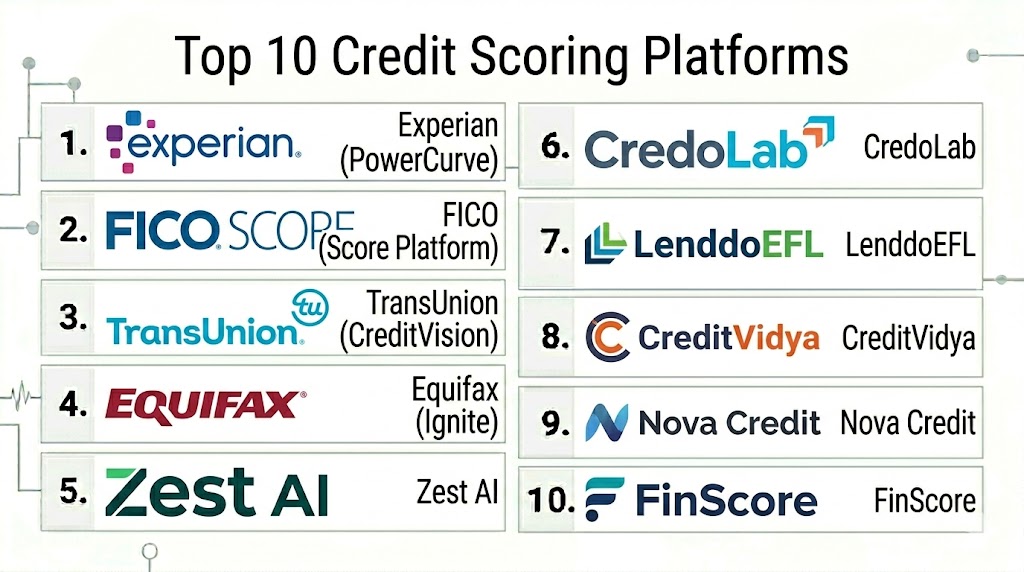
Top 10 Credit Scoring Platforms Tools
#1 — Experian PowerCurve
Short description:
An enterprise-grade credit decisioning and scoring platform used by global financial institutions. It combines advanced analytics, automation, and real-time decisioning to improve lending outcomes.
Key Features
- Advanced decision engine
- Real-time scoring
- Workflow automation
- Analytics dashboards
- Risk management tools
- Integration capabilities
Pros
- Industry-leading platform
- Strong analytics
- Scalable
- Reliable
Cons
- Complex implementation
- High cost
- Requires expertise
- Customization effort
Platforms / Deployment
Cloud / Hybrid
Security & Compliance
Encryption, RBAC, audit logs. Compliance not publicly stated.
Integrations & Ecosystem
Integrates with financial and data systems.
- Credit bureaus
- CRM platforms
- Core banking systems
- APIs
Support & Community
Strong enterprise support.
#2 — FICO Score Platform
Short description:
One of the most recognized credit scoring platforms globally, widely used by banks and lenders for standardized risk assessment and decision-making.
Key Features
- Standardized credit scoring models
- Risk analytics
- Decision automation
- Reporting tools
- Integration support
Pros
- Widely trusted
- Proven accuracy
- Strong ecosystem
- Scalable
Cons
- Limited flexibility
- Dependency on traditional data
- High cost
- Less customization
Platforms / Deployment
Cloud / Hybrid
Security & Compliance
Encryption, RBAC. Compliance not publicly stated.
Integrations & Ecosystem
Works with financial systems globally.
- Credit bureaus
- Banking systems
- Data platforms
- APIs
Support & Community
Extensive global support network.
#3 — TransUnion CreditVision
Short description:
A credit scoring platform that enhances traditional credit data with trended insights, helping lenders make better decisions.
Key Features
- Trended credit data
- Risk analytics
- Reporting tools
- Integration support
- Decision support
Pros
- Enhanced data insights
- Reliable
- Scalable
- Good analytics
Cons
- Limited customization
- Data dependency
- Integration effort
- Pricing not transparent
Platforms / Deployment
Cloud
Security & Compliance
Encryption, RBAC. Compliance not publicly stated.
Integrations & Ecosystem
Supports integration with financial systems.
- Credit bureaus
- CRM tools
- Data platforms
- APIs
Support & Community
Strong vendor support.
#4 — Equifax Ignite
Short description:
A cloud-based analytics platform offering credit scoring and decisioning capabilities with strong data integration and insights.
Key Features
- Data-driven scoring
- Analytics tools
- Workflow automation
- Reporting
- Integration support
Pros
- Strong data capabilities
- Scalable
- Reliable
- Good analytics
Cons
- Complex setup
- Customization effort
- Learning curve
- Pricing not transparent
Platforms / Deployment
Cloud
Security & Compliance
Encryption, RBAC. Compliance not publicly stated.
Integrations & Ecosystem
Integrates with enterprise systems.
- Data platforms
- CRM tools
- Financial systems
- APIs
Support & Community
Enterprise support available.
#5 — Zest AI
Short description:
An AI-driven credit scoring platform that uses machine learning to improve risk prediction and reduce bias in lending decisions.
Key Features
- Machine learning models
- Risk prediction
- Automated decisioning
- Analytics dashboards
- Integration support
Pros
- High accuracy
- Modern AI capabilities
- Flexible
- Scalable
Cons
- Requires data expertise
- Integration effort
- Pricing not transparent
- Learning curve
Platforms / Deployment
Cloud
Security & Compliance
Encryption, RBAC. Compliance not publicly stated.
Integrations & Ecosystem
Supports API integrations.
- Data platforms
- Financial systems
- CRM tools
- APIs
Support & Community
Vendor support available.
#6 — CredoLab
Short description:
An alternative credit scoring platform that uses smartphone and behavioral data to assess borrower risk, enabling financial inclusion.
Key Features
- Alternative data scoring
- Fraud detection
- Risk analytics
- Mobile data analysis
- Integration capabilities
Pros
- Strong alternative data use
- Improves inclusion
- Scalable
- Modern approach
Cons
- Data privacy concerns
- Limited traditional scoring
- Integration effort
- Pricing not transparent
Platforms / Deployment
Cloud / Mobile
Security & Compliance
Encryption, RBAC. Compliance not publicly stated.
Integrations & Ecosystem
Supports mobile and data integrations.
- Mobile data sources
- CRM tools
- Financial systems
- APIs
Support & Community
Growing ecosystem.
#7 — LenddoEFL
Short description:
A fintech platform focused on alternative credit scoring using behavioral and social data to assess risk in emerging markets.
Key Features
- Behavioral scoring
- Risk analytics
- Fraud detection
- Integration support
- Reporting tools
Pros
- Strong inclusion focus
- Flexible
- Scalable
- Good analytics
Cons
- Limited traditional scoring
- Data dependency
- Integration effort
- Pricing not transparent
Platforms / Deployment
Cloud
Security & Compliance
Encryption, RBAC. Compliance not publicly stated.
Integrations & Ecosystem
Supports API integrations.
- Financial systems
- CRM tools
- Data platforms
- APIs
Support & Community
Vendor support available.
#8 — CreditVidya
Short description:
A data-driven credit scoring platform that uses alternative data and analytics to improve risk assessment for lenders.
Key Features
- Alternative data scoring
- Analytics tools
- Risk assessment
- Integration support
- Reporting
Pros
- Strong analytics
- Flexible
- Scalable
- Good automation
Cons
- Data dependency
- Integration effort
- Learning curve
- Pricing not transparent
Platforms / Deployment
Cloud
Security & Compliance
Encryption, RBAC. Compliance not publicly stated.
Integrations & Ecosystem
Supports integrations with lending systems.
- Data platforms
- CRM tools
- Financial systems
- APIs
Support & Community
Vendor support available.
#9 — Nova Credit
Short description:
A cross-border credit scoring platform that enables lenders to assess applicants with international credit histories.
Key Features
- Cross-border credit data
- Risk analytics
- Integration capabilities
- Reporting tools
- Decision support
Pros
- Unique global data
- Improves inclusion
- Scalable
- Reliable
Cons
- Limited domestic focus
- Integration effort
- Pricing not transparent
- Customization limits
Platforms / Deployment
Cloud
Security & Compliance
Encryption, RBAC. Compliance not publicly stated.
Integrations & Ecosystem
Supports global integrations.
- Credit bureaus
- Financial systems
- APIs
- Data platforms
Support & Community
Strong fintech partnerships.
#10 — FinScore
Short description:
An alternative credit scoring platform that uses telecom and behavioral data to assess credit risk in underserved markets.
Key Features
- Telecom data scoring
- Risk analytics
- Fraud detection
- Integration support
- Reporting tools
Pros
- Strong alternative data
- Scalable
- Flexible
- Good analytics
Cons
- Limited traditional scoring
- Data dependency
- Integration effort
- Pricing not transparent
Platforms / Deployment
Cloud
Security & Compliance
Encryption, RBAC. Compliance not publicly stated.
Integrations & Ecosystem
Supports integrations with financial systems.
- Telecom data sources
- CRM tools
- APIs
- Data platforms
Support & Community
Vendor support available.
Comparison Table
| Tool Name | Best For | Platforms | Deployment | Standout Feature | Public Rating |
|---|---|---|---|---|---|
| Experian | Enterprise lenders | Web | Cloud Hybrid | Real-time decisioning | N/A |
| FICO | Global scoring | Web | Cloud Hybrid | Standardized models | N/A |
| TransUnion | Data insights | Web | Cloud | Trended data | N/A |
| Equifax | Analytics | Web | Cloud | Data integration | N/A |
| Zest AI | AI scoring | Web | Cloud | Machine learning | N/A |
| CredoLab | Alternative data | Mobile | Cloud | Behavioral scoring | N/A |
| LenddoEFL | Inclusion | Web | Cloud | Social data | N/A |
| CreditVidya | Analytics | Web | Cloud | Alternative scoring | N/A |
| Nova Credit | Global scoring | Web | Cloud | Cross-border data | N/A |
| FinScore | Telecom data | Web | Cloud | Behavioral insights | N/A |
Evaluation and Scoring of Credit Scoring Platforms
| Tool Name | Core | Ease | Integrations | Security | Performance | Support | Value | Weighted Total |
|---|---|---|---|---|---|---|---|---|
| Experian | 9 | 6 | 9 | 9 | 9 | 9 | 6 | 8.3 |
| FICO | 9 | 6 | 9 | 9 | 9 | 9 | 6 | 8.3 |
| TransUnion | 8 | 7 | 8 | 8 | 8 | 8 | 7 | 7.8 |
| Equifax | 8 | 7 | 8 | 8 | 8 | 8 | 7 | 7.8 |
| Zest AI | 8 | 7 | 8 | 8 | 8 | 8 | 7 | 7.8 |
| CredoLab | 8 | 7 | 8 | 8 | 8 | 8 | 7 | 7.8 |
| LenddoEFL | 8 | 7 | 8 | 8 | 8 | 8 | 7 | 7.8 |
| CreditVidya | 8 | 7 | 8 | 8 | 8 | 8 | 7 | 7.8 |
| Nova Credit | 8 | 7 | 8 | 8 | 8 | 8 | 7 | 7.8 |
| FinScore | 7 | 7 | 7 | 7 | 7 | 7 | 7 | 7.0 |
These scores are comparative and help highlight strengths across tools. Higher scores indicate stronger overall capabilities, but the best choice depends on your specific business needs.
Which Credit Scoring Platform Is Right for You
Solo / Freelancer
Not typically required. Basic credit checks are sufficient.
SMB
CreditVidya and CredoLab are suitable for flexible and cost-effective scoring.
Mid-Market
Zest AI, LenddoEFL, and TransUnion offer scalability and analytics.
Enterprise
Experian, FICO, and Equifax are best for large-scale operations.
Budget vs Premium
Budget tools focus on simplicity, while premium tools offer advanced analytics and automation.
Feature Depth vs Ease of Use
Enterprise platforms provide deep features, while smaller platforms are easier to adopt.
Integrations and Scalability
API-first platforms provide better scalability and integration.
Security and Compliance Needs
Enterprise platforms offer stronger compliance and audit capabilities.
Frequently Asked Questions
1. What is a credit scoring platform
A credit scoring platform evaluates borrower risk using financial and behavioral data.
It helps lenders decide approvals and loan terms.
It improves accuracy and efficiency in lending decisions.
2. How do credit scoring systems work
They collect data, validate it, and apply models to calculate risk scores.
Many systems use AI and analytics for better predictions.
They generate approve or reject decisions automatically.
3. What is alternative credit scoring
Alternative scoring uses non-traditional data like mobile usage or digital payments.
It helps evaluate borrowers without credit history.
This improves financial inclusion.
4. Why is AI important in credit scoring
AI improves accuracy and detects patterns in large datasets.
It enables faster and more inclusive decisions.
It reduces bias and improves risk assessment.
5. Are credit scoring platforms secure
Most platforms include encryption and access controls.
They also provide audit trails for compliance.
Security varies by vendor.
6. Can small lenders use these tools
Yes, many platforms are designed for SMB lenders.
They offer scalable and flexible solutions.
Cloud platforms are easier to adopt.
7. How long does implementation take
Implementation depends on complexity.
Cloud platforms are faster to deploy.
Enterprise systems may take longer.
8. Do these tools support integrations
Yes, most integrate with CRM, banking, and data systems.
API support is essential.
Integrations improve efficiency.
9. What are common mistakes
Ignoring data quality and integration needs is common.
Underestimating complexity is another issue.
Proper planning is critical.
10. What are alternatives
Alternatives include manual risk assessment or basic scoring models.
However, they lack automation and accuracy.
Dedicated platforms provide better results.
Conclusion
Credit Scoring Platforms are essential for modern lending, enabling faster, more accurate, and data-driven decisions. By combining AI, analytics, and diverse data sources, these platforms improve risk assessment, reduce defaults, and expand access to credit. Enterprise solutions like Experian and FICO provide robust capabilities for large institutions, while alternative platforms like CredoLab and FinScore drive innovation in financial inclusion. The best choice depends on your scale, data strategy, and integration needs. Organizations should prioritize accuracy, transparency, and scalability when selecting a platform. A practical next step is to shortlist a few tools, test their decision models, and validate integration and compliance requirements before finalizing.
