Introduction
Product Information Management (PIM) tools are platforms that help businesses centralize, manage, enrich, and distribute product data across multiple sales and marketing channels. These systems act as a single source of truth for product information such as descriptions, specifications, pricing, digital assets, and localization data.
In modern digital commerce, product data is no longer stored in one place. It flows across e-commerce websites, marketplaces, mobile apps, ERP systems, and retail channels. PIM tools ensure this data is accurate, consistent, and up to date everywhere.
Common use cases include:
- E-commerce product catalog management
- Multi-channel retail distribution
- Marketplace listings management
- Product data enrichment and localization
- Digital asset and catalog synchronization
Key evaluation criteria:
- Data modeling and catalog structure
- Multi-channel publishing capabilities
- Integration with ERP, CRM, and e-commerce platforms
- Workflow and collaboration features
- Data quality and enrichment tools
- Scalability for large product catalogs
- API and automation support
- Security and access control
Best for: Retailers, manufacturers, wholesalers, e-commerce brands, and enterprises managing large product catalogs across multiple channels.
Not ideal for: Small businesses with very limited product data or single-channel sales operations.
Key Trends in Product Information Management (PIM) Tools
- Adoption of cloud-native PIM platforms
- Integration with headless commerce architectures
- Use of AI for product data enrichment
- Expansion of real-time multi-channel syndication
- Increased focus on data governance and compliance
- Integration with DAM (Digital Asset Management) systems
- Rise of API-first PIM platforms
- Automation of product onboarding workflows
- Support for global localization and multilingual catalogs
- Strong alignment with composable commerce ecosystems
How We Selected These Tools (Methodology)
- Evaluated market adoption and enterprise usage
- Assessed data modeling and catalog management capabilities
- Reviewed integration ecosystems and API flexibility
- Considered scalability for large product datasets
- Included both enterprise and mid-market solutions
- Analyzed ease of use and workflow design
- Focused on real-world retail and manufacturing use cases
- Balanced innovation and stability
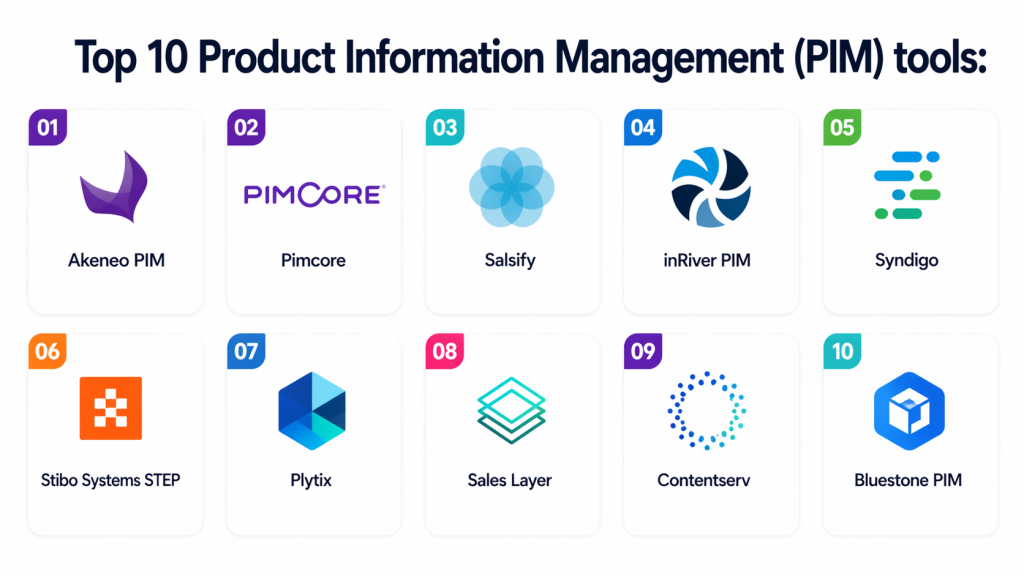
Top 10 Product Information Management (PIM) Tools
#1 — Akeneo PIM
Short description: A leading open-source and enterprise PIM platform designed to centralize and enrich product information for omnichannel commerce. It is widely used by retailers and manufacturers for scalable product data management.
Key Features
- Centralized product catalog management
- Data enrichment workflows
- Multi-channel publishing
- API-first architecture
- Localization support
- Workflow automation
Pros
- Highly flexible
- Strong community edition
Cons
- Enterprise features require paid version
- Setup complexity
Platforms / Deployment
Cloud / Self-hosted
Security & Compliance
Enterprise-grade features; details not publicly stated
Integrations & Ecosystem
Integrates with e-commerce, ERP, and DAM systems.
- Shopify
- Magento
- ERP systems
Support & Community
Strong global community and enterprise support.
#2 — Pimcore
Short description: An open-source digital experience platform that combines PIM, DAM, and CMS capabilities for unified product and content management.
Key Features
- Product data management
- Digital asset management
- Content management system
- API-first architecture
- Workflow automation
Pros
- Highly customizable
- All-in-one platform
Cons
- Complex implementation
- Requires technical expertise
Platforms / Deployment
Cloud / Self-hosted
Security & Compliance
Varies
Integrations & Ecosystem
Supports enterprise integrations via APIs.
Support & Community
Active open-source and enterprise support.
#3 — Salsify
Short description: A cloud-based product experience management platform focused on optimizing product content across digital commerce channels.
Key Features
- Product content syndication
- Digital shelf analytics
- Collaboration workflows
- Multi-channel publishing
- Data enrichment
Pros
- Strong commerce focus
- Easy collaboration
Cons
- High pricing
- Enterprise-oriented
Platforms / Deployment
Cloud
Security & Compliance
Enterprise-grade security
Integrations & Ecosystem
Works with major e-commerce platforms.
Support & Community
Strong enterprise support.
#4 — inRiver PIM
Short description: A product information management platform designed to help businesses manage and distribute product content across global channels.
Key Features
- Product information modeling
- Workflow automation
- Multi-channel distribution
- Data enrichment
- Collaboration tools
Pros
- Scalable
- Strong enterprise adoption
Cons
- Complex UI
- Pricing not transparent
Platforms / Deployment
Cloud
Security & Compliance
Not publicly stated
Integrations & Ecosystem
Supports ERP and e-commerce integrations.
Support & Community
Enterprise-level support.
#5 — Syndigo
Short description: A cloud-based PIM and product content syndication platform designed for retail and e-commerce businesses.
Key Features
- Product content syndication
- Data governance
- Digital shelf analytics
- Workflow management
- Data enrichment
Pros
- Strong retail focus
- Good analytics
Cons
- Complex setup
- Enterprise pricing
Platforms / Deployment
Cloud
Security & Compliance
Enterprise-grade
Integrations & Ecosystem
Works with retail and ERP systems.
Support & Community
Enterprise support model.
#6 — Pimly
Short description: A modern PIM solution focused on simplifying product data management for e-commerce and retail businesses.
Key Features
- Product catalog management
- API-first design
- Multi-channel publishing
- Data enrichment tools
- Automation workflows
Pros
- Easy to use
- Modern interface
Cons
- Smaller ecosystem
- Limited enterprise features
Platforms / Deployment
Cloud
Security & Compliance
Not publicly stated
Integrations & Ecosystem
Supports APIs and commerce platforms.
Support & Community
Growing support base.
#7 — Catsy PIM
Short description: A product information management platform designed for manufacturers and distributors to manage product catalogs efficiently.
Key Features
- Product data centralization
- Catalog management
- Digital asset management
- Multi-channel publishing
- Workflow automation
Pros
- Strong for manufacturing
- Easy collaboration
Cons
- Limited scalability
- Smaller ecosystem
Platforms / Deployment
Cloud
Security & Compliance
Not publicly stated
Integrations & Ecosystem
Works with ERP and e-commerce tools.
Support & Community
Moderate support.
#8 — Sales Layer
Short description: A cloud-based PIM platform designed for fast product data synchronization across multiple sales channels.
Key Features
- Centralized product data
- Multi-channel publishing
- API integration
- Data validation
- Workflow tools
Pros
- Easy integration
- Fast deployment
Cons
- Limited advanced features
- Smaller enterprise adoption
Platforms / Deployment
Cloud
Security & Compliance
Not publicly stated
Integrations & Ecosystem
Supports e-commerce platforms and APIs.
Support & Community
Moderate support.
#9 — Bluestone PIM
Short description: A flexible product information management platform designed for omnichannel commerce and digital transformation.
Key Features
- Product data modeling
- Omnichannel publishing
- Workflow automation
- API-first architecture
- Data enrichment
Pros
- Flexible architecture
- Scalable
Cons
- Complex onboarding
- Limited documentation
Platforms / Deployment
Cloud / Hybrid
Security & Compliance
Enterprise-grade features
Integrations & Ecosystem
Works with ERP and commerce systems.
Support & Community
Enterprise support available.
#10 — Contentserv
Short description: An enterprise-grade product experience management platform combining PIM, MDM, and DAM capabilities.
Key Features
- Product data management
- Digital asset management
- Workflow automation
- Multi-channel publishing
- AI-driven enrichment
Pros
- Comprehensive platform
- Strong enterprise features
Cons
- Expensive
- Complex setup
Platforms / Deployment
Cloud / On-prem
Security & Compliance
Enterprise-grade security
Integrations & Ecosystem
Supports enterprise ERP and commerce systems.
Support & Community
Strong enterprise support.
Comparison Table
| Tool Name | Best For | Platform(s) Supported | Deployment | Standout Feature | Public Rating |
|---|---|---|---|---|---|
| Akeneo | E-commerce | Multi-platform | Hybrid | Product enrichment | N/A |
| Pimcore | Digital experience | Multi-platform | Hybrid | PIM + CMS + DAM | N/A |
| Salsify | Retail brands | Web | Cloud | Digital shelf analytics | N/A |
| inRiver | Global commerce | Web | Cloud | Workflow automation | N/A |
| Syndigo | Retail syndication | Web | Cloud | Content distribution | N/A |
| Pimly | SMB commerce | Web | Cloud | Simple API-first PIM | N/A |
| Catsy | Manufacturing | Web | Cloud | Catalog management | N/A |
| Sales Layer | Fast deployment | Web | Cloud | Multi-channel sync | N/A |
| Bluestone | Omnichannel | Multi-platform | Hybrid | Flexible architecture | N/A |
| Contentserv | Enterprise PXM | Multi-platform | Hybrid | AI-driven enrichment | N/A |
Evaluation & Scoring of PIM Tools
| Tool Name | Core | Ease | Integrations | Security | Performance | Support | Value | Weighted Total |
|---|---|---|---|---|---|---|---|---|
| Akeneo | 9 | 7 | 9 | 8 | 9 | 9 | 8 | 8.5 |
| Pimcore | 9 | 6 | 9 | 8 | 8 | 8 | 9 | 8.3 |
| Salsify | 9 | 8 | 8 | 8 | 9 | 9 | 7 | 8.4 |
| inRiver | 8 | 7 | 8 | 8 | 8 | 8 | 7 | 8.0 |
| Syndigo | 8 | 7 | 8 | 8 | 8 | 8 | 7 | 8.0 |
| Pimly | 7 | 9 | 7 | 7 | 7 | 7 | 8 | 7.4 |
| Catsy | 7 | 8 | 7 | 7 | 7 | 7 | 8 | 7.3 |
| Sales Layer | 7 | 9 | 7 | 7 | 7 | 7 | 8 | 7.5 |
| Bluestone | 8 | 7 | 8 | 8 | 8 | 7 | 7 | 7.9 |
| Contentserv | 9 | 6 | 8 | 9 | 9 | 9 | 6 | 8.4 |
How to interpret scores:
These scores compare tools across key dimensions like scalability, integration, and usability. Higher scores indicate stronger enterprise capability, while mid-range tools often prioritize simplicity and speed of deployment.
Which PIM Tool Is Right for You?
Solo / Freelancer
Sales Layer or Pimly for lightweight catalog management.
SMB
Catsy or Akeneo Community for balanced features.
Mid-Market
Salsify and inRiver for scalable product operations.
Enterprise
Contentserv, Akeneo Enterprise, and Syndigo for global-scale PIM.
Budget vs Premium
Open-source or entry tools reduce cost; enterprise PIMs offer advanced governance.
Feature Depth vs Ease of Use
Akeneo offers depth; Sales Layer offers simplicity.
Integrations & Scalability
Contentserv and Salsify excel in enterprise integration environments.
Security & Compliance Needs
Enterprises should prioritize tools with governance and access control features.
Frequently Asked Questions (FAQs)
1. What is a PIM tool?
A Product Information Management (PIM) tool is software that centralizes and manages product data across multiple channels. It ensures consistent, accurate, and enriched product information across e-commerce, marketplaces, and retail systems.
2. Why is PIM important?
PIM is important because it eliminates data inconsistencies, improves product experience, and ensures faster product listings across multiple sales channels, improving operational efficiency.
3. Who uses PIM systems?
Retailers, manufacturers, wholesalers, and e-commerce companies use PIM systems to manage large and complex product catalogs across different platforms.
4. What is the difference between PIM and ERP?
ERP manages overall business operations, while PIM focuses specifically on product data management and enrichment for sales and marketing channels.
5. Can PIM integrate with e-commerce platforms?
Yes, most PIM tools integrate with platforms like Shopify, Magento, and other commerce systems for seamless product data synchronization.
6. Is PIM cloud-based?
Modern PIM systems are mostly cloud-based, but some enterprise solutions also support hybrid or on-prem deployments.
7. Does PIM improve SEO?
Yes, by ensuring consistent and enriched product descriptions, PIM systems improve product visibility and search engine optimization.
8. What challenges does PIM solve?
It solves issues like inconsistent product data, manual updates across channels, and inefficient product onboarding processes.
9. Is PIM suitable for small businesses?
Yes, but small businesses with limited product catalogs may not fully utilize advanced PIM features.
10. Can PIM handle multilingual catalogs?
Yes, most modern PIM systems support localization and multilingual product data for global commerce.
Conclusion
Product Information Management (PIM) tools are essential for businesses managing large and complex product catalogs across multiple digital and retail channels. They ensure consistency, accuracy, and efficiency in product data distribution. There is no single best PIM solution for everyone. Enterprise companies may prefer platforms like Contentserv or Salsify, while mid-sized businesses may find Akeneo or inRiver more suitable. Smaller teams can start with lightweight tools like Sales Layer or Pimly. The right choice depends on your product volume, integration needs, and scalability goals. Focus on tools that align with your digital commerce strategy and long-term growth. Start by shortlisting a few tools, testing workflows, and validating integrations with your existing systems. This ensures a smooth and scalable product data management strategy.
