Introduction
Shopping Cart Software is the core engine behind any online store, enabling customers to add products, calculate totals, manage checkout, and complete purchases seamlessly. It connects storefronts, payment gateways, inventory systems, and order management into one unified workflow.
In modern eCommerce, shopping carts are no longer just “add to cart” tools. They now include real-time pricing, tax calculation, discount handling, secure payments, and abandoned cart recovery, making them critical for conversion and revenue growth.
Real-world use cases
- Managing product checkout and payments
- Calculating taxes, shipping, and discounts
- Handling abandoned cart recovery
- Integrating with payment gateways and logistics
- Tracking customer purchase behavior
What buyers should evaluate
- Checkout experience and speed
- Payment gateway support
- Security and compliance features
- Integration with eCommerce platforms
- Customization and flexibility
- Mobile and responsive design
- Scalability for large catalogs
- Pricing and transaction fees
Best for: eCommerce businesses, startups, online retailers, and enterprises selling products or services online.
Not ideal for: Businesses without online transactions or with very basic selling needs.
Key Trends in Shopping Cart Software
- AI-driven checkout optimization
- One-click checkout and express payments
- Mobile-first and headless commerce experiences
- Integration with digital wallets and BNPL services
- Real-time pricing and tax automation
- Abandoned cart recovery automation
- API-first architecture for flexibility
- Subscription and recurring billing support
- Omnichannel checkout across platforms
- Enhanced fraud detection and security
How We Selected These Tools
- Evaluated global adoption and market presence
- Assessed checkout and payment capabilities
- Considered scalability for businesses of all sizes
- Reviewed integrations with eCommerce platforms
- Analyzed ease of use and customization
- Evaluated performance and reliability
- Considered pricing models and flexibility
- Assessed vendor ecosystem and support
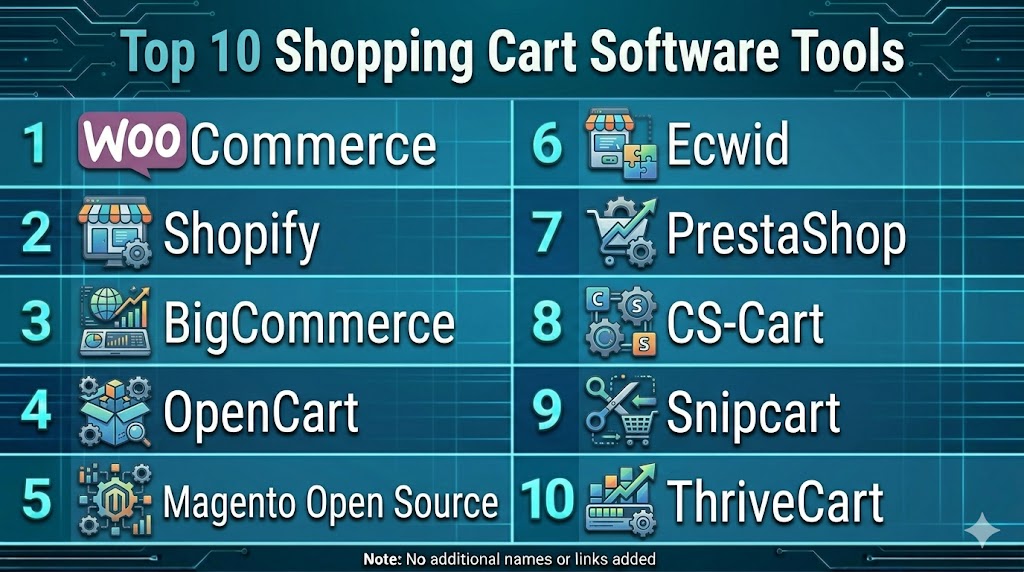
Top 10 Shopping Cart Software
#1 — WooCommerce
Short description: WooCommerce is a flexible open-source shopping cart solution for WordPress that allows full customization and control over online stores.
Key Features
- Customizable checkout
- Payment gateway integrations
- Plugin ecosystem
- Inventory management
- SEO optimization
Pros
- Open-source flexibility
- Large ecosystem
- Highly customizable
Cons
- Requires hosting
- Maintenance required
- Plugin dependency
Platforms / Deployment
- Web
- Self hosted
Security & Compliance
- Not publicly stated
Integrations & Ecosystem
Extensive plugin ecosystem with integrations across payment, shipping, and marketing tools.
- APIs
- Payment gateways
- CMS plugins
Support & Community
Large global community
#2 — Shopify
Short description: Shopify provides a fully hosted shopping cart system with seamless checkout, payment processing, and scalability.
Key Features
- Hosted checkout
- Payment processing
- Inventory management
- Mobile optimization
- Analytics
Pros
- Easy to use
- Scalable
- Secure
Cons
- Transaction fees
- Limited customization without apps
- Monthly cost
Platforms / Deployment
- Web Mobile
- Cloud
Security & Compliance
- Not publicly stated
Integrations & Ecosystem
Strong ecosystem with apps and integrations for payments and logistics.
- APIs
- Payment tools
- Marketing tools
Support & Community
Extensive support ecosystem
#3 — BigCommerce
Short description: BigCommerce offers a powerful shopping cart system with built-in features and strong scalability for growing businesses.
Key Features
- Multi-channel selling
- Built-in checkout
- Payment integrations
- Analytics
- API support
Pros
- Feature-rich
- Scalable
- No transaction fees
Cons
- Learning curve
- Pricing tiers
- Limited design flexibility
Platforms / Deployment
- Web
- Cloud
Security & Compliance
- Not publicly stated
Integrations & Ecosystem
Supports integration with marketplaces and enterprise tools.
- APIs
- Marketplaces
Support & Community
Enterprise support
#4 — Magento Open Source
Short description: Magento is a highly customizable shopping cart platform suited for enterprises with complex requirements.
Key Features
- Advanced checkout customization
- Product management
- Multi-store support
- API integration
- Analytics
Pros
- Highly flexible
- Scalable
- Enterprise-ready
Cons
- Complex setup
- Requires development
- Maintenance cost
Platforms / Deployment
- Web
- Self hosted
Security & Compliance
- Not publicly stated
Integrations & Ecosystem
Strong integration with enterprise systems.
- APIs
- ERP
Support & Community
Large developer community
#5 — OpenCart
Short description: OpenCart is a lightweight open-source shopping cart solution offering flexibility and ease of setup.
Key Features
- Product catalog
- Payment gateways
- Extensions
- Reporting
- Multi-store
Pros
- Free and open-source
- Easy setup
- Lightweight
Cons
- Limited advanced features
- Smaller ecosystem
- Basic UI
Platforms / Deployment
- Web
- Self hosted
Security & Compliance
- Not publicly stated
Integrations & Ecosystem
Supports extensions and plugins.
- APIs
- Extensions
Support & Community
Open-source community
#6 — Ecwid
Short description: Ecwid is a flexible shopping cart widget that integrates into existing websites and social media stores.
Key Features
- Embed cart into any site
- Multi-channel selling
- Inventory management
- Payment integration
- Mobile support
Pros
- Easy integration
- Flexible
- Affordable
Cons
- Limited advanced features
- Smaller ecosystem
- Customization limits
Platforms / Deployment
- Web Mobile
- Cloud
Security & Compliance
- Not publicly stated
Integrations & Ecosystem
Works across CMS and social platforms.
- APIs
- CMS
Support & Community
Good support
#7 — PrestaShop
Short description: PrestaShop is an open-source shopping cart platform with strong customization and global community support.
Key Features
- Customizable checkout
- Product management
- Payment integration
- Modules and themes
- Analytics
Pros
- Flexible
- Open-source
- Large community
Cons
- Requires hosting
- Maintenance
- Technical complexity
Platforms / Deployment
- Web
- Self hosted
Security & Compliance
- Not publicly stated
Integrations & Ecosystem
Supports extensions and modules.
- APIs
- Plugins
Support & Community
Strong community
#8 — CS Cart
Short description: CS Cart is a feature-rich shopping cart solution designed for small to mid-sized online businesses.
Key Features
- Multi-vendor support
- Checkout customization
- Inventory management
- Reporting
- Marketing tools
Pros
- Feature-rich
- Scalable
- Good customization
Cons
- Paid license
- Learning curve
- Smaller ecosystem
Platforms / Deployment
- Web
- Self hosted
Security & Compliance
- Not publicly stated
Integrations & Ecosystem
Supports integrations with business tools.
- APIs
- Plugins
Support & Community
Good support
#9 — Snipcart
Short description: Snipcart is a developer-friendly shopping cart that can be added to any website using simple integration.
Key Features
- Add cart to any site
- Secure checkout
- API-driven
- Inventory management
- Payment integration
Pros
- Lightweight
- Developer-friendly
- Flexible
Cons
- Requires coding
- Limited UI customization
- Smaller ecosystem
Platforms / Deployment
- Web
- Cloud
Security & Compliance
- Secure checkout
- Not publicly stated
Integrations & Ecosystem
API-first platform supporting custom integrations.
- APIs
- Developer tools
Support & Community
Developer-focused support
#10 — ThriveCart
Short description: ThriveCart is a conversion-focused shopping cart platform designed for digital products and online sales funnels.
Key Features
- One-click checkout
- Upsells and funnels
- Payment integration
- Subscription billing
- Analytics
Pros
- High conversion focus
- Easy setup
- Good for digital products
Cons
- Limited physical product features
- Smaller ecosystem
- Niche use case
Platforms / Deployment
- Web
- Cloud
Security & Compliance
- Not publicly stated
Integrations & Ecosystem
Supports integrations with marketing tools.
- APIs
- Marketing tools
Support & Community
Good support
Comparison Table
| Tool Name | Best For | Platform Supported | Deployment | Standout Feature | Public Rating |
|---|---|---|---|---|---|
| WooCommerce | Custom stores | Web | Self hosted | Flexibility | N/A |
| Shopify | All sizes | Web Mobile | Cloud | Ease of use | N/A |
| BigCommerce | Scaling business | Web | Cloud | Built-in features | N/A |
| Magento | Enterprise | Web | Self hosted | Customization | N/A |
| OpenCart | SMB | Web | Self hosted | Lightweight | N/A |
| Ecwid | Integration | Web Mobile | Cloud | Embedded cart | N/A |
| PrestaShop | Open-source | Web | Self hosted | Community support | N/A |
| CS Cart | SMB | Web | Self hosted | Multi-vendor | N/A |
| Snipcart | Developers | Web | Cloud | API-first | N/A |
| ThriveCart | Digital sales | Web | Cloud | Conversion funnels | N/A |
Evaluation & Scoring of Shopping Cart Software
| Tool Name | Core | Ease | Integrations | Security | Performance | Support | Value | Weighted Total |
|---|---|---|---|---|---|---|---|---|
| WooCommerce | 9 | 7 | 10 | 7 | 8 | 8 | 9 | 8.4 |
| Shopify | 9 | 9 | 9 | 8 | 9 | 9 | 8 | 8.8 |
| BigCommerce | 9 | 7 | 9 | 8 | 9 | 8 | 8 | 8.4 |
| Magento | 10 | 6 | 9 | 9 | 9 | 8 | 6 | 8.3 |
| OpenCart | 8 | 8 | 7 | 7 | 8 | 7 | 9 | 7.9 |
| Ecwid | 8 | 9 | 8 | 7 | 8 | 7 | 8 | 8.0 |
| PrestaShop | 8 | 7 | 8 | 7 | 8 | 7 | 8 | 7.8 |
| CS Cart | 8 | 7 | 7 | 7 | 8 | 7 | 8 | 7.7 |
| Snipcart | 7 | 7 | 9 | 8 | 8 | 7 | 8 | 7.8 |
| ThriveCart | 8 | 9 | 7 | 7 | 8 | 7 | 9 | 8.0 |
Scores are comparative and reflect checkout capabilities, flexibility, and scalability. Use them as directional guidance based on your business model.
Which Shopping Cart Software Is Right for You
Solo / Small Businesses
Ecwid and ThriveCart are simple and quick to deploy.
SMB
Shopify and OpenCart offer strong value and usability.
Mid-Market
BigCommerce and WooCommerce provide flexibility and scalability.
Enterprise
Magento is ideal for complex and large-scale operations.
Budget vs Premium
OpenCart is budget-friendly, Shopify is premium.
Feature Depth vs Ease of Use
Magento for depth, Shopify for simplicity.
Integrations & Scalability
WooCommerce and BigCommerce are strong options.
Security & Compliance Needs
Hosted platforms offer better managed security.
Frequently Asked Questions
1. What is shopping cart software
It is software that allows customers to select products and complete purchases online. It handles checkout, payments, and order management.
2. Why is it important
It is the core of eCommerce operations. It ensures smooth transactions and improves customer experience.
3. How does it work
It stores selected items, calculates totals, and processes payments. It integrates with payment gateways.
4. Is it suitable for small businesses
Yes, many tools are designed for small businesses. They offer easy setup and affordability.
5. How much does it cost
Costs vary widely. Some tools are free, while others require subscriptions.
6. Does it support mobile checkout
Yes, most modern tools support mobile-friendly checkout experiences.
7. How long does implementation take
It can take a few hours to weeks depending on complexity.
8. What are common mistakes
Choosing the wrong platform or ignoring checkout optimization is common.
9. Is shopping cart software secure
Most tools provide secure payment processing. Security varies by provider.
10. Are there alternatives
Custom-built solutions exist but require more effort and resources.
Conclusion
Shopping cart software is the backbone of any successful online store, enabling seamless product selection, checkout, and payment processing. These tools have evolved into powerful platforms that combine automation, analytics, and security to deliver smooth customer experiences and drive conversions. From flexible solutions like WooCommerce and OpenCart to fully managed platforms like Shopify and BigCommerce, each option offers distinct advantages depending on your technical expertise and business scale. The best choice depends on your requirements for customization, scalability, and ease of use rather than a single universal solution. Businesses should prioritize checkout performance, integrations, and security when selecting a shopping cart system. A practical next step is to shortlist a few tools, test checkout flows, and evaluate their impact on conversion rates and user experience before making a final decision.
