Introduction
Farming requires timely money. Farmers need funds before every season to buy seeds, fertilizers, pesticides, and diesel. They also need working capital to pay for tractor hiring, field labor, and irrigation. When institutional bank credit is unavailable or delayed, many rural families turn to local informal lenders who charge very high monthly interest rates. High interest debt lowers farm income and creates long-term financial stress for rural households.
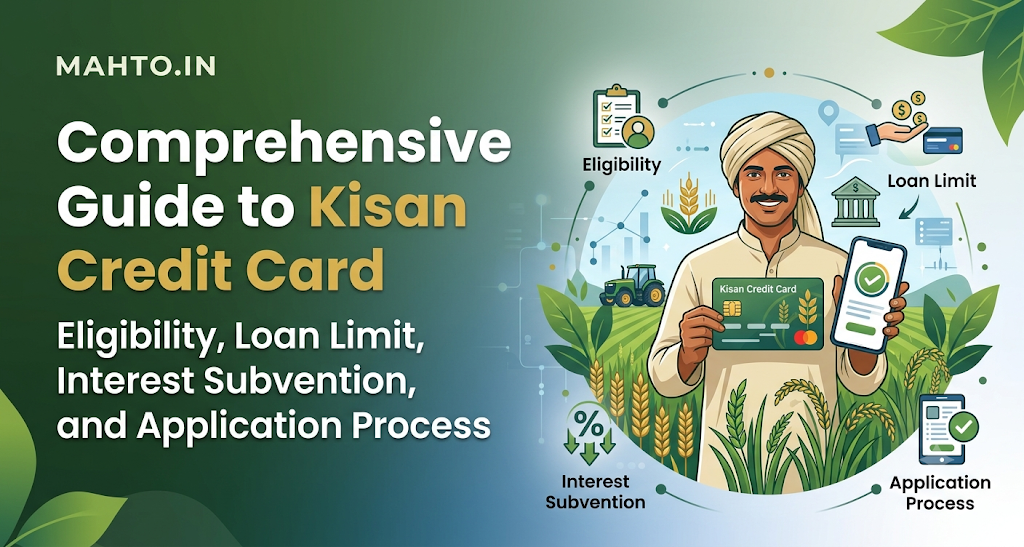
The Kisan Credit Card (KCC) scheme was created by the Government of India, the Reserve Bank of India (RBI), and NABARD to solve this problem. It provides farmers with flexible, low-interest short-term credit through commercial public sector banks, Regional Rural Banks (RRBs), and State Cooperative Banks. The scheme ensures that farmers can access credit whenever they need it without filling out new loan applications before every cropping season.
Understanding government credit programs can sometimes feel difficult due to complex banking terms. Rural information platforms like MAHTO.IN help simplify these procedures. By offering practical farming information in Hindi and clear breakdowns of government schemes for farmers, MAHTO.IN helps village communities access official benefits easily. This detailed guide explains everything you need to know about getting and using a Kisan Credit Card.
What Is the Kisan Credit Card Scheme?
The Kisan Credit Card is a flexible credit facility designed specifically for the agricultural sector. Instead of issuing a fixed single loan that requires a fresh application every season, banks provide an approved overall credit limit. This credit line remains valid for five years, subject to annual bank reviews.
+-----------------------------------------------------------------------+
|                       KISAN CREDIT CARD (KCC)                         |
|                                                                       |
|  [5-Year Credit Line] ---> [Draw Cash as Needed] ---> [Buy Inputs]   |
|                                                                       |
|  * 7% Base Interest Rate                                              |
|  * 3% Prompt Repayment Incentive (Effective Rate: 4%)                |
|  * Up to Rs. 1.60 Lakh Collateral-Free Limit                         |
+-----------------------------------------------------------------------+
Farmers receive a revolving cash credit account. They can withdraw cash using an ATM-cum-debit card (often a RuPay Kisan Card) or through bank branch withdrawals as expenses arise. Interest is charged only on the exact amount withdrawn for the number of days the money is used, not on the total sanctioned limit.
Core Objectives of KCC
- Meet short-term credit requirements for cultivating crops.
- Pay for post-harvest expenses and crop storage.
- Produce marketing loan requirements.
- Supply working capital for maintaining farm assets, irrigation pumps, and machinery.
- Meet household consumption requirements of agricultural families.
- Provide working capital for livestock farming information activities like dairy, goat rearing, poultry, and fisheries.
Main Benefits of a Kisan Credit Card
| Feature | Key Benefit for Farmers |
| Flexible Credit Limit | Sanctioned for 5 years based on crop pattern, land area, and scale of finance. |
| Low Interest Rates | Base interest is capped at 7% per annum for crop loans up to ₹3 lakh. |
| Interest Subvention | Prompt repayment reduces the effective interest rate to just 4% per annum. |
| Collateral-Free Loans | No property or land pledge needed for agricultural loans up to ₹1.60 lakh. |
| Simplified Repayment | Repayment schedules align with crop harvesting and marketing periods. |
| Built-in Insurance Cover | KCC holders can easily link their accounts to PM Fasal Bima Yojana for crop protection. |
The main advantage of KCC is convenience. Once your card is approved, you do not need to visit the bank with land documents every time you prepare your field for a new crop like paddy, wheat, or vegetables.
Who Is Eligible to Apply for KCC?
The Government of India has expanded KCC eligibility rules over time. Today, access is not restricted only to wealthy farmers or large landowners.
Eligible Applicant Categories
- Owner Cultivators: Individual farmers or joint borrowers who own agricultural land.
- Tenant Farmers and Sharecroppers: Individuals who cultivate rented land under formal or informal agreements.
- Lessee Farmers: Oral lessees and tenant cultivators working on leased farm plots.
- Self-Help Groups (SHGs) & JLGs: Joint Liability Groups formed by small or tenant farmers who do not own individual land titles.
- Livestock and Dairy Farmers: Individuals or groups raising cattle, buffaloes, goats, sheep, or poultry.
- Fish Farmers: Fish rearers, inland aquaculture farmers, and marine fishers.
                           KCC ELIGIBILITY
                                  |
    +-----------------------------+-----------------------------+
    |                                                           |
[Crop Cultivators]                                 [Animal Husbandry & Fishers]
 - Individual Landowners                            - Dairy & Cattle Farmers
 - Joint Borrowers                                  - Goat & Sheep Farmers
 - Tenant Farmers & Sharecroppers                   - Poultry Rearers
 - Self-Help Groups (SHGs)                          - Fish Farmers & Aquaculture
Whether you want to learn how to grow paddy on two acres of ancestral land or how to start goat farming near your village, you can apply for credit support under the KCC program.
Understanding KCC Interest Rates and Interest Subvention
Understanding interest rates is essential when taking any loan. The government offers special subventions to keep agricultural credit affordable.
The Standard Interest Rate
Commercial banks usually charge higher interest on regular personal or commercial loans. However, for short-term crop loans up to ₹3,00,000, the base interest rate is fixed at 7% per annum.
Government Interest Subvention Scheme (ISS)
To support farmers, the Central Government provides an Interest Subvention directly to banks. This ensures that banks can offer the 7% rate without suffering financial losses.
Prompt Repayment Incentive (PRI)
The government encourages timely loan clearing through an extra incentive:
- If a farmer repays their crop loan on or before the due date set by the bank, they receive a 3% Prompt Repayment Incentive.
- This reduces the actual interest paid by the farmer to just 4% per annum.
  Standard Short-Term Crop Loan Rate:     7% per annum
- Prompt Repayment Incentive (PRI):      3% per annum
-------------------------------------------------------
  Effective Interest Rate Paid:          4% per annum
Note: The 4% effective interest rate applies to short-term crop loans up to ₹3,00,000 when repaid on time.
Kisan Credit Card for Livestock, Dairy, and Fisheries
In 2019, the Government of India extended KCC benefits to animal husbandry and fisheries farmers to help meet their working capital needs.
+------------------------------------------------------------------------+
|                     KCC FOR ANIMAL HUSBANDRY                           |
|                                                                        |
|  * Dairy Farmers: Cattle feed, fodder, veterinary care, electricity.   |
|  * Goat / Sheep Farmers: Grazing management, feed, vaccination.        |
|  * Poultry Farmers: Chick purchasing, feed, health maintenance.        |
|  * Inland Fisheries: Fish seed (fingerlings), feed, pond maintenance.  |
|                                                                        |
|  Credit Limit: Up to Rs. 2 Lakh (with 2% interest subvention)          |
+------------------------------------------------------------------------+
Credit Limits for Livestock Farmers
- Non-landowning livestock owners can get working capital credit up to ₹2,00,000 with interest subvention benefits.
- If a farmer holds a KCC for both crops and livestock, the combined total ceiling eligible for interest subvention is ₹3,00,000.
- Collateral-free loans for livestock activities are available up to ₹1,60,000.
Covered Expenses for Livestock
- Purchase of feed, fodder, and green grass.
- Veterinary medicines, vaccinations, and doctor consultation fees.
- Water, electricity, and shed maintenance expenses.
- Purchase of fish seeds, fingerlings, and commercial feed for pond aquaculture.
If you are planning to start a small dairy unit or looking for practical guidance on village business ideas, getting a KCC for livestock provides reliable working capital.
Required Documents for KCC Application
Preparing your documents in advance helps prevent application delays at the bank branch.
Checklist of Essential Documents
- Application Form: Completed KCC form (available at bank branches or official bank websites).
- Identity Proof (Aadhaar Card): Copy of Aadhaar card. Ensure your PM Kisan eKYC is completed if linking with PM-Kisan.
- Address Proof: Voter ID card, MGNREGA job card, driving license, or Aadhaar card.
- Land Ownership Proof:
- Updated land record papers (Khatauni / Khasra / Parcha).
- Revenue department record signed by the local authority.
- For Tenant Farmers: Copy of registered lease agreement, crop-sharing agreement, or JLG undertaking form.
- Passport-Sized Photographs: Two recent color photographs.
- No-Dues Certificate: A self-declaration or certificate stating that you do not have active KCC loans at another bank branch.
How to Apply for a Kisan Credit Card (Step-by-Step)
Farmers can apply for a KCC through offline bank visits or online portals.
<Sequence>
  <Step title="Gather Required Documents" subtitle="Identity, address, and land records">
    Collect your Aadhaar card, address proof, recent passport photos, and land revenue documents (Khasra/Khatauni). If you are a tenant farmer, prepare your lease agreement or Joint Liability Group details.
  </Step>
  <Step title="Visit an Authorized Bank Branch" subtitle="Public sector, RRB, or Cooperative bank">
    Go to your nearest public sector bank, Regional Rural Bank (RRB), or local cooperative bank branch where you hold an active savings account.
  </Step>
  <Step title="Fill Out the KCC Application Form" subtitle="Single-page simplified form">
    Obtain the simplified KCC application form from the bank counter. Fill in your personal details, land holdings, cropping pattern, and requested credit limit carefully.
  </Step>
  <Step title="Submit the Application for Verification" subtitle="Branch manager evaluation">
    Hand over the completed form along with your document copies. The bank officer will verify your land records and check your credit history through CIBIL or rural banking records.
  </Step>
  <Step title="Receive Card and Credit Account" subtitle="RuPay Kisan Card issuance">
    Upon approval, the bank opens your KCC account and issues a RuPay Kisan ATM card. You can now withdraw cash from ATMs or use the card at local agricultural input dealers.
  </Step>
</Sequence>
Applying via PM-Kisan Portal
Beneficiaries of the PM-Kisan Samman Nidhi scheme benefit from a streamlined process:
- A simplified one-page KCC form is available on the official PM-Kisan portal.
- Farmers can fill out this form, attach their land records, and submit it to the bank branch where their PM-Kisan account is active.
- Banks use existing PM-Kisan verification records to process these applications faster.
Common Mistakes That Delay KCC Approvals
To ensure smooth processing of your credit card application, avoid these common mistakes:
- Name Mismatches Across Documents:Ensure your name is spelled identically across your Aadhaar card, bank passbook, and land revenue records (Khatauni).
- Incomplete Land Records:Submitting outdated or unverified land papers leads to immediate rejection. Always request updated records from your local land revenue office (Tehsildar or Lekhpal).
- Incomplete PM-Kisan eKYC:If you apply for a KCC through the PM-Kisan channel without completing your PM Kisan eKYC, the system may flag your application during automated background checks.
- Multiple Active Loans:Applying for a second KCC account at another bank branch while holding an unpaid balance on an existing card violates RBI guidelines.
- Incorrect Crop Scale of Finance:Requesting a credit limit that does not match your actual land acreage or local cropping guidelines can result in lower approved limits.
How Credit Limits Are Calculated
The total credit limit for your KCC account is determined using a standard formula based on local agricultural parameters.
+-------------------------------------------------------------------------+
|                  KCC CREDIT LIMIT CALCULATION FORMULA                   |
|                                                                         |
|  Year 1 Limit = (Crop Area x Scale of Finance) + 10% Post-Harvest       |
|                 + 20% Farm Maintenance                                  |
|                                                                         |
|  Subsequent Years (Years 2 to 5) = 10% Annual Automatic Escalation      |
+-------------------------------------------------------------------------+
The Calculation Breakdown
- Scale of Finance: Every District Level Technical Committee (DLTC) determines a fixed cost-per-acre for growing specific crops in that district (e.g., ₹25,000 per acre for paddy).
- Cropping Area: The area of land you plan to cultivate.
- Post-Harvest & Household Needs: The bank adds 10% of the crop cost for household consumption and post-harvest expenses.
- Maintenance of Assets: The bank adds an additional 20% for farm maintenance, equipment repairs, and crop insurance.
- Annual Escalation: The sanctioned limit automatically increases by 10% each year for five years to accommodate rising input costs.
Frequently Asked Questions (FAQs)
What is the maximum loan amount available under the Kisan Credit Card scheme?
There is no fixed maximum ceiling for general KCC loans. The limit depends on your land size, crop pattern, and district scale of finance. However, short-term crop loans up to ₹3,00,000 qualify for central interest subvention and prompt repayment incentives.
Can tenant farmers who do not own land get a Kisan Credit Card?
Yes. Tenant farmers, sharecroppers, and oral lessees can apply for a KCC. They can apply individually by presenting registered lease documents or collectively as part of a Joint Liability Group (JLG) or Self-Help Group (SHG).
What happens if a farmer fails to repay the KCC loan on time?
If you do not clear your dues by the bank’s scheduled repayment date, you lose the 3% Prompt Repayment Incentive. The interest rate will revert from 4% to the standard rate (7% or higher), and penal interest charges may apply according to bank rules.
Is collateral required to get a Kisan Credit Card?
No. Banks cannot ask for collateral security or land mortgage for KCC limits up to ₹1,60,000. For tie-up loans with institutional buyers, collateral-free limits can extend up to ₹3,00,000.
How long is a Kisan Credit Card valid?
A Kisan Credit Card account is valid for 5 years, subject to an annual performance review by the issuing bank branch.
Can I use my Kisan Credit Card to buy animal feed for dairy cows?
Yes. Working capital limits under KCC cover livestock activities, including purchasing dairy feed, green fodder, medicines, and veterinary care.
What is the difference between PM-Kisan and KCC?
PM-Kisan is a direct income support scheme offering ₹6,000 per year in three equal installments to eligible landholding farmers. KCC is a credit facility that offers low-interest bank loans for crop cultivation and livestock expenses.
How can I check if my bank branch processes KCC applications?
All public sector commercial banks, Regional Rural Banks (RRBs), and State Cooperative Banks process KCC applications. You can visit your local branch manager to obtain the application form.
Final Call to Action
Applying for a Kisan Credit Card is one of the most effective ways for Indian farmers to secure affordable farm credit and avoid high-interest informal loans. By gathering your updated land documents, completing your PM Kisan eKYC, and visiting your local bank branch, you can establish a reliable 5-year credit line for all your cropping and livestock needs.
For more simple, practical guides on government schemes for farmers, livestock care, crop cultivation tips, and village business ideas, explore the latest resources available on MAHTO.IN.
