Introduction
Secure Email Gateway SEG Tools protect business email systems by filtering messages before they reach users’ inboxes. In simple terms, an SEG checks incoming and outgoing email for spam, phishing, malware, malicious links, suspicious attachments, spoofed senders, impersonation, ransomware, and policy violations. These tools can sit in front of Microsoft 365, Google Workspace, Exchange, hybrid mail systems, or enterprise mail servers to add stronger email security controls.
Secure Email Gateway SEG tools matter because email remains one of the most common attack paths for credential theft, invoice fraud, malware delivery, ransomware entry, and business email compromise. A strong SEG helps security teams stop threats early, reduce inbox noise, enforce policies, quarantine risky emails, protect users from malicious URLs, and support compliance workflows. Common use cases include spam filtering, phishing defense, malware protection, attachment sandboxing, URL rewriting, spoofing prevention, email encryption, DLP, quarantine management, and outbound mail control.
Buyers should evaluate detection accuracy, false positive rates, deployment model, Microsoft 365 support, Google Workspace support, URL protection, attachment analysis, impersonation defense, DLP features, quarantine controls, admin reporting, incident response, pricing, and support quality.
Best for: IT teams, security teams, MSPs, enterprises, schools, healthcare organizations, finance teams, legal firms, ecommerce businesses, SaaS companies, and regulated organizations that need stronger email threat protection. Not ideal for: personal email users, very small teams with only basic filtering needs, or organizations that do not have admins to manage quarantines, policies, DNS records, mail routing, and user reporting workflows.
Key Trends in Secure Email Gateway SEG Tools
- SEG tools are becoming more cloud-native: Many businesses now use Microsoft 365 or Google Workspace, so SEG tools must integrate smoothly with cloud mail systems without creating routing complexity.
- Phishing and BEC protection are now core requirements: Modern email attacks often contain no malware, so tools must detect impersonation, fake invoices, vendor fraud, and social engineering.
- Attachment sandboxing is still important: Malicious files, compressed attachments, weaponized documents, and suspicious payloads still require deep inspection before delivery.
- URL rewriting and time-of-click protection are standard features: Attackers often change links after delivery, so links must be checked when users click, not only when email arrives.
- Outbound email filtering is gaining attention: Compromised accounts can send spam or data externally, so outbound scanning helps detect abuse and protect domain reputation.
- Email authentication is essential: SPF, DKIM, DMARC, sender alignment, and anti-spoofing controls remain foundational for reducing forged email.
- API-based email security is complementing gateways: Some organizations use SEG tools with API-based mailbox scanning for post-delivery remediation and deeper cloud email visibility.
- AI-driven detection is improving threat analysis: Vendors increasingly use machine learning, natural language analysis, sender behavior, and campaign detection to identify suspicious messages.
- User reporting workflows are becoming important: Phishing report buttons, user feedback, security awareness integration, and admin review queues help improve detection and response.
- Operational simplicity is a major buyer priority: Teams want strong filtering without excessive false positives, complex routing, or overwhelming quarantine review workload.
How We Selected These Tools
The tools below were selected based on their relevance to secure email gateways, spam filtering, phishing defense, malware scanning, URL protection, attachment analysis, impersonation defense, and enterprise email security workflows.
- Feature completeness: Tools were evaluated for spam filtering, phishing protection, malware detection, sandboxing, URL defense, DLP, encryption, quarantine, and reporting.
- Market adoption and mindshare: Preference was given to platforms widely recognized by IT teams, MSPs, security teams, enterprises, and regulated organizations.
- Cloud email compatibility: Microsoft 365, Google Workspace, Exchange, and hybrid mail support were considered important.
- Threat detection depth: Tools with strong anti-phishing, anti-malware, attachment analysis, URL rewriting, spoof protection, and impersonation defense were prioritized.
- Admin usability: Dashboards, policy controls, quarantine workflows, search, reporting, and incident review capabilities were reviewed.
- Security and compliance fit: DLP, encryption, audit logs, role-based access, email authentication, retention, and reporting capabilities were considered where clearly known.
- Deployment flexibility: Cloud gateway, virtual appliance, physical appliance, API integration, and hybrid deployment options were included.
- Buyer fit: The list includes options for SMBs, MSPs, mid-market organizations, large enterprises, regulated industries, and security-first companies.
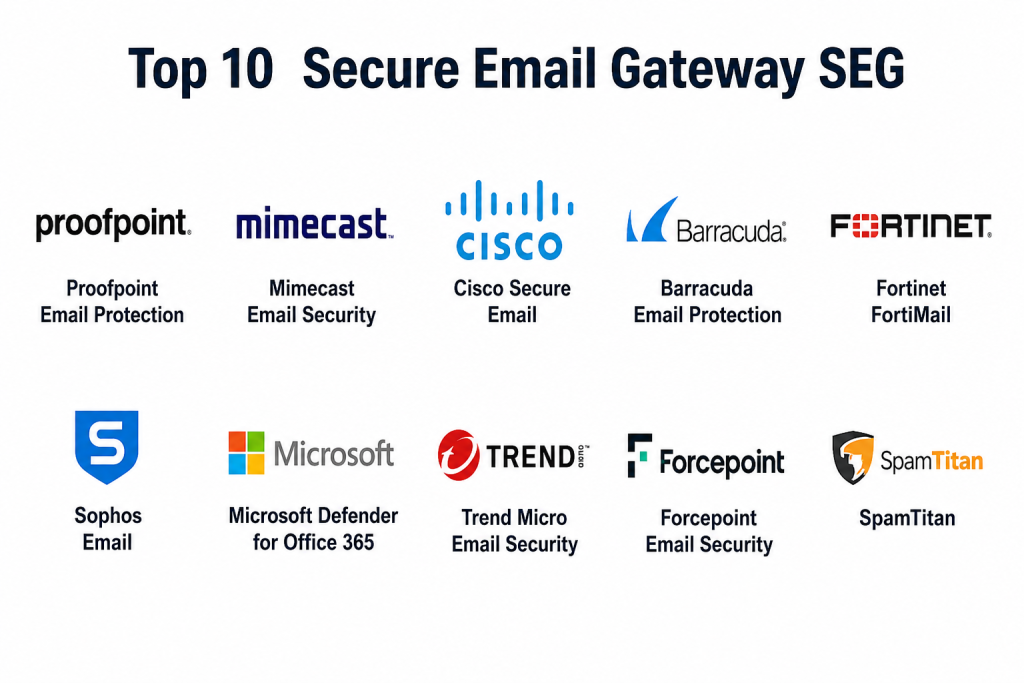
Top 10 Secure Email Gateway SEG Tools
#1 — Proofpoint Email Protection
Short description: Proofpoint Email Protection is an enterprise-grade secure email gateway platform designed to block spam, phishing, malware, credential theft, malicious URLs, attachment-based threats, and business email compromise. It is widely used by large organizations and regulated businesses that need advanced email threat protection and strong policy control. Proofpoint combines detection, threat intelligence, sandboxing, URL defense, impersonation protection, DLP options, and reporting. It is best for enterprises with high email risk and mature security operations.
Key Features
- Advanced spam, phishing, and malware protection.
- URL defense and time-of-click link protection.
- Attachment analysis and sandboxing capabilities.
- Impersonation and business email compromise protection.
- Email fraud and spoofing controls.
- DLP and encryption options depending on package.
- Reporting and investigation workflows for security teams.
Pros
- Strong enterprise reputation for email security.
- Good fit for organizations facing targeted phishing attacks.
- Rich policy controls and threat visibility.
- Useful for regulated and security-sensitive environments.
Cons
- May be costly for smaller teams.
- Implementation and tuning can require security expertise.
- Package selection can affect available capabilities.
- False positive management still requires admin attention.
Platforms / Deployment
Cloud / Secure email gateway / Microsoft 365 / Google Workspace / Exchange / Hybrid mail environments.
Security & Compliance
Security capabilities may include URL protection, attachment sandboxing, anti-phishing, anti-malware, DLP, encryption, admin controls, audit logs, and reporting depending on plan. Specific certifications should be verified directly. If uncertain, write: Not publicly stated.
Integrations & Ecosystem
Proofpoint fits enterprise security stacks where email protection must connect with compliance, user awareness, incident response, and security operations.
- Microsoft 365
- Google Workspace
- SIEM workflows
- Security awareness training
- DLP and encryption workflows
- Incident response processes
Support & Community
Proofpoint provides enterprise documentation, customer support, professional services, training resources, and threat research. It is best suited for organizations with dedicated IT or security teams.
#2 — Mimecast Email Security
Short description: Mimecast Email Security is a cloud-based secure email gateway platform that protects organizations from spam, phishing, malware, ransomware, malicious URLs, spoofing, and targeted email threats. It is commonly used by SMBs, mid-market companies, enterprises, and MSP-managed environments. Mimecast also offers email continuity, archiving, impersonation protection, user quarantine controls, and policy management depending on package. It is best for organizations that want strong gateway protection with email resilience and management features.
Key Features
- Spam filtering and malware scanning.
- URL protection and attachment analysis.
- Impersonation and spoofing protection.
- Quarantine management and user controls.
- Email continuity and archiving options.
- Inbound and outbound email policy enforcement.
- Support for Microsoft 365, Google Workspace, and hybrid environments.
Pros
- Strong balance of security, continuity, and email management.
- Good fit for mid-market and enterprise organizations.
- Useful quarantine and admin controls.
- MSP-friendly and cloud-focused deployment model.
Cons
- Policy configuration requires careful setup.
- Advanced protection may require additional modules.
- User quarantine experience must be managed properly.
- Some organizations may need extra API-based post-delivery security.
Platforms / Deployment
Cloud / Secure email gateway / Microsoft 365 / Google Workspace / Exchange / Hybrid mail systems.
Security & Compliance
Security capabilities may include anti-spam, anti-phishing, anti-malware, URL protection, attachment controls, email continuity, archiving, encryption, admin controls, and reporting depending on package. Specific certifications should be verified directly. If uncertain, write: Not publicly stated.
Integrations & Ecosystem
Mimecast fits organizations that want email security, continuity, archiving, and compliance-oriented controls in one platform.
- Microsoft 365
- Google Workspace
- Exchange environments
- Archiving workflows
- Email continuity programs
- Security reporting workflows
Support & Community
Mimecast provides documentation, customer support, training, and partner resources. It is a practical option for IT teams and MSPs managing business email security.
#3 — Microsoft Defender for Office 365
Short description: Microsoft Defender for Office 365 protects Microsoft 365 email and collaboration environments from spam, phishing, malicious URLs, risky attachments, impersonation, and business email compromise. It is not a traditional third-party gateway in every deployment, but it is often used as a secure email protection layer for Microsoft-first organizations. Defender integrates closely with Exchange Online, Microsoft 365, Microsoft Defender XDR, and Microsoft security workflows. It is best for organizations standardized on Microsoft 365.
Key Features
- Anti-spam, anti-phishing, and anti-malware protection.
- Safe Links and Safe Attachments depending on plan.
- Impersonation and spoofing protection.
- Automated investigation and response depending on plan.
- Threat Explorer and reporting workflows depending on license.
- Strong integration with Microsoft security ecosystem.
- Protection across email and collaboration tools.
Pros
- Native fit for Microsoft 365 environments.
- Strong integration with Microsoft security tools.
- Useful for reducing third-party routing complexity.
- Good visibility across email, identities, and collaboration activity.
Cons
- Best value depends on Microsoft licensing.
- Advanced features may require higher-tier plans.
- Policy configuration can be complex.
- Non-Microsoft environments may need other tools.
Platforms / Deployment
Cloud / Microsoft 365 / Exchange Online / Microsoft security ecosystem.
Security & Compliance
Security capabilities may include anti-phishing, anti-spam, Safe Links, Safe Attachments, spoof protection, audit logs, RBAC, reporting, and automated response depending on plan. Specific certifications should be verified directly. If uncertain, write: Not publicly stated.
Integrations & Ecosystem
Microsoft Defender for Office 365 works best for organizations already using Microsoft identity, collaboration, and security platforms.
- Microsoft 365
- Exchange Online
- Microsoft Defender XDR
- Microsoft Sentinel workflows
- Teams and collaboration security
- Microsoft Entra ID
Support & Community
Microsoft provides documentation, enterprise support, admin resources, partner services, and a large Microsoft security community. Success depends on proper configuration and ongoing tuning.
#4 — Cisco Secure Email
Short description: Cisco Secure Email is an enterprise email security solution that protects against spam, phishing, malware, ransomware, malicious URLs, business email compromise, and advanced email threats. It supports secure email gateway deployment and cloud email security models depending on environment. Cisco’s email protection benefits from the broader Cisco security ecosystem and threat intelligence. It is best for enterprises and security teams already invested in Cisco security infrastructure.
Key Features
- Spam, phishing, and malware protection.
- URL filtering and attachment analysis.
- Business email compromise and impersonation protection.
- Threat intelligence from Cisco security ecosystem.
- Secure email gateway deployment options.
- Reporting and message tracking workflows.
- Support for cloud and hybrid email environments.
Pros
- Strong enterprise email security capabilities.
- Good fit for Cisco security customers.
- Useful threat intelligence and security ecosystem integration.
- Supports complex mail environments.
Cons
- Can be complex for smaller teams.
- Licensing and deployment model require careful evaluation.
- Advanced features may require additional configuration.
- Admin experience depends on security team maturity.
Platforms / Deployment
Cloud / Secure email gateway / Appliance options may vary / Microsoft 365 / Google Workspace / Hybrid mail environments.
Security & Compliance
Security capabilities may include anti-spam, anti-malware, URL filtering, attachment analysis, impersonation protection, reporting, quarantine controls, and security ecosystem integrations depending on configuration. Specific certifications should be verified directly. If uncertain, write: Not publicly stated.
Integrations & Ecosystem
Cisco Secure Email fits organizations that want email protection connected to broader Cisco security workflows.
- Microsoft 365
- Google Workspace
- Cisco security tools
- SIEM workflows
- Threat intelligence workflows
- Incident response systems
Support & Community
Cisco provides enterprise support, documentation, partner services, and a broad security community. It is well suited for organizations with dedicated security operations teams.
#5 — Barracuda Email Protection
Short description: Barracuda Email Protection provides secure email gateway protection, spam filtering, phishing defense, malware scanning, URL protection, backup, archiving, encryption, and account protection features depending on package. It is popular with SMBs, mid-market organizations, schools, healthcare organizations, and MSPs. Barracuda focuses on practical email security and business continuity for organizations that need strong protection without overly complex enterprise tooling. It is best for teams that want a bundled email protection suite.
Key Features
- Spam, phishing, and malware filtering.
- URL protection and attachment analysis.
- Email backup and recovery options.
- Email encryption and DLP-related options.
- Inbound and outbound mail filtering.
- Quarantine and admin reporting tools.
- MSP-friendly management capabilities.
Pros
- Good fit for SMB and mid-market organizations.
- Useful bundle of security, backup, and encryption features.
- Practical for MSP-managed environments.
- Easier to operate than some enterprise-heavy tools.
Cons
- Advanced features may require specific packages.
- Enterprise-level investigation depth may be more limited.
- Policy tuning is still required.
- Buyers should test phishing and BEC protection carefully.
Platforms / Deployment
Cloud / Secure email gateway / Microsoft 365 / Google Workspace / Hybrid email environments.
Security & Compliance
Security capabilities may include spam filtering, anti-phishing, anti-malware, URL protection, attachment scanning, encryption, backup, DLP-related controls, quarantine, and reporting depending on plan. Specific certifications should be verified directly. If uncertain, write: Not publicly stated.
Integrations & Ecosystem
Barracuda fits business email environments that need security, backup, recovery, and admin-friendly protection.
- Microsoft 365
- Google Workspace
- MSP management workflows
- Email backup systems
- Encryption workflows
- Quarantine management
Support & Community
Barracuda provides documentation, support, partner resources, and MSP ecosystem support. It is best for practical email security operations across SMB and mid-market environments.
#6 — Fortinet FortiMail
Short description: Fortinet FortiMail is a secure email gateway solution designed to protect organizations from spam, phishing, malware, ransomware, impersonation, and email-borne threats. It can be deployed as hardware, virtual, cloud, or hosted options depending on the environment. FortiMail is especially useful for organizations already using Fortinet security products and wanting email security connected to broader network and security operations. It is best for enterprises, government, education, and security teams needing flexible gateway deployment.
Key Features
- Secure email gateway protection for inbound and outbound mail.
- Spam, phishing, and malware filtering.
- Attachment scanning and sandboxing support depending on deployment.
- Impersonation and spoofing protection.
- DLP, encryption, and archiving options depending on configuration.
- Flexible deployment across hardware, virtual, cloud, and hosted models.
- Integration with Fortinet security ecosystem.
Pros
- Flexible deployment options.
- Strong fit for Fortinet security customers.
- Good gateway protection for complex environments.
- Useful for organizations needing appliance or hybrid deployment.
Cons
- Configuration can be complex for smaller teams.
- Best value comes with Fortinet ecosystem alignment.
- Advanced features may require additional Fortinet components.
- Cloud-first teams may compare it with simpler SaaS options.
Platforms / Deployment
Cloud / Hardware appliance / Virtual appliance / Hosted service / Hybrid email environments.
Security & Compliance
Security capabilities may include anti-spam, anti-phishing, anti-malware, sandboxing, DLP, encryption, archiving, impersonation protection, admin controls, and logging depending on deployment. Specific certifications should be verified directly. If uncertain, write: Not publicly stated.
Integrations & Ecosystem
FortiMail fits organizations that want email security connected with network security, sandboxing, firewalls, SIEM, and Fortinet operations.
- Microsoft 365
- Exchange environments
- Fortinet security fabric
- Sandboxing workflows
- SIEM and logging systems
- DLP and encryption workflows
Support & Community
Fortinet provides documentation, enterprise support, partner services, and a large security administrator community. It is strongest for organizations with Fortinet expertise or hybrid security infrastructure.
#7 — Sophos Email
Short description: Sophos Email protects organizations from spam, phishing, malware, ransomware, malicious URLs, impersonation, and suspicious attachments. It is especially useful for SMBs and mid-market organizations already using Sophos Central, Sophos endpoint tools, or Sophos security products. Sophos Email provides policy control, quarantine management, URL protection, attachment analysis, encryption options, and integration with the broader Sophos ecosystem. It is best for businesses that want email protection inside a unified security platform.
Key Features
- Spam, phishing, and malware protection.
- Impersonation and spoofing defense.
- URL protection and attachment scanning.
- Email encryption options depending on plan.
- Quarantine and admin policy controls.
- Integration with Sophos Central.
- Protection for Microsoft 365 and Google Workspace environments.
Pros
- Strong fit for existing Sophos customers.
- Practical for SMB and mid-market teams.
- Easy to manage through Sophos Central.
- Good balance of email security and usability.
Cons
- Large enterprises may need deeper investigation features.
- Advanced capabilities depend on package.
- Buyers should test BEC protection and false positives.
- Best value comes when paired with Sophos ecosystem.
Platforms / Deployment
Cloud / Email security service / Microsoft 365 / Google Workspace / Sophos Central.
Security & Compliance
Security capabilities may include anti-spam, anti-phishing, anti-malware, URL protection, attachment scanning, encryption, quarantine controls, and admin policies depending on plan. Specific certifications should be verified directly. If uncertain, write: Not publicly stated.
Integrations & Ecosystem
Sophos Email fits organizations that use Sophos Central and want email protection connected with endpoint, network, and cloud security.
- Microsoft 365
- Google Workspace
- Sophos Central
- Endpoint security workflows
- Encryption workflows
- Quarantine and reporting tools
Support & Community
Sophos provides documentation, support, partner resources, and a strong SMB and mid-market security community. It is a practical choice for teams already using Sophos tools.
#8 — Trend Micro Email Security
Short description: Trend Micro Email Security protects organizations from spam, phishing, malware, ransomware, credential theft, business email compromise, and malicious URLs. It is available for cloud email environments and can support layered protection for Microsoft 365, Google Workspace, and hybrid email systems. Trend Micro combines email filtering, sandboxing, suspicious URL analysis, impersonation protection, and threat intelligence depending on product configuration. It is best for organizations that want email security connected with broader Trend Micro threat defense.
Key Features
- Spam, phishing, and malware protection.
- URL analysis and time-of-click protection.
- Attachment sandboxing and malware detection.
- Business email compromise and impersonation protection.
- Threat intelligence from Trend Micro ecosystem.
- Inbound and outbound mail filtering.
- Reporting and policy management.
Pros
- Strong email threat protection capabilities.
- Good fit for organizations already using Trend Micro.
- Useful for malware, phishing, and BEC defense.
- Supports cloud and hybrid email protection patterns.
Cons
- Feature availability depends on package and configuration.
- Admins may need time to tune policies and reports.
- Some organizations may require additional mailbox-level remediation tools.
- Buyers should validate integration depth for their mail platform.
Platforms / Deployment
Cloud / Email security service / Gateway options may vary / Microsoft 365 / Google Workspace / Hybrid environments.
Security & Compliance
Security capabilities may include spam filtering, anti-phishing, anti-malware, sandboxing, URL protection, BEC protection, admin controls, and reporting depending on plan. Specific certifications should be verified directly. If uncertain, write: Not publicly stated.
Integrations & Ecosystem
Trend Micro Email Security fits organizations that want email protection connected to endpoint, cloud, and security operations workflows.
- Microsoft 365
- Google Workspace
- Trend Micro security ecosystem
- Sandboxing workflows
- SIEM and incident response systems
- Email policy management
Support & Community
Trend Micro provides support, documentation, partner services, and enterprise security resources. It is best for teams that want email security as part of a broader threat defense program.
#9 — SpamTitan
Short description: SpamTitan is a secure email gateway and spam filtering platform designed for SMBs, MSPs, schools, and organizations that need affordable email protection. It helps block spam, phishing, malware, viruses, and unwanted email while providing quarantine controls and admin reporting. SpamTitan is especially useful for teams that want straightforward email filtering without heavy enterprise complexity. It is best for MSP-managed environments and budget-conscious organizations.
Key Features
- Spam filtering and malware protection.
- Phishing and suspicious message detection.
- Quarantine management for admins and users.
- Policy-based email filtering.
- Reporting and email flow visibility.
- MSP-friendly management options.
- Cloud-based deployment for business email.
Pros
- Good value for SMBs and MSPs.
- Simple spam filtering and quarantine workflows.
- Easier to manage than enterprise-heavy tools.
- Practical for schools, small businesses, and service providers.
Cons
- Advanced BEC and AI-driven detection may be more limited.
- Large enterprises may need deeper investigation workflows.
- Feature depth may not match premium SEG platforms.
- Buyers should test detection performance with real mail flow.
Platforms / Deployment
Cloud / Secure email gateway / Business email systems / MSP-managed environments.
Security & Compliance
Security capabilities may include spam filtering, phishing detection, malware scanning, quarantine controls, admin reporting, and policy settings depending on plan. Specific certifications should be verified directly. If uncertain, write: Not publicly stated.
Integrations & Ecosystem
SpamTitan fits organizations that need affordable and manageable email filtering.
- Microsoft 365
- Google Workspace
- SMB email environments
- MSP tenant management
- Quarantine workflows
- Reporting dashboards
Support & Community
SpamTitan provides documentation, support resources, and MSP-focused assistance. It is strongest for teams that value simplicity, predictable cost, and core spam protection.
#10 — Check Point Harmony Email and Collaboration
Short description: Check Point Harmony Email and Collaboration protects cloud email and collaboration environments from phishing, malware, ransomware, malicious links, impersonation, and file-based threats. It is especially useful for organizations using Microsoft 365 or Google Workspace that want API-based protection layered on top of native email security. While it is not only a traditional gateway, it functions as a cloud email security layer that supports secure email workflows. It is best for cloud-first organizations that need advanced email and collaboration protection.
Key Features
- Phishing, malware, and ransomware protection.
- Malicious URL and attachment protection.
- Business email compromise and impersonation detection.
- API-based protection for cloud email environments.
- Security across email and collaboration tools depending on configuration.
- Automated remediation and threat prevention workflows.
- Integration with Check Point security ecosystem.
Pros
- Strong fit for Microsoft 365 and Google Workspace.
- Useful for cloud-first email protection.
- Protects email and collaboration channels.
- Good option for Check Point security customers.
Cons
- Not a classic MX-based SEG in every deployment.
- Buyers should validate whether API-based deployment fits their architecture.
- Feature packaging may vary.
- Some organizations may still want gateway-level routing controls.
Platforms / Deployment
Cloud / API-based email security / Microsoft 365 / Google Workspace / Collaboration tools.
Security & Compliance
Security capabilities may include anti-phishing, anti-malware, ransomware protection, URL scanning, attachment protection, impersonation detection, automated remediation, and admin controls depending on configuration. Specific certifications should be verified directly. If uncertain, write: Not publicly stated.
Integrations & Ecosystem
Check Point Harmony Email and Collaboration fits businesses that want cloud email security integrated with broader Check Point security operations.
- Microsoft 365
- Google Workspace
- Cloud collaboration tools
- Check Point security ecosystem
- Incident response workflows
- Admin security dashboards
Support & Community
Check Point provides documentation, enterprise support, partner services, and security resources. It is best suited for organizations that want cloud email protection aligned with a broader security program.
Comparison Table
| Tool Name | Best For | Platform Supported | Deployment | Standout Feature | Public Rating |
|---|---|---|---|---|---|
| Proofpoint Email Protection | Enterprise phishing and malware defense | Microsoft 365 / Google Workspace / Exchange | Cloud / Gateway | Advanced URL, attachment, and email fraud protection | N/A |
| Mimecast Email Security | Gateway security plus continuity | Microsoft 365 / Google Workspace / Exchange | Cloud / Gateway | Spam filtering with continuity and archiving options | N/A |
| Microsoft Defender for Office 365 | Microsoft-first email protection | Microsoft 365 / Exchange Online | Cloud | Native Microsoft email and collaboration security | N/A |
| Cisco Secure Email | Enterprise secure email gateway | Microsoft 365 / Google Workspace / Hybrid mail | Cloud / Gateway / Varies | Cisco threat intelligence and email defense | N/A |
| Barracuda Email Protection | SMB and mid-market email security | Microsoft 365 / Google Workspace / Hybrid mail | Cloud / Gateway | Email protection with backup and encryption options | N/A |
| Fortinet FortiMail | Flexible appliance and gateway deployment | Cloud / Hardware / Virtual / Hybrid | Cloud / Appliance / Hybrid | Flexible SEG deployment with Fortinet ecosystem | N/A |
| Sophos Email | Sophos-centered SMB and mid-market teams | Microsoft 365 / Google Workspace | Cloud | Email protection inside Sophos Central | N/A |
| Trend Micro Email Security | Threat defense-focused organizations | Microsoft 365 / Google Workspace / Hybrid mail | Cloud / Gateway / Varies | Sandboxing and threat intelligence-driven email protection | N/A |
| SpamTitan | SMB and MSP spam filtering | Business email / Microsoft 365 / Google Workspace | Cloud / Gateway | Simple and affordable spam filtering | N/A |
| Check Point Harmony Email and Collaboration | Cloud-first email and collaboration protection | Microsoft 365 / Google Workspace | Cloud / API | Email and collaboration threat prevention | N/A |
Evaluation & Scoring of Secure Email Gateway SEG Tools
| Tool Name | Core 25% | Ease 15% | Integrations 15% | Security 10% | Performance 10% | Support 10% | Value 15% | Weighted Total |
|---|---|---|---|---|---|---|---|---|
| Proofpoint Email Protection | 10 | 7 | 9 | 9 | 9 | 9 | 7 | 8.65 |
| Mimecast Email Security | 9 | 8 | 9 | 8 | 8 | 8 | 8 | 8.40 |
| Microsoft Defender for Office 365 | 9 | 8 | 10 | 9 | 9 | 9 | 8 | 8.85 |
| Cisco Secure Email | 9 | 7 | 8 | 9 | 8 | 9 | 7 | 8.10 |
| Barracuda Email Protection | 8 | 8 | 8 | 8 | 8 | 8 | 8 | 8.00 |
| Fortinet FortiMail | 9 | 7 | 8 | 9 | 8 | 8 | 8 | 8.15 |
| Sophos Email | 8 | 8 | 8 | 8 | 8 | 8 | 8 | 8.00 |
| Trend Micro Email Security | 8 | 8 | 8 | 8 | 8 | 8 | 8 | 8.00 |
| SpamTitan | 7 | 8 | 7 | 7 | 8 | 8 | 9 | 7.65 |
| Check Point Harmony Email and Collaboration | 8 | 8 | 8 | 9 | 8 | 8 | 8 | 8.10 |
These scores are comparative and based on Secure Email Gateway SEG fit, not absolute product quality. A higher score means the tool aligns strongly with spam filtering, phishing protection, malware defense, URL protection, attachment analysis, integrations, security controls, admin workflows, and support. Enterprise tools score well for advanced threat protection and investigation depth, while SMB-focused tools score well for simplicity and value. Buyers should adjust the weights based on whether they need classic gateway routing, cloud-native email protection, MSP management, advanced BEC defense, or compliance-focused email controls.
Which Secure Email Gateway SEG Tool Is Right for You?
Solo / Freelancer
Solo users usually do not need a full SEG unless they manage a business domain or client mail environment. Built-in protection from Gmail, Outlook, Microsoft 365, or Google Workspace may be enough for basic use. If you operate a small business domain, start with SPF, DKIM, DMARC, MFA, strong passwords, and built-in spam controls. A third-party SEG becomes more useful when you manage multiple users, sensitive client data, or repeated phishing attempts.
SMB
SMBs should prioritize ease of setup, strong spam filtering, simple quarantine controls, and affordable pricing. Barracuda Email Protection, SpamTitan, Sophos Email, and Mimecast Email Security are practical options depending on budget and admin capacity. Microsoft 365 users should also evaluate Microsoft Defender for Office 365 before adding extra layers. SMBs should avoid overly complex tools if they do not have staff to manage policies and false positives.
Mid-Market
Mid-market organizations often need stronger phishing protection, URL rewriting, attachment sandboxing, user reporting, outbound filtering, and better dashboards. Mimecast, Proofpoint, Microsoft Defender for Office 365, Barracuda, Trend Micro, Sophos, and FortiMail are strong candidates. If the organization already uses Fortinet, Sophos, Cisco, or Microsoft security tools, ecosystem fit may influence the shortlist. Mid-market buyers should test detection accuracy and quarantine experience with real mail traffic.
Enterprise
Enterprises should prioritize advanced phishing defense, malware sandboxing, DLP, encryption, reporting, SIEM integration, incident response, admin roles, and support quality. Proofpoint, Microsoft Defender for Office 365, Cisco Secure Email, Mimecast, Fortinet FortiMail, Trend Micro Email Security, and Check Point Harmony Email and Collaboration are strong options. Enterprises may use layered protection, combining native Microsoft or Google controls with gateway or API-based tools. A production pilot with real mail flow is essential.
Budget vs Premium
Budget-conscious teams should first configure built-in email security correctly, including DNS authentication, quarantine policies, MFA, and user reporting. SpamTitan, Sophos Email, and Barracuda Email Protection can provide practical protection without enterprise-level complexity. Premium tools such as Proofpoint, Mimecast, Cisco, Fortinet, and Check Point are worth evaluating when the organization faces targeted phishing, BEC, compliance pressure, or high-value email risk. Cost should include licenses, admin time, support, false positives, and incident response workload.
Feature Depth vs Ease of Use
For ease of use, Microsoft Defender for Office 365, Google-native filtering with an added SEG, Sophos Email, SpamTitan, and Barracuda can be simpler depending on environment. For feature depth, Proofpoint, Mimecast, Cisco Secure Email, Fortinet FortiMail, and Trend Micro Email Security provide stronger enterprise controls. For cloud-first email and collaboration protection, Check Point Harmony Email and Collaboration is a useful option. The right choice depends on team skill, mail platform, risk level, and compliance needs.
Integrations & Scalability
Integration fit should guide the shortlist. Microsoft-heavy organizations should evaluate Microsoft Defender for Office 365, Proofpoint, Mimecast, and Barracuda. Google Workspace organizations should validate Gmail routing and API support. Fortinet, Cisco, Sophos, Trend Micro, and Check Point customers may benefit from ecosystem alignment. Scalability should include mail volume, number of domains, quarantine volume, admin workflows, SIEM integration, user reporting, and incident response.
Security & Compliance Needs
Security-sensitive organizations should prioritize anti-phishing, anti-spoofing, attachment sandboxing, URL rewriting, DLP, encryption, outbound filtering, audit logs, admin roles, reporting, and incident search. Regulated industries should also consider archiving, retention, legal hold, encryption, policy evidence, and compliance reporting. No SEG should be treated as perfect, so it should be combined with MFA, user awareness, email authentication, endpoint protection, and incident response playbooks.
Frequently Asked Questions
1. What is a Secure Email Gateway SEG?
A Secure Email Gateway SEG is a security tool that filters email before it reaches users’ inboxes or before outbound messages leave the organization. It blocks spam, phishing, malware, malicious URLs, risky attachments, spoofing, and policy violations. Some SEGs are cloud-based, while others use virtual or physical appliances. The goal is to reduce email-based cyber risk and protect users from harmful messages.
2. How does a Secure Email Gateway work?
A Secure Email Gateway usually scans messages using sender reputation, content analysis, attachment inspection, URL filtering, malware detection, email authentication, and policy rules. Many tools also use threat intelligence, sandboxing, and machine learning. Suspicious emails can be blocked, quarantined, tagged, rewritten, or delivered with warnings. Outbound filtering can also detect compromised accounts, spam abuse, or sensitive data leakage.
3. Is an SEG still needed with Microsoft 365 or Google Workspace?
Microsoft 365 and Google Workspace include built-in email protection, but some organizations still add an SEG for stronger filtering, advanced phishing defense, compliance controls, continuity, archiving, or layered protection. Whether an SEG is needed depends on risk level, industry, security maturity, and admin requirements. Microsoft-first organizations may start with Defender for Office 365. High-risk teams often evaluate third-party gateways or API-based tools as an additional layer.
4. What is the difference between an SEG and API-based email security?
An SEG typically filters email through mail routing before delivery, often using MX record changes or gateway routing. API-based email security connects directly to cloud mailboxes and scans messages after or during delivery using mailbox APIs. SEGs are strong for pre-delivery filtering, while API-based tools can be strong for post-delivery remediation and behavior-based detection. Many organizations use both approaches for layered protection.
5. What features should a good SEG include?
A good SEG should include spam filtering, phishing protection, malware scanning, URL rewriting, attachment sandboxing, spoofing protection, quarantine management, reporting, and policy controls. Advanced tools may also include DLP, encryption, impersonation defense, user reporting, outbound filtering, and automated remediation. Microsoft 365 and Google Workspace integration is also important for most modern organizations. Buyers should test false positives before rollout.
6. Can Secure Email Gateways stop all phishing attacks?
No Secure Email Gateway can stop every phishing attack. Attackers constantly change domains, wording, attachments, sender identities, QR codes, and social engineering tactics. A strong SEG reduces risk significantly, but it should be combined with MFA, user training, DMARC, endpoint security, passwordless authentication, and incident response. User reporting and fast remediation are also important when threats slip through.
7. How are Secure Email Gateway tools priced?
Pricing varies by vendor, mailbox count, user count, deployment model, features, support level, and add-on modules. Advanced features such as sandboxing, DLP, encryption, archiving, continuity, and AI-based BEC protection may cost extra. SMB-focused tools are usually simpler and more affordable, while enterprise tools may use custom pricing. Buyers should compare total cost, including admin time and support workload.
8. What are common mistakes when implementing an SEG?
A common mistake is routing all mail through a new gateway without testing false positives, quarantine workflows, and business-critical senders. Another mistake is ignoring SPF, DKIM, DMARC, and domain reputation. Some teams also forget outbound filtering and user reporting. Successful implementation includes a pilot, DNS validation, staged policy rollout, admin training, quarantine review, and regular tuning.
9. What integrations should buyers look for?
Important integrations include Microsoft 365, Google Workspace, Exchange, SIEM tools, XDR platforms, security awareness training, phishing report buttons, DLP systems, encryption tools, archiving systems, and ticketing workflows. MSPs should look for multi-tenant management. Enterprises should prioritize APIs, audit logs, automated remediation, and incident response workflows. Integration quality can strongly affect both security and admin productivity.
10. What is the best Secure Email Gateway overall?
There is no single best Secure Email Gateway for every organization. Proofpoint is strong for enterprise email security, Mimecast is strong for gateway protection plus continuity, Microsoft Defender for Office 365 is ideal for Microsoft-first environments, Cisco Secure Email and Fortinet FortiMail fit security ecosystem-driven enterprises, and Barracuda, Sophos Email, and SpamTitan are practical for SMB and MSP use cases. The best choice depends on email platform, threat profile, budget, admin skill, compliance needs, and desired deployment model.
Conclusion
Secure Email Gateway SEG Tools are essential for protecting organizations from spam, phishing, malware, spoofing, malicious links, risky attachments, ransomware, and business email compromise. The right platform depends on your email environment and risk level: Proofpoint and Mimecast are strong enterprise options, Microsoft Defender for Office 365 is ideal for Microsoft-centered teams, Cisco Secure Email and Fortinet FortiMail fit larger security ecosystems, while Barracuda, Sophos Email, Trend Micro Email Security, SpamTitan, and Check Point Harmony Email and Collaboration serve different SMB, mid-market, enterprise, and cloud-first needs. Buyers should avoid choosing only by brand name and should test real mail flow, false positives, quarantine usability, URL protection, attachment analysis, reporting, support, and integration depth. Start with your current email platform, shortlist two or three tools, run a pilot with real users and real mail patterns, tune policies carefully, then scale once security and productivity are both validated.

This article clearly explains secure email gateway tools and how they help organizations protect against phishing, spam, and other email-based security threats.
This article clearly explains secure email gateway tools and how they help organizations protect email communication from spam, phishing, and other cyber threats.
Email security is strongest when paired with user awareness and incident response processes. Even advanced gateways can’t eliminate risks from evolving social engineering tactics.