Introduction
IoT Device Management Platforms help organizations deploy, monitor, secure, update, and manage connected devices at scale. These platforms provide centralized visibility and control over IoT ecosystems, including sensors, gateways, industrial equipment, smart devices, and edge infrastructure. As businesses adopt connected technologies across manufacturing, healthcare, logistics, retail, and smart buildings, managing thousands of distributed devices efficiently has become a critical operational requirement.
Real-world use cases include remote firmware updates, device provisioning, real-time monitoring, predictive maintenance, fleet management, industrial automation, and security compliance. Organizations also rely on these platforms for analytics, telemetry collection, and integration with cloud infrastructure and enterprise systems. Buyers evaluating IoT management platforms should consider scalability, device provisioning, security controls, OTA update capabilities, edge management, analytics, automation, integrations, protocol support, and deployment flexibility.
Evaluation Criteria for Buyers: Device onboarding, OTA firmware updates, protocol support, analytics dashboards, edge device management, scalability, automation, security compliance, integration ecosystem, and monitoring capabilities.
Best for: Enterprises, manufacturers, logistics providers, smart city projects, healthcare organizations, utilities, and businesses managing connected device fleets.
Not ideal for: Small organizations with minimal IoT infrastructure, businesses using standalone unmanaged devices, or teams without centralized IT/OT management.
Key Trends in IoT Device Management Platforms
- AI-driven predictive maintenance and anomaly detection
- Edge computing integration for real-time processing
- Automated OTA firmware updates and patching
- Cloud-native IoT management architectures
- Digital twin technology for device simulation and monitoring
- Enhanced security and zero-trust IoT frameworks
- Multi-cloud and hybrid deployment flexibility
- Real-time telemetry analytics dashboards
- Support for industrial IoT and smart manufacturing
- Integration with enterprise analytics and automation platforms
How We Selected These Tools
- Evaluated market adoption and enterprise recognition
- Assessed feature completeness for provisioning, monitoring, and updates
- Reviewed scalability for large IoT deployments
- Verified security and compliance capabilities
- Evaluated analytics and telemetry management features
- Assessed protocol and device compatibility
- Considered cloud, edge, and hybrid deployment support
- Reviewed integration ecosystems and APIs
- Evaluated automation and AI-assisted management capabilities
- Assessed vendor support, documentation, and enterprise readiness
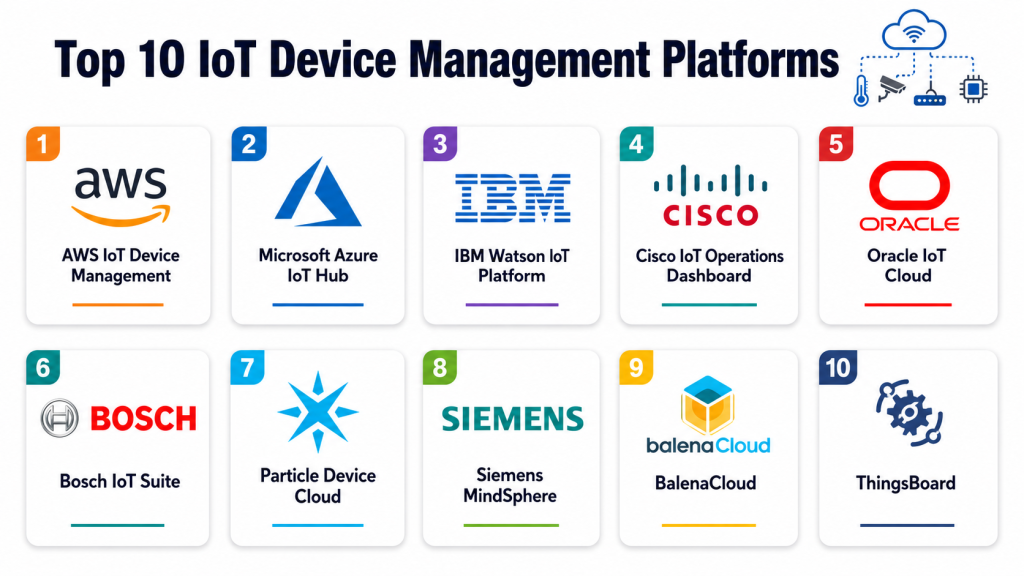
Top 10 IoT Device Management Platforms
#1 — AWS IoT Device Management
Short description: AWS IoT Device Management provides secure onboarding, monitoring, and remote management for large-scale IoT fleets integrated with the AWS cloud ecosystem.
Key Features
- Secure device onboarding and provisioning
- OTA firmware updates
- Fleet indexing and device grouping
- Real-time monitoring and telemetry
- Integration with AWS analytics services
- Device shadow synchronization
- Role-based access and security policies
Pros
- Highly scalable cloud infrastructure
- Deep AWS ecosystem integration
- Strong analytics and automation capabilities
- Enterprise-grade security controls
Cons
- Complex for beginners
- AWS ecosystem dependency
- Pricing can increase with scale
- Requires cloud expertise
Platforms / Deployment
Web / Linux / Windows
Cloud
Security & Compliance
- SSO, MFA, RBAC, encryption
- SOC 2, ISO 27001, GDPR
Integrations & Ecosystem
AWS IoT integrates deeply with analytics, machine learning, storage, and automation services for enterprise IoT deployments.
- AWS Lambda
- Amazon S3
- Amazon SageMaker
- API integrations
- Edge services
Support & Community
Extensive documentation, enterprise support plans, and large developer ecosystem.
#2 — Microsoft Azure IoT Hub
Short description: Azure IoT Hub enables secure IoT device communication, monitoring, provisioning, and lifecycle management across enterprise environments.
Key Features
- Device provisioning services
- Real-time telemetry monitoring
- OTA updates and configuration management
- Edge device support
- AI and analytics integration
- Security and access policies
- Device twin management
Pros
- Strong enterprise integrations
- Excellent hybrid cloud support
- Scalable architecture
- Advanced analytics capabilities
Cons
- Complex initial configuration
- Enterprise pricing structure
- Requires Azure expertise
- Advanced monitoring setup may take time
Platforms / Deployment
Web / Windows / Linux
Cloud / Hybrid
Security & Compliance
- MFA, RBAC, encryption
- SOC 2, ISO 27001, GDPR
Integrations & Ecosystem
Azure IoT integrates with analytics, AI, enterprise applications, and edge computing services.
- Azure AI services
- Power BI
- Azure Digital Twins
- Microsoft Defender
- API integrations
Support & Community
Enterprise support, documentation, certifications, and active developer community.
#3 — IBM Watson IoT Platform
Short description: IBM Watson IoT Platform provides industrial IoT device management, analytics, and AI-powered monitoring for enterprise environments.
Key Features
- Device connectivity and management
- AI-powered analytics
- Real-time telemetry monitoring
- Industrial IoT support
- OTA firmware management
- Edge computing integration
- Device lifecycle management
Pros
- Strong industrial IoT capabilities
- AI-assisted analytics
- Enterprise scalability
- Advanced telemetry management
Cons
- Enterprise-focused pricing
- Complex deployment
- Learning curve for advanced analytics
- Smaller ecosystem than AWS or Azure
Platforms / Deployment
Web / Linux / Windows
Cloud / Hybrid
Security & Compliance
- RBAC, encryption, MFA
- ISO 27001, GDPR
Integrations & Ecosystem
IBM Watson IoT integrates with enterprise analytics, AI, and industrial systems for advanced monitoring.
- IBM Cloud
- Watson AI services
- Industrial systems
- API integrations
Support & Community
Documentation, enterprise onboarding, and support resources.
#4 — Cisco IoT Operations Dashboard
Short description: Cisco IoT Operations Dashboard helps enterprises monitor, secure, and manage connected devices across industrial and enterprise IoT networks.
Key Features
- Centralized device visibility
- Network and device monitoring
- Security and policy enforcement
- Edge management capabilities
- Remote troubleshooting
- Analytics dashboards
- Device provisioning tools
Pros
- Strong networking expertise
- Enterprise-grade scalability
- Integrated security features
- Industrial IoT support
Cons
- Cisco ecosystem dependency
- Advanced features require expertise
- Premium enterprise pricing
- Complex configuration workflows
Platforms / Deployment
Web / Linux / Windows
Cloud / Hybrid
Security & Compliance
- SSO, RBAC, encryption
- SOC 2, ISO 27001
Integrations & Ecosystem
Cisco integrates IoT operations with networking, security, and analytics ecosystems.
- Cisco SecureX
- Cisco networking tools
- API integrations
- Edge infrastructure
Support & Community
Enterprise support, certifications, documentation, and partner ecosystem.
#5 — Oracle IoT Cloud
Short description: Oracle IoT Cloud offers device monitoring, predictive analytics, and enterprise integration capabilities for connected environments.
Key Features
- Device connectivity management
- Real-time telemetry analytics
- Predictive maintenance tools
- Enterprise workflow integration
- Device monitoring dashboards
- Event-driven automation
- Security policy management
Pros
- Strong enterprise integration
- Advanced analytics capabilities
- Scalable cloud infrastructure
- Predictive maintenance support
Cons
- Higher enterprise pricing
- Complex deployment process
- Smaller developer ecosystem
- Advanced customization requires expertise
Platforms / Deployment
Web / Linux / Windows
Cloud
Security & Compliance
- MFA, encryption, RBAC
- SOC 2, GDPR
Integrations & Ecosystem
Oracle IoT Cloud integrates with enterprise ERP, analytics, and automation ecosystems.
- Oracle ERP
- Oracle Analytics
- API integrations
- Enterprise workflow systems
Support & Community
Documentation, onboarding services, and enterprise support.
#6 — Bosch IoT Suite
Short description: Bosch IoT Suite provides industrial IoT device management, connectivity, and analytics for smart manufacturing and enterprise environments.
Key Features
- Device provisioning and onboarding
- OTA firmware updates
- Industrial IoT monitoring
- Edge computing support
- Analytics dashboards
- Security and access policies
- Device lifecycle management
Pros
- Strong industrial IoT focus
- Reliable edge management
- Advanced analytics support
- Scalable infrastructure
Cons
- Enterprise-oriented pricing
- Complex onboarding
- Limited SMB focus
- Smaller ecosystem compared to hyperscalers
Platforms / Deployment
Web / Linux / Windows
Cloud / Hybrid
Security & Compliance
- RBAC, encryption
- GDPR
Integrations & Ecosystem
Bosch IoT Suite integrates with manufacturing systems and enterprise analytics platforms.
- ERP integrations
- Industrial automation systems
- API access
- Edge infrastructure
Support & Community
Enterprise documentation, support services, and onboarding assistance.
#7 — Particle Device Cloud
Short description: Particle Device Cloud simplifies IoT device deployment, firmware updates, and monitoring for connected product teams and enterprises.
Key Features
- Secure device onboarding
- OTA firmware updates
- Real-time device monitoring
- Device fleet management
- Event-driven automation
- Analytics dashboards
- Developer APIs and SDKs
Pros
- Developer-friendly platform
- Simplified deployment workflows
- Fast onboarding
- Strong OTA capabilities
Cons
- Less enterprise-focused than AWS or Azure
- Limited advanced analytics
- Smaller ecosystem
- Industrial support limited
Platforms / Deployment
Web / Linux / Windows
Cloud
Security & Compliance
- Encryption, RBAC
- Not publicly stated
Integrations & Ecosystem
Particle integrates with developer and cloud platforms for connected product workflows.
- Webhooks
- Cloud APIs
- Automation platforms
- Developer SDKs
Support & Community
Developer documentation, tutorials, and support resources.
#8 — Siemens MindSphere
Short description: Siemens MindSphere provides industrial IoT management with analytics, monitoring, and automation for manufacturing and industrial operations.
Key Features
- Industrial asset monitoring
- Device lifecycle management
- Predictive maintenance analytics
- Edge computing support
- Device telemetry collection
- Analytics dashboards
- Integration with industrial systems
Pros
- Strong manufacturing focus
- Advanced predictive analytics
- Industrial automation integration
- Scalable industrial infrastructure
Cons
- Enterprise pricing
- Industrial-specific focus
- Complex onboarding
- Requires technical expertise
Platforms / Deployment
Web / Linux / Windows
Cloud / Hybrid
Security & Compliance
- Encryption, RBAC
- ISO 27001
Integrations & Ecosystem
MindSphere integrates with industrial systems, analytics platforms, and enterprise automation tools.
- Siemens industrial systems
- ERP platforms
- API integrations
- Edge devices
Support & Community
Enterprise onboarding, documentation, and industrial support services.
#9 — BalenaCloud
Short description: BalenaCloud provides container-based IoT fleet management for edge devices and connected infrastructure deployments.
Key Features
- Containerized device management
- Remote device updates
- Edge deployment automation
- Fleet monitoring dashboards
- Device provisioning
- Remote troubleshooting
- Developer APIs
Pros
- Excellent for edge computing
- Developer-friendly workflows
- Lightweight deployment model
- Strong container support
Cons
- Enterprise analytics limited
- Smaller ecosystem
- Industrial integrations less mature
- Requires DevOps expertise
Platforms / Deployment
Web / Linux
Cloud
Security & Compliance
- Encryption, RBAC
- Not publicly stated
Integrations & Ecosystem
BalenaCloud integrates with containerized workflows and developer infrastructure.
- Docker
- GitHub
- CI/CD systems
- API integrations
Support & Community
Developer community, tutorials, and support documentation.
#10 — ThingsBoard
Short description: ThingsBoard is an open-source IoT platform offering device management, telemetry monitoring, and analytics for connected environments.
Key Features
- Device provisioning and monitoring
- Real-time telemetry dashboards
- Rule engine automation
- OTA firmware support
- Multi-tenant architecture
- Analytics and reporting
- Open-source extensibility
Pros
- Open-source flexibility
- Affordable deployment model
- Strong telemetry dashboards
- Customizable workflows
Cons
- Requires self-hosting expertise
- Enterprise support limited
- Advanced scaling requires configuration
- UI less polished than enterprise tools
Platforms / Deployment
Web / Linux / Windows
Cloud / Self-hosted
Security & Compliance
- RBAC, encryption
- Not publicly stated
Integrations & Ecosystem
ThingsBoard integrates with IoT protocols, analytics systems, and cloud infrastructure.
- MQTT
- REST APIs
- Kafka
- Cloud integrations
Support & Community
Open-source community, documentation, and enterprise support options.
Comparison Table
| Tool Name | Best For | Platform Supported | Deployment | Standout Feature | Public Rating |
|---|---|---|---|---|---|
| AWS IoT Device Management | Enterprise cloud IoT | Web / Linux / Windows | Cloud | Deep AWS integration | N/A |
| Azure IoT Hub | Enterprise hybrid IoT | Web / Linux / Windows | Cloud / Hybrid | Device twin management | N/A |
| IBM Watson IoT | Industrial analytics | Web / Linux / Windows | Cloud / Hybrid | AI-powered telemetry analytics | N/A |
| Cisco IoT Operations Dashboard | Enterprise networking IoT | Web / Linux / Windows | Cloud / Hybrid | Integrated networking visibility | N/A |
| Oracle IoT Cloud | Enterprise workflows | Web / Linux / Windows | Cloud | Predictive maintenance | N/A |
| Bosch IoT Suite | Industrial IoT | Web / Linux / Windows | Cloud / Hybrid | Industrial device management | N/A |
| Particle Device Cloud | Connected products | Web / Linux / Windows | Cloud | Developer-friendly deployment | N/A |
| Siemens MindSphere | Smart manufacturing | Web / Linux / Windows | Cloud / Hybrid | Industrial analytics | N/A |
| BalenaCloud | Edge computing | Web / Linux | Cloud | Containerized edge deployment | N/A |
| ThingsBoard | Open-source IoT | Web / Linux / Windows | Cloud / Self-hosted | Open-source telemetry platform | N/A |
Evaluation & Scoring
| Tool Name | Core 25% | Ease 15% | Integrations 15% | Security 10% | Performance 10% | Support 10% | Value 15% | Weighted Total |
|---|---|---|---|---|---|---|---|---|
| AWS IoT Device Management | 9.5 | 7.5 | 9.5 | 9 | 9 | 8.5 | 7.5 | 8.8 |
| Azure IoT Hub | 9 | 7.5 | 9 | 9 | 8.5 | 8 | 7.5 | 8.5 |
| IBM Watson IoT | 8.5 | 7 | 8 | 8.5 | 8 | 7.5 | 7 | 8.0 |
| Cisco IoT Dashboard | 8.5 | 7 | 8 | 8.5 | 8 | 7.5 | 7 | 7.9 |
| Oracle IoT Cloud | 8 | 7 | 8 | 8 | 8 | 7.5 | 7 | 7.8 |
| Bosch IoT Suite | 8 | 7 | 7.5 | 8 | 8 | 7.5 | 7 | 7.7 |
| Particle Device Cloud | 7.5 | 8.5 | 7 | 7 | 7.5 | 7.5 | 8 | 7.7 |
| Siemens MindSphere | 8.5 | 6.5 | 7.5 | 8 | 8 | 7.5 | 7 | 7.8 |
| BalenaCloud | 7.5 | 8 | 7 | 7 | 7.5 | 7 | 8 | 7.5 |
| ThingsBoard | 7.5 | 7 | 7.5 | 7 | 7 | 6.5 | 8.5 | 7.4 |
The scoring reflects comparative performance across enterprise scalability, analytics depth, automation, integrations, and operational usability. Higher scores generally indicate stronger enterprise readiness and ecosystem maturity, while mid-range scores may represent easier deployment or cost efficiency. Organizations should prioritize tools that align with their deployment architecture, IoT scale, and security requirements.
Which IoT Device Management Platform Is Right for You?
Solo / Freelancer
ThingsBoard or BalenaCloud are suitable for smaller deployments, prototypes, and developer-focused edge projects with flexible deployment options.
SMB
Particle Device Cloud and BalenaCloud provide simpler onboarding, cloud management, and developer-friendly workflows for growing connected environments.
Mid-Market
Oracle IoT Cloud, Bosch IoT Suite, and Cisco IoT Dashboard support larger IoT environments with analytics, monitoring, and automation.
Enterprise
AWS IoT Device Management, Azure IoT Hub, IBM Watson IoT, and Siemens MindSphere deliver enterprise-grade scalability, security, and advanced telemetry analytics.
Budget vs Premium
Open-source and developer-focused platforms reduce deployment costs, while hyperscale enterprise solutions provide stronger automation, AI, and compliance capabilities.
Feature Depth vs Ease of Use
AWS and Azure provide extensive functionality but require cloud expertise, whereas Particle and BalenaCloud focus on simplified deployment experiences.
Integrations & Scalability
Enterprises needing ERP, AI, analytics, and industrial integrations should prioritize platforms with strong ecosystem support and API flexibility.
Security & Compliance Needs
Organizations managing sensitive industrial or customer data should prioritize platforms offering encryption, RBAC, MFA, compliance reporting, and secure OTA updates.
Frequently Asked Questions
1. What is an IoT Device Management Platform?
It is a centralized platform used to deploy, monitor, secure, and manage connected IoT devices throughout their lifecycle.
2. Why are these platforms important?
They simplify large-scale device operations, automate updates, improve visibility, and strengthen security across distributed IoT environments.
3. What is OTA firmware management?
OTA stands for over-the-air updates, allowing organizations to remotely patch and update IoT devices without physical access.
4. Can these platforms manage edge devices?
Yes, many modern platforms support edge computing environments and remote device orchestration.
5. Which industries use IoT management platforms most?
Manufacturing, logistics, healthcare, utilities, retail, automotive, and smart city projects are major adopters.
6. Are cloud deployments common?
Yes, most IoT management platforms are cloud-native to support scalability, remote monitoring, and analytics processing.
7. What protocols do these platforms support?
Common protocols include MQTT, HTTP, CoAP, AMQP, SNMP, and industrial IoT communication standards.
8. How do these platforms improve security?
They enforce secure onboarding, encryption, RBAC, OTA patching, compliance policies, and anomaly monitoring.
9. Are open-source options available?
Yes, platforms like ThingsBoard provide open-source IoT management capabilities with customizable deployment models.
10. What should organizations evaluate before selecting a platform?
Businesses should assess scalability, security, analytics, OTA capabilities, protocol support, integrations, deployment flexibility, and operational complexity.
Conclusion
IoT Device Management Platforms have become essential for organizations operating connected ecosystems across industrial, enterprise, and consumer environments. SMBs and developer-focused teams may benefit from lightweight platforms like Particle Device Cloud or BalenaCloud, while larger enterprises often require AWS IoT Device Management, Azure IoT Hub, or IBM Watson IoT for advanced scalability, analytics, and compliance capabilities. Industrial organizations can leverage Siemens MindSphere or Bosch IoT Suite for manufacturing-focused monitoring and automation. The ideal platform depends on deployment scale, device diversity, analytics requirements, and operational complexity. Before committing to a platform, organizations should evaluate integration requirements, test OTA workflows, validate security controls, and conduct pilot deployments to ensure long-term operational efficiency and scalability.

This article gives a very clear and practical overview of IoT device management platforms with well-structured comparisons and useful insights. The simple explanations made it easier to understand how each platform supports connected device management at scale.
A topic that often gets overlooked in IoT device management discussions is device retirement and technical debt management. Most platforms are evaluated on onboarding, monitoring, and OTA capabilities, but large-scale deployments eventually accumulate aging hardware, unsupported firmware branches, expired certificates, and inconsistent configurations. The operational burden of managing these legacy devices can become significant over time. A useful evaluation criterion would be how well each platform supports automated lifecycle governance—certificate rotation, end-of-life policies, device quarantine, hardware replacement workflows, and auditability of historical device state. For organizations managing tens of thousands of devices, long-term fleet hygiene can have a greater impact on security, reliability, and operational cost than the initial provisioning experience.
Managing IoT devices at scale is often less about onboarding new devices and more about handling the exceptions that occur over time. Hardware failures, connectivity issues, configuration drift, and ownership changes can create significant operational overhead in large deployments. Sharing insights on automated remediation, lifecycle governance, and fleet-wide compliance monitoring would help readers evaluate how well these platforms support long-term operational stability rather than just initial device management.
IoT device management platforms become significantly more valuable when they can automate operations across highly diverse device fleets rather than treating every endpoint the same. In real-world deployments, organizations often manage devices with different hardware capabilities, connectivity methods, and operating lifecycles. Covering policy-based automation, fleet segmentation, remote diagnostics, and digital twin support would give readers a better understanding of how these platforms simplify large-scale device administration while reducing operational overhead.