Introduction
Mining Operations Management Software helps mining companies manage production planning, fleet operations, maintenance, safety compliance, workforce coordination, and asset monitoring across mining sites. These platforms are used in surface mining, underground mining, quarrying, and mineral processing environments to improve operational efficiency and reduce downtime.
Modern mining environments are becoming increasingly data-driven, with organizations investing in automation, predictive maintenance, AI analytics, IoT sensors, and real-time operational visibility. Mining companies now require centralized platforms capable of connecting equipment telemetry, maintenance workflows, production data, environmental monitoring, and workforce management into a single operational ecosystem.
Real-world use cases include:
- Monitoring haul trucks, drills, and heavy mining equipment
- Production planning and ore tracking
- Predictive maintenance and equipment health monitoring
- Workforce scheduling and safety compliance
- Fleet dispatch and real-time operational visibility
Evaluation criteria for buyers:
- Fleet and asset management capabilities
- Real-time operational monitoring
- Predictive maintenance functionality
- GIS and mapping support
- IoT and telemetry integrations
- Scalability across mining sites
- Mobile and offline capabilities
- Security and compliance controls
- Reporting and analytics depth
- ERP and industrial integration support
Best for: Large mining enterprises, mineral extraction companies, open-pit and underground mining operators, EPC firms, and industrial operations teams requiring centralized operational visibility and automation.
Not ideal for: Small extraction operations with limited digital maturity, organizations needing only basic maintenance tracking, or companies with minimal fleet and production management requirements.
Key Trends in Mining Operations Management Software
- AI-powered predictive maintenance is reducing equipment downtime and operational interruptions.
- Autonomous haulage systems and fleet automation are becoming more common in large mining environments.
- Real-time telemetry and IoT sensor integration are improving asset visibility and operational intelligence.
- Digital twin technology is increasingly used for mine planning and equipment monitoring.
- Cloud-native mining platforms are replacing isolated on-premise operational systems.
- ESG and environmental reporting capabilities are becoming core platform requirements.
- Drone-based inspections and aerial mapping integrations are expanding rapidly.
- Edge computing adoption is improving performance in remote mining environments.
- Workforce safety analytics and wearable technology integrations are gaining traction.
- Integrated production planning and maintenance management workflows are improving operational coordination.
How We Selected These Tools
The platforms in this list were selected based on practical operational and enterprise evaluation criteria:
- Strong market adoption in mining and heavy industrial sectors
- Proven reliability in large-scale mining operations
- Asset and fleet management depth
- Integration support for ERP, IoT, SCADA, and telemetry systems
- Production planning and operational analytics capabilities
- Mobile workforce and offline functionality
- Security and governance capabilities
- AI and predictive analytics innovation
- Scalability across geographically distributed sites
- Vendor ecosystem maturity and industrial specialization
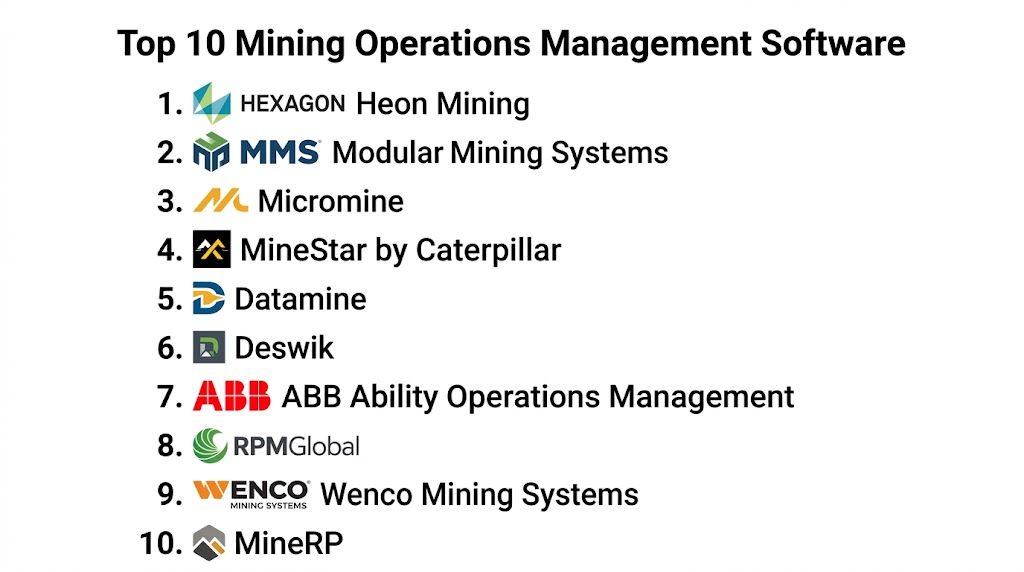
Top 10 Mining Operations Management Software
1- Hexagon Mining
Short description: Hexagon Mining is one of the most recognized mining operations platforms for fleet management, mine planning, safety monitoring, and operational intelligence. The platform supports both surface and underground mining environments and is widely used by large mining enterprises. Its strong automation and operational analytics capabilities make it a preferred choice for data-driven mining operations.
Key Features
- Fleet management and dispatch optimization
- Real-time operational analytics
- Collision avoidance systems
- Mine planning and scheduling
- Asset tracking and monitoring
- Underground mining support
- Safety and operator monitoring
Pros
- Strong mining industry specialization
- Advanced operational visibility
- Excellent fleet optimization tools
- Good scalability for enterprise deployments
Cons
- Premium pricing for advanced modules
- Complex implementation process
- Requires operational training
- Smaller operations may find it excessive
Platforms / Deployment
- Web / Windows / Android
- Cloud / Hybrid
Security & Compliance
- RBAC
- Encryption
- Audit logging
- SSO capabilities
Integrations & Ecosystem
Hexagon Mining integrates with industrial mining systems, GIS platforms, telemetry infrastructure, and ERP environments to improve operational coordination.
- ERP integrations
- GIS systems
- IoT sensors
- Fleet telemetry
- API support
- Industrial analytics tools
Support & Community
Strong enterprise support network with specialized mining implementation expertise and training programs.
2- Modular Mining
Short description: Modular Mining provides fleet management, dispatching, machine guidance, and operational analytics solutions for mining operations. The platform is widely deployed in large-scale surface mining environments and is known for its real-time operational intelligence and equipment productivity optimization.
Key Features
- Fleet dispatch optimization
- Real-time machine monitoring
- Equipment productivity analytics
- Mine production tracking
- Machine guidance systems
- Predictive maintenance insights
- Shift performance analytics
Pros
- Strong fleet management functionality
- Mature mining analytics tools
- Excellent operational visibility
- Proven enterprise-scale deployments
Cons
- Interface complexity for new users
- Higher implementation costs
- Requires technical onboarding
- Some modules may require customization
Platforms / Deployment
- Web / Windows
- Cloud / Hybrid
Security & Compliance
- RBAC
- Encryption
- Audit capabilities
- SSO support
Integrations & Ecosystem
Modular Mining supports integration with ERP systems, telemetry infrastructure, and industrial operational platforms.
- ERP systems
- Fleet telemetry
- Industrial APIs
- GIS integrations
- Maintenance systems
Support & Community
Well-established mining support organization with enterprise implementation and consulting services.
3- ABB Ability MineOptimize
Short description: ABB Ability MineOptimize combines mine electrification, process automation, operational analytics, and asset management into a unified mining operations platform. The solution is designed for large mining organizations seeking automation, sustainability tracking, and operational optimization.
Key Features
- Process automation
- Operational analytics
- Asset performance monitoring
- Mine electrification support
- Remote operations capabilities
- Predictive maintenance
- Sustainability reporting
Pros
- Strong automation expertise
- Good industrial integration capabilities
- Advanced operational analytics
- Sustainability-focused functionality
Cons
- Enterprise-focused pricing
- Complex deployments
- Best suited for larger mining environments
- May require ABB ecosystem alignment
Platforms / Deployment
- Web / Windows
- Cloud / Hybrid
Security & Compliance
- RBAC
- Encryption
- SSO
- Audit logging
Integrations & Ecosystem
ABB integrates with industrial automation infrastructure, SCADA systems, ERP platforms, and IoT environments.
- SCADA systems
- ERP integrations
- IoT infrastructure
- Industrial automation tools
- Analytics platforms
Support & Community
Strong enterprise support with industrial automation expertise and global consulting capabilities.
4- Datamine
Short description: Datamine provides mining software solutions focused on geology, planning, production management, and operational optimization. The platform supports end-to-end mine lifecycle management for both underground and surface mining operations.
Key Features
- Mine planning tools
- Geological modeling
- Production management
- Ore tracking
- Equipment monitoring
- Scheduling workflows
- Operational reporting
Pros
- Strong geological and planning capabilities
- Broad mining lifecycle coverage
- Good analytics functionality
- Flexible operational workflows
Cons
- Some modules require specialist training
- User interface may feel technical
- Enterprise deployments can be complex
- Pricing visibility limited
Platforms / Deployment
- Windows / Web
- Cloud / Hybrid
Security & Compliance
- RBAC
- Encryption
- Audit controls
Integrations & Ecosystem
Datamine integrates with geological systems, production planning tools, ERP environments, and reporting platforms.
- Geological databases
- ERP integrations
- GIS systems
- Reporting tools
- APIs
Support & Community
Strong mining-focused support with training resources and consulting services.
5- SAP S/4HANA for Mining
Short description: SAP S/4HANA for Mining extends SAP’s enterprise operational platform into mining-specific workflows, including asset management, procurement, workforce operations, maintenance, and supply chain coordination. Large mining enterprises often deploy it as a centralized operational backbone.
Key Features
- Enterprise asset management
- Maintenance planning
- Workforce management
- Supply chain coordination
- Production tracking
- Procurement workflows
- Operational analytics
Pros
- Deep enterprise integration capabilities
- Strong governance and compliance support
- Mature scalability
- Broad operational coverage
Cons
- Complex implementation
- High total cost of ownership
- Requires SAP expertise
- Less flexible for smaller organizations
Platforms / Deployment
- Web / Windows
- Cloud / Hybrid
Security & Compliance
- SSO
- MFA
- RBAC
- Encryption
- Audit logging
Integrations & Ecosystem
SAP integrates with industrial systems, maintenance tools, operational analytics, and ERP environments.
- SAP ERP
- GIS platforms
- IoT infrastructure
- Analytics systems
- APIs
- Industrial integrations
Support & Community
Extensive enterprise support ecosystem with global implementation partners and training resources.
6- Micromine
Short description: Micromine is widely used for geological modeling, mine planning, operational management, and resource estimation. The platform supports exploration teams, mine planners, and production managers seeking integrated operational visibility.
Key Features
- Geological modeling
- Resource estimation
- Mine design and planning
- Operational analytics
- Production tracking
- Reporting dashboards
- Scheduling support
Pros
- Strong geology-focused workflows
- Good visualization capabilities
- Flexible planning functionality
- Suitable for various mining operations
Cons
- Some advanced modules require training
- Less enterprise-focused than SAP or ABB
- Limited broader ERP ecosystem
- Smaller community compared to larger vendors
Platforms / Deployment
- Windows
- Cloud / Hybrid
Security & Compliance
- RBAC
- Encryption
- Not publicly stated for additional certifications
Integrations & Ecosystem
Micromine supports integration with geological systems, operational databases, and reporting environments.
- Geological databases
- GIS integrations
- APIs
- Reporting systems
- Planning tools
Support & Community
Mining-focused support structure with strong technical training programs.
7- MineRP
Short description: MineRP provides integrated operational intelligence, asset management, and data visualization solutions for mining operations. The platform focuses heavily on connecting siloed mining systems into a unified operational environment.
Key Features
- Operational data integration
- Asset performance management
- Real-time monitoring
- Production analytics
- Workflow automation
- Reporting dashboards
- Centralized operational visibility
Pros
- Strong data integration capabilities
- Good operational dashboards
- Useful centralized visibility
- Flexible industrial connectivity
Cons
- Smaller ecosystem than SAP or Hexagon
- Implementation may require customization
- Limited brand recognition outside mining
- Advanced analytics require configuration
Platforms / Deployment
- Web / Windows
- Cloud / Hybrid
Security & Compliance
- RBAC
- Encryption
- Audit logging
Integrations & Ecosystem
MineRP integrates with ERP systems, telemetry infrastructure, maintenance tools, and operational databases.
- ERP systems
- SCADA systems
- Industrial databases
- APIs
- Analytics platforms
Support & Community
Mining-specialized support with implementation consulting and operational onboarding.
8- Wenco Mining Systems
Short description: Wenco Mining Systems specializes in fleet management, machine guidance, and operational optimization for mining operations. The platform is designed to improve productivity, equipment coordination, and operational efficiency in surface mining environments.
Key Features
- Fleet management
- Machine guidance
- Dispatch optimization
- Operational analytics
- Asset monitoring
- Real-time productivity tracking
- Equipment performance reporting
Pros
- Strong fleet management tools
- Good mining operational focus
- Reliable dispatch functionality
- Useful real-time analytics
Cons
- Less broad ERP functionality
- Smaller ecosystem
- Advanced customization may require consulting
- Limited non-mining applicability
Platforms / Deployment
- Windows / Web
- Cloud / Hybrid
Security & Compliance
- RBAC
- Encryption
- SSO support
Integrations & Ecosystem
Wenco integrates with mining telemetry systems, fleet infrastructure, and industrial operational platforms.
- Fleet telemetry
- APIs
- ERP integrations
- Reporting systems
- Operational databases
Support & Community
Focused mining support services with operational consulting expertise.
9- Trimble Mine Management
Short description: Trimble Mine Management delivers operational visibility, fleet management, and machine control solutions for mining environments. The platform emphasizes productivity optimization and operational efficiency through connected mining technologies.
Key Features
- Machine control systems
- Fleet optimization
- Operational analytics
- GPS and positioning support
- Productivity monitoring
- Reporting dashboards
- Equipment visibility
Pros
- Strong positioning and GPS expertise
- Good operational monitoring tools
- Useful productivity analytics
- Mature industrial technology ecosystem
Cons
- Mining planning depth may vary
- Complex deployments for large sites
- Some modules require specialized expertise
- Premium pricing for advanced capabilities
Platforms / Deployment
- Web / Windows
- Cloud / Hybrid
Security & Compliance
- Encryption
- RBAC
- Audit capabilities
Integrations & Ecosystem
Trimble integrates with positioning technologies, operational systems, ERP environments, and analytics platforms.
- GPS systems
- ERP integrations
- APIs
- Fleet systems
- Analytics tools
Support & Community
Strong industrial support organization with global mining implementation experience.
10- RPMGlobal
Short description: RPMGlobal provides mining software for planning, scheduling, maintenance, simulation, and operational analytics. The platform supports both strategic mine planning and day-to-day operational management across mining operations.
Key Features
- Mine scheduling
- Asset maintenance management
- Production simulation
- Workforce planning
- Operational analytics
- Budget forecasting
- Equipment management
Pros
- Broad mining operational coverage
- Strong planning and simulation tools
- Good maintenance workflows
- Useful operational forecasting
Cons
- User interface can feel technical
- Advanced modules require training
- Enterprise deployments may be resource-intensive
- Limited SMB suitability
Platforms / Deployment
- Windows / Web
- Cloud / Hybrid
Security & Compliance
- RBAC
- Encryption
- Audit logging
Integrations & Ecosystem
RPMGlobal integrates with operational planning systems, ERP tools, maintenance software, and industrial databases.
- ERP systems
- Planning platforms
- APIs
- Maintenance tools
- Analytics systems
Support & Community
Mining-focused support ecosystem with implementation guidance and training resources.
Comparison Table
| Tool Name | Best For | Platform(s) Supported | Deployment | Standout Feature | Public Rating |
|---|---|---|---|---|---|
| Hexagon Mining | Enterprise mining operations | Web, Windows, Android | Cloud, Hybrid | Fleet optimization | N/A |
| Modular Mining | Surface mining fleets | Web, Windows | Cloud, Hybrid | Real-time dispatching | N/A |
| ABB Ability MineOptimize | Industrial automation | Web, Windows | Cloud, Hybrid | Process automation | N/A |
| Datamine | Geological planning | Windows, Web | Cloud, Hybrid | Mine lifecycle management | N/A |
| SAP S/4HANA for Mining | Enterprise mining ERP | Web, Windows | Cloud, Hybrid | Enterprise integration | N/A |
| Micromine | Geological modeling | Windows | Cloud, Hybrid | Resource estimation | N/A |
| MineRP | Operational intelligence | Web, Windows | Cloud, Hybrid | Data integration | N/A |
| Wenco Mining Systems | Fleet operations | Windows, Web | Cloud, Hybrid | Dispatch optimization | N/A |
| Trimble Mine Management | Connected mining operations | Web, Windows | Cloud, Hybrid | GPS and positioning | N/A |
| RPMGlobal | Mine planning and maintenance | Windows, Web | Cloud, Hybrid | Simulation and forecasting | N/A |
Evaluation & Scoring of Mining Operations Management Software
| Tool Name | Core | Ease | Integrations | Security | Performance | Support | Value | Weighted Total |
|---|---|---|---|---|---|---|---|---|
| Hexagon Mining | 9.5 | 7.9 | 9.2 | 8.9 | 9.3 | 8.8 | 7.8 | 8.84 |
| Modular Mining | 9.2 | 7.8 | 8.8 | 8.7 | 9.1 | 8.6 | 7.9 | 8.61 |
| ABB Ability MineOptimize | 9.0 | 7.5 | 8.9 | 8.8 | 9.0 | 8.5 | 7.7 | 8.49 |
| Datamine | 8.7 | 7.9 | 8.3 | 8.2 | 8.5 | 8.4 | 8.0 | 8.28 |
| SAP S/4HANA for Mining | 9.4 | 7.1 | 9.5 | 9.3 | 9.1 | 8.9 | 7.2 | 8.73 |
| Micromine | 8.4 | 8.1 | 7.8 | 7.9 | 8.4 | 8.2 | 8.3 | 8.14 |
| MineRP | 8.5 | 7.7 | 8.6 | 8.1 | 8.4 | 8.0 | 8.1 | 8.20 |
| Wenco Mining Systems | 8.8 | 7.8 | 8.4 | 8.2 | 8.7 | 8.3 | 8.0 | 8.38 |
| Trimble Mine Management | 8.7 | 7.9 | 8.5 | 8.3 | 8.6 | 8.4 | 7.9 | 8.37 |
| RPMGlobal | 8.9 | 7.6 | 8.4 | 8.3 | 8.8 | 8.5 | 7.8 | 8.40 |
These scores are comparative and intended to help buyers evaluate relative strengths across the mining operations software landscape. Enterprise-focused platforms typically score higher in integrations, scalability, and operational depth, while specialized tools may perform better in usability or niche mining workflows. Organizations should prioritize criteria based on operational complexity, infrastructure maturity, and production requirements.
Which Mining Operations Management Software Tool Is Right for You?
Solo / Freelancer
Smaller mining contractors and independent operational consultants may benefit from simpler operational platforms such as Micromine or Datamine due to easier deployment and focused planning functionality.
SMB
Small and mid-sized mining organizations often require a balance between operational depth and deployment simplicity. RPMGlobal, Datamine, and MineRP provide strong mining functionality without the broader complexity of enterprise ERP ecosystems.
Mid-Market
Mid-market mining operators needing integrated production management, maintenance workflows, and fleet visibility should evaluate Wenco Mining Systems, Modular Mining, and Trimble Mine Management.
Enterprise
Large mining enterprises typically require enterprise-grade scalability, operational automation, and centralized visibility. Hexagon Mining, SAP S/4HANA for Mining, and ABB Ability MineOptimize are strong choices for complex mining environments.
Budget vs Premium
Budget-conscious organizations should prioritize deployment speed, usability, and operational fit rather than maximum feature breadth. Premium enterprise platforms deliver stronger analytics, integrations, and automation but involve higher implementation and operational costs.
Feature Depth vs Ease of Use
Highly advanced platforms often require training and operational onboarding. Simpler tools improve adoption speed but may lack advanced analytics, automation, and operational intelligence functionality.
Integrations & Scalability
Organizations already operating ERP, telemetry, IoT, or industrial automation systems should prioritize platforms with mature integration ecosystems and API capabilities.
Security & Compliance Needs
Mining companies handling sensitive operational data and industrial infrastructure should prioritize platforms with strong RBAC, encryption, audit logging, and centralized governance capabilities.
Frequently Asked Questions
1. What is Mining Operations Management Software?
Mining Operations Management Software helps mining companies manage production, maintenance, workforce operations, fleet coordination, safety monitoring, and operational analytics across mining environments. These platforms centralize operational visibility and improve efficiency across mining workflows.
2. Why is real-time operational visibility important in mining?
Real-time operational monitoring helps organizations improve productivity, reduce downtime, optimize fleet performance, and respond quickly to operational issues. Visibility into equipment status and workforce activity improves overall operational coordination.
3. How does predictive maintenance help mining operations?
Predictive maintenance identifies potential equipment failures before breakdowns occur. This reduces downtime, improves asset utilization, lowers repair costs, and helps mining organizations maintain production targets more consistently.
4. Are these platforms suitable for underground mining?
Yes. Many platforms support both underground and surface mining environments. Features such as telemetry integration, equipment monitoring, workforce tracking, and operational analytics are commonly adapted for underground mining requirements.
5. What integrations are most important for mining companies?
Key integrations include ERP systems, SCADA platforms, telemetry infrastructure, GIS tools, fleet systems, IoT sensors, and operational analytics platforms. Integration maturity significantly impacts operational efficiency.
6. Is cloud deployment common in mining software?
Cloud adoption is growing rapidly because it improves scalability, remote accessibility, and centralized data management. However, hybrid deployments remain common in mining environments with remote operational constraints.
7. What are the biggest implementation challenges?
Common challenges include integrating legacy systems, workforce training, operational process redesign, and connectivity limitations at remote mining sites. Large deployments often require phased implementation strategies.
8. How important are mobile capabilities?
Mobile functionality is essential for operational teams working in the field. Offline mobile access allows personnel to access inspections, maintenance workflows, and operational data in environments with limited connectivity.
9. Are AI features becoming standard in mining platforms?
Yes. AI capabilities are increasingly used for predictive maintenance, operational analytics, production forecasting, and fleet optimization. These technologies help improve operational efficiency and reduce downtime.
10. How should buyers shortlist mining software vendors?
Organizations should evaluate operational fit, integration capabilities, scalability, deployment complexity, workforce usability, vendor support quality, and long-term operational requirements before selecting a platform.
Conclusion
Mining Operations Management Software has become a critical technology layer for modern mining organizations seeking better operational visibility, equipment reliability, production efficiency, and workforce coordination. Enterprise-grade platforms such as Hexagon Mining, SAP S/4HANA for Mining, and ABB Ability MineOptimize deliver strong scalability, automation, and industrial integration capabilities for complex mining environments. Mid-market organizations may find stronger operational flexibility and deployment efficiency with platforms such as RPMGlobal, Datamine, or MineRP. The best solution depends heavily on mining scale, operational complexity, fleet requirements, integration needs, and digital maturity. Rather than focusing only on feature lists, organizations should shortlist a few suitable platforms, validate operational workflows through pilot programs, evaluate integration and security requirements carefully, and measure workforce adoption before scaling deployments across mining operations.

Excellent comparison of mining operations management software—really helpful for understanding how these platforms improve operational control, safety, and resource management in mining industries.
Mining operations management software delivers the greatest business value when it connects planning with real-time execution across the entire mining lifecycle. Production targets can quickly become outdated due to equipment failures, changing ore grades, weather conditions, or workforce constraints. Including insights on dynamic production optimization, digital twin capabilities, sustainability reporting, and AI-driven operational decision support would give readers a more comprehensive understanding of how these platforms improve productivity, resource utilization, and operational resilience in modern mining environments.
Mining operations software has to cope with conditions that can change significantly during a shift, so planning data alone is rarely enough for effective operational control. Connecting dispatch, equipment health, production targets, maintenance schedules, workforce activity, and site conditions can help teams understand why planned output differs from actual performance. Historical operational data can also reveal recurring bottlenecks, equipment-related delays, and areas where maintenance timing affects production. Another useful capability is scenario planning, allowing supervisors to test how a breakdown, weather disruption, haul-route change, or workforce constraint could affect the rest of the operation. That moves the platform beyond reporting and toward practical day-to-day decision support.