Introduction
Cap Table Management Tools are software platforms that help companies track ownership, equity distribution, investors, and stock options in a structured and accurate way. Instead of relying on spreadsheets, businesses use these tools to manage complex ownership structures, funding rounds, and employee equity.
As startups scale and funding structures become more complex, managing equity manually becomes risky and inefficient. These tools provide clarity, automation, and compliance support, making them essential for modern businesses dealing with investors and employee stock programs.
Real-world use cases include:
- Managing equity during fundraising rounds
- Issuing and tracking employee stock options
- Preparing reports for investors and stakeholders
- Running dilution and exit scenario analysis
- Ensuring compliance with legal requirements
What buyers should evaluate:
- Ease of use and onboarding
- Equity modeling and scenario capabilities
- Security and access control
- Compliance and audit readiness
- Integration with finance and HR tools
- Reporting and analytics features
- Scalability for future growth
- Pricing flexibility
Best for: Startup founders, CFOs, finance teams, legal advisors, and investors managing ownership structures.
Not ideal for: Very small businesses with no external investors or equity distribution where simple tracking methods may be sufficient.
Key Trends in Cap Table Management Tools
- AI-driven equity modeling for better decision-making
- Automation of compliance and reporting workflows
- Integrated fundraising and investor management features
- Real-time collaboration across stakeholders
- Improved employee equity visibility dashboards
- API-first platforms for integration flexibility
- Enhanced data security with granular access controls
- Scenario simulation for funding and exit planning
- Growing focus on global compliance requirements
- Flexible pricing models for startups and enterprises
How We Selected These Tools
- Evaluated market adoption and industry recognition
- Assessed feature depth for equity and cap table management
- Considered ease of use and onboarding experience
- Reviewed security and compliance capabilities
- Checked integration flexibility and ecosystem strength
- Analyzed scalability across different business stages
- Considered support quality and documentation
- Evaluated overall value for money
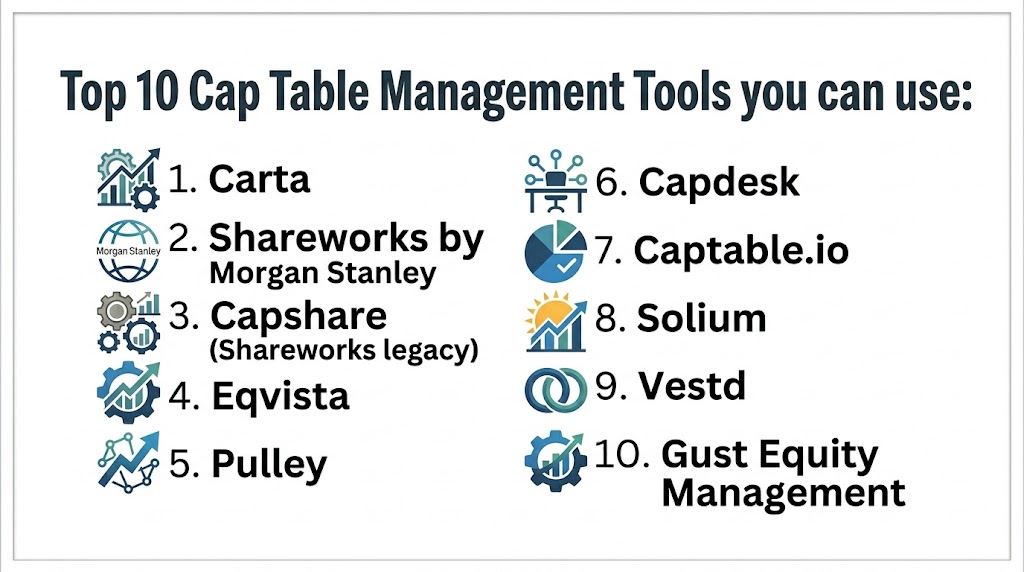
Top 10 Cap Table Management Tools Tools
#1 — Carta
Short description: Carta is a leading cap table platform used by startups and enterprises to manage equity, investors, and valuations. It provides strong automation and reporting capabilities for complex ownership structures.
Key Features
- Cap table automation
- Equity issuance and tracking
- Valuation support
- Scenario modeling
- Investor reporting dashboards
- Employee stock option management
- Compliance tools
Pros
- Industry-leading platform
- Strong ecosystem and integrations
- Advanced analytics and modeling
Cons
- Higher pricing
- Complex for beginners
- Learning curve
Platforms / Deployment
- Web
- Cloud
Security & Compliance
- SSO, MFA, encryption, audit logs
- SOC 2 widely reported
Integrations & Ecosystem
Integrates with HR, finance, and legal tools.
- HR platforms
- Accounting systems
- Legal tools
Support & Community
Strong documentation and enterprise-grade support.
#2 — Pulley
Short description: Pulley is a modern cap table tool designed for startups. It focuses on simplicity, clean design, and strong modeling features for growing companies.
Key Features
- Cap table tracking
- Scenario modeling
- Employee equity management
- Fundraising support
- Compliance workflows
Pros
- Easy to use
- Startup-friendly pricing
- Fast onboarding
Cons
- Limited enterprise features
- Smaller ecosystem
- Fewer integrations
Platforms / Deployment
- Web
- Cloud
Security & Compliance
- MFA, encryption
- Not publicly stated
Integrations & Ecosystem
Supports API-based integrations.
- Finance systems
- HR tools
- API access
Support & Community
Responsive support with growing adoption.
#3 — Shareworks by Morgan Stanley
Short description: Shareworks is an enterprise-grade platform for managing global equity plans and compliance. It is suitable for organizations with complex ownership structures.
Key Features
- Global equity management
- Cap table tracking
- Compliance automation
- Employee dashboards
- Reporting tools
Pros
- Strong enterprise capabilities
- Global compliance support
- Scalable
Cons
- Complex setup
- High cost
- Not beginner-friendly
Platforms / Deployment
- Web
- Cloud
Security & Compliance
- Enterprise-level controls
- Not publicly stated
Integrations & Ecosystem
Integrates with HR and payroll systems.
- HR tools
- Payroll systems
Support & Community
Enterprise-level onboarding and support.
#4 — Ledgy
Short description: Ledgy is a cap table platform designed for startups and scaleups with a strong focus on automation, compliance, and ease of use.
Key Features
- Cap table management
- Employee stock option tracking
- Scenario modeling
- Compliance workflows
- Investor dashboards
Pros
- Clean interface
- Strong compliance features
- Automation capabilities
Cons
- Limited enterprise features
- Smaller ecosystem
- Regional focus
Platforms / Deployment
- Web
- Cloud
Security & Compliance
- Encryption and access controls
- GDPR aligned
Integrations & Ecosystem
Offers integrations with finance tools.
- HR systems
- Accounting tools
- API access
Support & Community
Good onboarding and support.
#5 — Eqvista
Short description: Eqvista is a budget-friendly cap table solution for startups and small businesses. It offers essential equity management features with simple onboarding.
Key Features
- Cap table tracking
- Equity issuance
- Valuation support
- Scenario modeling
- Reporting tools
Pros
- Affordable
- Easy setup
- Simple interface
Cons
- Limited advanced features
- Basic integrations
- Not for large enterprises
Platforms / Deployment
- Web
- Cloud
Security & Compliance
- Not publicly stated
Integrations & Ecosystem
Limited integrations available.
- Accounting tools
- Export options
Support & Community
Basic support and documentation.
#6 — Capdesk
Short description: Capdesk focuses on simplifying equity management and improving employee engagement with transparent ownership dashboards.
Key Features
- Cap table tracking
- Employee dashboards
- Reporting tools
- Scenario modeling
- Compliance tools
Pros
- User-friendly
- Good employee experience
- Easy onboarding
Cons
- Limited advanced features
- Smaller ecosystem
- Fewer integrations
Platforms / Deployment
- Web
- Cloud
Security & Compliance
- Not publicly stated
Integrations & Ecosystem
Supports HR and finance integrations.
- HR tools
- API access
Support & Community
Reliable support and onboarding.
#7 — Shareworks Startup
Short description: Shareworks Startup provides essential equity management features for early-stage companies with a scalable foundation.
Key Features
- Cap table management
- Equity issuance
- Reporting tools
- Compliance support
Pros
- Reliable platform
- Scalable
- Backed by enterprise system
Cons
- Limited features
- UI improvements needed
- Pricing unclear
Platforms / Deployment
- Web
- Cloud
Security & Compliance
- Enterprise-level practices
- Not publicly stated
Integrations & Ecosystem
Integrates with HR and payroll systems.
- HR platforms
- Payroll systems
Support & Community
Stable support structure.
#8 — Gust Equity Management
Short description: Gust offers cap table and fundraising tools tailored for startups and angel investors with simple workflows.
Key Features
- Cap table tracking
- Investor management
- Fundraising tools
- Document storage
Pros
- Easy to use
- Good for fundraising
- Cost-effective
Cons
- Limited modeling features
- Basic reporting
- Not enterprise-ready
Platforms / Deployment
- Web
- Cloud
Security & Compliance
- Not publicly stated
Integrations & Ecosystem
Focused on investor workflows.
- Investor tools
- API access
Support & Community
Startup-focused support.
#9 — Vestd
Short description: Vestd is designed for managing share schemes and employee ownership with strong compliance support and ease of use.
Key Features
- Share scheme management
- Cap table tracking
- Compliance automation
- Employee dashboards
Pros
- Strong compliance
- Easy to use
- Employee-focused
Cons
- Limited scalability
- Region-specific features
- Smaller ecosystem
Platforms / Deployment
- Web
- Cloud
Security & Compliance
- GDPR aligned
- Not publicly stated
Integrations & Ecosystem
Integrates with HR and finance tools.
- HR systems
- Accounting tools
Support & Community
Reliable onboarding and support.
#10 — Qapita
Short description: Qapita is a modern platform for managing equity and employee stock options with flexibility and scalability for growing companies.
Key Features
- Cap table management
- Employee stock option tracking
- Scenario modeling
- Compliance tools
- Investor reporting
Pros
- Modern interface
- Flexible features
- Scalable
Cons
- Limited global presence
- Smaller ecosystem
- Fewer integrations
Platforms / Deployment
- Web
- Cloud
Security & Compliance
- Not publicly stated
Integrations & Ecosystem
Offers API integrations with finance systems.
- Finance tools
- API integrations
Support & Community
Growing support ecosystem.
Comparison Table Top 10
| Tool Name | Best For | Platform Supported | Deployment | Standout Feature | Public Rating |
|---|---|---|---|---|---|
| Carta | Scaling startups | Web | Cloud | Advanced modeling | N/A |
| Pulley | Early-stage startups | Web | Cloud | Ease of use | N/A |
| Shareworks | Enterprises | Web | Cloud | Global compliance | N/A |
| Ledgy | Growing startups | Web | Cloud | Automation | N/A |
| Eqvista | Budget users | Web | Cloud | Low cost | N/A |
| Capdesk | Employee equity | Web | Cloud | User experience | N/A |
| Shareworks Startup | Startups | Web | Cloud | Scalability | N/A |
| Gust | Fundraising startups | Web | Cloud | Investor tools | N/A |
| Vestd | Small businesses | Web | Cloud | Share schemes | N/A |
| Qapita | Growth companies | Web | Cloud | Flexibility | N/A |
Evaluation & Scoring of Cap Table Management Tools
| Tool Name | Core | Ease | Integrations | Security | Performance | Support | Value | Weighted Total |
|---|---|---|---|---|---|---|---|---|
| Carta | 9 | 7 | 9 | 9 | 9 | 8 | 7 | 8.4 |
| Pulley | 7 | 9 | 6 | 7 | 8 | 7 | 9 | 7.8 |
| Shareworks | 9 | 6 | 8 | 9 | 9 | 9 | 6 | 8.3 |
| Ledgy | 8 | 8 | 7 | 8 | 8 | 7 | 8 | 7.9 |
| Eqvista | 6 | 8 | 5 | 6 | 7 | 6 | 9 | 7.0 |
| Capdesk | 7 | 8 | 6 | 7 | 7 | 7 | 7 | 7.2 |
| Shareworks Startup | 7 | 7 | 7 | 8 | 8 | 7 | 7 | 7.4 |
| Gust | 6 | 8 | 5 | 6 | 7 | 6 | 8 | 6.9 |
| Vestd | 7 | 8 | 6 | 7 | 7 | 7 | 7 | 7.3 |
| Qapita | 8 | 8 | 6 | 7 | 8 | 7 | 8 | 7.7 |
Scoring is comparative and helps evaluate tools across multiple dimensions. Higher scores indicate stronger alignment with business needs, but the right choice depends on your specific use case and growth stage.
Which Cap Table Management Tool Is Right for You
Solo / Freelancer
Eqvista or Gust are simple and cost-effective choices.
SMB
Pulley and Ledgy offer strong usability and balanced features.
Mid Market
Carta and Qapita provide scalability and modeling.
Enterprise
Shareworks is best for compliance-heavy environments.
Budget vs Premium
Budget option is Eqvista, premium option is Carta.
Feature Depth vs Ease of Use
Carta for depth, Pulley for simplicity.
Integrations & Scalability
Carta and Shareworks are strong choices.
Security & Compliance Needs
Enterprise tools provide stronger compliance.
Frequently Asked Questions
1. What is a cap table
A cap table is a structured record of company ownership that shows shareholders, equity percentages, and changes over time. It helps track dilution and ownership accurately. Businesses use it to manage investor stakes and employee equity.
2. Why should I use cap table software
Cap table software reduces manual errors and simplifies equity management. It improves transparency and ensures accurate tracking of ownership. It also helps with compliance and investor reporting.
3. How much do these tools cost
Pricing depends on company size and features required. Some tools offer free or low-cost plans for startups, while enterprise platforms have higher pricing tiers. Costs generally scale with complexity.
4. Can I switch between tools later
Yes, switching is possible but may require careful data migration. The complexity depends on how detailed your cap table is. Planning ahead can reduce migration challenges.
5. Are these tools secure
Most platforms provide encryption and access control features to protect sensitive data. Some include audit logs and role-based access. Security levels vary across tools.
6. Do these tools support employee stock options
Yes, most cap table tools include features for managing employee stock options. They help track grants, vesting schedules, and ownership changes. This is essential for growing companies.
7. How long does implementation take
Implementation can take a few days for simple setups and longer for complex structures. It depends on data accuracy and company size. Most tools provide onboarding assistance.
8. Do they integrate with other systems
Many tools integrate with HR, accounting, and legal systems. Some offer APIs for custom integrations. Integration capability is important for scaling businesses.
9. What are common mistakes in cap table management
Common mistakes include relying on spreadsheets too long and failing to update ownership data. Poor documentation and lack of compliance tracking can also create issues.
10. Are there free cap table tools available
Some platforms offer free tiers or trial versions for startups. These usually include limited features. As companies grow, paid plans become necessary for advanced capabilities.
Conclusion
Cap table management tools have become essential for companies managing equity, investors, and ownership complexity. They replace error-prone spreadsheets with structured systems that improve accuracy and transparency. From simple tools like Eqvista to advanced platforms like Carta and Shareworks, each solution serves different business needs. The right choice depends on company size, funding stage, and compliance requirements rather than a single best option. Startups should focus on ease of use and affordability, while larger organizations should prioritize scalability and integrations. It is always recommended to shortlist a few tools and test them before making a final decision. A pilot approach helps validate usability and compatibility with existing systems.

A useful consideration is how well these tools handle future growth and ownership changes. As companies add investors, employees, and funding rounds, having accurate and easily accessible equity records becomes increasingly important.