Introduction
Order Management Systems OMS are software solutions that help businesses track, manage, and fulfill customer orders across multiple sales channels. From order placement to delivery and returns, OMS ensures that every step of the order lifecycle is handled efficiently and accurately.
With the rise of eCommerce, omnichannel retail, and global supply chains, managing orders manually is no longer practical. OMS tools provide real-time visibility into inventory, streamline order processing, and improve customer satisfaction by ensuring timely and accurate deliveries. They also connect various systems like inventory, warehouse, and shipping to create a unified workflow.
Common use cases include:
- Managing orders from multiple sales channels
- Tracking inventory and order status in real time
- Automating order fulfillment and shipping
- Handling returns and exchanges
- Improving customer experience with accurate delivery updates
Key evaluation criteria:
- Order processing and tracking capabilities
- Inventory visibility and synchronization
- Integration with eCommerce platforms and ERP
- Automation of fulfillment workflows
- Scalability across channels and regions
- Ease of use and implementation
- Reporting and analytics
- Security and access control
- Support for returns and reverse logistics
Best for: Retailers, eCommerce businesses, wholesalers, and enterprises managing high volumes of orders across multiple channels.
Not ideal for: Very small businesses with low order volume or those using simple manual tracking methods.
Key Trends in Order Management Systems OMS
- Cloud-based OMS platforms are becoming standard
- Real-time inventory visibility is a top priority
- AI-driven demand forecasting is gaining traction
- Omnichannel order management is essential
- Automation of fulfillment and routing is increasing
- Integration with logistics and shipping providers is improving
- Mobile access for order tracking and updates
- Data-driven insights for better decision-making
- Microservices architecture for scalability
- Focus on faster delivery and customer experience
How We Selected These Tools
- Evaluated market adoption and industry relevance
- Assessed order lifecycle management capabilities
- Reviewed performance and scalability
- Analyzed integration with eCommerce and ERP systems
- Checked security and compliance features
- Covered SMB to enterprise solutions
- Evaluated usability and onboarding
- Considered vendor ecosystem and support
- Balanced modern SaaS and enterprise platforms
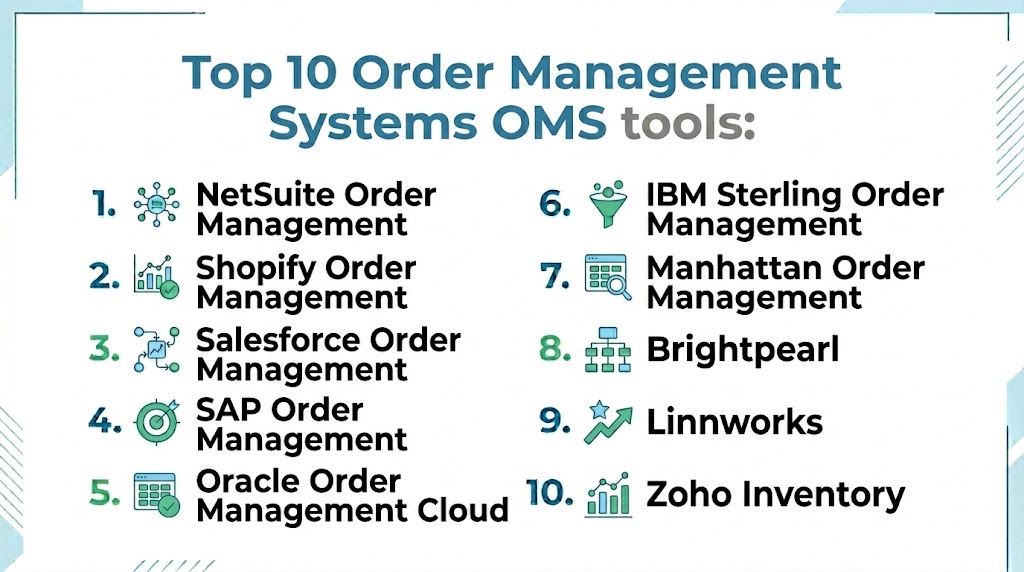
Top 10 Order Management Systems OMS
#1 — Shopify Plus OMS
Short description: A powerful OMS integrated within Shopify Plus, designed for fast-growing eCommerce businesses needing seamless order and inventory management. It simplifies omnichannel operations and provides a unified platform for managing orders.
Key Features
- Centralized order management
- Real-time inventory tracking
- Multi-channel support
- Automated fulfillment workflows
- Returns management
- Analytics dashboards
Pros
- Easy to use
- Strong eCommerce integration
Cons
- Limited customization
- Best within Shopify ecosystem
Platforms / Deployment
- Web
- Cloud
Security & Compliance
- Not publicly stated
Integrations & Ecosystem
- Shopify apps
- Payment gateways
- APIs
Support & Community
Strong support and large ecosystem.
#2 — Salesforce Order Management
Short description: An enterprise-grade OMS that integrates deeply with Salesforce CRM, providing end-to-end order visibility and automation for large organizations.
Key Features
- Order lifecycle management
- Inventory visibility
- Automated workflows
- Returns processing
- Analytics
Pros
- Strong CRM integration
- Scalable
Cons
- Complex setup
- Higher cost
Platforms / Deployment
- Web
- Cloud
Security & Compliance
- Role-based access, audit logs
- Compliance support varies
Integrations & Ecosystem
- Salesforce ecosystem
- ERP systems
- APIs
Support & Community
Enterprise-level support.
#3 — SAP Order Management
Short description: A comprehensive OMS solution integrated with SAP systems, designed for large enterprises with complex supply chains.
Key Features
- Order processing
- Inventory management
- Fulfillment optimization
- Returns handling
- Reporting
Pros
- Strong ERP integration
- Enterprise scalability
Cons
- Requires SAP ecosystem
- Complex implementation
Platforms / Deployment
- Web
- Cloud / On-premise
Security & Compliance
- Enterprise security controls
- Compliance support varies
Integrations & Ecosystem
- SAP ERP
- APIs
Support & Community
Strong enterprise support.
#4 — Oracle Order Management Cloud
Short description: A cloud-based OMS solution offering advanced order orchestration and fulfillment capabilities.
Key Features
- Order orchestration
- Fulfillment automation
- Inventory tracking
- Returns management
- Analytics
Pros
- Advanced features
- Scalable
Cons
- Complex UI
- Implementation effort
Platforms / Deployment
- Web
- Cloud
Security & Compliance
- Role-based access
- Compliance support varies
Integrations & Ecosystem
- Oracle ecosystem
- ERP integrations
- APIs
Support & Community
Enterprise support.
#5 — Brightpearl
Short description: A retail-focused OMS designed for fast-growing brands needing automation and real-time visibility.
Key Features
- Order processing
- Inventory management
- Automation workflows
- Reporting dashboards
- Multi-channel support
Pros
- Retail-focused
- Automation features
Cons
- Limited customization
- Pricing varies
Platforms / Deployment
- Web
- Cloud
Security & Compliance
- Not publicly stated
Integrations & Ecosystem
- eCommerce platforms
- APIs
Support & Community
Good support and onboarding.
#6 — Linnworks
Short description: A multi-channel OMS that helps businesses manage orders, inventory, and fulfillment across various platforms.
Key Features
- Multi-channel order management
- Inventory synchronization
- Automation workflows
- Shipping integrations
- Reporting
Pros
- Strong channel integration
- Scalable
Cons
- Learning curve
- UI complexity
Platforms / Deployment
- Web
- Cloud
Security & Compliance
- Not publicly stated
Integrations & Ecosystem
- Marketplaces
- Shipping providers
- APIs
Support & Community
Strong support resources.
#7 — NetSuite Order Management
Short description: A cloud-based OMS within NetSuite ERP, offering end-to-end order processing and financial integration.
Key Features
- Order processing
- Inventory tracking
- Financial integration
- Fulfillment workflows
- Reporting
Pros
- Unified ERP system
- Scalable
Cons
- Expensive
- Complex setup
Platforms / Deployment
- Web
- Cloud
Security & Compliance
- Role-based access
- Compliance support varies
Integrations & Ecosystem
- NetSuite ecosystem
- APIs
Support & Community
Enterprise support.
#8 — Zoho Inventory
Short description: A simple and affordable OMS solution for small businesses managing orders and inventory.
Key Features
- Order tracking
- Inventory management
- Multi-channel integration
- Shipping management
- Reporting
Pros
- Easy to use
- Affordable
Cons
- Limited advanced features
- Not enterprise-grade
Platforms / Deployment
- Web
- Cloud
Security & Compliance
- Not publicly stated
Integrations & Ecosystem
- Zoho apps
- APIs
Support & Community
Good SMB support.
#9 — Skubana
Short description: An operations platform combining OMS with inventory and analytics for eCommerce businesses.
Key Features
- Order management
- Inventory tracking
- Automation workflows
- Analytics
- Multi-channel support
Pros
- Data-driven insights
- Automation features
Cons
- Learning curve
- Pricing varies
Platforms / Deployment
- Web
- Cloud
Security & Compliance
- Not publicly stated
Integrations & Ecosystem
- eCommerce platforms
- APIs
Support & Community
Strong onboarding support.
#10 — ShipStation
Short description: A shipping-focused OMS solution designed to streamline order fulfillment and logistics.
Key Features
- Order import and management
- Shipping automation
- Carrier integrations
- Tracking updates
- Reporting
Pros
- Easy shipping management
- Fast setup
Cons
- Limited full OMS features
- Focus on shipping
Platforms / Deployment
- Web
- Cloud
Security & Compliance
- Not publicly stated
Integrations & Ecosystem
- eCommerce platforms
- Shipping carriers
- APIs
Support & Community
Good support and resources.
Comparison Table
| Tool Name | Best For | Platform Supported | Deployment | Standout Feature | Public Rating |
|---|---|---|---|---|---|
| Shopify Plus | eCommerce | Web | Cloud | Easy integration | N/A |
| Salesforce OMS | Enterprise | Web | Cloud | CRM integration | N/A |
| SAP OMS | Enterprise | Web | Hybrid | ERP integration | N/A |
| Oracle OMS | Enterprise | Web | Cloud | Order orchestration | N/A |
| Brightpearl | Retail | Web | Cloud | Automation | N/A |
| Linnworks | Multi-channel | Web | Cloud | Channel sync | N/A |
| NetSuite OMS | ERP users | Web | Cloud | Financial integration | N/A |
| Zoho Inventory | SMB | Web | Cloud | Affordability | N/A |
| Skubana | eCommerce ops | Web | Cloud | Analytics | N/A |
| ShipStation | Shipping | Web | Cloud | Fulfillment focus | N/A |
Evaluation & Scoring of Order Management Systems OMS
| Tool Name | Core 25% | Ease 15% | Integrations 15% | Security 10% | Performance 10% | Support 10% | Value 15% | Weighted Total |
|---|---|---|---|---|---|---|---|---|
| Shopify Plus | 8 | 9 | 8 | 6 | 8 | 8 | 7 | 7.9 |
| Salesforce OMS | 9 | 6 | 9 | 9 | 8 | 8 | 6 | 8.0 |
| SAP OMS | 9 | 5 | 9 | 9 | 9 | 8 | 5 | 8.0 |
| Oracle OMS | 9 | 5 | 9 | 8 | 8 | 8 | 6 | 7.9 |
| Brightpearl | 8 | 8 | 7 | 6 | 7 | 7 | 8 | 7.5 |
| Linnworks | 8 | 7 | 8 | 6 | 7 | 7 | 7 | 7.4 |
| NetSuite OMS | 9 | 6 | 8 | 8 | 8 | 8 | 6 | 7.8 |
| Zoho Inventory | 7 | 9 | 7 | 6 | 7 | 7 | 9 | 7.6 |
| Skubana | 8 | 7 | 7 | 6 | 7 | 7 | 7 | 7.3 |
| ShipStation | 7 | 9 | 7 | 6 | 7 | 7 | 8 | 7.5 |
How to interpret scores:
- Higher scores indicate stronger overall capabilities
- Enterprise tools excel in integrations and scalability
- SMB tools perform better in ease of use and value
- Scores are relative comparisons
- Choose based on your business needs
Which Order Management System OMS Is Right for You
Solo / Freelancer
Zoho Inventory and ShipStation are simple tools for managing small order volumes efficiently.
SMB
Brightpearl and Linnworks provide a balance of automation, usability, and affordability.
Mid-Market
NetSuite OMS and Skubana offer scalability and deeper operational insights.
Enterprise
Salesforce OMS, SAP OMS, and Oracle OMS are ideal for complex, large-scale operations.
Budget vs Premium
- Budget tools include Zoho Inventory and ShipStation
- Premium tools include SAP OMS and Salesforce OMS
Feature Depth vs Ease of Use
- Advanced tools include SAP OMS and Oracle OMS
- Easy tools include Shopify Plus and Zoho Inventory
Integrations & Scalability
- Strong integrations in Salesforce OMS and NetSuite OMS
- Moderate in SMB tools
Security & Compliance Needs
- High compliance needs fit enterprise tools
- Moderate needs fit SMB tools
Frequently Asked Questions
1. What is an Order Management System OMS
An OMS is a software platform that manages the entire order lifecycle, from order placement to fulfillment and delivery. It helps businesses track orders, manage inventory, and ensure timely processing across multiple channels.
2. Who should use an OMS
Retailers, eCommerce businesses, wholesalers, and enterprises with high order volumes benefit the most. It is especially useful for businesses managing multiple sales channels.
3. How does OMS improve efficiency
OMS automates order processing, reduces manual errors, and provides real-time visibility into inventory and order status. This helps businesses fulfill orders faster and improve customer satisfaction.
4. Can OMS integrate with other systems
Yes, most OMS tools integrate with ERP, CRM, eCommerce platforms, and shipping providers. This ensures seamless data flow and unified operations across systems.
5. Is OMS suitable for small businesses
Yes, many OMS tools are designed specifically for small businesses with simple workflows. These tools are affordable and easy to implement.
6. How long does OMS implementation take
Implementation time depends on the complexity of the business. Simple setups can take a few weeks, while enterprise systems may take several months.
7. What are key features of OMS
Key features include order tracking, inventory management, fulfillment automation, returns handling, and reporting. Integration and scalability are also important factors.
8. Can OMS handle returns and exchanges
Yes, most OMS tools support reverse logistics, allowing businesses to manage returns and exchanges efficiently. This improves customer experience and operational control.
9. What industries use OMS
OMS is widely used in retail, eCommerce, manufacturing, and logistics industries. Any business handling product orders can benefit from it.
10. How secure are OMS platforms
Security depends on the provider, but most tools offer role-based access, encryption, and audit logs. Businesses should evaluate security features before choosing a tool.
Conclusion
Order Management Systems play a crucial role in modern business operations by ensuring that orders are processed accurately and efficiently. They provide a centralized platform to manage inventory, track orders, and streamline fulfillment across multiple channels. One of the biggest advantages of OMS is the ability to bring visibility and control into the entire order lifecycle. Businesses can monitor everything from order placement to delivery, reducing errors and improving customer satisfaction. This becomes even more important as operations scale and complexity increases. Choosing the right OMS depends on your business size, order volume, and integration needs. Enterprise tools offer deep functionality and scalability, while smaller tools focus on simplicity and cost-effectiveness. There is no one-size-fits-all solution. Organizations should evaluate how well a tool integrates with existing systems and supports their operational workflows. Testing a few tools in real scenarios can help identify the best fit. A well-implemented OMS can significantly improve efficiency, reduce operational costs, and enhance the overall customer experience. It allows teams to focus on growth instead of manual processes. Over time, investing in the right OMS solution can lead to better inventory management, faster deliveries, and stronger customer relationships.The key is to start with a clear understanding of your needs and choose a platform that can grow with your business.
