Introduction
Manufacturing Resource Planning (MRP) Tools are software systems used to plan, schedule, and manage manufacturing resources such as raw materials, production capacity, inventory, and workforce. These tools ensure that production runs smoothly by aligning demand with available resources in real time.
MRP systems are a core part of modern manufacturing and often sit inside or alongside ERP systems. They help manufacturers avoid stock shortages, production delays, and excess inventory, while improving operational efficiency and cost control.
Common use cases include:
- Production planning and scheduling
- Inventory and material management
- Supply chain coordination
- Capacity planning
- Demand forecasting and procurement
Key evaluation criteria:
- Production planning accuracy
- Inventory and material tracking
- Integration with ERP and MES systems
- Real-time scheduling capabilities
- Scalability for large manufacturing setups
- Reporting and analytics features
- Ease of use and deployment
- Supply chain visibility
Best for: Manufacturing companies, automotive industries, electronics production, FMCG manufacturers, and large-scale industrial operations.
Not ideal for: Small businesses with minimal production complexity or service-only organizations.
Key Trends in Manufacturing Resource Planning (MRP) Tools
- Shift toward cloud-based MRP systems
- Integration with AI-driven demand forecasting
- Real-time inventory optimization and tracking
- Strong alignment with ERP + MES convergence
- Use of predictive analytics for production planning
- Adoption of digital supply chain ecosystems
- Integration with IoT-enabled manufacturing systems
- Increased automation in procurement workflows
- Expansion of mobile-first manufacturing dashboards
- Focus on end-to-end supply chain visibility
How We Selected These Tools (Methodology)
- Evaluated industry adoption and enterprise usage
- Assessed production planning and scheduling capabilities
- Reviewed inventory and supply chain management features
- Considered integration with ERP/MES systems
- Included both enterprise and mid-market tools
- Analyzed scalability and performance
- Focused on real-world manufacturing use cases
- Balanced modern cloud and traditional ERP systems
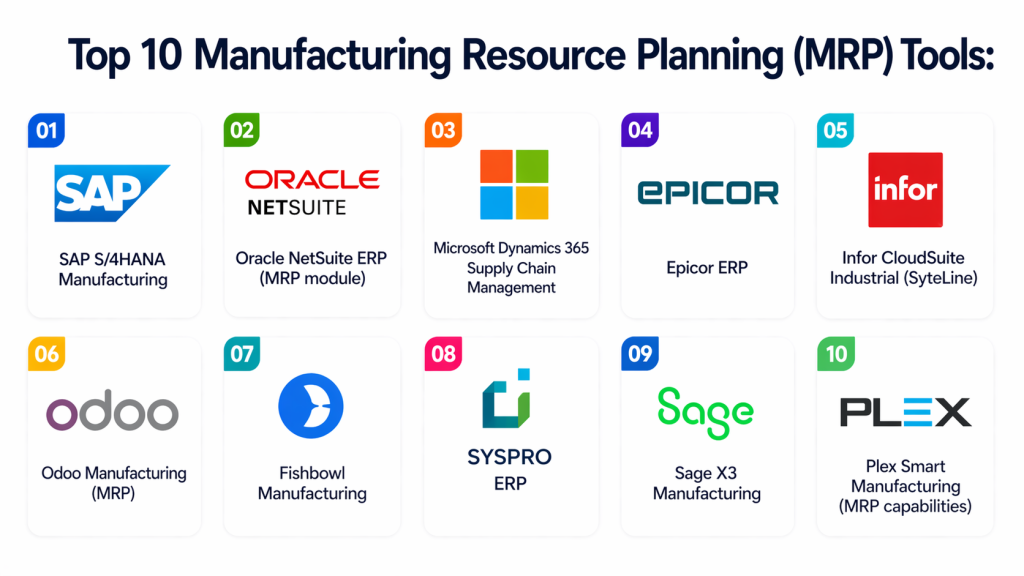
Top 10 Manufacturing Resource Planning (MRP) Tools
#1 — SAP S/4HANA Manufacturing
Short description: A powerful enterprise-grade ERP and MRP system that provides advanced production planning, supply chain management, and real-time resource optimization for global manufacturers.
Key Features
- Advanced production planning
- Real-time inventory management
- Supply chain optimization
- Demand forecasting
- Integration with ERP modules
Pros
- Highly scalable
- Strong enterprise ecosystem
Cons
- Very expensive
- Complex implementation
Platforms / Deployment
Cloud / On-prem
Security & Compliance
Enterprise-grade security and compliance
Integrations & Ecosystem
Deep integration with SAP ecosystem.
- SAP ERP modules
- Supply chain systems
Support & Community
Strong global enterprise support.
#2 — Oracle NetSuite ERP
Short description: A cloud-based ERP and MRP solution designed to manage manufacturing operations, inventory, and financial planning in a unified platform.
Key Features
- Production planning
- Inventory control
- Demand forecasting
- Procurement management
- Financial integration
Pros
- Fully cloud-based
- Easy scalability
Cons
- Expensive for small businesses
- Customization complexity
Platforms / Deployment
Cloud
Security & Compliance
Enterprise-grade cloud security
Integrations & Ecosystem
Works with Oracle cloud ecosystem and APIs.
Support & Community
Strong enterprise support.
#3 — Microsoft Dynamics 365 Supply Chain Management
Short description: A cloud-based MRP and supply chain platform that helps manufacturers optimize production planning and resource allocation.
Key Features
- Production scheduling
- Inventory tracking
- Demand forecasting
- Supply chain visibility
- AI-driven insights
Pros
- Strong Microsoft ecosystem
- AI integration
Cons
- Licensing complexity
- Requires training
Platforms / Deployment
Cloud
Security & Compliance
Enterprise-grade Microsoft security
Integrations & Ecosystem
Works with Microsoft 365 and Azure.
Support & Community
Strong enterprise support.
#4 — Epicor ERP
Short description: A manufacturing-focused ERP and MRP system designed for discrete manufacturing, supply chain optimization, and production planning.
Key Features
- Production scheduling
- Inventory control
- Material planning
- Supply chain management
- Real-time analytics
Pros
- Manufacturing-focused
- Strong flexibility
Cons
- Complex UI
- Implementation cost
Platforms / Deployment
Cloud / On-prem
Security & Compliance
Not publicly stated
Integrations & Ecosystem
Supports ERP and MES integrations.
Support & Community
Enterprise support.
#5 — Infor CloudSuite Industrial (SyteLine)
Short description: A cloud-based ERP and MRP system designed for manufacturing operations with strong production planning and scheduling capabilities.
Key Features
- Advanced scheduling
- Inventory management
- Production planning
- Quality control
- Supply chain visibility
Pros
- Industry-specific features
- Scalable
Cons
- Complex deployment
- Costly for SMBs
Platforms / Deployment
Cloud
Security & Compliance
Enterprise-grade
Integrations & Ecosystem
Works with Infor ecosystem and APIs.
Support & Community
Strong enterprise support.
#6 — Odoo Manufacturing (MRP)
Short description: A flexible open-source ERP and MRP system that provides modular manufacturing planning and inventory management tools.
Key Features
- Production planning
- Inventory management
- Work order tracking
- Bill of materials (BOM)
- Demand forecasting
Pros
- Open-source flexibility
- Modular system
Cons
- Requires setup expertise
- Limited enterprise features
Platforms / Deployment
Cloud / Self-hosted
Security & Compliance
Varies
Integrations & Ecosystem
Large Odoo app ecosystem
Support & Community
Strong open-source community.
#7 — Fishbowl Manufacturing
Short description: A manufacturing and inventory management system designed for small and mid-sized businesses.
Key Features
- Inventory tracking
- Work order management
- Production planning
- Barcode scanning
- Reporting tools
Pros
- Easy to use
- SMB-friendly
Cons
- Limited scalability
- Not enterprise-grade
Platforms / Deployment
Cloud / On-prem
Security & Compliance
Not publicly stated
Integrations & Ecosystem
Integrates with QuickBooks and other tools.
Support & Community
Moderate support.
#8 — SYSPRO ERP
Short description: A manufacturing-focused ERP system with strong MRP capabilities for inventory, production, and supply chain management.
Key Features
- Material planning
- Production scheduling
- Inventory optimization
- Financial integration
- Supply chain management
Pros
- Manufacturing-focused
- Strong reporting
Cons
- UI complexity
- Limited modern UX
Platforms / Deployment
Cloud / On-prem
Security & Compliance
Enterprise-grade
Integrations & Ecosystem
ERP and supply chain integrations
Support & Community
Strong enterprise support.
#9 — Sage X3 Manufacturing
Short description: A global ERP system with MRP capabilities designed for manufacturing, distribution, and supply chain optimization.
Key Features
- Production planning
- Inventory control
- Procurement management
- Financial integration
- Supply chain visibility
Pros
- Strong global support
- Scalable
Cons
- Complex setup
- High cost
Platforms / Deployment
Cloud / On-prem
Security & Compliance
Enterprise-grade
Integrations & Ecosystem
Works with Sage ecosystem
Support & Community
Strong enterprise support.
#10 — Plex Smart Manufacturing Platform
Short description: A cloud-based manufacturing platform with built-in MRP capabilities for real-time production and inventory management.
Key Features
- Real-time production tracking
- Inventory management
- Quality control
- Supply chain visibility
- Cloud-based planning
Pros
- Easy deployment
- Real-time visibility
Cons
- Subscription cost
- Limited customization
Platforms / Deployment
Cloud
Security & Compliance
Enterprise-grade
Integrations & Ecosystem
Works with ERP and MES systems
Support & Community
Strong enterprise support.
Comparison Table (Top 10)
| Tool Name | Best For | Platform(s) Supported | Deployment | Standout Feature | Public Rating |
|---|---|---|---|---|---|
| SAP S/4HANA | Enterprise manufacturing | Multi-platform | Hybrid | Advanced planning | N/A |
| Oracle NetSuite | Cloud ERP | Web | Cloud | Unified ERP+MRP | N/A |
| Microsoft Dynamics | Supply chain | Web | Cloud | AI insights | N/A |
| Epicor ERP | Discrete manufacturing | Multi-platform | Hybrid | Flexibility | N/A |
| Infor CloudSuite | Industrial manufacturing | Web | Cloud | Scheduling | N/A |
| Odoo | SMB & open-source | Multi-platform | Hybrid | Modular ERP | N/A |
| Fishbowl | Small business | Multi-platform | Hybrid | Inventory control | N/A |
| SYSPRO | Manufacturing ERP | Multi-platform | Hybrid | Reporting tools | N/A |
| Sage X3 | Global ERP | Multi-platform | Hybrid | Financial integration | N/A |
| Plex | Smart manufacturing | Web | Cloud | Real-time visibility | N/A |
Evaluation & Scoring of MRP Tools
| Tool Name | Core | Ease | Integrations | Security | Performance | Support | Value | Weighted Total |
|---|---|---|---|---|---|---|---|---|
| SAP S/4HANA | 10 | 7 | 9 | 9 | 9 | 9 | 7 | 8.7 |
| Oracle NetSuite | 9 | 8 | 9 | 9 | 9 | 9 | 7 | 8.6 |
| Microsoft Dynamics | 9 | 8 | 9 | 9 | 9 | 9 | 7 | 8.6 |
| Epicor ERP | 8 | 7 | 8 | 8 | 8 | 8 | 7 | 7.9 |
| Infor CloudSuite | 8 | 7 | 8 | 8 | 8 | 8 | 7 | 7.9 |
| Odoo | 8 | 9 | 8 | 7 | 7 | 8 | 9 | 8.0 |
| Fishbowl | 7 | 9 | 7 | 7 | 7 | 7 | 9 | 7.6 |
| SYSPRO | 8 | 7 | 8 | 8 | 8 | 8 | 7 | 7.9 |
| Sage X3 | 8 | 7 | 8 | 8 | 8 | 8 | 7 | 7.9 |
| Plex | 8 | 8 | 8 | 8 | 8 | 8 | 7 | 8.0 |
Which MRP Tool Is Right for You?
Solo / Small Teams
Odoo or Fishbowl for low-cost and flexible planning.
SMB Manufacturers
Plex or SYSPRO for balanced capabilities.
Mid-Market
Epicor or Infor CloudSuite for scalable operations.
Enterprise
SAP S/4HANA, Oracle NetSuite, and Microsoft Dynamics for global manufacturing.
Budget vs Premium
Open-source tools reduce cost; enterprise systems offer full control.
Feature Depth vs Ease of Use
SAP offers depth; Odoo offers simplicity.
Integrations & Scalability
SAP and Microsoft excel in large enterprise ecosystems.
Security & Compliance Needs
Enterprise tools provide strong governance and compliance features.
Frequently Asked Questions (FAQs)
1. What is an MRP tool?
An MRP tool is software used to plan manufacturing resources, manage inventory, and schedule production. It ensures materials and resources are available when needed for efficient manufacturing operations.
2. Why is MRP important in manufacturing?
MRP helps reduce waste, prevent stock shortages, and improve production efficiency by aligning demand with available resources.
3. What is the difference between MRP and ERP?
MRP focuses on production planning and materials, while ERP covers broader business functions like finance, HR, and supply chain management.
4. Who uses MRP systems?
Manufacturers, supply chain managers, production planners, and industrial engineers use MRP systems.
5. Are MRP tools cloud-based?
Many modern MRP systems are cloud-based, but some also support on-premise deployments.
6. Do MRP tools integrate with ERP?
Yes, MRP systems are often part of or integrated with ERP platforms for end-to-end business management.
7. What industries use MRP systems?
Industries like automotive, electronics, aerospace, FMCG, and industrial manufacturing widely use MRP tools.
8. Can MRP improve production efficiency?
Yes, MRP systems optimize material usage, reduce delays, and improve scheduling efficiency.
9. Are there open-source MRP tools?
Yes, Odoo is a popular open-source MRP solution used by small and mid-sized businesses.
10. What are common challenges in MRP systems?
Challenges include implementation complexity, data accuracy issues, and integration with legacy systems.
Conclusion
Manufacturing Resource Planning (MRP) tools are essential for modern manufacturing operations, enabling organizations to efficiently manage materials, production schedules, and supply chains. They help reduce costs, improve productivity, and ensure timely delivery of products. There is no single best MRP system for all companies. Large enterprises often prefer SAP, Oracle, or Microsoft Dynamics, while mid-sized manufacturers benefit from Epicor or Infor. Smaller businesses can start with Odoo or Fishbowl for simpler needs. The right choice depends on your production scale, integration needs, and budget. Focus on tools that align with your manufacturing complexity and long-term growth strategy. Start by evaluating a few systems, testing workflows, and validating integration with your existing operations. This ensures a scalable and efficient manufacturing planning process.
