Introduction
Industrial Automation SCADA Systems are platforms used to monitor, control, and analyze industrial processes in real time. These systems collect data from sensors, PLCs, and machines, then provide centralized dashboards for operators to supervise and control operations remotely.
SCADA systems are the backbone of industries like manufacturing, energy, water treatment, and logistics. They help improve efficiency, reduce downtime, and enable predictive maintenance by providing continuous visibility into operations.
Common use cases include:
- Manufacturing process monitoring
- Power grid and energy management
- Water and wastewater control systems
- Oil & gas pipeline monitoring
- Smart factories and IIoT environments
Key evaluation criteria:
- Real-time monitoring and control
- Scalability and performance
- Protocol support (OPC UA, Modbus, etc.)
- Integration with PLCs and IoT devices
- Visualization and dashboards
- Security and compliance
- Reporting and analytics
- Ease of deployment and maintenance
Best for: Industrial engineers, automation teams, manufacturing companies, utilities, and enterprises managing large-scale operations.
Not ideal for: Small applications without automation requirements or simple monitoring use cases.
Key Trends in Industrial Automation SCADA Systems
- Rise of IIoT-enabled SCADA platforms
- Integration with cloud and edge computing
- Adoption of AI-driven predictive maintenance
- Growth of web-based SCADA systems
- Use of real-time analytics and dashboards
- Increased focus on cybersecurity in SCADA
- Integration with MES and ERP systems
- Expansion of mobile and remote monitoring
- Adoption of digital twin technology
- Support for hybrid cloud deployments
How We Selected These Tools (Methodology)
- Evaluated market adoption and industry usage
- Assessed feature completeness and scalability
- Reviewed integration with industrial systems
- Considered security and reliability
- Included enterprise and open-source tools
- Analyzed performance and usability
- Focused on real-world industrial deployments
- Balanced modern and legacy-compatible platforms
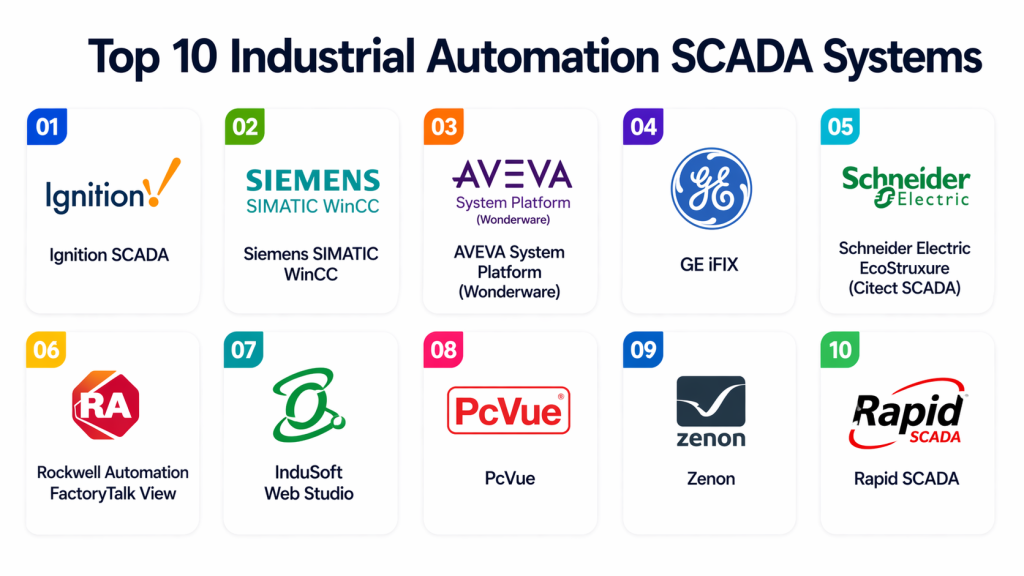
Top 10 Industrial Automation SCADA Systems
#1 — Ignition SCADA
Short description: A modern SCADA platform designed for real-time monitoring, control, and data analysis. It offers a unified architecture that supports industrial automation, IIoT, and MES applications with strong scalability.
Key Features
- Real-time data acquisition
- Web-based deployment
- Unlimited licensing model
- OPC UA integration
- Reporting and analytics
Pros
- Highly scalable
- Flexible architecture
Cons
- Requires setup expertise
- Learning curve
Platforms / Deployment
Cloud / Self-hosted
Security & Compliance
Supports encryption, authentication; details not publicly stated
Integrations & Ecosystem
Integrates with databases, PLCs, and IIoT devices.
Support & Community
Strong community and enterprise support.
#2 — Siemens SIMATIC WinCC
Short description: A leading SCADA system used in industrial automation for process control and data visualization. It is widely adopted in manufacturing and infrastructure industries.
Key Features
- Real-time monitoring
- Data visualization
- Process control
- Scalability
- Integration with Siemens systems
Pros
- Enterprise-grade reliability
- Strong industrial ecosystem
Cons
- Complex configuration
- Licensing cost
Platforms / Deployment
Cloud / On-prem
Security & Compliance
Enterprise-grade features
Integrations & Ecosystem
Works with Siemens automation stack.
Support & Community
Strong global support.
#3 — AVEVA Edge (Wonderware)
Short description: A flexible SCADA and HMI platform designed for industrial automation with strong visualization and control capabilities.
Key Features
- Visualization dashboards
- Alarm management
- Real-time control
- Device connectivity
- Data analytics
Pros
- User-friendly
- Strong visualization
Cons
- Licensing complexity
- Vendor dependency
Platforms / Deployment
Cloud / Hybrid
Security & Compliance
Enterprise-grade security
Integrations & Ecosystem
Works with industrial automation systems.
Support & Community
Enterprise support.
#4 — GE iFIX
Short description: A SCADA solution focused on industrial automation, offering real-time monitoring and control for mission-critical systems.
Key Features
- Real-time monitoring
- Data analytics
- Alarm management
- Visualization tools
- High availability
Pros
- Reliable
- Strong performance
Cons
- Complex setup
- Limited flexibility
Platforms / Deployment
Windows / Cloud
Security & Compliance
Not publicly stated
Integrations & Ecosystem
Integrates with GE industrial systems.
Support & Community
Enterprise support.
#5 — Schneider Electric EcoStruxure (Citect SCADA)
Short description: A comprehensive SCADA platform for industrial automation and energy management with strong scalability and analytics.
Key Features
- Real-time monitoring
- Energy management
- Alarm systems
- Visualization
- Reporting
Pros
- Scalable
- Energy-focused
Cons
- Complex deployment
- Vendor lock-in
Platforms / Deployment
Cloud / Hybrid
Security & Compliance
Enterprise-grade
Integrations & Ecosystem
Works with Schneider ecosystem.
Support & Community
Enterprise support.
#6 — Rockwell Automation FactoryTalk View
Short description: A SCADA and HMI solution designed for manufacturing environments with strong integration into Rockwell systems.
Key Features
- HMI/SCADA integration
- Real-time monitoring
- Visualization tools
- Reporting
- Data analytics
Pros
- Manufacturing-focused
- Reliable
Cons
- Vendor-specific
- Expensive
Platforms / Deployment
Windows / Cloud
Security & Compliance
Not publicly stated
Integrations & Ecosystem
Works with Rockwell automation tools.
Support & Community
Strong enterprise support.
#7 — InduSoft Web Studio
Short description: A flexible SCADA platform designed for rapid development and deployment of industrial automation systems.
Key Features
- Web-based interface
- Real-time monitoring
- Device connectivity
- Visualization
- Reporting
Pros
- Easy to use
- Flexible
Cons
- Limited advanced features
- Smaller ecosystem
Platforms / Deployment
Cloud / Self-hosted
Security & Compliance
Not publicly stated
Integrations & Ecosystem
Supports industrial protocols and APIs.
Support & Community
Moderate community.
#8 — PcVue
Short description: A SCADA platform designed for industrial and building management systems with strong monitoring and control capabilities.
Key Features
- Data monitoring
- Alarm management
- Visualization tools
- Reporting
- Remote control
Pros
- Versatile
- Easy integration
Cons
- Limited scalability
- Smaller ecosystem
Platforms / Deployment
Cloud / On-prem
Security & Compliance
Not publicly stated
Integrations & Ecosystem
Works with industrial devices and systems.
Support & Community
Active community.
#9 — Zenon
Short description: A SCADA platform designed for energy, manufacturing, and infrastructure applications with strong automation capabilities.
Key Features
- Real-time monitoring
- Process control
- Visualization
- Energy management
- Reporting
Pros
- Industry-focused
- Reliable
Cons
- Learning curve
- Cost
Platforms / Deployment
Cloud / Hybrid
Security & Compliance
Not publicly stated
Integrations & Ecosystem
Works with industrial systems and APIs.
Support & Community
Enterprise support.
#10 — Rapid SCADA
Short description: An open-source SCADA system designed for building distributed automation systems with real-time monitoring and control capabilities.
Key Features
- Real-time data acquisition
- Alarm management
- Trend analysis
- Web interface
- Modular architecture
Pros
- Open-source
- Cost-effective
Cons
- Requires setup
- Limited enterprise features
Platforms / Deployment
Windows / Linux
Security & Compliance
Varies
Integrations & Ecosystem
Supports industrial protocols like Modbus and OPC.
Support & Community
Open-source community support.
Comparison Table (Top 10)
| Tool Name | Best For | Platform(s) Supported | Deployment | Standout Feature | Public Rating |
|---|---|---|---|---|---|
| Ignition SCADA | Modern automation | Multi-platform | Hybrid | Web-based SCADA | N/A |
| Siemens WinCC | Enterprise | Multi-platform | Hybrid | Industrial integration | N/A |
| AVEVA Edge | Visualization | Multi-platform | Hybrid | HMI + SCADA | N/A |
| GE iFIX | Reliability | Windows | Hybrid | High availability | N/A |
| EcoStruxure | Energy | Multi-platform | Hybrid | Energy analytics | N/A |
| FactoryTalk | Manufacturing | Windows | Hybrid | HMI integration | N/A |
| InduSoft | Flexibility | Multi-platform | Hybrid | Rapid deployment | N/A |
| PcVue | Monitoring | Multi-platform | Hybrid | Remote control | N/A |
| Zenon | Infrastructure | Multi-platform | Hybrid | Energy focus | N/A |
| Rapid SCADA | Open-source | Multi-platform | Self-hosted | Modular design | N/A |
Evaluation & Scoring of Industrial Automation SCADA Systems
| Tool Name | Core | Ease | Integrations | Security | Performance | Support | Value | Weighted Total |
|---|---|---|---|---|---|---|---|---|
| Ignition SCADA | 9 | 7 | 9 | 7 | 9 | 9 | 8 | 8.5 |
| Siemens WinCC | 9 | 6 | 9 | 8 | 9 | 9 | 7 | 8.4 |
| AVEVA Edge | 8 | 8 | 8 | 8 | 8 | 8 | 7 | 8.0 |
| GE iFIX | 8 | 7 | 8 | 7 | 9 | 8 | 7 | 7.9 |
| EcoStruxure | 9 | 7 | 8 | 8 | 9 | 8 | 7 | 8.2 |
| FactoryTalk | 8 | 7 | 8 | 7 | 8 | 8 | 7 | 7.8 |
| InduSoft | 7 | 8 | 7 | 6 | 7 | 7 | 8 | 7.4 |
| PcVue | 7 | 8 | 7 | 6 | 7 | 7 | 7 | 7.2 |
| Zenon | 8 | 7 | 7 | 7 | 8 | 7 | 7 | 7.6 |
| Rapid SCADA | 7 | 7 | 6 | 6 | 7 | 6 | 9 | 7.1 |
How to interpret scores:
These scores compare tools across key criteria. Higher scores indicate stronger overall performance, but the right tool depends on your industry, scale, and integration needs.
Which Industrial Automation SCADA System Is Right for You?
Solo / Freelancer
Rapid SCADA or InduSoft for learning and small deployments.
SMB
PcVue and InduSoft for ease of use and flexibility.
Mid-Market
Ignition SCADA and GE iFIX for scalability and performance.
Enterprise
Siemens WinCC, AVEVA Edge, and EcoStruxure for large-scale deployments.
Budget vs Premium
Open-source tools reduce cost; enterprise tools offer advanced features.
Feature Depth vs Ease of Use
WinCC offers depth; InduSoft offers simplicity.
Integrations & Scalability
Ignition and Siemens excel in integration-heavy environments.
Security & Compliance Needs
Enterprises should prioritize secure and compliant platforms.
Frequently Asked Questions (FAQs)
1. What is a SCADA system?
A SCADA system is used to monitor and control industrial processes in real time. It collects data from sensors and devices, processes it, and displays it for operators to manage operations efficiently.
2. Why are SCADA systems important?
They improve operational efficiency, reduce downtime, and enable better decision-making. SCADA systems provide real-time visibility into processes, helping organizations optimize performance and reduce costs.
3. What industries use SCADA systems?
Industries such as manufacturing, energy, water management, oil and gas, and transportation rely heavily on SCADA systems for automation and monitoring.
4. Are SCADA systems secure?
Modern SCADA systems include security features like encryption, authentication, and monitoring. However, proper configuration and cybersecurity practices are essential to protect against threats.
5. Can SCADA systems integrate with IoT?
Yes, modern SCADA platforms support IIoT integration, enabling real-time data collection from connected devices and sensors across distributed environments.
6. What protocols do SCADA systems support?
Common protocols include OPC UA, Modbus, DNP3, and MQTT. These protocols enable communication between devices, sensors, and control systems.
7. Are there open-source SCADA solutions?
Yes, tools like Rapid SCADA and OpenSCADA are open-source options. They are cost-effective but may require more technical expertise to deploy and maintain.
8. How scalable are SCADA systems?
SCADA systems are highly scalable and can support operations ranging from small facilities to large industrial networks with thousands of devices.
9. What are common challenges?
Challenges include integration complexity, cybersecurity risks, and maintaining system reliability across distributed environments.
10. Can SCADA systems work in real time?
Yes, real-time monitoring and control are core features. SCADA systems continuously collect and process data to provide instant insights and control capabilities.
Conclusion
Industrial Automation SCADA Systems are essential for modern industrial operations, providing real-time monitoring, control, and analytics. They enable organizations to improve efficiency, reduce downtime, and make data-driven decisions. There is no single best SCADA system for every use case. Enterprises may prefer platforms like Siemens WinCC or AVEVA Edge, while mid-sized organizations may benefit from Ignition SCADA. Smaller teams can start with open-source tools like Rapid SCADA. The right choice depends on your operational scale, integration requirements, and technical expertise. Focus on tools that align with your infrastructure and long-term goals. Start by shortlisting a few SCADA platforms, testing their capabilities, and validating integration with your systems. This ensures long-term success and scalability.
