Introduction
Robotics Fleet Management Tools are platforms that help organizations manage, monitor, and coordinate multiple robots from a centralized system. These tools ensure that robot fleets operate efficiently, safely, and at scale across industries like logistics, manufacturing, and healthcare.
As robotics deployments grow, managing fleets manually becomes impossible. Fleet management tools provide automation, real-time monitoring, and intelligent orchestration, making them essential for modern robotics operations.
Common use cases include:
- Warehouse automation and robot coordination
- Autonomous delivery fleet management
- Industrial robotics orchestration
- Healthcare robot operations
- Smart factory automation
Key evaluation criteria:
- Fleet orchestration capabilities
- Real-time monitoring and analytics
- Integration with robotics frameworks
- Scalability and performance
- Security and access control
- Ease of deployment
- Reliability and uptime
- API and ecosystem support
Best for: Enterprises, robotics startups, logistics companies, and AI teams managing multiple robots.
Not ideal for: Single-robot setups or small-scale projects without fleet requirements.
Key Trends in Robotics Fleet Management Tools
- Growth of cloud-based fleet orchestration
- Adoption of AI-driven scheduling and routing
- Increased use of real-time analytics dashboards
- Integration with edge computing systems
- Rise of multi-vendor fleet platforms
- Focus on predictive maintenance and diagnostics
- Expansion of digital twin integrations
- Improved security and compliance frameworks
- Support for heterogeneous robot fleets
- Automation of decision-making workflows
How We Selected These Tools (Methodology)
- Evaluated industry adoption and usage
- Assessed fleet management capabilities
- Reviewed integration and scalability
- Considered performance and reliability
- Included open-source and enterprise tools
- Analyzed ease of use and documentation
- Focused on production-ready platforms
- Balanced innovation and stability
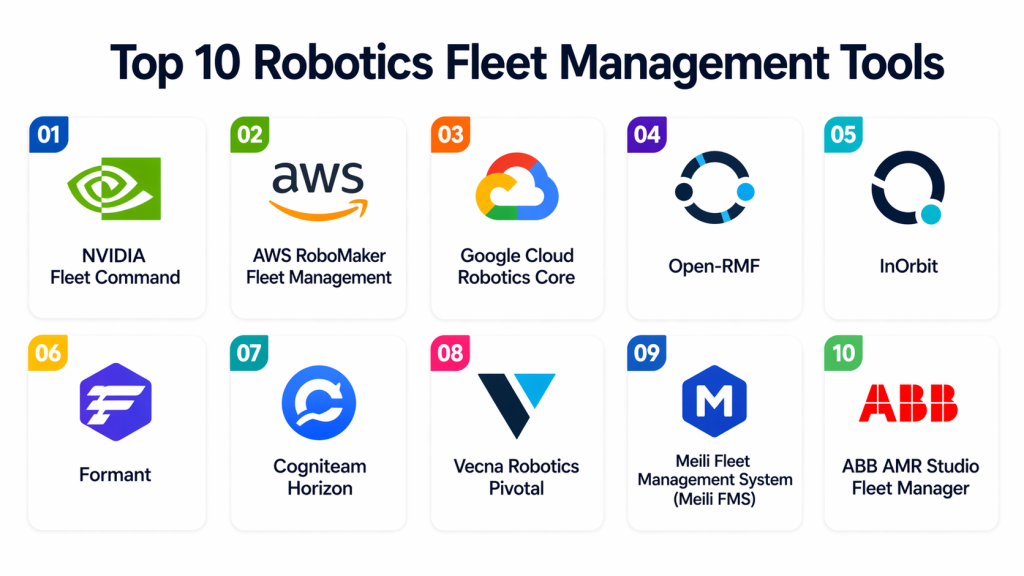
Top 10 Robotics Fleet Management Tools
#1 — NVIDIA Fleet Command
Short description: A cloud-based platform designed to deploy, monitor, and manage AI-powered robot fleets at scale. It provides centralized control with strong integration into AI workflows and edge devices.
Key Features
- Centralized fleet control
- Remote deployment
- AI integration
- Monitoring dashboards
- Secure device management
Pros
- Scalable
- Strong AI ecosystem
Cons
- Requires NVIDIA stack
- Complex setup
Platforms / Deployment
Cloud / Hybrid
Security & Compliance
Not publicly stated
Integrations & Ecosystem
Works with NVIDIA AI, edge devices, and APIs.
Support & Community
Enterprise support available.
#2 — AWS RoboMaker Fleet Management
Short description: A cloud-based robotics service that enables simulation, deployment, and management of robot fleets using AWS infrastructure and services.
Key Features
- Fleet monitoring
- Deployment pipelines
- ROS support
- Logging and analytics
- Simulation tools
Pros
- Scalable
- Strong AWS integration
Cons
- AWS dependency
- Pricing complexity
Platforms / Deployment
Cloud
Security & Compliance
Enterprise-grade cloud security
Integrations & Ecosystem
Deep integration with AWS ecosystem.
Support & Community
Strong enterprise support.
#3 — Google Cloud Robotics Core
Short description: A cloud robotics platform that allows centralized fleet management and synchronization between robots and cloud-based systems.
Key Features
- Fleet coordination
- Data synchronization
- Monitoring tools
- Cloud orchestration
- API integration
Pros
- Scalable
- Strong cloud capabilities
Cons
- Limited availability
- Requires expertise
Platforms / Deployment
Cloud
Security & Compliance
Enterprise-grade cloud security
Integrations & Ecosystem
Works with Google Cloud services.
Support & Community
Enterprise support.
#4 — Open-RMF
Short description: An open-source framework designed to manage and coordinate multi-robot systems across shared environments with interoperability support.
Key Features
- Multi-robot coordination
- Traffic management
- Task scheduling
- Interoperability
- Open-source framework
Pros
- Vendor-neutral
- Flexible
Cons
- Requires expertise
- Setup complexity
Platforms / Deployment
Self-hosted / Cloud
Security & Compliance
Varies
Integrations & Ecosystem
Strong ROS integration.
Support & Community
Active open-source community.
#5 — InOrbit
Short description: A robot operations platform that provides real-time monitoring, analytics, and fleet orchestration for robotics deployments.
Key Features
- Fleet orchestration
- Monitoring dashboards
- API integration
- Performance tracking
- Automation tools
Pros
- Easy integration
- Scalable
Cons
- Limited advanced features
- Smaller ecosystem
Platforms / Deployment
Cloud
Security & Compliance
Not publicly stated
Integrations & Ecosystem
Supports APIs and robotics frameworks.
Support & Community
Active community.
#6 — Formant
Short description: A cloud-based robotics platform focused on fleet monitoring, analytics, and operational insights across distributed robot fleets.
Key Features
- Real-time monitoring
- Data analytics
- Remote control
- Visualization dashboards
- API integrations
Pros
- Strong analytics
- Developer-friendly
Cons
- Pricing not transparent
- Integration effort required
Platforms / Deployment
Cloud
Security & Compliance
Not publicly stated
Integrations & Ecosystem
Works with APIs and robotics systems.
Support & Community
Growing community.
#7 — Cogniteam Horizon
Short description: A robotics platform designed for fleet orchestration, remote monitoring, and cloud-based robot application deployment.
Key Features
- Fleet orchestration
- Remote monitoring
- Application deployment
- Data analytics
- Automation workflows
Pros
- Easy to deploy
- Cloud-native
Cons
- Limited ecosystem
- Newer platform
Platforms / Deployment
Cloud
Security & Compliance
Not publicly stated
Integrations & Ecosystem
Supports APIs and robotics tools.
Support & Community
Emerging community.
#8 — Vecna Robotics Pivotal
Short description: A fleet management solution focused on warehouse and logistics robotics, enabling coordination of autonomous mobile robots.
Key Features
- Fleet coordination
- Task scheduling
- Real-time monitoring
- Workflow automation
- Analytics tools
Pros
- Logistics-focused
- Reliable
Cons
- Limited flexibility
- Vendor dependency
Platforms / Deployment
Cloud
Security & Compliance
Not publicly stated
Integrations & Ecosystem
Works with warehouse systems.
Support & Community
Enterprise support.
#9 — Meili FMS
Short description: An open-source fleet management system designed for managing autonomous mobile robots with flexibility and customization.
Key Features
- Fleet scheduling
- Task management
- Open-source framework
- Custom workflows
- API support
Pros
- Flexible
- Cost-effective
Cons
- Requires setup
- Limited enterprise features
Platforms / Deployment
Self-hosted
Security & Compliance
Varies
Integrations & Ecosystem
Supports robotics APIs.
Support & Community
Open-source community.
#10 — ABB AMR Studio Fleet Manager
Short description: A fleet management platform designed for industrial automation, enabling centralized control and optimization of mobile robots.
Key Features
- Fleet scheduling
- Traffic management
- Real-time monitoring
- Analytics dashboards
- Automation workflows
Pros
- Industrial-grade
- Reliable
Cons
- Vendor-specific
- Enterprise pricing
Platforms / Deployment
Cloud / On-prem
Security & Compliance
Not publicly stated
Integrations & Ecosystem
Works with ABB automation systems.
Support & Community
Enterprise support.
Comparison Table (Top 10)
| Tool Name | Best For | Platform(s) Supported | Deployment | Standout Feature | Public Rating |
|---|---|---|---|---|---|
| NVIDIA Fleet Command | AI robotics | Multi-platform | Hybrid | AI deployment | N/A |
| AWS RoboMaker | Cloud robotics | Web | Cloud | Simulation + fleet | N/A |
| Google Robotics Core | Cloud fleets | Web | Cloud | Data sync | N/A |
| Open-RMF | Open-source fleets | Multi-platform | Hybrid | Multi-robot coordination | N/A |
| InOrbit | Operations | Web | Cloud | API integration | N/A |
| Formant | Analytics | Web | Cloud | Fleet insights | N/A |
| Cogniteam Horizon | Cloud robotics | Web | Cloud | App deployment | N/A |
| Vecna Pivotal | Logistics | Web | Cloud | Workflow automation | N/A |
| Meili FMS | Open-source | Multi-platform | Self-hosted | Custom workflows | N/A |
| ABB AMR Studio | Industrial | Multi-platform | Hybrid | Traffic management | N/A |
Evaluation & Scoring of Robotics Fleet Management Tools
| Tool Name | Core | Ease | Integrations | Security | Performance | Support | Value | Weighted Total |
|---|---|---|---|---|---|---|---|---|
| NVIDIA Fleet Command | 9 | 7 | 8 | 8 | 9 | 8 | 7 | 8.3 |
| AWS RoboMaker | 8 | 7 | 9 | 8 | 9 | 8 | 7 | 8.2 |
| Google Robotics Core | 8 | 7 | 8 | 8 | 9 | 7 | 7 | 8.0 |
| Open-RMF | 8 | 6 | 8 | 6 | 8 | 7 | 8 | 7.7 |
| InOrbit | 7 | 8 | 7 | 6 | 7 | 7 | 7 | 7.2 |
| Formant | 8 | 8 | 8 | 6 | 8 | 7 | 7 | 7.8 |
| Cogniteam Horizon | 7 | 8 | 7 | 6 | 7 | 6 | 7 | 7.1 |
| Vecna Pivotal | 8 | 7 | 7 | 6 | 8 | 7 | 6 | 7.5 |
| Meili FMS | 7 | 7 | 6 | 6 | 7 | 6 | 8 | 7.0 |
| ABB AMR Studio | 8 | 7 | 7 | 7 | 8 | 7 | 6 | 7.5 |
How to interpret scores:
These scores provide a comparative view of tools across key criteria. Higher scores indicate stronger overall performance, but the best tool depends on your fleet size, integration needs, and operational goals.
Which Robotics Fleet Management Tool Is Right for You?
Solo / Freelancer
Open-RMF or Meili FMS for flexibility and low cost.
SMB
Formant and InOrbit for ease of use and scalability.
Mid-Market
AWS RoboMaker and Cogniteam Horizon for balanced capabilities.
Enterprise
NVIDIA Fleet Command, Google Robotics Core, and ABB AMR Studio for large-scale deployments.
Budget vs Premium
Open-source tools reduce cost; enterprise platforms offer advanced features.
Feature Depth vs Ease of Use
NVIDIA Fleet Command offers depth; Formant offers usability.
Integrations & Scalability
AWS and NVIDIA excel in integration-heavy environments.
Security & Compliance Needs
Enterprises should prioritize tools with strong monitoring and access control.
Frequently Asked Questions (FAQs)
1. What are robotics fleet management tools?
These tools help manage multiple robots from a central platform, enabling monitoring, scheduling, and coordination. They ensure robots work efficiently together and reduce manual intervention in large-scale deployments.
2. Why are they important?
They improve efficiency, reduce downtime, and enable scaling of robotic operations. Without them, managing multiple robots becomes complex and inefficient.
3. Can they handle different robot types?
Yes, many tools support heterogeneous fleets, allowing different types of robots to work together under a unified system with shared workflows and coordination.
4. Are these tools cloud-based?
Most modern tools are cloud-based for scalability and remote access. Some also support hybrid or on-prem deployments for specific enterprise needs.
5. Do they support real-time monitoring?
Yes, real-time monitoring is a core feature. These tools provide dashboards and alerts to track robot performance, status, and health instantly.
6. How scalable are these tools?
They are designed to scale from small fleets to thousands of robots. Enterprise platforms are built for large deployments across multiple locations.
7. Can they integrate with AI systems?
Yes, many tools integrate with AI models for automation, optimization, and predictive analytics, improving decision-making and efficiency.
8. What industries use these tools?
Industries like logistics, manufacturing, retail, and healthcare widely use these tools to manage robotic operations and improve productivity.
9. What are common challenges?
Challenges include integration complexity, managing multiple robot types, and ensuring low latency communication across systems.
10. Are open-source options available?
Yes, tools like Open-RMF and Meili FMS offer open-source solutions. They provide flexibility but require technical expertise for setup and maintenance.
Conclusion
Robotics Fleet Management Tools are essential for organizations scaling their robotics operations. They provide centralized control, automation, and real-time insights, enabling efficient coordination of multiple robots across environments. There is no single best tool for every scenario. Enterprises may prefer NVIDIA Fleet Command or AWS RoboMaker for scalability, while developers may choose Open-RMF for flexibility. Mid-sized teams can benefit from tools like Formant or InOrbit for balanced capabilities. The right choice depends on your fleet size, technical expertise, and integration requirements. Focus on tools that align with your existing robotics ecosystem and long-term goals. Start by shortlisting a few tools, testing their capabilities, and validating integration with your systems. This ensures your fleet management solution delivers long-term value and supports future growth.
