Introduction
Machine learning platforms are end-to-end environments that help organizations build, train, deploy, and manage machine learning models at scale. These platforms streamline the entire lifecycle—from data preparation and experimentation to production deployment and monitoring—making it easier for teams to turn data into intelligent applications.
As businesses increasingly rely on automation and predictive insights, machine learning platforms have become essential for accelerating AI adoption. They reduce the complexity of infrastructure, enable collaboration, and support scalable model deployment across different environments.
Real-world use cases include:
- Fraud detection and risk scoring
- Recommendation systems and personalization
- Predictive maintenance in manufacturing
- Customer churn prediction
- Natural language processing and chatbots
What buyers should evaluate:
- Model development and training capabilities
- AutoML and AI-assisted features
- Scalability and compute resources
- Deployment and MLOps support
- Integration with data sources and tools
- Ease of use for technical and non-technical users
- Security and compliance features
- Monitoring and model governance
- Cost and pricing structure
- Community and ecosystem support
Best for: Data scientists, ML engineers, AI teams, enterprises, and organizations scaling machine learning workflows.
Not ideal for: Small projects with minimal data or teams that only need basic analytics without predictive modeling.
Key Trends in Machine Learning Platforms
- Rise of AutoML and no-code/low-code ML tools
- Strong focus on MLOps and model lifecycle management
- Integration with real-time data pipelines
- Growth of cloud-native ML platforms
- Increasing use of AI assistants in model development
- Emphasis on explainable AI and transparency
- Hybrid and multi-cloud deployment strategies
- Integration with data lakes and lakehouse architectures
- Improved model monitoring and drift detection
- Enhanced collaboration across data teams
How We Selected These Tools (Methodology)
The platforms were selected based on:
- Market adoption and enterprise usage
- Feature completeness across ML workflows
- Ease of use for different user levels
- Integration with modern data ecosystems
- Scalability and performance capabilities
- Strength of MLOps and deployment features
- Community and vendor support
- Flexibility across industries and use cases
- Innovation in AI and automation
- Overall value and reliability
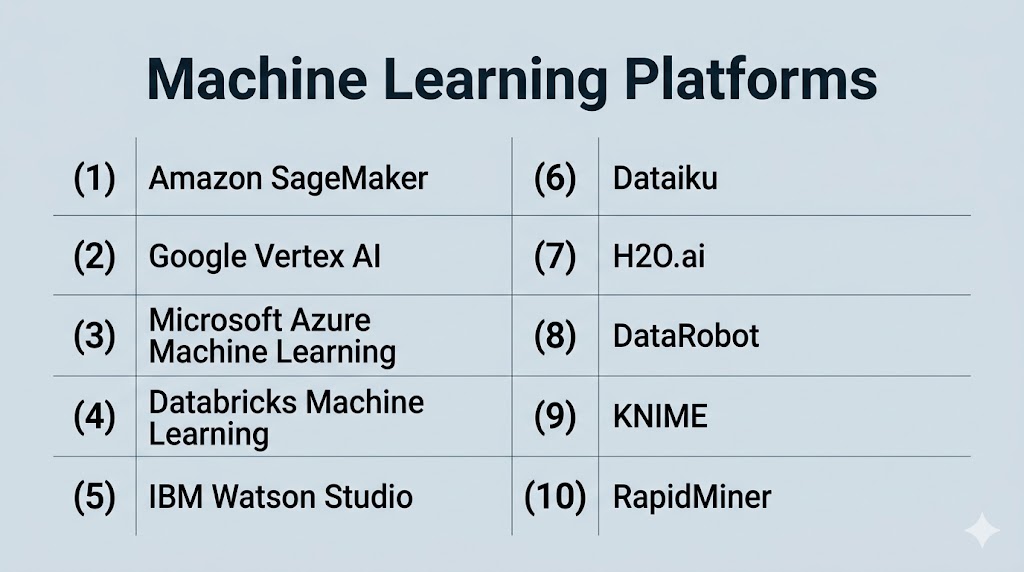
Top 10 Machine Learning Platforms Tools
#1 — Amazon SageMaker
Short description: A fully managed platform for building, training, and deploying machine learning models at scale.
Key Features
- End-to-end ML workflows
- AutoML capabilities
- Managed infrastructure
- Model deployment and monitoring
- Integration with cloud services
- Scalable compute resources
Pros
- Highly scalable
- Comprehensive ML features
Cons
- Pricing complexity
- AWS dependency
Platforms / Deployment
Cloud
Security & Compliance
Not publicly stated
Integrations & Ecosystem
Integrates deeply with cloud services and data tools.
- APIs
- Data storage
- ML services
Support & Community
Strong enterprise support.
#2 — Google Vertex AI
Short description: A unified platform for building and deploying machine learning models using managed infrastructure.
Key Features
- AutoML and custom training
- Managed pipelines
- Model deployment
- Scalable infrastructure
- Integration with AI tools
Pros
- Fully managed
- Advanced AI capabilities
Cons
- Pricing complexity
- Cloud dependency
Platforms / Deployment
Cloud
Security & Compliance
Not publicly stated
Integrations & Ecosystem
- Cloud services
- APIs
- Data tools
Support & Community
Strong documentation and support.
#3 — Microsoft Azure Machine Learning
Short description: A cloud-based platform for building, training, and deploying machine learning models.
Key Features
- AutoML
- MLOps capabilities
- Model deployment
- Integration with Azure services
- Scalable compute
Pros
- Enterprise-ready
- Strong integration with Microsoft ecosystem
Cons
- Learning curve
- Cloud dependency
Platforms / Deployment
Cloud
Security & Compliance
Not publicly stated
Integrations & Ecosystem
- Azure services
- APIs
- Data tools
Support & Community
Enterprise support available.
#4 — Databricks Machine Learning
Short description: A unified analytics and ML platform built on lakehouse architecture.
Key Features
- Collaborative notebooks
- ML lifecycle management
- Integration with Spark
- Scalable data processing
- Experiment tracking
Pros
- Strong for big data
- Unified platform
Cons
- Requires expertise
- Cost considerations
Platforms / Deployment
Cloud
Security & Compliance
Not publicly stated
Integrations & Ecosystem
- Data lakes
- APIs
- ML tools
Support & Community
Strong enterprise support.
#5 — IBM Watson Studio
Short description: An enterprise AI platform for building and managing machine learning models collaboratively.
Key Features
- AutoML
- Model lifecycle management
- Collaboration tools
- Data preparation
- Integration with IBM ecosystem
Pros
- Strong enterprise features
- Robust AI tools
Cons
- Complex interface
- Expensive
Platforms / Deployment
Cloud / Hybrid
Security & Compliance
Not publicly stated
Integrations & Ecosystem
- Enterprise systems
- APIs
- Data tools
Support & Community
Enterprise-grade support.
#6 — Dataiku
Short description: A collaborative data science and machine learning platform with visual workflows.
Key Features
- Visual pipelines
- AutoML
- Collaboration tools
- Model deployment
- Data preparation
Pros
- User-friendly
- Strong collaboration
Cons
- Expensive for small teams
- Limited deep customization
Platforms / Deployment
Cloud / Self-hosted
Security & Compliance
Not publicly stated
Integrations & Ecosystem
- Databases
- APIs
- Data tools
Support & Community
Good enterprise support.
#7 — H2O.ai
Short description: A machine learning platform focused on automation and high-performance modeling.
Key Features
- AutoML
- Distributed computing
- Model interpretability
- Scalable performance
- Open-source components
Pros
- Strong AutoML
- High performance
Cons
- Requires technical knowledge
- Limited UI features
Platforms / Deployment
Cloud / Self-hosted
Security & Compliance
Not publicly stated
Integrations & Ecosystem
- APIs
- Data tools
- ML libraries
Support & Community
Active community.
#8 — RapidMiner
Short description: A platform focused on automation and ease of use for machine learning workflows.
Key Features
- Visual workflows
- AutoML
- Data preparation
- Model deployment
- Predictive analytics
Pros
- Beginner-friendly
- Easy automation
Cons
- Limited scalability
- Performance constraints
Platforms / Deployment
Cloud / Desktop
Security & Compliance
Not publicly stated
Integrations & Ecosystem
- APIs
- Data tools
Support & Community
Active community.
#9 — KNIME
Short description: An open-source platform for data analytics and machine learning workflows.
Key Features
- Visual workflows
- Open-source flexibility
- Data integration
- ML tools
- Extensible plugins
Pros
- Free and flexible
- Strong community
Cons
- Outdated UI
- Limited enterprise features
Platforms / Deployment
Desktop / Cloud
Security & Compliance
Not publicly stated
Integrations & Ecosystem
- Plugins
- Data tools
Support & Community
Large community support.
#10 — Domino Data Lab
Short description: An enterprise platform for managing machine learning workflows and governance.
Key Features
- Model management
- Collaboration tools
- Governance and compliance
- Experiment tracking
- Scalable infrastructure
Pros
- Strong governance
- Enterprise-focused
Cons
- Expensive
- Requires expertise
Platforms / Deployment
Cloud / Hybrid
Security & Compliance
Not publicly stated
Integrations & Ecosystem
- Data platforms
- APIs
- ML tools
Support & Community
Enterprise-level support.
Comparison Table (Top 10)
| Tool Name | Best For | Platform(s) Supported | Deployment | Standout Feature | Public Rating |
|---|---|---|---|---|---|
| SageMaker | AWS users | Web | Cloud | End-to-end ML | N/A |
| Vertex AI | Google users | Web | Cloud | Managed AI | N/A |
| Azure ML | Microsoft users | Web | Cloud | MLOps | N/A |
| Databricks ML | Big data ML | Web | Cloud | Lakehouse | N/A |
| Watson Studio | Enterprise AI | Web | Hybrid | AI lifecycle | N/A |
| Dataiku | Collaboration | Web | Hybrid | Visual workflows | N/A |
| H2O.ai | AutoML | Web | Hybrid | Automation | N/A |
| RapidMiner | Beginners | Desktop/Web | Hybrid | Ease of use | N/A |
| KNIME | Open-source | Desktop | Hybrid | Free workflows | N/A |
| Domino | Enterprise ML | Web | Hybrid | Governance | N/A |
Evaluation & Scoring of Machine Learning Platforms
| Tool Name | Core (25%) | Ease (15%) | Integrations (15%) | Security (10%) | Performance (10%) | Support (10%) | Value (15%) | Weighted Total |
|---|---|---|---|---|---|---|---|---|
| SageMaker | 9 | 6 | 9 | 8 | 9 | 8 | 7 | 8.3 |
| Vertex AI | 9 | 7 | 9 | 8 | 8 | 8 | 7 | 8.3 |
| Azure ML | 9 | 7 | 9 | 8 | 8 | 8 | 7 | 8.3 |
| Databricks | 10 | 6 | 9 | 8 | 9 | 9 | 7 | 8.7 |
| Watson | 9 | 7 | 8 | 8 | 8 | 8 | 7 | 8.1 |
| Dataiku | 8 | 9 | 8 | 7 | 8 | 8 | 7 | 8.0 |
| H2O | 8 | 7 | 7 | 6 | 9 | 7 | 8 | 7.8 |
| RapidMiner | 7 | 9 | 7 | 6 | 7 | 7 | 8 | 7.5 |
| KNIME | 7 | 8 | 7 | 6 | 7 | 7 | 9 | 7.6 |
| Domino | 9 | 6 | 8 | 8 | 8 | 8 | 6 | 7.9 |
How to interpret scores:
- Scores are comparative within this category
- Higher scores indicate stronger capabilities
- Enterprise tools rank higher in performance and scalability
- Beginner tools rank higher in ease of use
- Choose based on your use case and expertise
Which Machine Learning Platform Is Right for You?
Solo / Freelancer
- Best: KNIME, RapidMiner
- Easy and cost-effective
SMB
- Best: Dataiku, H2O.ai
- Balanced usability and features
Mid-Market
- Best: Azure ML, SageMaker
- Scalable and flexible
Enterprise
- Best: Databricks, Domino
- Advanced features and governance
Budget vs Premium
- Budget: KNIME, H2O.ai
- Premium: Databricks, Domino
Feature Depth vs Ease of Use
- Depth: Databricks, SageMaker
- Ease: Dataiku, RapidMiner
Integrations & Scalability
- Strong: Databricks, Azure
- Moderate: RapidMiner, KNIME
Security & Compliance Needs
- Enterprise tools offer better governance
- Open-source tools require setup
Frequently Asked Questions (FAQs)
What is a machine learning platform?
A machine learning platform is a system that helps build, train, and deploy machine learning models. It provides tools for data preparation, modeling, and monitoring. These platforms simplify the entire ML lifecycle.
Do I need coding skills to use ML platforms?
Some platforms require coding, while others offer no-code or low-code interfaces. Beginners can start with visual tools, while advanced users can use programming for customization. Most teams use a mix of both approaches.
Which platform is best for beginners?
Platforms like KNIME and RapidMiner are beginner-friendly due to their visual workflows. They reduce the need for coding and simplify model building. This makes them ideal for learning and small projects.
Are ML platforms cloud-based?
Many modern ML platforms are cloud-based, but some also support hybrid or self-hosted deployment. Cloud platforms are easier to scale and manage. Self-hosted options provide more control over data.
How much do ML platforms cost?
Costs vary depending on features, usage, and deployment model. Open-source tools are free but require infrastructure. Enterprise platforms can be expensive but offer advanced capabilities.
Can ML platforms handle big data?
Yes, most platforms are designed to handle large datasets using distributed computing. They scale across multiple nodes to process data efficiently. This makes them suitable for enterprise workloads.
What industries use ML platforms?
Industries like finance, healthcare, retail, and technology use ML platforms extensively. They apply them for predictions, automation, and analytics. Any data-driven business can benefit.
Can ML platforms integrate with other tools?
Yes, most platforms integrate with databases, APIs, and data pipelines. Integration is essential for building complete workflows. A strong ecosystem improves scalability.
What is AutoML?
AutoML automates the process of building and optimizing machine learning models. It reduces manual effort and speeds up development. This makes ML accessible to non-experts.
How do I choose the right ML platform?
Evaluate your use case, data size, and team expertise. Consider scalability, integrations, and cost. Testing a few platforms through pilot projects is the best approach.
Conclusion
Machine learning platforms are essential for organizations looking to build and scale intelligent systems efficiently. They simplify the complex process of developing, deploying, and managing machine learning models. Choosing the right platform depends on your business goals, technical expertise, and data requirements. Open-source tools provide flexibility, while enterprise platforms offer advanced capabilities and governance. Scalability and integration should be key decision factors when evaluating options. Cost planning is important as usage grows over time. Security and compliance must align with industry standards and organizational policies. Running pilot projects can help validate performance and usability before full adoption. A well-chosen platform can significantly improve productivity and innovation. Ultimately, the best platform is the one that aligns with your long-term data and AI strategy.
