Introduction
SD-WAN (Software-Defined Wide Area Network) Management Platforms are solutions that enable centralized control, automation, and optimization of wide-area networks across multiple locations. These platforms abstract traditional networking complexity and allow IT teams to manage traffic routing, performance, and security policies from a single interface.
Modern enterprises rely on SD-WAN platforms to connect branch offices, cloud services, and remote users efficiently. With centralized policy management and automation, organizations can reduce operational complexity, improve application performance, and enhance security posture.
Common Use Cases
- Centralized WAN management across multiple branch locations
- Traffic optimization and intelligent routing
- Secure connectivity for remote and hybrid workforces
- Cloud and SaaS performance optimization
- Automated network provisioning and policy enforcement
What Buyers Should Evaluate
- Centralized orchestration and policy control
- Multi-cloud and hybrid support
- Built-in security (firewall, encryption, zero trust)
- Automation and API capabilities
- Performance optimization features
- Scalability across global networks
- Integration with SASE and security tools
- Ease of deployment and management
- Vendor ecosystem and support
Best for: Enterprises, MSPs, and organizations managing distributed networks, multi-cloud environments, or remote workforces.
Not ideal for: Small businesses with simple network setups or organizations that do not require multi-site connectivity.
Key Trends in SD-WAN Management Platforms
- Convergence with SASE platforms (network + security unified)
- AI-driven traffic optimization and anomaly detection
- Cloud-first SD-WAN orchestration models
- Zero Trust integration for secure access
- Automation and API-driven network management reducing manual tasks
- Multi-cloud connectivity optimization
- Real-time analytics and performance monitoring
- Edge computing integration
- Subscription-based pricing models
How We Selected These Tools (Methodology)
- Strong market presence and enterprise adoption
- Comprehensive SD-WAN management and orchestration capabilities
- Proven performance, reliability, and scalability
- Availability of built-in security features
- Rich integration ecosystem and APIs
- Suitability across SMB, mid-market, and enterprise segments
- Vendor reputation and support quality
- Alignment with modern networking (cloud, hybrid, SASE)
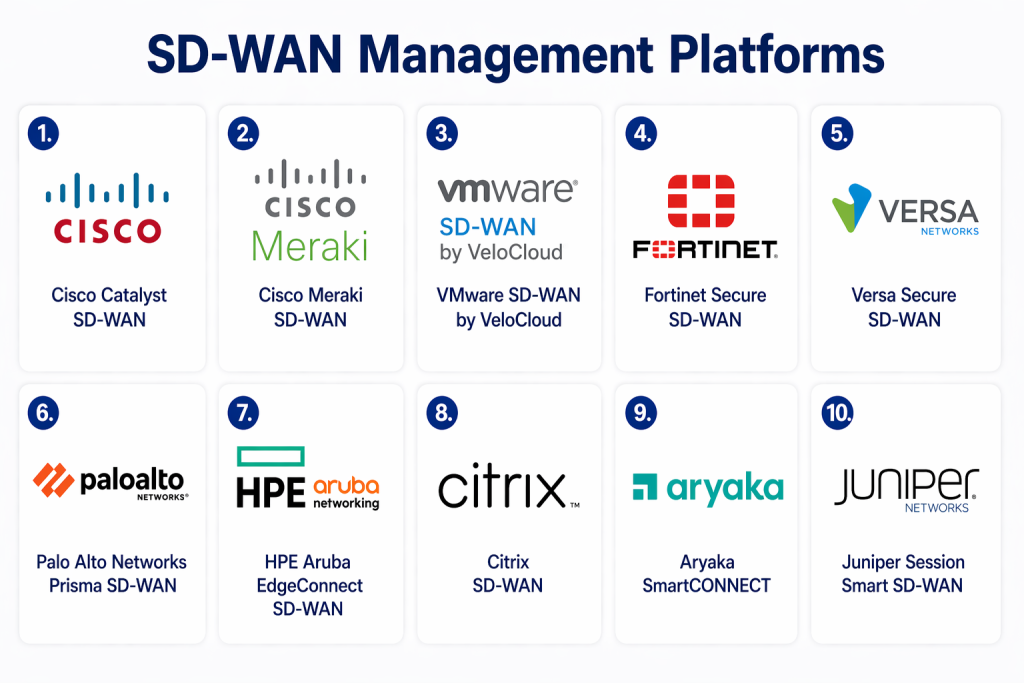
Top 10 SD-WAN Management Platforms
#1 — Cisco SD-WAN (Meraki + Viptela)
Short description:
A leading SD-WAN platform offering centralized cloud management, strong security, and enterprise-grade scalability.
Key Features
- Centralized policy management
- Application-aware routing
- Integrated security features
- Cloud-based orchestration
- Multi-cloud connectivity
- Real-time analytics
- Zero-touch provisioning
Pros
- Strong enterprise adoption
- Robust security and performance
Cons
- Complex licensing
- Cisco-centric ecosystem
Platforms / Deployment
Cloud / On-prem / Hybrid
Security & Compliance
Encryption, RBAC, secure access controls (certifications not publicly stated)
Integrations & Ecosystem
Extensive integrations across networking and cloud tools.
- Cloud providers
- Security platforms
- APIs
Support & Community
Strong enterprise support and global presence
#2 — VMware SD-WAN (VeloCloud)
Short description:
A cloud-first SD-WAN solution focused on application performance and simplified management.
Key Features
- Dynamic multipath optimization
- Cloud gateway architecture
- Application performance monitoring
- Centralized orchestration
- Edge device management
- Secure connectivity
Pros
- Strong cloud performance
- Easy deployment
Cons
- Pricing complexity
- Limited customization
Platforms / Deployment
Cloud / Hybrid
Security & Compliance
Encryption, secure tunnels (certifications not publicly stated)
Integrations & Ecosystem
Integrates with cloud and virtualization platforms.
Support & Community
Strong enterprise support
#3 — Fortinet Secure SD-WAN
Short description:
A security-focused SD-WAN platform integrating firewall and advanced threat protection.
Key Features
- Built-in next-gen firewall
- Application control
- Secure VPN connectivity
- Centralized management
- Traffic steering
- Threat detection
Pros
- Strong integrated security
- High performance
Cons
- Requires Fortinet ecosystem
- Learning curve
Platforms / Deployment
Cloud / On-prem / Hybrid
Security & Compliance
Firewall, encryption, security controls
Integrations & Ecosystem
Works within Fortinet security ecosystem.
Support & Community
Enterprise-grade support
#4 — Versa Secure SD-WAN
Short description:
A software-driven SD-WAN platform offering networking and security in a unified solution.
Key Features
- Centralized orchestration
- Integrated security services
- Multi-tenant support
- Application-aware routing
- Automation capabilities
- Cloud-native design
Pros
- Flexible deployment
- Strong security integration
Cons
- Complex setup
- Requires expertise
Platforms / Deployment
Cloud / Hybrid
Security & Compliance
Encryption, access controls
Integrations & Ecosystem
API-driven integrations with cloud and security tools
Support & Community
Strong enterprise support
#5 — Palo Alto Prisma SD-WAN
Short description:
A next-generation SD-WAN platform combining networking with advanced security and AI-driven insights.
Key Features
- AI-based network optimization
- Integrated security platform
- Centralized management
- Cloud integration
- Real-time analytics
- Zero-touch deployment
Pros
- Strong security capabilities
- AI-driven insights
Cons
- Premium pricing
- Complex deployment
Platforms / Deployment
Cloud / Hybrid
Security & Compliance
Firewall, encryption, zero trust features
Integrations & Ecosystem
Integrates with security and cloud platforms
Support & Community
Enterprise-level support
#6 — Aruba EdgeConnect SD-WAN
Short description:
A performance-focused SD-WAN solution designed to improve application delivery and network efficiency.
Key Features
- Application optimization
- Centralized orchestration
- WAN optimization
- Traffic shaping
- Real-time analytics
Pros
- Strong performance optimization
- Enterprise capabilities
Cons
- Higher cost
- Complex setup
Platforms / Deployment
Hybrid
Security & Compliance
Encryption, policy enforcement
Integrations & Ecosystem
Supports integrations with enterprise tools
Support & Community
Strong enterprise support
#7 — Citrix SD-WAN
Short description:
A cloud-integrated SD-WAN solution designed for secure application delivery and hybrid work environments.
Key Features
- Application-aware routing
- Integrated security
- WAN optimization
- Centralized control
- Cloud connectivity
Pros
- Strong cloud integration
- Secure application delivery
Cons
- Limited flexibility
- Requires Citrix ecosystem
Platforms / Deployment
Cloud / Hybrid
Security & Compliance
Encryption, firewall integration
Integrations & Ecosystem
Works with Citrix and cloud platforms
Support & Community
Vendor support available
#8 — Aryaka SmartServices SD-WAN
Short description:
A managed SD-WAN service focused on global connectivity and cloud-first networking.
Key Features
- Managed SD-WAN service
- Global connectivity
- Cloud-first architecture
- Centralized management
- Performance optimization
Pros
- Easy deployment
- Global reach
Cons
- Less customization
- Managed service dependency
Platforms / Deployment
Cloud
Security & Compliance
Encryption, secure connectivity
Integrations & Ecosystem
Supports cloud integrations
Support & Community
Strong managed support
#9 — Juniper Session Smart SD-WAN
Short description:
A modern SD-WAN solution focused on efficiency and session-based routing.
Key Features
- Session-based routing
- Centralized management
- Secure connectivity
- Performance optimization
- Automation capabilities
Pros
- Efficient routing model
- Strong performance
Cons
- Learning curve
- Smaller ecosystem
Platforms / Deployment
Cloud / Hybrid
Security & Compliance
Encryption, access controls
Integrations & Ecosystem
API-based integrations
Support & Community
Enterprise support
#10 — Zscaler SD-WAN (Cloud-delivered)
Short description:
A cloud-native SD-WAN solution integrated with secure access and zero trust architecture.
Key Features
- Cloud-based management
- Zero Trust security
- Secure access
- Traffic optimization
- Real-time analytics
Pros
- Strong security focus
- Cloud-native design
Cons
- Requires internet dependency
- Limited on-prem control
Platforms / Deployment
Cloud
Security & Compliance
Zero trust, encryption, access controls
Integrations & Ecosystem
Integrates with cloud and security platforms
Support & Community
Enterprise support
Comparison Table (Top 10)
| Tool Name | Best For | Platform(s) Supported | Deployment | Standout Feature | Public Rating |
|---|---|---|---|---|---|
| Cisco SD-WAN | Enterprise | Multi-platform | Hybrid | Centralized control | N/A |
| VMware SD-WAN | Cloud environments | Multi-platform | Cloud/Hybrid | Multipath optimization | N/A |
| Fortinet SD-WAN | Security-focused | Multi-platform | Hybrid | Built-in firewall | N/A |
| Versa SD-WAN | Unified networking | Multi-platform | Hybrid | Software-driven platform | N/A |
| Prisma SD-WAN | AI + security | Multi-platform | Hybrid | AI optimization | N/A |
| Aruba EdgeConnect | Performance | Multi-platform | Hybrid | WAN optimization | N/A |
| Citrix SD-WAN | Hybrid workforce | Multi-platform | Hybrid | App delivery | N/A |
| Aryaka | Managed SD-WAN | Multi-platform | Cloud | Global reach | N/A |
| Juniper SD-WAN | Efficient routing | Multi-platform | Hybrid | Session-based routing | N/A |
| Zscaler SD-WAN | Zero Trust | Multi-platform | Cloud | Cloud security | N/A |
Evaluation & Scoring of SD-WAN Management Platforms
| Tool Name | Core | Ease | Integrations | Security | Performance | Support | Value | Weighted Total |
|---|---|---|---|---|---|---|---|---|
| Cisco | 9 | 7 | 9 | 9 | 9 | 9 | 7 | 8.6 |
| VMware | 8 | 8 | 8 | 8 | 9 | 8 | 7 | 8.2 |
| Fortinet | 9 | 7 | 8 | 10 | 9 | 8 | 7 | 8.5 |
| Versa | 8 | 6 | 8 | 9 | 8 | 7 | 7 | 7.9 |
| Prisma | 9 | 7 | 9 | 10 | 9 | 8 | 6 | 8.6 |
| Aruba | 8 | 6 | 7 | 8 | 9 | 7 | 7 | 7.8 |
| Citrix | 8 | 7 | 7 | 8 | 8 | 7 | 7 | 7.7 |
| Aryaka | 8 | 8 | 7 | 8 | 8 | 8 | 7 | 8.0 |
| Juniper | 8 | 6 | 7 | 8 | 9 | 7 | 7 | 7.8 |
| Zscaler | 9 | 8 | 9 | 10 | 8 | 8 | 6 | 8.5 |
Interpretation:
Scores represent a balanced comparison across functionality, usability, and value. Security-focused platforms rank higher in compliance, while cloud-native solutions excel in ease of deployment and scalability.
Which SD-WAN Management Platform Is Right for You?
Solo / Freelancer
- Not typically required
SMB
- VMware SD-WAN, Aruba
- Easy deployment and cost efficiency
Mid-Market
- Fortinet, Versa
- Balanced features and security
Enterprise
- Cisco, Prisma, Zscaler
- Advanced security and scalability
Budget vs Premium
- Budget: Aruba, Citrix
- Premium: Cisco, Prisma
Feature Depth vs Ease of Use
- Deep features: Cisco
- Ease of use: VMware
Integrations & Scalability
- Strongest: Cisco, Zscaler
Security & Compliance Needs
- Best: Fortinet, Prisma, Zscaler
Frequently Asked Questions (FAQs)
1. What is an SD-WAN management platform?
It is a solution that centralizes the control and management of wide-area networks, allowing administrators to manage traffic, policies, and performance from a single interface.
2. How does SD-WAN improve network performance?
SD-WAN dynamically routes traffic over the best available path, improving latency and reliability while reducing congestion.
3. Is SD-WAN secure?
Yes, most platforms include encryption, firewalls, and zero trust features to secure network traffic.
4. What is the difference between SD-WAN and traditional WAN?
Traditional WAN relies on static routing and hardware, while SD-WAN uses software-defined control and centralized management.
5. Can SD-WAN replace MPLS?
In many cases, yes. SD-WAN can reduce reliance on MPLS by using broadband and internet connections efficiently.
6. How long does deployment take?
Deployment can range from days to weeks depending on network size and complexity.
7. What industries benefit most from SD-WAN?
Retail, healthcare, finance, and global enterprises benefit the most due to distributed operations.
8. Does SD-WAN support cloud applications?
Yes, it is designed to optimize SaaS and cloud performance.
9. What is zero-touch provisioning?
It allows devices to be deployed automatically without manual configuration.
10. What should I avoid when choosing a platform?
Avoid platforms that lack scalability, security features, or integration capabilities.
Conclusion
SD-WAN management platforms have become a critical foundation for modern enterprise networking, enabling centralized control, automation, and intelligent traffic management across distributed environments. As organizations continue to adopt cloud-first and hybrid infrastructures, these platforms provide the flexibility and scalability needed to maintain performance and security.
The right platform depends heavily on your organization’s priorities. Security-focused platforms offer integrated protection, while cloud-native solutions emphasize simplicity and rapid deployment. Enterprises typically benefit from platforms with advanced automation, analytics, and global scalability, while mid-sized organizations may prioritize ease of use and cost efficiency.
