Introduction
Observability Platforms are tools designed to collect, correlate, and analyze telemetry data—including logs, metrics, and traces—from applications, infrastructure, and cloud environments. Unlike traditional monitoring, observability emphasizes contextual insight and root-cause analysis, enabling teams to understand system behavior and respond faster to incidents.
Modern software architectures—such as microservices, serverless applications, and hybrid cloud environments—demand full-stack visibility. Observability platforms help organizations reduce downtime, optimize performance, and improve user experience by providing actionable insights from complex systems.
Real-world use cases include:
- Monitoring distributed microservices across hybrid cloud environments
- Tracing requests to diagnose performance bottlenecks
- Correlating metrics and logs for faster incident response
- Detecting anomalies and predicting outages
- Supporting DevOps and SRE teams with dashboards and alerts
What buyers should evaluate:
- Full-stack telemetry collection (logs, metrics, traces)
- Alerting and anomaly detection capabilities
- Integration with cloud, containers, and serverless workloads
- Real-time analytics and dashboards
- Scalability for high-volume environments
- Collaboration and incident management features
- API and ecosystem integrations
- Security and access control
- Data retention and storage flexibility
- Cost and operational efficiency
Best for: DevOps, SRE, IT operations, cloud architects, and enterprises operating complex distributed systems.
Not ideal for: Small environments with minimal telemetry or where basic monitoring is sufficient.
Key Trends in Observability Platforms
- AI-driven anomaly detection and predictive alerts
- Integration with DevOps and CI/CD pipelines
- Unified logging, metrics, and tracing (full observability)
- Cloud-native and container-first architectures
- OpenTelemetry adoption as standard for telemetry collection
- Self-healing and automated remediation workflows
- Role-based dashboards and collaboration for SRE/DevOps teams
- Multi-cloud and hybrid visibility
- Observability as a service (SaaS) adoption
- Correlation of telemetry with business KPIs
How We Selected These Tools (Methodology)
- Evaluated market adoption and enterprise usage
- Reviewed full-stack telemetry capabilities
- Assessed analytics, dashboards, and anomaly detection
- Considered integration with cloud, container, and DevOps ecosystems
- Compared ease of deployment and operational usability
- Included tools suitable for enterprise, mid-market, and developer-first teams
- Analyzed scalability for high-volume telemetry
- Evaluated security, access control, and compliance features
- Focused on real-world observability effectiveness and speed
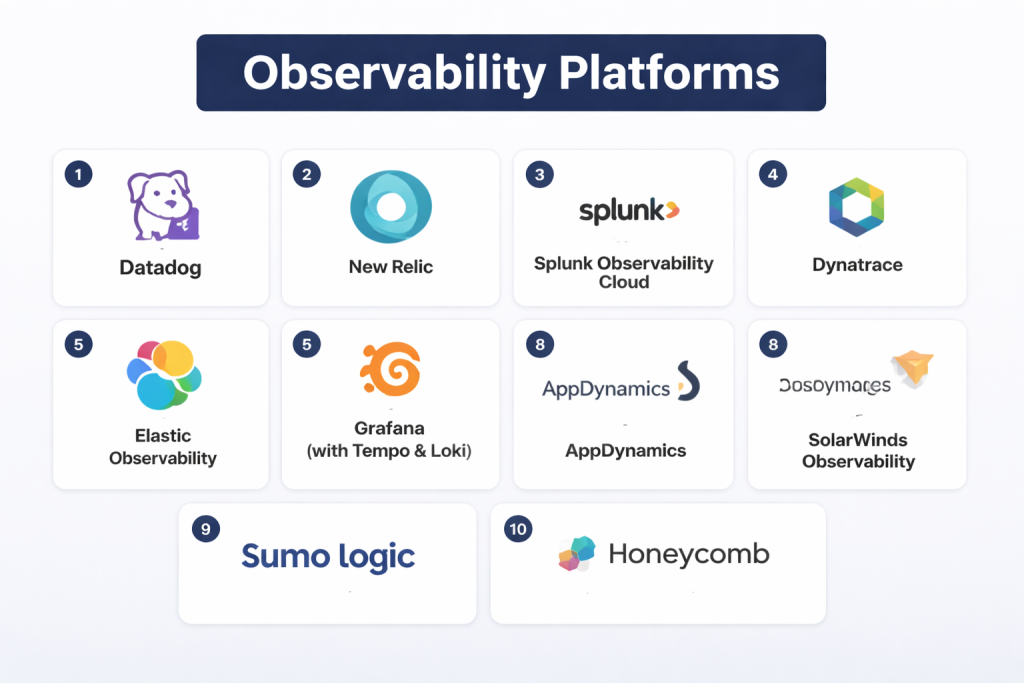
Top 10 Observability Platforms
#1 — Datadog
Short description: Datadog is a cloud-native observability platform providing unified monitoring for infrastructure, applications, logs, and traces.
Key Features
- Full-stack metrics, logs, and traces
- Real-time dashboards and alerting
- AI-assisted anomaly detection
- Cloud, container, and Kubernetes monitoring
- API-first integrations
- Collaboration and incident response features
Pros
- Highly scalable cloud-native platform
- Strong ecosystem integrations
- Unified dashboards across telemetry
Cons
- Premium pricing for high-volume telemetry
- Learning curve for advanced features
Platforms / Deployment
Web / Cloud
Security & Compliance
RBAC, encryption, audit logs (details not publicly stated)
Integrations & Ecosystem
- AWS, Azure, GCP
- Kubernetes and Docker
- CI/CD and monitoring tools
Support & Community
Extensive documentation, enterprise support, and active user community.
#2 — New Relic
Short description: New Relic provides full-stack observability with insights into applications, infrastructure, and customer experience.
Key Features
- Application performance monitoring
- Infrastructure and log monitoring
- Distributed tracing
- Anomaly detection and AI-driven alerts
- Real-time dashboards and visualization
- Integration with DevOps tools
Pros
- Unified observability across stacks
- Developer-friendly and cloud-native
- Strong analytics capabilities
Cons
- Complex pricing tiers
- UI can be overwhelming for small teams
Platforms / Deployment
Web / Cloud
Security & Compliance
Not publicly stated
Integrations & Ecosystem
- Cloud platforms: AWS, Azure, GCP
- CI/CD pipelines
- Logging and monitoring tools
Support & Community
Enterprise support and extensive documentation.
#3 — Splunk Observability Cloud
Short description: Splunk provides a comprehensive observability platform with advanced analytics, dashboards, and anomaly detection for enterprise-scale systems.
Key Features
- Metrics, logs, and traces correlation
- Real-time incident response dashboards
- AI and machine learning-assisted analytics
- Infrastructure and application monitoring
- Alerting and workflow automation
- Cloud-native deployment support
Pros
- Enterprise-grade scalability
- Strong analytics and machine learning
- Broad ecosystem and integration
Cons
- Expensive for high-volume environments
- Onboarding complexity
Platforms / Deployment
Web / Cloud
Security & Compliance
RBAC, encryption, audit logs (details not publicly stated)
Integrations & Ecosystem
- Cloud providers and Kubernetes
- CI/CD and DevOps tools
- ITSM and incident response systems
Support & Community
Strong enterprise support and active community.
#4 — Dynatrace
Short description: Dynatrace delivers AI-powered observability with automatic full-stack instrumentation and root-cause analysis.
Key Features
- Automatic deployment and instrumentation
- Full-stack monitoring with traces and logs
- AI-driven root-cause analysis
- Cloud and container monitoring
- Real-time alerts and dashboards
- Digital experience monitoring
Pros
- Automatic instrumentation reduces configuration
- Strong AI-assisted insights
- Cloud-native and scalable
Cons
- Premium pricing
- Learning curve for advanced dashboards
Platforms / Deployment
Web / Cloud
Security & Compliance
Not publicly stated
Integrations & Ecosystem
- Kubernetes and cloud platforms
- CI/CD pipelines
- Monitoring and logging tools
Support & Community
Enterprise-grade support and documentation.
#5 — Elastic Observability
Short description: Elastic Observability unifies logs, metrics, and APM traces for monitoring and troubleshooting distributed systems.
Key Features
- Centralized log and metrics management
- Distributed tracing for applications
- Alerting and anomaly detection
- Visualization with Kibana dashboards
- OpenTelemetry support
- Elastic Stack integrations
Pros
- Open-source core with enterprise support
- Flexible and scalable
- Strong visualization tools
Cons
- Setup complexity for large environments
- Advanced features require enterprise subscription
Platforms / Deployment
Web / Cloud / On-premises
Security & Compliance
Not publicly stated
Integrations & Ecosystem
- Elastic Stack: Elasticsearch, Kibana, Beats
- Cloud platforms and containers
- CI/CD pipelines
Support & Community
Strong open-source community and enterprise support.
#6 — AppDynamics
Short description: AppDynamics provides application performance monitoring with full observability into business and infrastructure performance.
Key Features
- End-to-end application monitoring
- Business transaction monitoring
- Distributed tracing
- Real-time dashboards and alerting
- Cloud and hybrid environment support
- Performance baselining and anomaly detection
Pros
- Strong business-centric monitoring
- Deep APM capabilities
- Supports hybrid and cloud environments
Cons
- Premium pricing
- Focused more on APM than pure infrastructure
Platforms / Deployment
Web / Cloud
Security & Compliance
Not publicly stated
Integrations & Ecosystem
- Cloud providers and Kubernetes
- CI/CD and DevOps tools
- Incident management systems
Support & Community
Enterprise-level support and documentation.
#7 — Grafana (with Tempo & Loki)
Short description: Grafana provides observability via visualization dashboards, metrics, logs (Loki), and traces (Tempo), supporting cloud-native and microservices environments.
Key Features
- Unified dashboards for logs, metrics, and traces
- Open-source and extensible
- Alerting and notifications
- Integration with Prometheus, Kubernetes, and cloud metrics
- API-first integrations
- Multi-tenant support
Pros
- Highly flexible and open-source
- Strong visualization and analytics
- Good for Kubernetes-native stacks
Cons
- Requires configuration for full observability
- Enterprise features require Grafana Enterprise
Platforms / Deployment
Web / Cloud / On-premises
Security & Compliance
Not publicly stated
Integrations & Ecosystem
- Prometheus, Loki, Tempo
- Kubernetes and cloud metrics
- CI/CD pipelines
Support & Community
Large open-source community and enterprise support available.
#8 — SolarWinds Observability
Short description: SolarWinds Observability provides infrastructure and application monitoring with integrated alerting and dashboards.
Key Features
- Metrics, logs, and network observability
- Custom dashboards and alerts
- Distributed system monitoring
- Automated anomaly detection
- Multi-cloud monitoring
- API integrations
Pros
- Broad infrastructure coverage
- Enterprise-focused features
- Easy to deploy for hybrid environments
Cons
- Less developer-centric than cloud-native competitors
- UI can feel complex
Platforms / Deployment
Web / Cloud / On-premises
Security & Compliance
Not publicly stated
Integrations & Ecosystem
- Cloud providers: AWS, Azure, GCP
- Network devices and servers
- DevOps and CI/CD tools
Support & Community
Enterprise support and documentation.
#9 — Sumo Logic
Short description: Sumo Logic provides cloud-native observability with log analytics, metrics, and distributed tracing.
Key Features
- Log aggregation and analytics
- Metrics collection and monitoring
- Tracing for applications
- Real-time dashboards and alerts
- Security and operational insights
- API-first and cloud-native
Pros
- Scalable cloud-native platform
- Strong analytics and reporting
- Unified telemetry
Cons
- Enterprise pricing
- Requires proper configuration for best insights
Platforms / Deployment
Web / Cloud
Security & Compliance
Not publicly stated
Integrations & Ecosystem
- Cloud services and Kubernetes
- CI/CD and monitoring pipelines
- Incident management tools
Support & Community
Enterprise support and documentation.
#10 — Honeycomb
Short description: Honeycomb provides observability with high-cardinality analytics and event-based tracing for modern microservices and distributed systems.
Key Features
- High-cardinality event analytics
- Distributed tracing and logs
- Query-based real-time analysis
- Collaboration and debugging workflows
- Cloud-native support
- Alerting and anomaly detection
Pros
- Strong for microservices and cloud-native stacks
- Developer-friendly query system
- Real-time troubleshooting
Cons
- May require learning curve
- Pricing scales with event volume
Platforms / Deployment
Web / Cloud
Security & Compliance
Not publicly stated
Integrations & Ecosystem
- Kubernetes and cloud-native apps
- CI/CD pipelines
- Observability and monitoring ecosystem
Support & Community
Active community and enterprise support.
Comparison Table (Top 10)
| Tool Name | Best For | Platform(s) Supported | Deployment | Standout Feature | Public Rating |
|---|---|---|---|---|---|
| Datadog | Cloud-native observability | Multi-platform | Cloud | Full-stack telemetry | N/A |
| New Relic | Full-stack monitoring | Multi-platform | Cloud | Application + infra insights | N/A |
| Splunk Observability Cloud | Enterprise observability | Multi-platform | Cloud | Advanced analytics | N/A |
| Dynatrace | AI-powered observability | Multi-platform | Cloud | Automatic instrumentation | N/A |
| Elastic Observability | Open-source flexibility | Multi-platform | Cloud / On-prem | Kibana dashboards | N/A |
| AppDynamics | Business-focused APM | Multi-platform | Cloud | Business transaction tracing | N/A |
| Grafana | Open-source visualization | Multi-platform | Cloud / On-prem | Unified dashboards | N/A |
| SolarWinds Observability | Infrastructure monitoring | Multi-platform | Cloud / On-prem | Network + infra coverage | N/A |
| Sumo Logic | Cloud-native logging & metrics | Multi-platform | Cloud | Cloud log analytics | N/A |
| Honeycomb | Microservices tracing | Multi-platform | Cloud | Event-based high-cardinality analysis | N/A |
Evaluation & Scoring of Observability Platforms
| Tool Name | Core (25%) | Ease (15%) | Integrations (15%) | Security (10%) | Performance (10%) | Support (10%) | Value (15%) | Weighted Total (0–10) |
|---|---|---|---|---|---|---|---|---|
| Datadog | 9 | 8 | 9 | 8 | 8 | 8 | 7 | 8.3 |
| New Relic | 9 | 8 | 8 | 8 | 8 | 8 | 7 | 8.1 |
| Splunk | 9 | 7 | 9 | 8 | 8 | 8 | 7 | 8.0 |
| Dynatrace | 9 | 8 | 8 | 8 | 8 | 8 | 7 | 8.0 |
| Elastic | 8 | 7 | 8 | 8 | 8 | 7 | 7 | 7.6 |
| AppDynamics | 8 | 7 | 8 | 8 | 8 | 7 | 7 | 7.6 |
| Grafana | 8 | 7 | 7 | 8 | 7 | 7 | 8 | 7.5 |
| SolarWinds | 8 | 7 | 7 | 8 | 7 | 7 | 7 | 7.4 |
| Sumo Logic | 8 | 7 | 8 | 8 | 7 | 7 | 7 | 7.5 |
| Honeycomb | 8 | 7 | 7 | 8 | 7 | 7 | 7 | 7.4 |
Which Observability Platform Is Right for You?
Solo / Developer
Grafana or Honeycomb are flexible, cloud-native, and open-source options.
SMB
Datadog and New Relic provide fast deployment and good cloud telemetry.
Mid-Market
Elastic Observability and Sumo Logic provide scalability with rich dashboards.
Enterprise
Splunk, Dynatrace, AppDynamics, and SolarWinds are suitable for large-scale telemetry, AI-driven analysis, and multi-team collaboration.
Cloud-Native vs On-Prem
Cloud-native platforms like Datadog, Dynatrace, and Honeycomb offer rapid deployment and scaling; Grafana and Elastic provide hybrid and self-hosted flexibility.
Feature Depth vs Ease of Use
Datadog and Dynatrace provide automated insights, whereas Grafana and Honeycomb prioritize customization and developer-friendly analytics.
Integrations & Scalability
Ensure the platform supports your cloud providers, container orchestration, CI/CD, and alerting tools.
Security & Compliance
Enterprise environments should prioritize RBAC, encryption, audit logging, and compliance-ready reporting.
Frequently Asked Questions (FAQs)
1. What is an observability platform?
It provides visibility into system health through logs, metrics, and traces for troubleshooting and performance optimization.
2. How is it different from monitoring?
Monitoring focuses on predefined alerts; observability emphasizes root-cause analysis and exploratory debugging.
3. Do these tools support cloud-native applications?
Yes, all listed tools support modern cloud and microservices architectures.
4. Can observability reduce downtime?
Yes, by enabling faster detection and resolution of incidents.
5. Are open-source tools viable for enterprise observability?
Yes, tools like Grafana and Elastic are scalable and can be extended for enterprise use.
6. Can these tools integrate with CI/CD pipelines?
Yes, integration with DevOps workflows and pipelines is common.
7. Do observability tools use AI?
Many platforms leverage AI for anomaly detection, alert triage, and predictive insights.
8. Are these tools suitable for hybrid environments?
Yes, most support multi-cloud, hybrid, and on-premises deployments.
9. How do I choose an observability platform?
Evaluate team size, system complexity, telemetry volume, and integration needs.
10. Can these tools monitor microservices and containers?
Yes, modern observability platforms provide telemetry collection for containerized and microservice architectures.
Conclusion
Observability platforms are essential for modern software teams that operate distributed, cloud-native, or hybrid systems. They provide the ability to detect, analyze, and resolve issues faster, improving uptime and user experience. Open-source and developer-friendly platforms like Grafana or Honeycomb suit small teams and microservices deployments, while enterprise-grade platforms like Datadog, Dynatrace, and Splunk are ideal for large organizations with complex, high-volume telemetry needs. Selecting the right platform requires balancing feature depth, ease of use, integrations, scalability, and cost, and piloting several options ensures the best fit for your operational and business goals.
