Introduction
Kubernetes Management Platforms help organizations simplify the deployment, monitoring, governance, and scaling of Kubernetes clusters across environments. In simple terms, while Kubernetes handles container orchestration, these platforms act as a control layer to manage multiple clusters, users, policies, and workloads efficiently.
As Kubernetes adoption grows, managing clusters manually becomes complex—especially in multi-cloud and hybrid environments. Kubernetes management tools solve this by providing centralized dashboards, automation, security policies, and lifecycle management capabilities. They are essential for platform engineering teams, DevOps teams, and enterprises operating at scale.
Modern platforms go beyond basic cluster management. They include features like GitOps workflows, RBAC governance, observability, cost optimization, compliance controls, and developer self-service portals.
Common use cases include:
- Multi-cluster management
- Centralized governance and policy enforcement
- DevOps and GitOps workflows
- Monitoring and observability
- Hybrid and multi-cloud Kubernetes operations
What buyers should evaluate:
- Ease of cluster management
- Multi-cloud support
- Security and RBAC controls
- Automation capabilities
- Observability and monitoring
- Integration ecosystem
- Developer experience
- Scalability
- Cost and licensing
- Support and community
Best for: DevOps teams, platform engineers, enterprises, SaaS companies, and cloud-native organizations.
Not ideal for: Small teams running a single Kubernetes cluster with minimal complexity.
Key Trends in Kubernetes Management Platforms
- Growth of platform engineering and internal developer platforms
- GitOps-based deployment becoming standard
- Multi-cloud and hybrid Kubernetes management
- AI-driven observability and optimization
- Policy-as-code governance
- Self-service developer portals
- Cost visibility and optimization tools
- Integration with CI/CD pipelines
- Simplified cluster lifecycle management
- Enhanced security and compliance controls
How We Selected These Tools (Methodology)
- Market adoption and reputation
- Feature completeness
- Ease of use
- Multi-cluster support
- Integration ecosystem
- Security capabilities
- Scalability
- Automation and DevOps support
- Vendor reliability
- Overall value
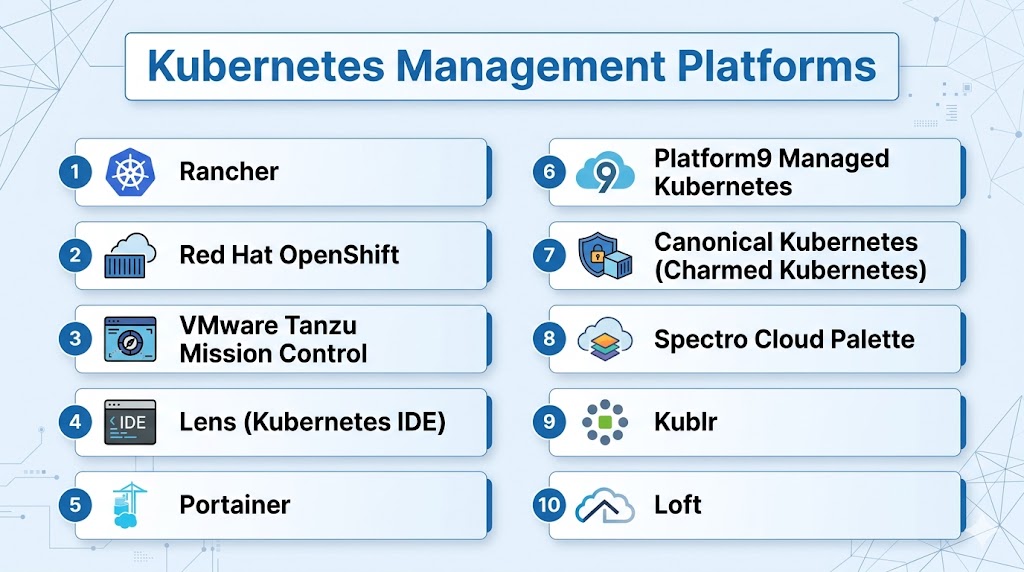
Top 10 Kubernetes Management Platforms
#1 — Rancher
Short description: One of the most popular Kubernetes management platforms for multi-cluster environments.
Key Features
- Multi-cluster management
- Centralized dashboard
- RBAC and access control
- Monitoring tools
- Policy enforcement
- Multi-cloud support
Pros
- Strong open-source community
- Multi-cloud flexibility
Cons
- Requires Kubernetes knowledge
- Setup complexity
Platforms / Deployment
Linux / Cloud
Cloud / Hybrid
Security & Compliance
Enterprise-grade RBAC and policies.
Integrations & Ecosystem
Kubernetes ecosystem, CI/CD tools.
Support & Community
Strong open-source adoption.
#2 — Red Hat OpenShift
Short description: Enterprise Kubernetes platform with integrated management, security, and developer tools.
Key Features
- Cluster management
- Built-in CI/CD
- Security policies
- Developer console
- Monitoring and logging
- Multi-cloud support
Pros
- Enterprise-ready platform
- Strong security features
Cons
- Premium pricing
- Requires expertise
Platforms / Deployment
Linux / Cloud
Cloud / Hybrid
Security & Compliance
Enterprise-grade controls.
Integrations & Ecosystem
Red Hat ecosystem, enterprise tools.
Support & Community
Strong enterprise support.
#3 — VMware Tanzu Mission Control
Short description: Centralized Kubernetes management platform for VMware environments.
Key Features
- Cluster lifecycle management
- Policy management
- Access control
- Monitoring tools
- Multi-cloud support
- Backup and restore
Pros
- Strong enterprise integration
- Reliable performance
Cons
- VMware dependency
- Premium pricing
Platforms / Deployment
Cloud / Hybrid
Security & Compliance
Enterprise-grade controls.
Integrations & Ecosystem
VMware ecosystem.
Support & Community
Strong enterprise presence.
#4 — Lens (Kubernetes IDE)
Short description: Desktop-based Kubernetes IDE for developers and operators.
Key Features
- Cluster visualization
- Resource management
- Real-time metrics
- Multi-cluster support
- Plugin ecosystem
- Debugging tools
Pros
- Developer-friendly UI
- Easy to use
Cons
- Limited enterprise governance
- Desktop-focused
Platforms / Deployment
Windows / macOS / Linux
Security & Compliance
Basic controls available.
Integrations & Ecosystem
Kubernetes tools and plugins.
Support & Community
Large developer user base.
#5 — Portainer
Short description: Lightweight container and Kubernetes management platform with simple UI.
Key Features
- Cluster management
- Role-based access control
- Application deployment
- Monitoring tools
- Dashboard interface
- Multi-platform support
Pros
- Easy to use
- Lightweight
Cons
- Limited advanced features
- Smaller enterprise capabilities
Platforms / Deployment
Cross-platform
Cloud / Self-hosted
Security & Compliance
Basic enterprise controls available.
Integrations & Ecosystem
Docker, Kubernetes.
Support & Community
Growing community.
#6 — Platform9 Managed Kubernetes
Short description: SaaS-based Kubernetes management platform with centralized control plane.
Key Features
- Managed clusters
- Automation tools
- Monitoring and analytics
- Multi-cloud support
- Security controls
- Centralized dashboard
Pros
- Simplified operations
- Multi-cloud flexibility
Cons
- Smaller vendor ecosystem
- Pricing varies
Platforms / Deployment
Cloud / Hybrid
Security & Compliance
Enterprise controls available.
Integrations & Ecosystem
Cloud providers, DevOps tools.
Support & Community
Growing adoption.
#7 — Canonical Charmed Kubernetes
Short description: Flexible Kubernetes distribution with strong automation capabilities.
Key Features
- Automated deployment
- Lifecycle management
- Multi-cloud support
- Monitoring tools
- Security controls
- Open-source flexibility
Pros
- Flexible and customizable
- Open-source
Cons
- Requires expertise
- Smaller ecosystem
Platforms / Deployment
Linux
Cloud / Hybrid
Security & Compliance
Enterprise controls available.
Integrations & Ecosystem
Open-source tools.
Support & Community
Active community.
#8 — Spectro Cloud Palette
Short description: Platform for managing Kubernetes clusters across edge, cloud, and data center environments.
Key Features
- Multi-cluster management
- Edge Kubernetes support
- Lifecycle automation
- Policy management
- Monitoring tools
- Centralized control
Pros
- Strong edge computing capabilities
- Multi-environment support
Cons
- Smaller market presence
- Learning curve
Platforms / Deployment
Cloud / Hybrid
Security & Compliance
Enterprise-grade controls.
Integrations & Ecosystem
Cloud and edge tools.
Support & Community
Growing adoption.
#9 — Kublr
Short description: Enterprise Kubernetes platform for multi-cloud and on-prem deployments.
Key Features
- Cluster lifecycle management
- Automation tools
- Monitoring and analytics
- Security controls
- Multi-cloud support
- Centralized management
Pros
- Strong enterprise features
- Flexible deployment
Cons
- Smaller ecosystem
- Premium pricing
Platforms / Deployment
Cloud / Hybrid
Security & Compliance
Enterprise-grade controls.
Integrations & Ecosystem
Cloud providers and DevOps tools.
Support & Community
Enterprise-focused support.
#10 — Loft
Short description: Kubernetes platform designed for developer self-service and multi-tenancy.
Key Features
- Virtual clusters
- Developer self-service
- Multi-tenancy
- Resource isolation
- Automation tools
- Integration support
Pros
- Great for platform engineering
- Developer-friendly
Cons
- Requires Kubernetes knowledge
- Smaller ecosystem
Platforms / Deployment
Cloud / Hybrid
Security & Compliance
Advanced isolation and RBAC controls.
Integrations & Ecosystem
Kubernetes ecosystem.
Support & Community
Growing developer adoption.
Comparison Table (Top 10)
| Tool Name | Best For | Platform(s) Supported | Deployment | Standout Feature | Public Rating |
|---|---|---|---|---|---|
| Rancher | Multi-cluster teams | Cross-platform | Hybrid | Centralized management | N/A |
| OpenShift | Enterprises | Linux/Cloud | Hybrid | Enterprise Kubernetes | N/A |
| VMware Tanzu | Enterprises | Cloud | Hybrid | VMware integration | N/A |
| Lens | Developers | Cross-platform | Desktop | Kubernetes IDE | N/A |
| Portainer | SMBs | Cross-platform | Hybrid | Simplicity | N/A |
| Platform9 | Multi-cloud teams | Cloud | Hybrid | SaaS control plane | N/A |
| Charmed Kubernetes | Open-source users | Linux | Hybrid | Flexibility | N/A |
| Spectro Cloud | Edge/cloud teams | Cloud | Hybrid | Edge Kubernetes | N/A |
| Kublr | Enterprises | Cloud | Hybrid | Multi-cloud support | N/A |
| Loft | Dev platforms | Cloud | Hybrid | Virtual clusters | N/A |
Evaluation & Scoring of Kubernetes Management Platforms
| Tool Name | Core (25%) | Ease (15%) | Integrations (15%) | Security (10%) | Performance (10%) | Support (10%) | Value (15%) | Weighted Total |
|---|---|---|---|---|---|---|---|---|
| Rancher | 9 | 8 | 9 | 9 | 8 | 8 | 9 | 8.7 |
| OpenShift | 9 | 7 | 9 | 10 | 9 | 9 | 7 | 8.7 |
| VMware Tanzu | 9 | 8 | 9 | 9 | 9 | 9 | 7 | 8.8 |
| Lens | 7 | 9 | 7 | 7 | 7 | 7 | 9 | 7.7 |
| Portainer | 8 | 9 | 7 | 8 | 8 | 7 | 9 | 8.1 |
| Platform9 | 8 | 8 | 8 | 8 | 8 | 7 | 8 | 8.0 |
| Charmed Kubernetes | 8 | 7 | 8 | 8 | 8 | 7 | 9 | 8.0 |
| Spectro Cloud | 8 | 7 | 8 | 8 | 8 | 7 | 8 | 7.9 |
| Kublr | 8 | 7 | 8 | 8 | 8 | 7 | 7 | 7.8 |
| Loft | 8 | 8 | 8 | 9 | 8 | 7 | 8 | 8.1 |
How to interpret scores:
Enterprise platforms score higher in governance and integrations, while lightweight tools excel in usability and affordability.
Which Kubernetes Management Platform Is Right for You?
Solo / Freelancer
Lens, Portainer
SMB
Portainer, Rancher
Mid-Market
Rancher, Platform9
Enterprise
OpenShift, VMware Tanzu, Kublr
Budget vs Premium
- Budget: Rancher, Portainer
- Premium: OpenShift, VMware Tanzu
Feature Depth vs Ease of Use
- Easy: Portainer, Lens
- Deep: OpenShift, Rancher
Integrations & Scalability
Rancher, VMware Tanzu, OpenShift
Security & Compliance Needs
OpenShift, Tanzu, Loft
Frequently Asked Questions (FAQs)
What is a Kubernetes management platform?
It helps manage clusters, users, and workloads centrally.
Is Kubernetes management necessary?
Yes, especially at scale.
Are these tools cloud-based?
Many support cloud, on-prem, or hybrid.
Which tool is best for beginners?
Portainer or Lens.
Which is best for enterprise?
OpenShift or VMware Tanzu.
Do they support multi-cloud?
Yes, most platforms do.
Can I automate deployments?
Yes, automation is a key feature.
Are open-source options available?
Yes, Rancher is a popular one.
Is security included?
Enterprise tools provide strong controls.
How do I choose?
Evaluate scale, integrations, and complexity.
Conclusion
Kubernetes Management Platforms are essential for organizations running containerized applications at scale. Rancher offers strong multi-cluster management, OpenShift delivers enterprise-grade capabilities, and VMware Tanzu integrates well with enterprise infrastructure. Lightweight tools like Portainer and Lens are ideal for smaller teams, while Platform9 and Spectro Cloud support multi-cloud and edge deployments. The right platform depends on your Kubernetes maturity, team expertise, and operational scale. Start with a solution that matches your current needs and expand as your infrastructure grows.
