Introduction
Webhook Management Tools are platforms that help developers and teams create, monitor, secure, route, retry, and debug webhooks at scale. In simple terms, webhooks are automated HTTP messages sent between applications whenever a specific event occurs—like a payment, signup, or system update.
As businesses increasingly rely on real-time integrations, webhook management has become critical. Instead of polling APIs continuously, webhooks enable instant, event-driven communication, making systems faster and more efficient.
Common Use Cases
- Real-time payment notifications (e.g., Stripe events)
- CI/CD pipeline triggers (GitHub, GitLab)
- SaaS integrations (CRM, marketing tools)
- Monitoring and alerting workflows
- Automation across microservices and cloud apps
What Buyers Should Evaluate
- Reliability (delivery guarantees, retries)
- Security (authentication, signing, encryption)
- Monitoring & debugging capabilities
- Scalability under high traffic
- Ease of integration with APIs
- Developer experience (SDKs, docs)
- Automation & routing features
- Cost efficiency and pricing model
- Deployment flexibility (cloud/self-hosted)
Best for: Developers, DevOps teams, SaaS companies, platform engineers, and enterprises building event-driven architectures.
Not ideal for: Teams with simple integrations, low event volumes, or those relying solely on traditional APIs without real-time requirements.
Key Trends in Webhook Management Tools for 2026 and Beyond
- Webhook-as-a-Service (WaaS): Platforms offering fully managed webhook infrastructure
- AI-powered debugging: Automated anomaly detection in webhook delivery
- Event-driven architecture adoption: Webhooks as a core integration pattern
- Security-first design: HMAC signing, token authentication, and IP whitelisting
- High availability & retry logic: Ensuring guaranteed message delivery
- Observability & logging: Deep visibility into webhook events and failures
- Low-code automation: Visual workflow builders for webhook routing
- Cloud-native scalability: Handling millions of events in real time
- Open-source adoption: Greater flexibility and customization options
- Integration with API platforms: Unified API + webhook management
How We Selected These Tools (Methodology)
- Evaluated industry adoption and developer popularity
- Assessed feature depth (monitoring, retry logic, routing)
- Reviewed security capabilities (authentication, encryption)
- Considered scalability and reliability signals
- Analyzed integration ecosystem and API support
- Evaluated ease of use and developer experience
- Reviewed documentation and community support
- Balanced enterprise and developer-first tools
- Included open-source and SaaS options
- Focused on modern, event-driven architecture compatibility
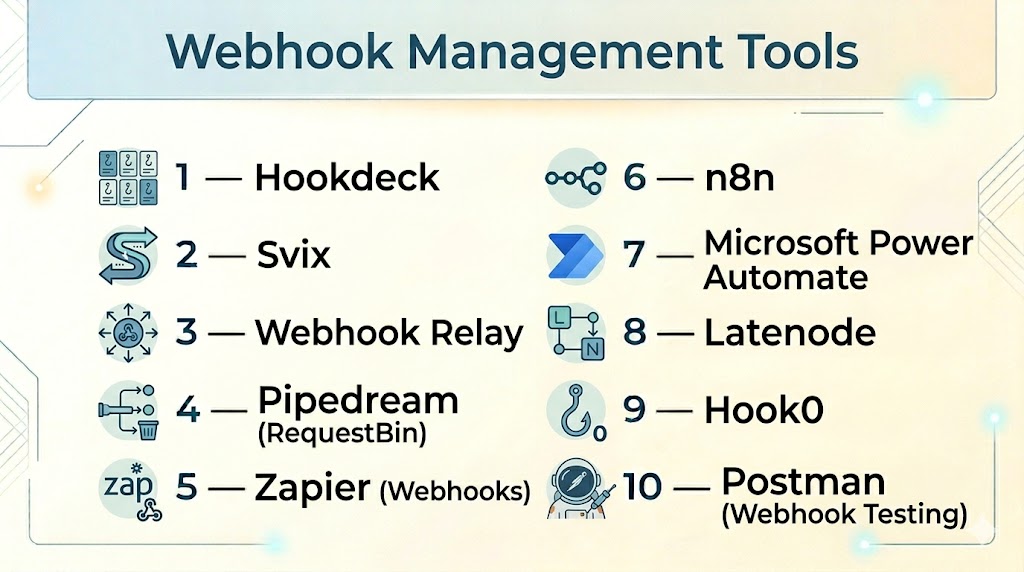
Top Webhook Management Tools
#1 — Hookdeck
Short description: A modern webhook infrastructure platform designed to manage, monitor, and debug webhook traffic at scale.
Key Features
- Real-time webhook monitoring
- Event filtering and routing
- Retry and replay mechanisms
- Debugging tools
- Scalable webhook pipelines
- Logging and analytics
Pros
- Excellent observability
- Developer-friendly interface
Cons
- Advanced features may require learning
- Pricing can scale with usage
Platforms / Deployment
Cloud
Security & Compliance
Encryption, authentication; others Not publicly stated
Integrations & Ecosystem
Supports integration with APIs and SaaS tools
- REST APIs
- Event-driven systems
- Cloud platforms
Support & Community
Strong documentation and active developer community
#2 — Svix
Short description: Enterprise-grade webhook service with high reliability and built-in security features.
Key Features
- Managed webhook delivery
- Retry and failure handling
- End-to-end encryption
- Webhook inspection tools
- High scalability
- Subscription management
Pros
- Enterprise-grade reliability
- Strong security posture
Cons
- May be overkill for small teams
- Pricing complexity
Platforms / Deployment
Cloud / Self-hosted
Security & Compliance
Encryption, SOC 2, GDPR (as stated by vendor)
Integrations & Ecosystem
- APIs
- SaaS platforms
- Custom integrations
Support & Community
Good documentation; growing ecosystem
#3 — Webhook Relay
Short description: A lightweight webhook gateway that enables routing and secure delivery across environments.
Key Features
- Webhook forwarding
- Tunneling for local development
- Event routing
- Real-time analytics
- Secure delivery
Pros
- Easy setup
- Great for testing and debugging
Cons
- Limited enterprise features
- Smaller ecosystem
Platforms / Deployment
Cloud / Self-hosted
Security & Compliance
Token authentication; others Not publicly stated
Integrations & Ecosystem
- APIs
- Cloud services
- Dev tools
Support & Community
Moderate community support
#4 — Pipedream (RequestBin)
Short description: A developer-focused platform for testing, debugging, and automating webhook workflows.
Key Features
- Request inspection tools
- Workflow automation
- Event triggers
- Debugging capabilities
- Integration support
Pros
- Great for debugging
- Easy to use
Cons
- Limited enterprise features
- Not a full SOAR-style platform
Platforms / Deployment
Cloud
Security & Compliance
Not publicly stated
Integrations & Ecosystem
- APIs
- SaaS tools
- Automation platforms
Support & Community
Strong developer community
#5 — Zapier (Webhooks)
Short description: Automation platform with webhook support for connecting apps without coding.
Key Features
- Webhook triggers and actions
- Workflow automation
- App integrations
- Low-code interface
- Event-driven workflows
Pros
- Very easy to use
- Huge integration library
Cons
- Limited advanced webhook control
- Can get expensive
Platforms / Deployment
Cloud
Security & Compliance
Encryption, authentication; others Not publicly stated
Integrations & Ecosystem
- 5,000+ apps
- APIs
- SaaS platforms
Support & Community
Large community and support resources
#6 — n8n
Short description: Open-source workflow automation tool with strong webhook capabilities.
Key Features
- Webhook triggers
- Visual workflow builder
- Self-hosting support
- API integrations
- Custom logic
Pros
- Open-source flexibility
- Cost-effective
Cons
- Requires setup
- Limited enterprise support
Platforms / Deployment
Cloud / Self-hosted
Security & Compliance
Varies / N/A
Integrations & Ecosystem
- APIs
- SaaS tools
- Custom connectors
Support & Community
Active open-source community
#7 — Microsoft Power Automate
Short description: Enterprise automation tool with webhook and event-driven workflow capabilities.
Key Features
- Event triggers
- Workflow automation
- Integration with Microsoft ecosystem
- AI automation
- Cloud-native
Pros
- Strong enterprise capabilities
- Seamless Microsoft integration
Cons
- Vendor lock-in
- Complexity for beginners
Platforms / Deployment
Cloud
Security & Compliance
MFA, RBAC; others Not publicly stated
Integrations & Ecosystem
- Microsoft 365
- Azure
- APIs
Support & Community
Enterprise-level support
#8 — Latenode
Short description: Workflow automation platform with webhook-based integrations and visual builders.
Key Features
- Visual automation builder
- Webhook triggers
- Multi-app integrations
- Real-time workflows
- Custom logic
Pros
- Flexible workflows
- Easy integration
Cons
- Limited enterprise adoption
- Smaller ecosystem
Platforms / Deployment
Cloud
Security & Compliance
Not publicly stated
Integrations & Ecosystem
- 300+ integrations
- APIs
- SaaS tools
Support & Community
Growing support
#9 — Hook0
Short description: Open-source Webhooks-as-a-Service platform focused on simplicity and scalability.
Key Features
- Managed webhook delivery
- Retry logic
- Security features
- API-based control
- Scalable architecture
Pros
- Open-source
- Developer-friendly
Cons
- Limited enterprise features
- Smaller ecosystem
Platforms / Deployment
Cloud / Self-hosted
Security & Compliance
GDPR (as stated by vendor)
Integrations & Ecosystem
- APIs
- Developer tools
- Custom integrations
Support & Community
Open-source community
#10 — Postman (Webhook Testing)
Short description: API development tool with webhook testing and monitoring capabilities.
Key Features
- Webhook testing
- Request logging
- Debugging tools
- API integration
- Monitoring
Pros
- Widely used
- Easy debugging
Cons
- Not a full webhook platform
- Limited automation
Platforms / Deployment
Web / Desktop
Security & Compliance
Not publicly stated
Integrations & Ecosystem
- APIs
- Dev tools
Support & Community
Large global community
Comparison Table (Top 10)
| Tool Name | Best For | Platform(s) Supported | Deployment | Standout Feature | Public Rating |
|---|---|---|---|---|---|
| Hookdeck | Monitoring & debugging | Web | Cloud | Observability | N/A |
| Svix | Enterprise scale | Web | Hybrid | Secure delivery | N/A |
| Webhook Relay | Routing | Web | Hybrid | Tunneling | N/A |
| Pipedream | Debugging | Web | Cloud | Request inspection | N/A |
| Zapier | Automation | Web | Cloud | No-code workflows | N/A |
| n8n | Open-source automation | Web | Hybrid | Flexibility | N/A |
| Power Automate | Enterprise workflows | Web | Cloud | Microsoft integration | N/A |
| Latenode | Workflow automation | Web | Cloud | Visual builder | N/A |
| Hook0 | Open-source WaaS | Web | Hybrid | Simplicity | N/A |
| Postman | Testing | Web/Desktop | Cloud | Debugging tools | N/A |
Webhook Management Tools Scoring
| Tool Name | Core (25%) | Ease (15%) | Integrations (15%) | Security (10%) | Performance (10%) | Support (10%) | Value (15%) | Weighted Total |
|---|---|---|---|---|---|---|---|---|
| Hookdeck | 9 | 8 | 8 | 8 | 9 | 8 | 7 | 8.3 |
| Svix | 9 | 7 | 8 | 9 | 9 | 8 | 7 | 8.4 |
| Webhook Relay | 7 | 8 | 7 | 7 | 8 | 7 | 8 | 7.5 |
| Pipedream | 7 | 9 | 7 | 7 | 7 | 8 | 8 | 7.7 |
| Zapier | 7 | 10 | 9 | 7 | 7 | 9 | 7 | 8.1 |
| n8n | 8 | 7 | 8 | 7 | 7 | 7 | 9 | 7.8 |
| Power Automate | 8 | 7 | 9 | 8 | 8 | 9 | 7 | 8.1 |
| Latenode | 7 | 8 | 7 | 7 | 7 | 7 | 8 | 7.4 |
| Hook0 | 7 | 7 | 6 | 7 | 7 | 6 | 8 | 7.0 |
| Postman | 6 | 9 | 7 | 6 | 7 | 9 | 9 | 7.5 |
Interpretation:
These scores are relative comparisons based on features, usability, and ecosystem strength. Enterprise users should prioritize security and scalability, while developers may value flexibility and ease of use more. Always validate based on your specific workload and integration needs.
Which Webhook Management Tool Is Right for You?
Solo / Freelancer
- Best: Postman, Pipedream
- Focus on debugging and simplicity
SMB
- Best: Zapier, n8n
- Focus on cost and ease of use
Mid-Market
- Best: Hookdeck, Latenode
- Balance automation and scalability
Enterprise
- Best: Svix, Power Automate
- Focus on security and reliability
Budget vs Premium
- Budget: n8n, Hook0
- Premium: Svix, Hookdeck
Feature Depth vs Ease of Use
- Advanced: Hookdeck, Svix
- Easy: Zapier, Pipedream
Integrations & Scalability
- High: Zapier, Power Automate
- Moderate: n8n, Hook0
Security & Compliance Needs
- High: Svix
- Moderate: Hookdeck, Power Automate
Webhook Management Tools FAQs
What are webhook management tools?
They are platforms that help manage, monitor, and secure webhook communication between applications.
How do webhooks differ from APIs?
Webhooks push data automatically, while APIs require polling for updates.
Are webhook tools necessary?
Yes, for large-scale systems where reliability and monitoring are critical.
How much do webhook tools cost?
Pricing varies from free open-source tools to enterprise subscription models.
Can webhook tools handle high traffic?
Yes, most modern tools are designed for high scalability.
Are webhook tools secure?
Many include encryption and authentication, but features vary.
How long does implementation take?
From minutes (simple tools) to weeks (enterprise setups).
What are common mistakes?
Poor retry logic, lack of monitoring, and weak security configurations.
Can I self-host webhook tools?
Yes, many tools offer self-hosted options.
What are alternatives to webhook tools?
Traditional APIs or message queues, but they lack real-time efficiency.
Conclusion
Webhook Management Tools are becoming essential in modern software architectures where real-time communication and automation are critical. From developer-friendly tools like Postman and Pipedream to enterprise-grade platforms like Svix and Hookdeck, the ecosystem offers a wide range of solutions tailored to different needs. The right choice depends on your scale, technical expertise, and integration complexity. Instead of focusing only on features, prioritize reliability, security, and ecosystem compatibility. Start by shortlisting 2–3 tools, test them in your environment, and validate how well they handle real-world webhook traffic before committing to a full implementation.
