Introduction
Influencer Marketing Platforms are tools that help businesses discover, manage, collaborate with, and measure influencers and creators at scale. Instead of manually searching and messaging creators, these platforms provide databases, automation, analytics, and campaign management tools in one place.
In simple terms, they are the backbone behind creator discovery, outreach, campaign execution, and ROI tracking for influencer campaigns.
Why it matters now
- Influencer marketing has become a core growth channel
- Brands are shifting from vanity metrics to ROI-driven campaigns
- Managing creators manually does not scale
- AI is improving creator discovery and performance prediction
Common use cases
- Finding relevant influencers
- Running creator campaigns
- Managing influencer relationships
- Tracking campaign ROI and conversions
- Affiliate and UGC (user-generated content) programs
What buyers should evaluate
- Creator database size and quality
- Search filters (engagement, audience, niche, authenticity)
- Outreach and automation tools
- Campaign management workflows
- ROI tracking and analytics
- Integration with ecommerce and CRM tools
- Pricing model (subscription vs commission)
- Ease of use vs enterprise complexity
- Fraud detection and authenticity scoring
Best for: Ecommerce brands, agencies, SaaS companies, DTC startups, and enterprises running influencer campaigns.
Not ideal for: Very small businesses testing influencer marketing manually or those relying only on organic outreach.
Key Trends in Influencer Marketing Platforms
- AI-powered creator discovery: Matching brands with the right influencers using data signals
- ROI-focused campaigns: Shift from reach to conversions and revenue
- Affiliate + influencer hybrid models: Combining creators with performance marketing
- Micro and nano influencer focus: Higher engagement and authenticity
- UGC-first strategies: Creators producing ad-ready content
- Automation workflows: Outreach, follow-ups, and payments handled automatically
- Brand safety and fraud detection: Ensuring authentic partnerships
- Creator CRM systems: Managing long-term influencer relationships
- Commerce integrations: Direct tracking of sales from influencer campaigns
How We Selected These Tools (Methodology)
- Market adoption and credibility
- Feature completeness (discovery, outreach, analytics)
- Creator database depth and accuracy
- Ease of use across SMB and enterprise
- Integration ecosystem (ecommerce, CRM, APIs)
- Automation and AI capabilities
- Performance tracking and ROI measurement
- Pricing transparency and flexibility
- Support quality and onboarding
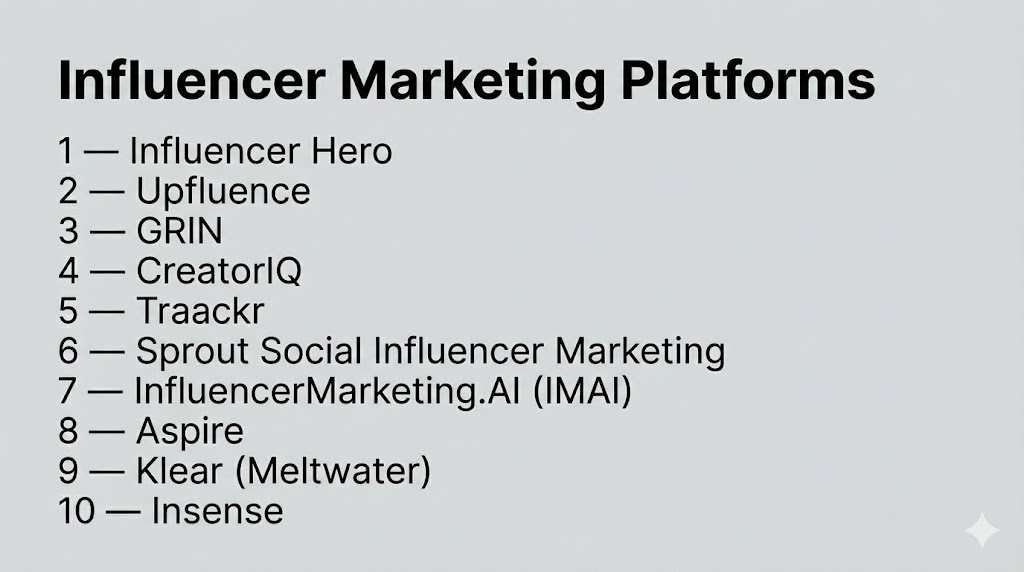
Top 10 Influencer Marketing Platforms
#1 — Influencer Hero
Short description: An all-in-one influencer marketing platform designed to manage the entire campaign lifecycle from discovery to ROI tracking.
Key Features
- Advanced creator search engine
- Built-in CRM for influencer management
- Bulk outreach and automation
- Campaign tracking and analytics
- Multi-platform support (Instagram, TikTok, YouTube)
- Performance-based filtering
Pros
- End-to-end workflow management
- Strong automation features
Cons
- Learning curve for beginners
- Pricing varies
Platforms / Deployment
Web
Cloud
Security & Compliance
Varies / Not publicly stated
Integrations & Ecosystem
Supports integrations across marketing workflows.
- CRM tools
- Ecommerce platforms
- APIs
Support & Community
Good documentation and onboarding support.
#2 — Upfluence
Short description: A full-funnel influencer marketing and affiliate platform designed for ecommerce brands.
Key Features
- AI-driven influencer discovery
- Affiliate tracking
- Automated outreach
- Payment and contract management
- Ecommerce integrations
- Influencer marketplace
Pros
- Strong ecommerce integration
- Combines affiliate + influencer marketing
Cons
- Expensive
- Complex setup
Platforms / Deployment
Web
Cloud
Security & Compliance
Varies / Not publicly stated
Integrations & Ecosystem
- Shopify, WooCommerce
- CRM tools
- APIs
Support & Community
Enterprise-level onboarding.
#3 — GRIN
Short description: A creator relationship management platform focused on long-term influencer partnerships.
Key Features
- Creator CRM
- Product seeding workflows
- Content management
- Payment automation
- Ecommerce integrations
- Campaign tracking
Pros
- Strong relationship management
- Ideal for DTC brands
Cons
- High pricing
- Best for established teams
Platforms / Deployment
Web
Cloud
Security & Compliance
Varies / Not publicly stated
Integrations & Ecosystem
- Shopify
- Ecommerce tools
- APIs
Support & Community
Strong enterprise support.
#4 — CreatorIQ
Short description: An enterprise-grade platform for managing large-scale global influencer programs.
Key Features
- AI-powered creator discovery
- Brand safety monitoring
- Workflow automation
- Campaign analytics
- Multi-team collaboration
- Global campaign management
Pros
- Enterprise-ready
- Strong compliance and brand safety
Cons
- Expensive
- Complex onboarding
Platforms / Deployment
Web
Cloud
Security & Compliance
Varies / Not publicly stated
Integrations & Ecosystem
- Salesforce
- Enterprise systems
- APIs
Support & Community
Enterprise-level support.
#5 — Traackr
Short description: A data-driven influencer marketing platform designed for large brands.
Key Features
- Influencer discovery
- Campaign performance tracking
- Market benchmarking
- ROI analytics
- Global campaign support
- Influencer relationship management
Pros
- Strong analytics
- Trusted by large brands
Cons
- Expensive
- Not SMB-friendly
Platforms / Deployment
Web
Cloud
Security & Compliance
Varies / Not publicly stated
Integrations & Ecosystem
- Analytics tools
- APIs
- Marketing platforms
Support & Community
Enterprise support.
#6 — Sprout Social Influencer Marketing
Short description: A platform combining influencer marketing with social media management.
Key Features
- AI-powered influencer discovery
- Brand fit scoring
- Campaign management
- ROI reporting
- Social integration
- Performance analytics
Pros
- Integrated with social media workflows
- Easy to use
Cons
- Limited depth vs specialized tools
- Premium pricing
Platforms / Deployment
Web
Cloud
Security & Compliance
SSO, audit logs
Varies / Not publicly stated
Integrations & Ecosystem
- Social media tools
- CRM platforms
- APIs
Support & Community
Strong documentation.
#7 — InfluencerMarketing.AI (IMAI)
Short description: An AI-driven influencer platform focused on predictive analytics and ROI tracking.
Key Features
- 300M+ creator database
- AI-powered discovery
- Affiliate tracking
- Campaign analytics
- Competitor benchmarking
- Fraud detection
Pros
- Strong AI capabilities
- Large database
Cons
- Pricing varies
- Advanced features may require training
Platforms / Deployment
Web
Cloud
Security & Compliance
Varies / Not publicly stated
Integrations & Ecosystem
- APIs
- Ecommerce platforms
- CRM tools
Support & Community
Good enterprise support.
#8 — Aspire
Short description: A platform for managing influencer relationships and campaigns at scale.
Key Features
- Creator marketplace
- Campaign workflows
- Influencer CRM
- Analytics and reporting
- Automation tools
- Content management
Pros
- Strong workflow management
- Scalable
Cons
- Expensive
- Complex
Platforms / Deployment
Web
Cloud
Security & Compliance
Varies / Not publicly stated
Integrations & Ecosystem
- CRM tools
- APIs
- Marketing platforms
Support & Community
Enterprise onboarding.
#9 — Klear (Meltwater)
Short description: A platform combining influencer marketing with media intelligence and PR analytics.
Key Features
- Influencer discovery
- Campaign analytics
- Media monitoring integration
- Audience insights
- ROI tracking
- Reporting dashboards
Pros
- Strong analytics
- PR + influencer integration
Cons
- Complex ecosystem
- Pricing varies
Platforms / Deployment
Web
Cloud
Security & Compliance
Varies / Not publicly stated
Integrations & Ecosystem
- Meltwater ecosystem
- APIs
- CRM tools
Support & Community
Enterprise support.
#10 — Insense
Short description: A creator marketplace focused on UGC and paid social campaigns.
Key Features
- Creator marketplace
- UGC content creation
- Paid ad integration
- Campaign management
- Influencer collaboration
- Performance tracking
Pros
- Great for UGC campaigns
- Easy collaboration
Cons
- Limited enterprise features
- Focused use case
Platforms / Deployment
Web
Cloud
Security & Compliance
Varies / Not publicly stated
Integrations & Ecosystem
- Ecommerce platforms
- Social ads platforms
- APIs
Support & Community
Good SMB support.
Comparison Table (Top 10)
| Tool Name | Best For | Platform(s) Supported | Deployment | Standout Feature | Public Rating |
|---|---|---|---|---|---|
| Influencer Hero | All-in-one | Web | Cloud | End-to-end automation | N/A |
| Upfluence | Ecommerce | Web | Cloud | Affiliate + influencer | N/A |
| GRIN | DTC brands | Web | Cloud | Creator CRM | N/A |
| CreatorIQ | Enterprise | Web | Cloud | Brand safety & scale | N/A |
| Traackr | Large brands | Web | Cloud | Data analytics | N/A |
| Sprout Social | Integrated workflows | Web | Cloud | AI discovery | N/A |
| IMAI | AI-driven | Web | Cloud | Large database | N/A |
| Aspire | Campaign workflows | Web | Cloud | Influencer CRM | N/A |
| Klear | PR + influencer | Web | Cloud | Media integration | N/A |
| Insense | UGC campaigns | Web | Cloud | Creator marketplace | N/A |
Evaluation & Scoring of Influencer Marketing Platforms
| Tool Name | Core (25%) | Ease (15%) | Integrations (15%) | Security (10%) | Performance (10%) | Support (10%) | Value (15%) | Weighted Total |
|---|---|---|---|---|---|---|---|---|
| Influencer Hero | 9 | 8 | 8 | 7 | 8 | 8 | 9 | 8.4 |
| Upfluence | 9 | 7 | 9 | 8 | 9 | 8 | 7 | 8.5 |
| GRIN | 9 | 7 | 8 | 8 | 9 | 9 | 6 | 8.3 |
| CreatorIQ | 10 | 6 | 9 | 9 | 9 | 9 | 6 | 8.6 |
| Traackr | 9 | 6 | 8 | 8 | 9 | 8 | 6 | 8.1 |
| Sprout Social | 8 | 9 | 8 | 8 | 8 | 8 | 7 | 8.2 |
| IMAI | 9 | 7 | 8 | 8 | 8 | 8 | 7 | 8.2 |
| Aspire | 9 | 7 | 8 | 8 | 8 | 8 | 6 | 8.0 |
| Klear | 8 | 7 | 8 | 8 | 8 | 8 | 7 | 7.9 |
| Insense | 8 | 9 | 7 | 7 | 7 | 7 | 8 | 7.9 |
How to interpret scores:
- Enterprise tools score higher in features and scalability
- SMB tools score higher in ease and value
- AI-driven tools excel in discovery and analytics
- Choose based on campaign complexity and team size
Which Influencer Marketing Platform Is Right for You?
Solo / Freelancer
- Best: Insense, Influencer Hero
- Focus on simplicity and affordability
SMB
- Best: Influencer Hero, IMAI
- Balance automation and cost
Mid-Market
- Best: Upfluence, Aspire
- Need scalable workflows
Enterprise
- Best: CreatorIQ, Traackr, GRIN
- Focus on scale and compliance
Budget vs Premium
- Budget: Insense
- Premium: CreatorIQ, Traackr
Feature Depth vs Ease of Use
- Advanced: CreatorIQ, Upfluence
- Easy: Insense
Integrations & Scalability
- Best: Upfluence, CreatorIQ
Security & Compliance Needs
- High: Enterprise tools
- Standard: SMB tools
Frequently Asked Questions (FAQs)
What is an influencer marketing platform?
It is software that helps manage influencer campaigns from discovery to analytics.
How do these platforms find influencers?
They use large databases and AI-powered search filters.
Are influencer platforms expensive?
Pricing varies widely depending on features and scale.
Do I need one?
If you run multiple campaigns, yes—it saves time and improves results.
Can small businesses use them?
Yes, many tools are SMB-friendly.
What is the biggest benefit?
Automation and scalability.
Do they track ROI?
Yes, most platforms include performance analytics.
Can I manage payments?
Many tools support automated payments and contracts.
Are these tools secure?
Security varies by vendor.
What is the biggest mistake?
Choosing a tool that is too complex for your needs.
Conclusion
Influencer Marketing Platforms have evolved into full-scale growth engines, helping brands move from manual outreach to data-driven campaigns. They enable better targeting, automation, and measurable ROI.
