Introduction
Records Management & Retention tools are specialized software systems designed to manage the lifecycle of records—from creation and classification to retention, archival, and secure disposal. Unlike standard document management tools, these platforms focus heavily on compliance, legal defensibility, and governance.
In today’s data-heavy environment, organizations must handle growing volumes of sensitive information while complying with strict regulations. These tools help automate retention policies, reduce legal risk, and ensure that records are stored and disposed of according to predefined rules.
Common Use Cases
- Regulatory compliance and audit readiness
- Managing legal and financial records
- Automated retention and deletion policies
- Email and communication archiving
- Enterprise-wide information governance
What Buyers Should Evaluate
- Retention policy automation
- Lifecycle management capabilities
- Audit trails and compliance reporting
- Classification and metadata tagging
- Integration with ECM/DMS systems
- Security and access control
- Scalability for large datasets
- Support for physical + digital records
- Deployment flexibility
- Ease of policy configuration
Best for: Enterprises, legal teams, compliance officers, financial institutions, and regulated industries.
Not ideal for: Small teams needing only file storage or basic document sharing tools.
Key Trends in Records Management & Retention Tools
- AI-driven classification and retention automation
- Policy-based deletion to reduce data risk
- Integration with data governance platforms
- Unified management of physical and digital records
- Real-time audit trails and compliance reporting
- Cloud-first and hybrid deployment models
- No-code retention policy builders
- Global compliance support (multi-jurisdiction rules)
- Integration with eDiscovery and legal hold systems
- Increased focus on data minimization and privacy
How We Selected These Tools (Methodology)
- Adoption in enterprise compliance environments
- Strength of retention and lifecycle management features
- Ability to handle large-scale data governance
- Integration with ECM, DMS, and enterprise systems
- Security and audit capabilities
- Deployment flexibility (cloud, on-premise)
- Automation and AI capabilities
- Industry-specific applicability
- Vendor reliability and support
- Balance between usability and compliance depth
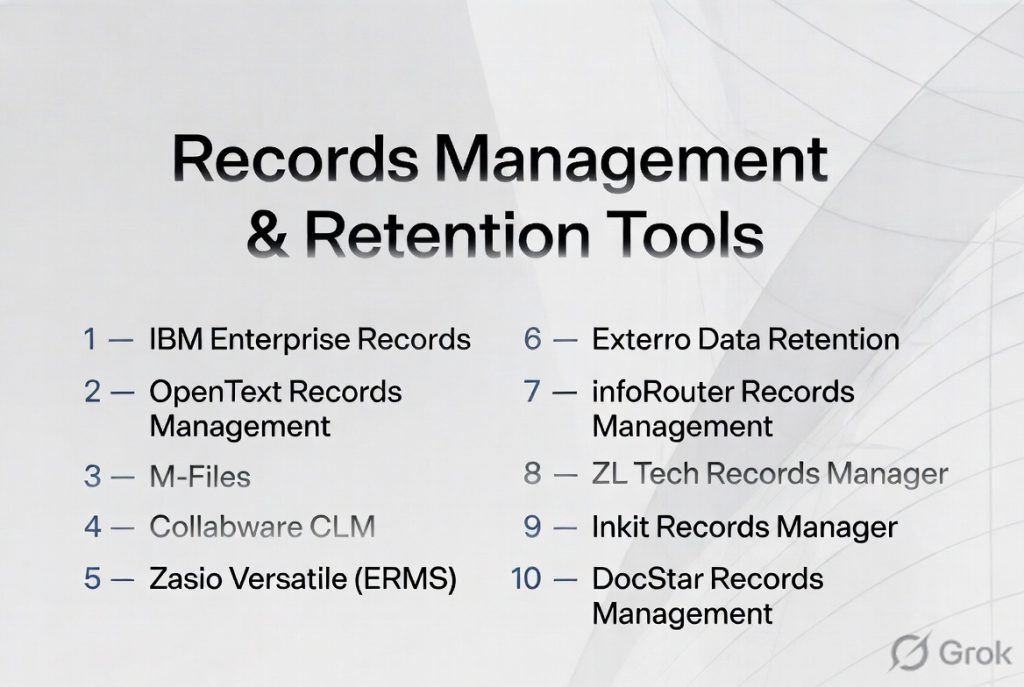
Top 10 Records Management & Retention Tools
#1 — IBM Enterprise Records
Short description: A comprehensive enterprise records management solution designed for compliance-driven organizations managing both physical and digital records.
Key Features
- Automated records lifecycle management
- Retention and disposition policies
- Compliance enforcement automation
- Federated content management
- Audit trails and reporting
- Integration with enterprise systems
Pros
- Strong compliance capabilities
- Scalable enterprise solution
Cons
- Complex implementation
- Requires expertise
Platforms / Deployment
Web / Enterprise systems
Cloud / On-premise
Security & Compliance
Audit trails, compliance enforcement, policy automation
Integrations & Ecosystem
Supports integration with enterprise content systems.
- ECM platforms
- Business automation tools
- APIs
Support & Community
Enterprise-level support and documentation.
#2 — OpenText Records Management
Short description: A robust records management solution focused on governance, compliance, and lifecycle automation.
Key Features
- Retention scheduling
- Records classification
- Compliance automation
- Legal hold management
- Audit tracking
- Workflow integration
Pros
- Strong governance features
- Enterprise-ready
Cons
- Expensive
- Complex setup
Platforms / Deployment
Web / Enterprise
Cloud / Hybrid
Security & Compliance
Enterprise compliance support (varies)
Integrations & Ecosystem
Integrates with ECM and enterprise systems.
Support & Community
Strong enterprise ecosystem.
#3 — M-Files
Short description: A metadata-driven records management tool that automates classification and retention policies.
Key Features
- Metadata-based organization
- Automated retention rules
- Workflow automation
- Audit trails
- Version control
- AI-powered classification
Pros
- Reduces duplication
- Strong automation
Cons
- Learning curve
- Premium pricing
Platforms / Deployment
Windows / Web
Cloud / Hybrid
Security & Compliance
SSO, audit logs (varies)
Integrations & Ecosystem
- Microsoft ecosystem
- CRM/ERP integrations
Support & Community
Strong enterprise support.
#4 — Collabware CLM
Short description: A compliance-focused records management layer built to extend Microsoft SharePoint capabilities.
Key Features
- Automated classification
- Retention policy enforcement
- Legal hold functionality
- Compliance automation
- Records lifecycle tracking
- Integration with SharePoint
Pros
- Enhances SharePoint
- Strong compliance
Cons
- Dependent on SharePoint
- Limited standalone use
Platforms / Deployment
Web
Cloud / On-premise
Security & Compliance
Compliance automation and legal controls
Integrations & Ecosystem
- Microsoft SharePoint
- Enterprise tools
Support & Community
Enterprise-focused support.
#5 — Zasio Versatile (ERMS)
Short description: A records retention management platform focused on policy scheduling and lifecycle control.
Key Features
- Retention schedule management
- Physical and electronic records support
- Central repository
- Lifecycle tracking
- Policy updates
- Compliance management
Pros
- Strong retention scheduling
- Handles physical + digital records
Cons
- Niche focus
- Limited UI modernity
Platforms / Deployment
Web
Cloud / On-premise
Security & Compliance
Not publicly stated
Integrations & Ecosystem
Supports connectors to repositories.
Support & Community
Strong records management specialization.
#6 — Exterro Data Retention
Short description: A data governance platform focused on global retention policies and risk reduction.
Key Features
- Global retention policy library
- Data risk minimization
- Automated deletion workflows
- Audit trails
- Legal hold support
- Data classification
Pros
- Strong governance focus
- Handles complex regulations
Cons
- Enterprise-focused
- Expensive
Platforms / Deployment
Web
Cloud
Security & Compliance
Compliance-driven retention framework
Integrations & Ecosystem
- Data governance tools
- Compliance systems
Support & Community
Enterprise-level support.
#7 — infoRouter Records Management
Short description: A centralized records management platform with strong compliance and lifecycle tracking capabilities.
Key Features
- Document lifecycle management
- Retention and disposition schedules
- Metadata tagging
- Audit trails
- Workflow automation
- Legal hold
Pros
- Strong compliance support
- Flexible workflows
Cons
- UI not modern
- Requires setup
Platforms / Deployment
Web / Windows
Cloud / On-premise
Security & Compliance
HIPAA, audit logs, access control
Integrations & Ecosystem
- Enterprise systems
- APIs
Support & Community
Moderate enterprise adoption.
#8 — ZL Tech Records Manager
Short description: A unified records and compliance platform with advanced classification and retention automation.
Key Features
- Automated classification
- Retention policy enforcement
- Legal holds
- Audit logs
- Global search
- Data deduplication
Pros
- Strong compliance automation
- Unified governance
Cons
- Complex setup
- Enterprise pricing
Platforms / Deployment
Web
Cloud / Hybrid
Security & Compliance
Audit logs, compliance tracking
Integrations & Ecosystem
- Email systems
- Microsoft ecosystem
Support & Community
Enterprise-focused support.
#9 — Inkit Records Management
Short description: A modern records retention platform with API-first automation and compliance features.
Key Features
- Automated retention policies
- No-code workflow builder
- API integrations
- Audit logs
- Secure repository
- Real-time tracking
Pros
- Developer-friendly
- Strong automation
Cons
- Newer platform
- Limited ecosystem
Platforms / Deployment
Web
Cloud
Security & Compliance
HIPAA support, audit logs
Integrations & Ecosystem
- REST APIs
- Backend systems
Support & Community
Growing adoption.
#10 — DocStar Records Management
Short description: A records management tool focused on compliance, lifecycle tracking, and audit readiness.
Key Features
- Lifecycle management
- Retention rules
- Audit reporting
- Secure repository
- Compliance tools
- Document tracking
Pros
- Easy deployment
- Good compliance features
Cons
- Limited customization
- Smaller ecosystem
Platforms / Deployment
Web
Cloud
Security & Compliance
Compliance with regulatory standards
Integrations & Ecosystem
Supports business workflows.
Support & Community
Moderate adoption.
Comparison Table (Top 10)
| Tool Name | Best For | Platform(s) Supported | Deployment | Standout Feature | Public Rating |
|---|---|---|---|---|---|
| IBM Enterprise Records | Enterprise | Web/Enterprise | Hybrid | Lifecycle automation | N/A |
| OpenText RM | Compliance | Enterprise | Hybrid | Governance | N/A |
| M-Files | Automation | Cross-platform | Hybrid | Metadata system | N/A |
| Collabware | SharePoint users | Web | Hybrid | Compliance layer | N/A |
| Zasio | Retention policies | Web | Hybrid | Scheduling | N/A |
| Exterro | Data governance | Web | Cloud | Risk reduction | N/A |
| infoRouter | Compliance | Cross-platform | Hybrid | Lifecycle tracking | N/A |
| ZL Tech | Unified governance | Web | Hybrid | Classification | N/A |
| Inkit | Modern API-first | Web | Cloud | Automation | N/A |
| DocStar | SMB/Mid | Web | Cloud | Simplicity | N/A |
Evaluation & Scoring of Records Management Tools
| Tool Name | Core (25%) | Ease (15%) | Integrations (15%) | Security (10%) | Performance (10%) | Support (10%) | Value (15%) | Weighted Total |
|---|---|---|---|---|---|---|---|---|
| IBM ER | 10 | 6 | 9 | 10 | 9 | 9 | 7 | 8.7 |
| OpenText | 10 | 6 | 9 | 10 | 9 | 9 | 6 | 8.6 |
| M-Files | 9 | 7 | 8 | 9 | 9 | 8 | 7 | 8.3 |
| Collabware | 8 | 7 | 8 | 9 | 8 | 8 | 7 | 7.9 |
| Zasio | 8 | 7 | 7 | 8 | 8 | 8 | 8 | 7.8 |
| Exterro | 9 | 7 | 8 | 10 | 9 | 8 | 6 | 8.3 |
| infoRouter | 8 | 7 | 7 | 9 | 8 | 7 | 8 | 7.9 |
| ZL Tech | 9 | 6 | 8 | 9 | 9 | 8 | 7 | 8.2 |
| Inkit | 8 | 8 | 8 | 9 | 8 | 7 | 8 | 8.0 |
| DocStar | 7 | 8 | 7 | 8 | 8 | 7 | 8 | 7.6 |
How to interpret scores:
- Enterprise tools score high on compliance and security
- Modern tools score high on ease and automation
- Open platforms offer better flexibility
- Choose based on regulatory needs and scale
Which Records Management Tool Is Right for You?
Solo / Freelancer
- Not required
- Use basic storage tools
SMB
- Best: DocStar, Inkit
- Focus on ease and cost
Mid-Market
- Best: M-Files, infoRouter
- Need automation + compliance
Enterprise
- Best: IBM, OpenText, Exterro
- Require governance and global compliance
Budget vs Premium
- Budget: Inkit, DocStar
- Premium: IBM, OpenText
Feature Depth vs Ease of Use
- Advanced: IBM, OpenText
- Easy: Inkit, DocStar
Integrations & Scalability
- Strong: IBM, M-Files
- Moderate: others
Security & Compliance Needs
- Strong: IBM, Exterro
- Others: Varies
Frequently Asked Questions (FAQs)
What is records management software?
It manages records throughout their lifecycle, ensuring compliance and retention.
What is a retention policy?
Rules defining how long records must be stored before deletion.
Why is records management important?
It reduces legal risk and ensures regulatory compliance.
What is defensible deletion?
Secure and compliant removal of records after retention periods.
Can these tools handle physical records?
Yes, many support both digital and physical records.
Are these tools required for compliance?
Yes, especially in regulated industries.
What is a legal hold?
A process to prevent deletion during legal investigations.
Are these tools cloud-based?
Most offer cloud, on-premise, or hybrid deployment.
How do they integrate with other systems?
Via APIs, ECM, and enterprise software integrations.
What are common mistakes?
Poor policy setup and lack of regular audits.
Conclusion
Records Management & Retention tools are critical for organizations dealing with compliance, legal requirements, and large-scale data governance. They go beyond document storage by enforcing policies, automating retention, and ensuring defensible deletion.
