Introduction
Single Pane of Glass IT Dashboards (SPOG dashboards) are unified platforms that combine data from multiple IT systems into one centralized view. Instead of switching between separate tools for cloud monitoring, security alerts, network performance, and application health, IT teams get everything in one dashboard.
In modern 2026 IT environments, this approach is essential because organizations now operate across multi-cloud, SaaS-heavy, hybrid infrastructure, and distributed systems. Without a unified view, teams suffer from alert fatigue, slow incident response, and fragmented visibility across tools.
Common use cases include IT infrastructure monitoring, cloud observability, cybersecurity operations, DevOps dashboards, network performance tracking, SaaS visibility, and incident management.
Buyers should evaluate data integration depth, real-time observability, scalability, automation capabilities, alert correlation, security coverage, customization, API support, and ease of use.
Best for: IT operations teams, DevOps engineers, SRE teams, cybersecurity teams, FinOps teams, and enterprise IT administrators managing complex environments.
Not ideal for: very small IT setups, single-application environments, or organizations without distributed infrastructure.
Key Trends in Single Pane of Glass IT Dashboards
- AI-driven observability correlation reduces alert noise and improves incident detection
- Unified IT + security + finance dashboards are replacing siloed monitoring tools
- Real-time telemetry streaming (metrics, logs, traces) is becoming standard
- AIOps automation is enabling self-healing infrastructure insights
- Cross-cloud observability (AWS, Azure, GCP) is now a baseline requirement
- Security + operations convergence (SecOps + DevOps + FinOps) is increasing
- Agent-based monitoring architectures are replacing traditional polling systems
- Composable dashboards with API-first design are becoming dominant
- Digital experience monitoring (DEX) is integrated into SPOG platforms
- Context-aware alerting and root cause analysis automation is reducing MTTR
How We Selected These Tools
- Focused on platforms providing true unified IT visibility (SPOG capability)
- Included observability, AIOps, and IT operations platforms
- Prioritized tools with multi-source data aggregation (logs, metrics, traces)
- Evaluated support for cloud-native and hybrid environments
- Considered integration ecosystems across DevOps, security, and cloud platforms
- Included enterprise and mid-market solutions
- Ensured support for real-time dashboards and alert correlation
- Reviewed scalability for large distributed systems
- Included tools supporting automation and incident response
- Used Not publicly stated where compliance or ratings are unknown
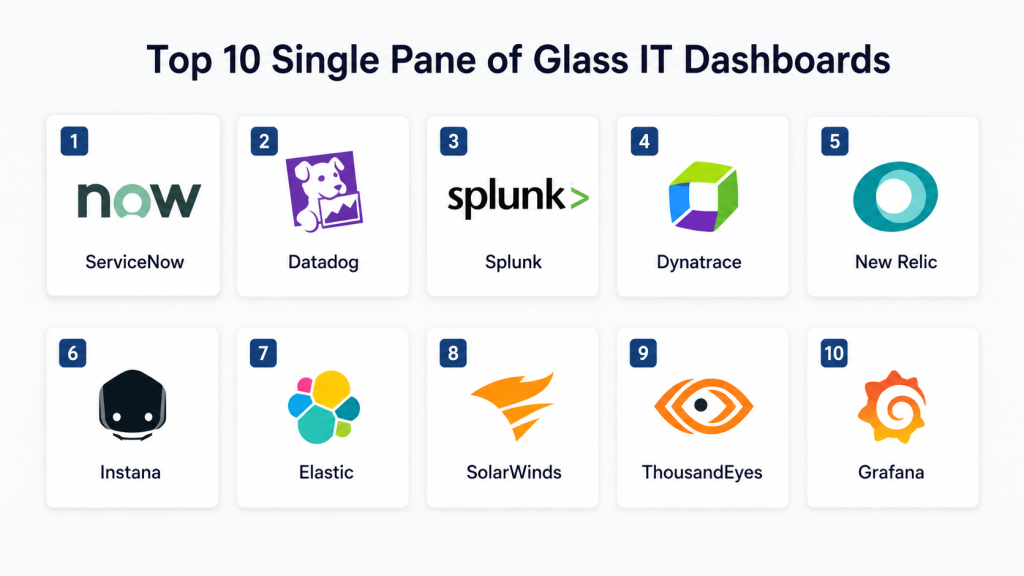
Top 10 Single Pane of Glass IT Dashboard Tools
1- Datadog
Short description: Datadog is a leading observability and monitoring platform that provides a powerful single pane of glass dashboard for infrastructure, applications, logs, and security data. It is widely used by DevOps and SRE teams to unify monitoring across complex distributed systems.
Key Features
- Unified dashboards for metrics, logs, and traces
- Real-time infrastructure monitoring
- Application performance monitoring (APM)
- Security monitoring integration
- AIOps-based alert correlation
- Cloud service integrations
- Custom dashboard creation
Pros
- Extremely broad observability coverage
- Strong cloud-native support
- Excellent real-time analytics
- Large integration ecosystem
Cons
- Can become expensive at scale
- Complex configuration for large environments
- Requires tuning to reduce alert noise
- Learning curve for advanced features
Platforms / Deployment
Cloud-based SaaS platform
Security & Compliance
Supports enterprise security features including RBAC, encryption, and audit logs. Compliance certifications vary and are Not publicly stated.
Integrations & Ecosystem
- AWS, Azure, GCP
- Kubernetes
- CI/CD pipelines
- Security tools
- Databases and APIs
Support & Community
Strong enterprise support and large developer community.
2- New Relic
Short description: New Relic provides a unified observability platform that consolidates application, infrastructure, and digital experience monitoring into a single dashboard.
Key Features
- Full-stack observability dashboards
- Application performance monitoring
- Infrastructure monitoring
- Distributed tracing
- Error tracking and analytics
- AIOps insights
- Custom dashboards
Pros
- Strong end-to-end visibility
- Good developer experience
- Easy dashboard creation
- Scalable monitoring platform
Cons
- Pricing can scale quickly
- Requires configuration tuning
- Some advanced features complex
- Data ingestion costs can be high
Platforms / Deployment
Cloud-based SaaS platform
Security & Compliance
Includes encryption, access control, and audit logging. Compliance is Not publicly stated.
Integrations & Ecosystem
- Cloud providers
- DevOps tools
- CI/CD systems
- Databases
- API integrations
Support & Community
Strong documentation and enterprise support.
3- Dynatrace
Short description: Dynatrace is an AI-powered observability platform that provides automated single pane of glass monitoring across applications, infrastructure, and user experience.
Key Features
- AI-driven root cause analysis
- Full-stack observability
- Infrastructure monitoring
- Application performance monitoring
- Real-user monitoring (RUM)
- Smart alerting and anomaly detection
- Kubernetes observability
Pros
- Strong AI automation capabilities
- Excellent root cause detection
- Deep enterprise observability
- High accuracy monitoring
Cons
- Expensive for large deployments
- Complex setup initially
- Less flexible customization
- Requires training for full use
Platforms / Deployment
Cloud and hybrid environments
Security & Compliance
Enterprise security controls available. Compliance certifications are Not publicly stated.
Integrations & Ecosystem
- Cloud platforms
- Kubernetes
- CI/CD pipelines
- Security tools
- Enterprise systems
Support & Community
Strong enterprise support and professional services.
4- Splunk Observability Cloud
Short description: Splunk provides a unified observability platform combining logs, metrics, and traces into a single operational dashboard.
Key Features
- Centralized log analytics
- Infrastructure monitoring
- Application observability
- Real-time streaming analytics
- AIOps-powered insights
- Custom dashboards
- Incident investigation tools
Pros
- Strong log analytics capabilities
- Excellent enterprise scalability
- Deep security + observability integration
- Powerful search engine
Cons
- High cost of ownership
- Complex configuration
- Requires expertise for optimization
- Resource-intensive deployments
Platforms / Deployment
Cloud and hybrid enterprise environments
Security & Compliance
Enterprise-grade security features included. Compliance details are Not publicly stated.
Integrations & Ecosystem
- Security tools (SIEM integration)
- Cloud providers
- DevOps pipelines
- APIs and data sources
- Enterprise applications
Support & Community
Strong enterprise support ecosystem.
5- Grafana
Short description: Grafana is an open-source visualization and observability platform that provides flexible single pane of glass dashboards for metrics, logs, and traces.
Key Features
- Custom dashboard creation
- Multi-source data integration
- Metrics visualization
- Log aggregation support
- Alerting system
- Plugin ecosystem
- Open-source extensibility
Pros
- Highly flexible and customizable
- Open-source and cost-effective
- Strong community support
- Works with many data sources
Cons
- Requires setup effort
- No built-in full observability stack
- Needs external tools for complete SPOG
- Operational overhead for scaling
Platforms / Deployment
Self-hosted, cloud, hybrid
Security & Compliance
Security depends on deployment setup. Compliance is Not publicly stated.
Integrations & Ecosystem
- Prometheus
- Elasticsearch
- Cloud services
- Databases
- Logging systems
Support & Community
Very strong open-source community support.
6- Zabbix
Short description: Zabbix is an enterprise monitoring platform providing centralized IT infrastructure visibility through a single pane of glass dashboard.
Key Features
- Infrastructure monitoring
- Network performance monitoring
- Alerting and notifications
- Custom dashboards
- Distributed monitoring support
- Agent-based data collection
- Capacity planning tools
Pros
- Open-source and cost-effective
- Strong infrastructure monitoring
- Reliable alerting system
- Highly scalable
Cons
- Complex setup and configuration
- UI less modern than competitors
- Requires maintenance expertise
- Limited cloud-native focus
Platforms / Deployment
Self-hosted and hybrid environments
Security & Compliance
Security depends on deployment. Compliance is Not publicly stated.
Integrations & Ecosystem
- Servers and networks
- Cloud services
- APIs
- Databases
- External monitoring tools
Support & Community
Strong open-source community and enterprise support options.
7- Datadog APM + Infra Suite (Unified View Layer)
Short description: Datadog’s unified suite extends SPOG capabilities across infrastructure, applications, logs, and security for complete observability.
Key Features
- Unified observability dashboards
- Cross-layer correlation
- Distributed tracing
- Security monitoring
- Cloud integration coverage
- Alert correlation engine
- Real-time visualization
Pros
- Full-stack visibility
- Strong correlation capabilities
- Excellent cloud support
- Highly scalable
Cons
- Cost increases with scale
- Requires tuning for efficiency
- Complex usage models
- Data volume pricing challenges
Platforms / Deployment
Cloud-based SaaS
Security & Compliance
Enterprise-grade security controls available. Compliance is Not publicly stated.
Integrations & Ecosystem
- Cloud platforms
- DevOps tools
- Security systems
- APIs
- Kubernetes
Support & Community
Strong enterprise support ecosystem.
8- LogicMonitor
Short description: LogicMonitor provides automated infrastructure monitoring and a unified dashboard for hybrid IT environments.
Key Features
- Hybrid infrastructure monitoring
- Cloud and on-prem visibility
- Automated device discovery
- Performance dashboards
- Alerting and forecasting
- Network monitoring
- Custom reporting
Pros
- Strong hybrid IT support
- Easy automation setup
- Good scalability
- Minimal manual configuration
Cons
- Limited deep APM capabilities
- UI less modern than newer tools
- Pricing can scale with usage
- Requires integration tuning
Platforms / Deployment
Cloud-based SaaS platform
Security & Compliance
Includes access control and encryption features. Compliance is Not publicly stated.
Integrations & Ecosystem
- Cloud providers
- Networking tools
- ITSM systems
- APIs
- Monitoring systems
Support & Community
Strong enterprise support and onboarding services.
9- ManageEngine OpManager
Short description: ManageEngine OpManager provides centralized network and infrastructure monitoring with a unified IT dashboard for enterprises.
Key Features
- Network monitoring dashboards
- Server performance tracking
- Fault management system
- Application monitoring
- Custom reports
- Alert automation
- Capacity planning
Pros
- Strong network monitoring
- Cost-effective enterprise option
- Easy deployment
- Good IT operations coverage
Cons
- Limited cloud-native depth
- UI less modern
- Scaling limitations in large environments
- Requires manual tuning
Platforms / Deployment
On-premise and hybrid environments
Security & Compliance
Security features depend on deployment. Compliance is Not publicly stated.
Integrations & Ecosystem
- ITSM tools
- Network systems
- Cloud integrations
- APIs
- Enterprise tools
Support & Community
Good enterprise support and documentation.
10- AppDynamics
Short description: AppDynamics is a Cisco-owned application performance monitoring platform that provides unified visibility across applications and infrastructure.
Key Features
- Application performance monitoring
- Business transaction tracking
- Infrastructure visibility
- Real-user monitoring
- Anomaly detection
- End-to-end tracing
- Dashboard analytics
Pros
- Strong enterprise APM capabilities
- Good Cisco ecosystem integration
- Deep transaction monitoring
- Reliable performance analytics
Cons
- Complex deployment
- Expensive for large scale
- Requires expertise
- Less flexible than newer tools
Platforms / Deployment
Cloud and hybrid environments
Security & Compliance
Enterprise security controls available. Compliance details are Not publicly stated.
Integrations & Ecosystem
- Cisco ecosystem
- Cloud platforms
- DevOps tools
- APIs
- Enterprise monitoring systems
Support & Community
Strong enterprise-level support.
Comparison Table
| Tool Name | Best For | Platforms Supported | Deployment | Standout Feature | Public Rating |
|---|---|---|---|---|---|
| Datadog | Full-stack observability | Cloud | Cloud | Unified telemetry view | N/A |
| New Relic | App + infra monitoring | Cloud | Cloud | Developer-friendly APM | N/A |
| Dynatrace | AI-driven observability | Cloud + Hybrid | Cloud | AI root cause analysis | N/A |
| Splunk | Log + security analytics | Cloud + Hybrid | Cloud/Hybrid | Powerful log search | N/A |
| Grafana | Visualization dashboards | Multi-source | Cloud/Self-hosted | Open-source flexibility | N/A |
| Zabbix | Infrastructure monitoring | On-prem + Cloud | Self-hosted | Cost-effective monitoring | N/A |
| LogicMonitor | Hybrid IT monitoring | Cloud + On-prem | Cloud | Automated discovery | N/A |
| ManageEngine | Network monitoring | Enterprise systems | On-prem/Hybrid | Network visibility | N/A |
| AppDynamics | APM monitoring | Cloud + Hybrid | Cloud/Hybrid | Business transaction tracking | N/A |
| Datadog Suite | Unified observability | Cloud | Cloud | Cross-layer correlation | N/A |
Evaluation & Scoring of SPOG IT Dashboard Tools
| Tool Name | Core 25% | Ease 15% | Integrations 15% | Security 10% | Performance 10% | Support 10% | Value 15% | Weighted Total |
|---|---|---|---|---|---|---|---|---|
| Datadog | 9.4 | 9.0 | 9.3 | 9.0 | 9.2 | 9.0 | 8.8 | 9.1 |
| New Relic | 9.0 | 9.0 | 9.0 | 8.8 | 9.0 | 8.8 | 8.7 | 8.9 |
| Dynatrace | 9.2 | 8.0 | 9.0 | 9.2 | 9.3 | 9.0 | 8.5 | 9.0 |
| Splunk | 9.1 | 7.8 | 9.2 | 9.3 | 9.0 | 9.0 | 8.0 | 8.8 |
| Grafana | 8.8 | 9.0 | 9.0 | 8.5 | 8.8 | 8.8 | 9.5 | 8.8 |
| Zabbix | 8.6 | 7.8 | 8.5 | 8.5 | 8.5 | 8.6 | 9.2 | 8.5 |
| LogicMonitor | 8.7 | 8.6 | 8.8 | 8.6 | 8.6 | 8.7 | 8.7 | 8.6 |
| ManageEngine | 8.5 | 8.5 | 8.5 | 8.4 | 8.4 | 8.5 | 9.0 | 8.5 |
| AppDynamics | 9.0 | 7.8 | 9.0 | 9.0 | 9.0 | 8.8 | 8.2 | 8.8 |
| Datadog Suite | 9.3 | 8.8 | 9.4 | 9.0 | 9.2 | 9.0 | 8.7 | 9.0 |
Which Single Pane of Glass Tool Is Right for You?
Solo / Freelancer
Grafana or Zabbix is sufficient for basic observability needs.
SMB
ManageEngine, LogicMonitor, and New Relic offer balanced monitoring and usability.
Mid-Market
Datadog, New Relic, and LogicMonitor provide strong unified observability.
Enterprise
Dynatrace, Splunk, Datadog, and AppDynamics are best for large-scale SPOG environments.
Budget vs Premium
Grafana and Zabbix are cost-effective, while Datadog and Dynatrace are premium solutions.
Feature Depth vs Ease of Use
Grafana is flexible but complex, while New Relic is easier to adopt.
Integrations & Scalability
Enterprise platforms should integrate with cloud providers, DevOps pipelines, and security systems.
Security & Compliance Needs
Organizations should prioritize RBAC, audit logs, and multi-source correlation capabilities.
Frequently Asked Questions
1. What is a single pane of glass dashboard?
It is a unified IT dashboard that consolidates data from multiple tools into one view. It provides centralized visibility into infrastructure, applications, and security systems. It reduces tool switching and improves efficiency. It is widely used in IT operations.
2. Why is SPOG important in IT operations?
SPOG is important because modern IT environments are highly complex and distributed. It helps reduce alert fatigue and improves incident response. It provides real-time visibility across systems. It improves decision-making.
3. What data does SPOG integrate?
It integrates logs, metrics, traces, alerts, and security events. It also includes cloud performance data and application metrics. Some platforms also include business KPIs. It creates a unified data layer.
4. Is SPOG the same as a dashboard?
No. A dashboard shows specific metrics, while SPOG integrates multiple systems into a unified operational view. It provides correlation across tools. It is more advanced than standard dashboards.
5. What industries use SPOG tools?
Industries include IT operations, fintech, healthcare, SaaS, telecom, and cloud services. Any organization with distributed systems uses SPOG tools. They are critical in DevOps environments. They are widely adopted in enterprise IT.
6. What is AIOps in SPOG?
AIOps uses artificial intelligence to analyze IT data and automate insights. It helps detect anomalies and predict incidents. It reduces manual monitoring work. It enhances SPOG platforms.
7. Do SPOG tools improve security?
Yes, they help by centralizing security data and alerts. They improve visibility into threats and vulnerabilities. They support compliance monitoring. They strengthen SecOps practices.
8. Are SPOG tools expensive?
Some enterprise tools are expensive due to data ingestion and scale. Open-source options like Grafana and Zabbix are cost-effective. Pricing depends on usage and scale. Enterprises often invest heavily in SPOG.
9. Can SPOG tools integrate with cloud platforms?
Yes, most SPOG tools integrate with AWS, Azure, and Google Cloud. They also support Kubernetes and SaaS platforms. Integration is a core feature. It enables cross-cloud visibility.
10. What is the best SPOG tool?
There is no single best tool. Datadog and Dynatrace are leaders for enterprise observability. Grafana is best for flexibility. The right choice depends on infrastructure complexity and budget.
Conclusion
Single Pane of Glass IT dashboards are essential for modern IT operations because they unify fragmented data from infrastructure, applications, security, and cloud environments into one actionable view. As organizations adopt multi-cloud and distributed architectures, SPOG tools like Datadog, Dynatrace, and New Relic provide deep observability, while Grafana and Zabbix offer flexible and cost-effective alternatives. The best solution depends on scale, integration needs, and operational maturity, but every modern IT organization benefits from consolidating visibility into a single operational dashboard.

This article clearly explains single-pane-of-glass IT dashboards and how they help organizations monitor systems, manage operations, and improve visibility through a unified interface.
Informative comparison showing how single-pane-of-glass IT dashboards help teams centralize monitoring, improve visibility, and simplify infrastructure management.
Beyond visualization, the real challenge is whether the dashboard can unify disparate data sources into a truly actionable single view without adding latency, duplication, or conflicting metrics.