Introduction
SaaS Management Platforms are centralized tools that help organizations discover, control, optimize, and govern all Software as a Service applications used across teams. In simple terms, they act like a control center for your entire SaaS ecosystem—tracking subscriptions, usage, costs, security risks, and compliance from one dashboard.
These platforms are becoming critical in 2026 because modern organizations now use hundreds of SaaS tools across departments. This creates challenges like SaaS sprawl, shadow IT, unused licenses, security gaps, and uncontrolled spending. Without centralized management, companies often lose visibility into what software is being used and by whom.
Real-world use cases include identifying unused subscriptions, detecting shadow IT apps, managing license renewals, automating employee onboarding and offboarding, optimizing SaaS costs, enforcing security policies, and improving compliance readiness across organizations.
When evaluating SaaS Management Platforms, buyers should consider application discovery depth, license optimization, shadow IT detection, automation capabilities, integration ecosystem, identity management, security and compliance features, cost analytics, reporting dashboards, and scalability across enterprise environments.
Best for: IT operations teams, FinOps teams, security and compliance teams, procurement departments, and enterprises managing large SaaS portfolios across multiple departments.
Not ideal for: very small businesses with minimal SaaS usage, early-stage startups with few tools, or organizations that primarily use on-premise software.
Key Trends in SaaS Management Platforms
- AI-powered SaaS discovery and usage analytics for better decision-making
- Strong focus on shadow IT detection and governance
- Automated license optimization and cost reduction workflows
- Deeper integration with IAM and SSO providers for access control
- FinOps-driven SaaS spend visibility and budgeting tools
- Automated onboarding and offboarding workflows for employees
- Increased adoption of SaaS security posture management features
- Unified platforms combining SaaS, identity, and security management
- Real-time SaaS usage monitoring and behavioral analytics
- Vendor consolidation as organizations reduce SaaS tool sprawl
SaaS management adoption is accelerating as organizations face rising software sprawl, with many enterprises now managing hundreds of SaaS applications across departments.
How We Selected These Tools
- Focused on platforms designed specifically for SaaS discovery and lifecycle management
- Included tools widely adopted in enterprise SaaS operations and FinOps programs
- Evaluated ability to detect shadow IT and unmanaged applications
- Prioritized license optimization and cost governance capabilities
- Considered integration with SSO, IAM, and identity providers
- Included automation features for onboarding and offboarding workflows
- Reviewed reporting, analytics, and dashboard capabilities
- Assessed scalability for mid-market and enterprise environments
- Focused on platforms actively used in real-world SaaS governance
- Avoided generic ITSM tools without SaaS-specific depth
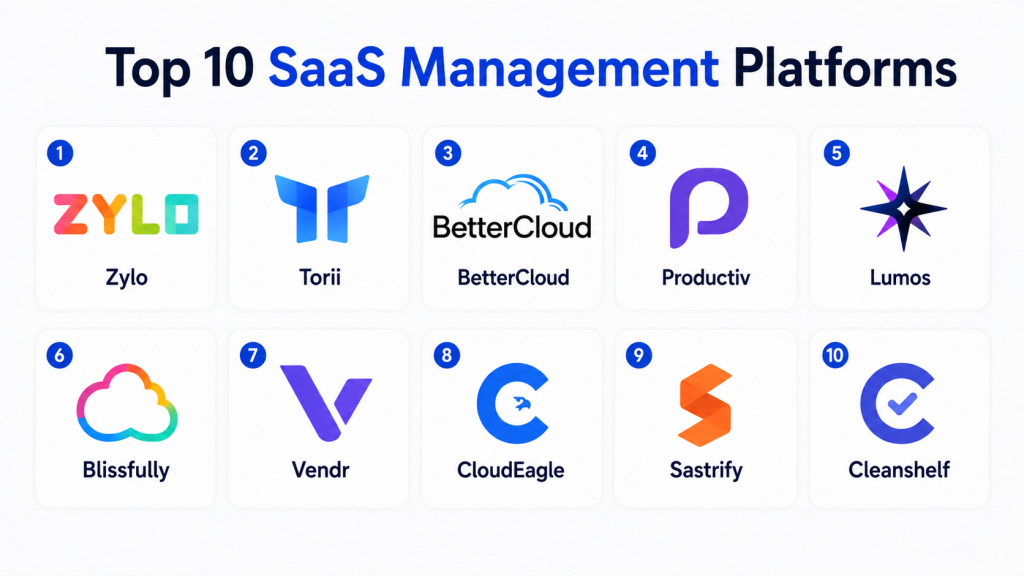
Top 10 SaaS Management Platforms
1- Zylo
Short description: Zylo is a leading enterprise SaaS management platform that provides deep visibility into SaaS usage, spend, and contracts. It helps organizations optimize software investments and eliminate waste from unused or underutilized applications. Zylo is widely used by large enterprises to manage SaaS sprawl and improve financial governance.
Key Features
- SaaS application discovery across enterprise environments
- License optimization and usage tracking
- SaaS spend analytics and budgeting insights
- Contract and renewal management automation
- Shadow IT detection and governance
- Vendor management and SaaS inventory tracking
- Reporting dashboards for IT and finance teams
Pros
- Strong enterprise SaaS visibility and analytics
- Excellent license optimization capabilities
- Good integration with finance and procurement workflows
- Helps reduce SaaS waste at scale
Cons
- Enterprise-focused pricing structure
- Requires onboarding and configuration effort
- Less suitable for small organizations
- Advanced features may need training
Platforms / Deployment
Web. Cloud SaaS.
Security & Compliance
Supports enterprise-grade security controls including SSO, RBAC, and audit logs. Compliance certifications are not publicly stated.
Integrations & Ecosystem
Zylo integrates with enterprise SaaS ecosystems and identity platforms.
- Okta
- Azure Active Directory
- Google Workspace
- Finance systems
- SaaS applications APIs
Support & Community
Enterprise-level support with onboarding assistance and customer success programs.
2- BetterCloud
Short description: BetterCloud is a SaaS operations management platform focused on automation, security, and lifecycle management. It helps IT teams manage SaaS applications, automate workflows, and enforce security policies across cloud environments.
Key Features
- SaaS application lifecycle automation
- User provisioning and deprovisioning workflows
- Shadow IT discovery and monitoring
- Security policy enforcement across SaaS apps
- License management and optimization
- Workflow automation engine
- SaaS activity monitoring
Pros
- Strong automation capabilities
- Excellent identity and access management workflows
- Good security policy enforcement
- Strong SaaS lifecycle management
Cons
- Complex setup for advanced workflows
- Requires IAM maturity for full value
- Enterprise pricing model
- Learning curve for non-technical users
Platforms / Deployment
Web. Cloud SaaS.
Security & Compliance
Supports SSO, MFA, audit logging, and enterprise access controls. Detailed certifications vary by configuration.
Integrations & Ecosystem
- Google Workspace
- Microsoft 365
- Okta
- Slack
- SaaS APIs
- Identity providers
Support & Community
Strong enterprise support and documentation with workflow automation guidance.
3- Torii
Short description: Torii is a SaaS management platform that focuses on automation, shadow IT discovery, and workflow optimization. It provides deep visibility into SaaS usage and helps organizations automate SaaS operations at scale.
Key Features
- SaaS application discovery and mapping
- Shadow IT detection
- Automated onboarding and offboarding workflows
- License usage optimization
- SaaS inventory management
- Cost tracking and analytics
- Workflow automation builder
Pros
- Strong automation-first approach
- Good shadow IT visibility
- Easy workflow creation
- Strong integration ecosystem
Cons
- Limited advanced financial planning features
- Enterprise features may require tuning
- Pricing can scale quickly
- Requires configuration for full automation
Platforms / Deployment
Web. Cloud SaaS.
Security & Compliance
Supports enterprise authentication and access controls. Compliance certifications not publicly stated.
Integrations & Ecosystem
- Okta
- Azure AD
- Google Workspace
- SaaS APIs
- HR systems
- ITSM tools
Support & Community
Good documentation and enterprise support options.
4- Zluri
Short description: Zluri is a SaaS management platform designed to provide visibility, governance, and optimization across SaaS environments. It focuses on spend control, security insights, and IT automation.
Key Features
- SaaS discovery and inventory management
- License optimization and cost tracking
- Shadow IT detection
- Automated access management
- SaaS usage analytics
- Compliance monitoring
- Workflow automation
Pros
- Strong SaaS visibility capabilities
- Good cost optimization features
- Easy integration with identity systems
- Strong reporting dashboards
Cons
- Requires configuration for full accuracy
- Enterprise pricing model
- Learning curve for advanced workflows
- Limited offline capabilities
Platforms / Deployment
Web. Cloud SaaS.
Security & Compliance
Supports RBAC, SSO, and audit logging. Compliance certifications vary by deployment.
Integrations & Ecosystem
- Okta
- Azure AD
- Google Workspace
- HR systems
- SaaS APIs
- ITSM tools
Support & Community
Enterprise support with onboarding assistance and documentation.
5- Productiv
Short description: Productiv is a SaaS intelligence platform that helps organizations understand SaaS usage, adoption, and spending across the enterprise. It focuses heavily on usage analytics and business value insights.
Key Features
- SaaS usage analytics and insights
- Application adoption tracking
- License optimization recommendations
- SaaS spend visibility
- Shadow IT detection
- Department-level usage reporting
- Integration with SaaS ecosystems
Pros
- Strong usage analytics capabilities
- Good visibility into adoption patterns
- Helps improve SaaS ROI
- Useful for enterprise decision-making
Cons
- Less automation compared to competitors
- Requires data maturity for best results
- Enterprise pricing structure
- Limited workflow automation features
Platforms / Deployment
Web. Cloud SaaS.
Security & Compliance
Supports enterprise access controls and identity integration. Certifications not publicly stated.
Integrations & Ecosystem
- Okta
- Microsoft 365
- Google Workspace
- SaaS APIs
- Finance tools
- Data warehouses
Support & Community
Enterprise support and customer success programs.
6- Lumos
Short description: Lumos is a modern SaaS management platform focused on identity-first SaaS governance. It combines SaaS visibility with access control and lifecycle automation.
Key Features
- SaaS discovery and shadow IT detection
- Identity-based access governance
- Automated onboarding and offboarding
- License optimization and management
- Access request workflows
- SaaS usage tracking
- Compliance reporting
Pros
- Strong identity-centric approach
- Good automation for access management
- Modern UI and workflows
- Strong security alignment
Cons
- Newer platform compared to competitors
- Limited enterprise maturity in some areas
- Requires IAM integration setup
- Pricing may scale with usage
Platforms / Deployment
Web. Cloud SaaS.
Security & Compliance
Supports SSO, RBAC, and audit logs. Compliance certifications not publicly stated.
Integrations & Ecosystem
- Okta
- Azure AD
- Google Workspace
- HR systems
- SaaS applications
- ITSM tools
Support & Community
Growing enterprise support and documentation base.
7- CloudEagle.ai
Short description: CloudEagle.ai is a SaaS management platform that uses AI to optimize SaaS spend, manage licenses, and automate procurement workflows. It focuses heavily on cost governance and automation.
Key Features
- AI-powered SaaS discovery
- License optimization and cost savings
- Contract and renewal management
- Shadow IT detection
- SaaS spend analytics
- Procurement automation
- Usage-based optimization
Pros
- Strong AI-driven insights
- Good cost optimization features
- Helps reduce SaaS waste
- Strong procurement workflows
Cons
- Requires setup for accurate insights
- Enterprise-focused pricing
- Limited customization in workflows
- Newer compared to established platforms
Platforms / Deployment
Web. Cloud SaaS.
Security & Compliance
Supports enterprise security controls and access management. Certifications not publicly stated.
Integrations & Ecosystem
- Okta
- Azure AD
- Google Workspace
- Finance systems
- SaaS APIs
- HR tools
Support & Community
Enterprise support with onboarding assistance.
8- BetterCloud Ops
Short description: BetterCloud Ops focuses on SaaS operations automation, helping IT teams manage workflows, security, and access across SaaS ecosystems. It is widely used in IT operations environments.
Key Features
- SaaS workflow automation
- Access lifecycle management
- Policy enforcement across SaaS apps
- Shadow IT monitoring
- License optimization tools
- SaaS security controls
- Operational dashboards
Pros
- Strong IT automation capabilities
- Good governance and policy control
- Mature SaaS operations platform
- Strong enterprise adoption
Cons
- Complex configuration
- Requires IT expertise
- Enterprise pricing model
- Limited SMB suitability
Platforms / Deployment
Web. Cloud SaaS.
Security & Compliance
Supports enterprise authentication and logging. Compliance certifications vary.
Integrations & Ecosystem
- Google Workspace
- Microsoft 365
- Okta
- SaaS APIs
- ITSM platforms
Support & Community
Strong enterprise support with workflow automation guidance.
9- Okta SaaS Management
Short description: Okta SaaS Management provides visibility and control over SaaS applications as part of the broader Okta Identity platform. It focuses on SaaS discovery, access governance, and lifecycle management.
Key Features
- SaaS discovery through identity layer
- Access lifecycle management
- Shadow IT detection
- License usage insights
- Identity-based governance
- Security policy enforcement
- Integration with Okta IAM
Pros
- Strong identity-first architecture
- Seamless integration with Okta ecosystem
- Good security governance capabilities
- Reliable enterprise adoption
Cons
- Limited advanced SaaS spend analytics
- Best value within Okta ecosystem
- Less flexible than dedicated SMPs
- Requires Okta dependency
Platforms / Deployment
Web. Cloud SaaS.
Security & Compliance
Strong enterprise IAM security controls including SSO, MFA, and RBAC. Compliance features depend on Okta configuration.
Integrations & Ecosystem
- Okta Identity Cloud
- SaaS applications
- HR systems
- ITSM tools
- Security platforms
Support & Community
Strong enterprise support through Okta ecosystem.
10- CoreView
Short description: CoreView is a SaaS management and Microsoft 365 governance platform focused on visibility, automation, and compliance for Microsoft ecosystems and SaaS environments.
Key Features
- SaaS governance for Microsoft 365
- License optimization and management
- User lifecycle automation
- Security and compliance monitoring
- Shadow IT detection
- Reporting dashboards
- Role-based access controls
Pros
- Strong Microsoft ecosystem integration
- Good governance and compliance features
- Strong automation capabilities
- Useful for enterprise IT teams
Cons
- Best suited for Microsoft-heavy environments
- Limited broader SaaS ecosystem depth
- Requires configuration effort
- Enterprise pricing model
Platforms / Deployment
Web. Cloud SaaS.
Security & Compliance
Supports enterprise security controls and compliance reporting. Certifications vary by deployment.
Integrations & Ecosystem
- Microsoft 365
- Azure AD
- SaaS APIs
- ITSM tools
- HR systems
Support & Community
Strong enterprise support for Microsoft-centric organizations.
Comparison Table
| Tool Name | Best For | Platforms Supported | Deployment | Standout Feature | Public Rating |
|---|---|---|---|---|---|
| Zylo | SaaS spend optimization | Web | Cloud | Enterprise SaaS visibility | N/A |
| BetterCloud | SaaS automation | Web | Cloud | Workflow automation engine | N/A |
| Torii | SaaS discovery + automation | Web | Cloud | Shadow IT detection | N/A |
| Zluri | SaaS governance | Web | Cloud | License optimization | N/A |
| Productiv | SaaS intelligence | Web | Cloud | Usage analytics | N/A |
| Lumos | Identity SaaS governance | Web | Cloud | Identity-first control | N/A |
| CloudEagle.ai | AI SaaS optimization | Web | Cloud | AI cost optimization | N/A |
| BetterCloud Ops | IT SaaS operations | Web | Cloud | Policy automation | N/A |
| Okta SaaS Mgmt | Identity-based SaaS control | Web | Cloud | IAM integration | N/A |
| CoreView | Microsoft SaaS governance | Web | Cloud | M365 optimization | N/A |
Evaluation and Scoring of SaaS Management Platforms
| Tool Name | Core 25% | Ease 15% | Integrations 15% | Security 10% | Performance 10% | Support 10% | Value 15% | Weighted Total |
|---|---|---|---|---|---|---|---|---|
| Zylo | 9 | 8 | 9 | 9 | 9 | 9 | 8 | 8.85 |
| BetterCloud | 9 | 8 | 9 | 9 | 9 | 9 | 8 | 8.85 |
| Torii | 8 | 9 | 9 | 8 | 9 | 8 | 9 | 8.60 |
| Zluri | 8 | 9 | 9 | 8 | 9 | 8 | 9 | 8.60 |
| Productiv | 8 | 8 | 9 | 8 | 8 | 8 | 8 | 8.15 |
| Lumos | 8 | 9 | 9 | 9 | 8 | 8 | 8 | 8.40 |
| CloudEagle.ai | 8 | 8 | 9 | 8 | 9 | 8 | 9 | 8.45 |
| BetterCloud Ops | 9 | 8 | 9 | 9 | 9 | 9 | 8 | 8.85 |
| Okta SaaS Mgmt | 8 | 9 | 10 | 9 | 8 | 9 | 8 | 8.70 |
| CoreView | 8 | 9 | 9 | 9 | 8 | 9 | 8 | 8.65 |
These scores reflect SaaS discovery depth, automation capabilities, integration strength, identity governance, cost optimization, and enterprise readiness. Zylo and BetterCloud lead in enterprise SaaS governance, Torii and Zluri excel in automation and discovery, while Okta and CoreView are strongest in identity-centric SaaS control.
Which SaaS Management Platform Is Right for You
Solo / Freelancer
Solo users typically do not need full SaaS management platforms. Basic tracking tools or manual spreadsheets are usually sufficient.
SMB
SMBs benefit from lightweight SaaS discovery and cost optimization. Torii, Zluri, and CloudEagle.ai are strong choices for balancing automation and affordability.
Mid-Market
Mid-market organizations need visibility, automation, and license optimization. Zylo, BetterCloud, Torii, and Productiv are strong options.
Enterprise
Enterprises require deep SaaS governance, security, compliance, and automation. Zylo, BetterCloud, Okta SaaS Management, CoreView, and Zluri are leading solutions.
Budget vs Premium
Open SaaS tools are limited in this category. Most platforms are premium SaaS due to integration complexity. SMBs often start with Zluri or CloudEagle.ai.
Feature Depth vs Ease of Use
BetterCloud and Zylo provide deep enterprise governance but require setup. Torii and Lumos offer easier workflows. Okta SaaS Management is simplest for identity-driven environments.
Integrations & Scalability
Okta, Zylo, and BetterCloud offer the strongest integration ecosystems. Torii and Zluri scale well across SaaS-heavy environments.
Security & Compliance Needs
Enterprises with strict compliance needs should prioritize Zylo, BetterCloud, Okta SaaS Management, CoreView, and Zluri due to governance, access control, and audit capabilities.
Frequently Asked Questions FAQs
1. What is a SaaS Management Platform?
A SaaS Management Platform is a tool that helps organizations discover, manage, and optimize all SaaS applications in use. It provides visibility into subscriptions, usage, and costs. It also helps manage licenses and security risks. It acts as a central control system for SaaS ecosystems.
2. Why do companies need SaaS management?
Companies need SaaS management to avoid waste, improve security, and control software costs. Without it, organizations often face SaaS sprawl and shadow IT. It ensures better visibility across all applications. It also improves operational efficiency.
3. What is SaaS sprawl?
SaaS sprawl refers to uncontrolled growth of SaaS applications across an organization. It leads to duplicate tools, unused licenses, and security risks. It becomes difficult to manage without centralized tools. SaaS management platforms solve this problem.
4. What is shadow IT in SaaS?
Shadow IT refers to employees using SaaS applications without IT approval. These tools may not be secure or compliant. It creates security and governance risks. SaaS management tools help detect and control shadow IT.
5. Do SaaS management platforms reduce costs?
Yes, they reduce costs by identifying unused licenses and duplicate subscriptions. They help optimize SaaS spending across departments. Many companies save significant budgets through optimization. They also improve renewal management.
6. Are SaaS management platforms secure?
Yes, most enterprise platforms follow strong security practices. They use SSO, RBAC, and encryption. They also provide audit logs for compliance. Security depends on vendor configuration and policies.
7. Can SMBs use SaaS management tools?
Yes, SMBs can use lightweight SaaS management tools. Platforms like Zluri and Torii are suitable for smaller teams. They help control SaaS growth early. This prevents future governance problems.
8. Do SaaS management platforms integrate with IAM tools?
Yes, most platforms integrate with identity providers like Okta, Azure AD, and Google Workspace. This helps manage user access and lifecycle events. It improves security and automation. IAM integration is a core feature.
9. What is license optimization in SaaS management?
License optimization ensures companies only pay for SaaS licenses they actually use. It identifies unused or underused accounts. It helps reassign or remove unnecessary subscriptions. This improves cost efficiency.
10. How do companies choose the right SaaS management platform?
Companies choose based on SaaS scale, budget, automation needs, and integration requirements. Enterprises prefer Zylo or BetterCloud. SMBs prefer Zluri or Torii. Identity-heavy organizations prefer Okta SaaS Management.
Conclusion
SaaS Management Platforms are essential for controlling the growing complexity of modern SaaS ecosystems. They help organizations reduce waste, eliminate shadow IT, improve security, and optimize software spending. Platforms like Zylo and BetterCloud are strong enterprise leaders, while Torii and Zluri offer excellent automation and discovery for mid-market teams. Identity-focused tools like Okta SaaS Management and CoreView are ideal for governance-heavy environments. The right choice depends on organization size, SaaS maturity, and automation needs. Companies should start by identifying SaaS sprawl challenges, shortlist two to three platforms, and run pilot integrations before full-scale adoption.

This article clearly explains SaaS management platforms and how they help organizations manage applications, optimize software usage, and improve overall operational control.
Informative comparison article highlighting how SaaS management platforms help businesses improve application visibility, automate administration, and optimize software usage.
A key gap is how well SaaS management platforms balance deep visibility with automated governance actions without creating friction or breaking existing workflows.