Introduction
Warehouse Labor Management Tools help organizations plan, measure, optimize, and control workforce productivity inside warehouses and distribution centers. These platforms focus on tracking labor performance, assigning tasks efficiently, improving workforce utilization, and reducing operational costs while increasing throughput.
In modern logistics and e-commerce-driven supply chains, labor is one of the biggest cost drivers in warehouse operations. Companies now rely on labor management systems integrated with Warehouse Management Systems (WMS) to improve productivity, reduce idle time, and ensure accurate order fulfillment in real time.
Real-world use cases include:
- Workforce scheduling and shift optimization
- Task assignment and productivity tracking
- Incentive-based performance management
- Labor forecasting for peak demand periods
- Reducing overtime and idle time in warehouses
Key evaluation criteria buyers should consider:
- Real-time productivity tracking accuracy
- Task assignment automation
- Integration with WMS and ERP systems
- Workforce forecasting and planning capability
- Ease of use for supervisors and operators
- Reporting and analytics depth
- Incentive and performance management features
- Scalability across warehouse networks
- Mobile and handheld device support
- Deployment flexibility (cloud/on-premise)
Best for: warehouse operators, logistics companies, 3PL providers, retail distribution centers, e-commerce fulfillment teams, manufacturing warehouses, and supply chain leaders.
Not ideal for: small businesses with minimal warehouse operations or teams that only need basic inventory tracking without labor optimization needs.
Key Trends in Warehouse Labor Management Tools
- AI-driven workforce forecasting is improving shift planning accuracy.
- Real-time productivity tracking dashboards are replacing manual reporting.
- WMS + LMS convergence is creating unified warehouse execution systems.
- Gamification and incentive models are improving worker engagement.
- Mobile-first labor management apps are enabling floor-level decision-making.
- Automation of task assignment is reducing supervisor workload.
- Predictive labor planning is aligning staffing with demand forecasting.
- IoT-enabled labor tracking is improving operational visibility.
- Cloud-based labor platforms are enabling multi-warehouse control.
- Advanced analytics for labor cost optimization is becoming standard.
How We Selected These Tools
The tools listed below were selected based on warehouse industry adoption, labor optimization capabilities, integration strength, and operational scalability.
- Evaluated adoption across logistics, retail, manufacturing, and 3PL sectors.
- Reviewed labor productivity tracking and workforce optimization features.
- Assessed integration with WMS, ERP, and supply chain systems.
- Considered forecasting, scheduling, and incentive management capabilities.
- Evaluated real-time analytics and reporting functionality.
- Reviewed usability for warehouse supervisors and operators.
- Considered scalability across multi-site warehouse operations.
- Assessed mobile and handheld device support.
- Reviewed vendor maturity and implementation ecosystem.
- Evaluated enterprise reliability and operational impact.
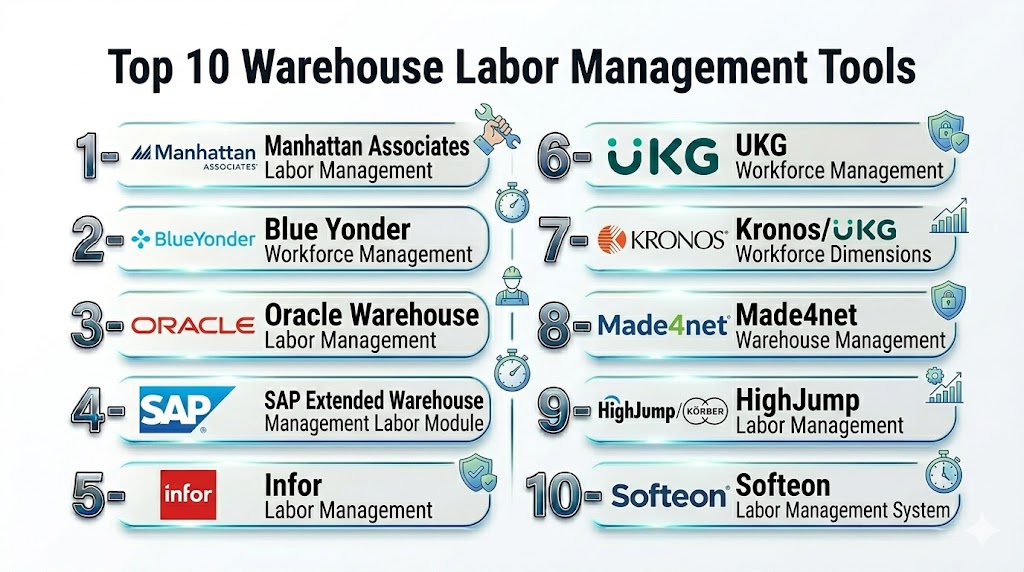
Top 10 Warehouse Labor Management Tools
#1 — Manhattan Active Labor Management
Short description: Manhattan Active Labor Management is a leading enterprise workforce optimization platform designed for large warehouse and distribution environments. It provides real-time labor tracking, forecasting, task optimization, and productivity management integrated directly with warehouse execution systems. It is widely used in high-volume retail, e-commerce, and logistics operations. The platform helps organizations align workforce performance with operational demand.
Key Features
- Real-time labor tracking
- Workforce forecasting and planning
- Task assignment optimization
- Productivity benchmarking
- Incentive management
- WMS integration
- Performance analytics dashboards
Pros
- Strong enterprise scalability
- Deep warehouse integration
- Advanced forecasting capabilities
- Real-time visibility
Cons
- Complex implementation
- High enterprise cost
- Requires training for adoption
- Best suited for large operations
Platforms / Deployment
- Web
- Cloud
Security & Compliance
- SSO
- MFA
- RBAC
- Audit logging
Integrations & Ecosystem
Manhattan integrates with WMS, ERP, and supply chain execution systems.
- Warehouse management systems
- ERP platforms
- IoT devices
- Labor tracking systems
- Analytics tools
Support & Community
Strong enterprise support ecosystem with supply chain expertise and global implementation partners.
#2 — Blue Yonder Labor Management
Short description: Blue Yonder Labor Management is a workforce optimization solution focused on warehouse productivity, demand forecasting, and operational efficiency. It uses advanced analytics to balance labor supply with warehouse demand. The platform is widely used in retail, manufacturing, and logistics operations. It helps reduce labor costs while improving throughput and accuracy.
Key Features
- Labor forecasting
- Workforce scheduling optimization
- Real-time performance tracking
- Productivity analytics
- Demand-based staffing models
- WMS integration
- KPI dashboards
Pros
- Strong AI-driven forecasting
- Good enterprise scalability
- Deep analytics capabilities
- Strong supply chain alignment
Cons
- Complex configuration
- Premium pricing model
- Requires structured data
- Training required for users
Platforms / Deployment
- Web
- Cloud / Hybrid
Security & Compliance
- SSO
- MFA
- RBAC
- Encryption
Integrations & Ecosystem
Blue Yonder integrates with supply chain planning, WMS, and ERP systems.
- Supply chain platforms
- Warehouse systems
- ERP integrations
- Analytics tools
- API connectivity
Support & Community
Strong enterprise support with global supply chain consulting ecosystem.
#3 — SAP Labor Management (SAP EWM)
Short description: SAP Labor Management is part of the SAP Extended Warehouse Management ecosystem and focuses on tracking warehouse labor efficiency and productivity. It helps organizations align workforce performance with warehouse execution processes. The platform is widely used in large enterprise logistics and manufacturing environments. It provides deep integration with SAP ERP systems.
Key Features
- Labor performance tracking
- Task-based productivity measurement
- Workforce benchmarking
- Time and motion studies
- WMS integration
- KPI reporting
- Cost optimization analytics
Pros
- Strong SAP ecosystem integration
- Reliable enterprise functionality
- Good workforce visibility
- Scalable for global operations
Cons
- Best for SAP users
- Complex implementation process
- Requires expert configuration
- High enterprise cost
Platforms / Deployment
- Web
- Cloud / Hybrid
Security & Compliance
- SSO
- MFA
- RBAC
- Audit logging
Integrations & Ecosystem
SAP integrates deeply with ERP, EWM, and enterprise supply chain systems.
- SAP ERP suite
- SAP EWM
- Supply chain tools
- Analytics platforms
- Industrial systems
Support & Community
Strong global enterprise support and partner ecosystem.
#4 — Oracle Warehouse Labor Management
Short description: Oracle Warehouse Labor Management helps organizations optimize workforce productivity through labor planning, forecasting, and real-time performance tracking. It is part of Oracle’s broader supply chain suite. The platform is used in enterprise logistics, retail distribution, and manufacturing environments. It provides strong operational visibility and labor optimization tools.
Key Features
- Workforce planning
- Real-time productivity tracking
- Task assignment optimization
- Labor forecasting
- WMS integration
- Performance analytics
- Cost control reporting
Pros
- Strong enterprise integration
- Good forecasting tools
- Reliable analytics capabilities
- Scalable architecture
Cons
- Best suited for Oracle ecosystem users
- Complex setup requirements
- Premium pricing structure
- Requires training
Platforms / Deployment
- Web
- Cloud
Security & Compliance
- SSO
- MFA
- RBAC
- Encryption
Integrations & Ecosystem
Oracle integrates with ERP, WMS, and enterprise supply chain systems.
- Oracle ERP
- Warehouse systems
- Supply chain tools
- Analytics platforms
- API integrations
Support & Community
Enterprise-grade support with global implementation services.
#5 — JDA Warehouse Labor Management (legacy Blue Yonder)
Short description: JDA Labor Management, now part of Blue Yonder, provides warehouse workforce optimization and productivity tracking capabilities. It focuses on improving labor efficiency, scheduling accuracy, and warehouse performance visibility. The platform is widely used in distribution and retail environments. It supports structured labor planning and execution workflows.
Key Features
- Labor scheduling optimization
- Productivity tracking
- Workforce analytics
- Task assignment systems
- Performance benchmarking
- WMS integration
- Reporting dashboards
Pros
- Proven enterprise adoption
- Strong labor analytics
- Good scheduling capabilities
- Mature platform
Cons
- Legacy architecture in some deployments
- Complex onboarding process
- Requires integration planning
- Higher cost structure
Platforms / Deployment
- Web
- Cloud / Hybrid
Security & Compliance
- RBAC
- MFA
- Audit logging
- Encryption
Integrations & Ecosystem
Integrates with supply chain systems, warehouse platforms, and ERP solutions.
- WMS systems
- ERP integration
- Supply chain planning tools
- Analytics platforms
- APIs
Support & Community
Strong enterprise supply chain support ecosystem.
#6 — Easy Metrics Labor Management
Short description: Easy Metrics is a warehouse labor analytics and performance management platform focused on productivity tracking, incentive programs, and operational efficiency. It provides visibility into labor performance across warehouse operations. The platform is popular in logistics and distribution environments. It helps companies identify inefficiencies and improve workforce utilization.
Key Features
- Labor productivity tracking
- Incentive management
- Performance analytics
- Real-time dashboards
- Cost analysis tools
- Workforce reporting
- WMS integration
Pros
- Easy to deploy
- Strong incentive tracking
- Good analytics visibility
- Useful for SMB and mid-market
Cons
- Less advanced than enterprise suites
- Limited global ecosystem
- Requires WMS integration
- Advanced forecasting may vary
Platforms / Deployment
- Web
- Cloud
Security & Compliance
- RBAC
- Authentication controls
- Encryption
Integrations & Ecosystem
Easy Metrics integrates with warehouse systems, ERP tools, and analytics platforms.
- WMS integration
- ERP systems
- Reporting tools
- API connectivity
- Workforce systems
Support & Community
Good customer support and implementation assistance.
#7 — Lucas Systems Labor Management
Short description: Lucas Systems provides AI-driven warehouse labor management and optimization tools. It focuses on dynamic task assignment, workforce productivity improvement, and real-time decision support. The platform is widely used in distribution centers and fulfillment operations. It helps reduce travel time, improve efficiency, and optimize warehouse labor flows.
Key Features
- AI-driven task assignment
- Workforce optimization
- Real-time decision support
- Productivity analytics
- Warehouse routing optimization
- Labor forecasting
- Mobile worker guidance
Pros
- Strong AI optimization features
- Improves warehouse efficiency
- Good real-time decision support
- Useful for complex workflows
Cons
- Requires operational maturity
- Integration complexity possible
- Not as widely adopted as top enterprise suites
- Training required
Platforms / Deployment
- Web
- Cloud / Hybrid
Security & Compliance
- RBAC
- MFA
- Audit logging
Integrations & Ecosystem
Integrates with warehouse systems, mobile devices, and logistics platforms.
- WMS systems
- Mobile apps
- ERP systems
- IoT devices
- API integrations
Support & Community
Strong warehouse optimization support and consulting services.
#8 — Softeon Labor Management
Short description: Softeon Labor Management provides workforce optimization tools for warehouse operations, focusing on productivity tracking, task optimization, and operational efficiency. It integrates closely with warehouse execution systems. The platform is widely used in distribution and fulfillment environments. It supports real-time labor visibility and planning.
Key Features
- Labor productivity tracking
- Task assignment optimization
- Real-time dashboards
- Workforce planning
- WMS integration
- Performance reporting
- Incentive tracking
Pros
- Strong WMS integration
- Good operational visibility
- Flexible workforce planning
- Reliable analytics tools
Cons
- Smaller ecosystem than top vendors
- Requires integration setup
- Limited brand presence globally
- Advanced features vary
Platforms / Deployment
- Web
- Cloud / Hybrid
Security & Compliance
- RBAC
- MFA
- Audit logging
Integrations & Ecosystem
Softeon integrates with warehouse systems, ERP platforms, and logistics tools.
- WMS integration
- ERP systems
- Supply chain tools
- APIs
- Analytics platforms
Support & Community
Good supply chain software support with implementation services.
#9 — Manhattan Associates Labor Management (Legacy Suite)
Short description: Manhattan Associates Labor Management (legacy systems) provides warehouse labor tracking, productivity optimization, and workforce planning tools. It is widely used in large-scale logistics operations. It focuses on aligning workforce performance with warehouse execution requirements. It remains a strong enterprise solution in legacy deployments.
Key Features
- Labor tracking and monitoring
- Productivity benchmarking
- Workforce scheduling
- Task assignment optimization
- Performance analytics
- WMS integration
- Reporting dashboards
Pros
- Strong enterprise reliability
- Proven warehouse adoption
- Good labor analytics
- Scalable systems
Cons
- Legacy architecture in some environments
- Complex upgrade cycles
- High implementation cost
- Requires expert management
Platforms / Deployment
- Web
- Hybrid
Security & Compliance
- RBAC
- MFA
- Audit logging
Integrations & Ecosystem
Integrates with warehouse systems, ERP tools, and logistics platforms.
- WMS systems
- ERP platforms
- Supply chain tools
- Analytics systems
- APIs
Support & Community
Strong enterprise logistics support ecosystem.
#10 — Infios Labor Management System
Short description: Infios Labor Management System provides workforce optimization tools for warehouse and distribution operations. It focuses on labor planning, productivity tracking, and operational efficiency. The platform helps organizations align workforce performance with warehouse demand. It is suitable for mid-market and enterprise logistics environments.
Key Features
- Labor planning and forecasting
- Productivity tracking
- Task assignment
- Workforce analytics
- Performance dashboards
- WMS integration
- Reporting tools
Pros
- Flexible workforce planning
- Good mid-market fit
- Easy reporting tools
- Useful analytics dashboards
Cons
- Smaller ecosystem than enterprise leaders
- Integration setup required
- Limited global presence
- Advanced AI features vary
Platforms / Deployment
- Web
- Cloud
Security & Compliance
- RBAC
- Authentication controls
- Encryption
Integrations & Ecosystem
Infios integrates with warehouse systems, ERP platforms, and logistics tools.
- WMS integration
- ERP systems
- API connectivity
- Reporting systems
- Workforce tools
Support & Community
Moderate enterprise support with implementation assistance.
Comparison Table
| Tool Name | Best For | Platform(s) Supported | Deployment | Standout Feature | Public Rating |
|---|---|---|---|---|---|
| Manhattan Active Labor Management | Enterprise warehouses | Web | Cloud | Real-time labor optimization | N/A |
| Blue Yonder Labor Management | Supply chain forecasting | Web | Cloud / Hybrid | AI labor forecasting | N/A |
| SAP Labor Management | SAP enterprise users | Web | Cloud / Hybrid | ERP-integrated labor control | N/A |
| Oracle Warehouse Labor Management | Oracle ecosystems | Web | Cloud | Enterprise labor planning | N/A |
| JDA Labor Management | Retail distribution | Web | Cloud / Hybrid | Mature labor analytics | N/A |
| Easy Metrics | SMB logistics | Web | Cloud | Incentive-based productivity tracking | N/A |
| Lucas Systems | AI warehouse optimization | Web | Cloud / Hybrid | AI task assignment | N/A |
| Softeon Labor Management | Warehouse execution users | Web | Cloud / Hybrid | Strong WMS integration | N/A |
| Manhattan Legacy Suite | Large logistics ops | Web | Hybrid | Proven labor tracking | N/A |
| Infios Labor Management | Mid-market warehouses | Web | Cloud | Flexible labor forecasting | N/A |
Evaluation & Scoring of Warehouse Labor Management Tools
| Tool Name | Core 25% | Ease 15% | Integrations 15% | Security 10% | Performance 10% | Support 10% | Value 15% | Weighted Total |
|---|---|---|---|---|---|---|---|---|
| Manhattan Active Labor Management | 9 | 7 | 9 | 9 | 9 | 9 | 7 | 8.4 |
| Blue Yonder Labor Management | 9 | 7 | 9 | 8 | 9 | 8 | 7 | 8.2 |
| SAP Labor Management | 8 | 7 | 10 | 9 | 8 | 9 | 7 | 8.2 |
| Oracle Warehouse Labor Management | 8 | 7 | 9 | 9 | 8 | 8 | 7 | 8.0 |
| JDA Labor Management | 8 | 6 | 8 | 8 | 8 | 8 | 7 | 7.6 |
| Easy Metrics | 7 | 8 | 7 | 7 | 7 | 7 | 8 | 7.3 |
| Lucas Systems | 8 | 7 | 8 | 8 | 8 | 8 | 7 | 7.8 |
| Softeon Labor Management | 8 | 7 | 8 | 8 | 8 | 8 | 7 | 7.8 |
| Manhattan Legacy Suite | 8 | 6 | 8 | 8 | 8 | 8 | 6 | 7.4 |
| Infios Labor Management | 7 | 8 | 7 | 7 | 7 | 7 | 8 | 7.2 |
These scores are comparative and reflect typical enterprise expectations for warehouse labor optimization platforms. High-scoring tools generally provide stronger integration, forecasting accuracy, and enterprise scalability, while mid-market solutions often prioritize usability and faster deployment. The best choice depends on warehouse complexity, labor intensity, integration needs, and operational maturity.
Which Warehouse Labor Management Tool Is Right for You?
Solo / Freelancer
Individual consultants or small logistics advisors usually do not require full labor management platforms. They may rely on lightweight analytics tools or WMS-built-in labor tracking instead of dedicated enterprise systems.
SMB
Small and mid-sized warehouse operations should prioritize simplicity, cost efficiency, and easy deployment. Easy Metrics and Infios Labor Management are good starting points for improving productivity without heavy enterprise complexity.
Mid-Market
Mid-market logistics companies benefit from balanced functionality and scalability. Lucas Systems, Softeon Labor Management, and Blue Yonder offer strong operational optimization and forecasting capabilities.
Enterprise
Large-scale distribution centers, retail networks, and logistics enterprises require deep optimization, forecasting, and integration. Manhattan Active Labor Management, SAP Labor Management, and Oracle Warehouse Labor Management are best suited for complex environments.
Budget vs Premium
Budget-focused solutions prioritize basic productivity tracking and reporting, while premium systems provide advanced AI forecasting, automation, and enterprise integration. The right choice depends on ROI expectations and operational scale.
Feature Depth vs Ease of Use
Advanced platforms offer powerful forecasting, optimization, and analytics but require training and structured data. Simpler systems are easier to deploy but may lack advanced labor intelligence features.
Integrations & Scalability
Warehouses should prioritize integration with WMS, ERP, IoT systems, and workforce mobility tools. Scalability is essential for multi-warehouse or multi-region logistics operations.
Security & Compliance Needs
Enterprise warehouses must ensure RBAC, MFA, encryption, audit logging, and secure API integrations. Labor systems often handle sensitive workforce and operational data requiring strong governance.
Frequently Asked Questions
1- What is a Warehouse Labor Management Tool?
A Warehouse Labor Management Tool is software that helps organizations track, manage, and optimize workforce productivity in warehouses. It improves labor planning, task assignment, and operational efficiency.
2- How does labor management differ from WMS?
WMS focuses on inventory, storage, and order processing, while labor management focuses on workforce productivity, scheduling, and performance optimization. Both systems often work together.
3- Why is labor management important in warehouses?
Labor is one of the largest operational costs in warehouses. Effective labor management improves productivity, reduces overtime, and increases order fulfillment efficiency.
4- Do these tools require WMS integration?
Yes, most labor management tools integrate with WMS systems to track tasks, monitor performance, and align workforce activities with warehouse operations.
5- Can labor management tools reduce costs?
Yes, they help reduce labor costs by optimizing staffing levels, reducing idle time, improving task efficiency, and minimizing overtime expenses.
6- What industries use labor management tools?
They are widely used in retail, e-commerce, logistics, 3PL, manufacturing, distribution centers, and supply chain operations.
7- Are AI features common in these platforms?
Yes, many modern platforms use AI for labor forecasting, task optimization, and productivity prediction to improve workforce planning.
8- How long does implementation take?
Implementation time varies from a few weeks for mid-market tools to several months for enterprise systems depending on integration complexity.
9- What are common challenges in adoption?
Common challenges include data integration issues, employee training, change management, and aligning labor standards across operations.
10- How do companies measure ROI?
ROI is measured through reduced labor costs, improved productivity, lower overtime, faster order fulfillment, and better workforce utilization.
Conclusion
Warehouse Labor Management Tools are essential for modern logistics and distribution operations where labor efficiency directly impacts cost, speed, and service quality. These platforms help organizations transform workforce management from reactive scheduling to data-driven optimization powered by real-time analytics and predictive insights. Enterprise systems offer deep integration and advanced forecasting, while mid-market and SMB solutions provide faster deployment and operational simplicity. The right choice depends on warehouse scale, operational complexity, and digital maturity. Organizations should begin by identifying labor bottlenecks, defining key productivity metrics, and piloting tools in high-impact areas before scaling across the entire warehouse network.

Very informative comparison of warehouse labor management tools—this article does a great job explaining how these platforms improve workforce productivity, scheduling, and operational efficiency.